




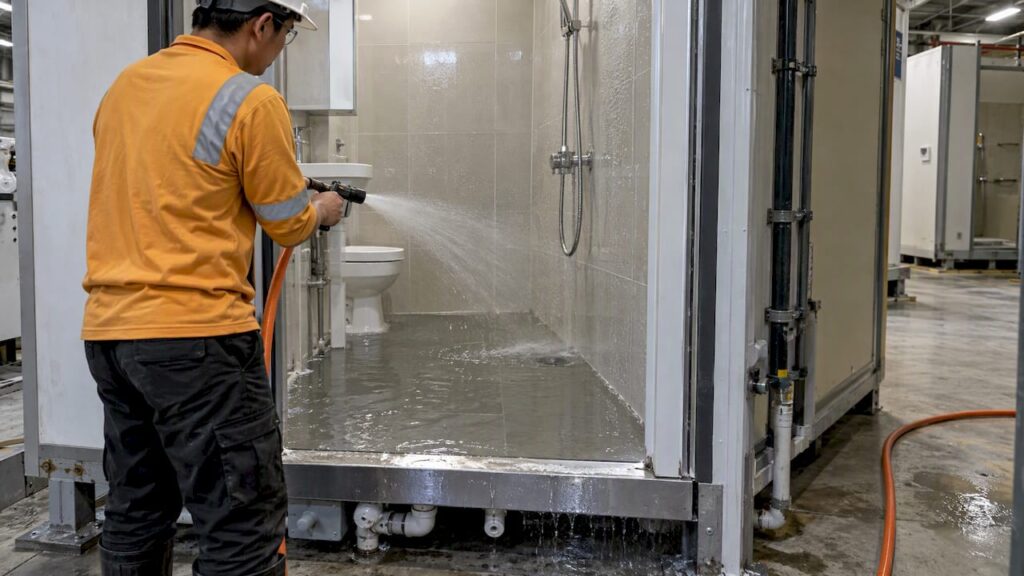
PBU acceptance in Singapore is the documented, witnessed confirmation that a prefabricated bathroom unit meets BCA performance requirements, SCI PBU MAS accreditation evidence and, where applicable, PUB sanitary test requirements. It runs in two stages, factory and site. Before delivery, insist on witnessed factory tests, full accreditation evidence rather than an IPA alone, and approved method statements.
TL;DR:
- BCA’s preliminary approval is not enough: SCI accreditation requires a completed plant audit, and site checks must match approved drawings and methods.
- PUB requires factory high pressure air testing for every unit, plus low pressure testing when water closets and floor traps are preinstalled.
- Contractually require witnessed ponding and spray tests, hydrostatic pipe tests, and each unit’s PUB air test; shower spray testing commonly runs continuously for 15 minutes.
- Require signed test reports, a completed delivery checklist, a signed delivery order, the manufacturer’s label, and a user manual before accepting any batch.
Table of Contents
- What PBU acceptance covers in Singapore
- Which authorities and documents govern acceptance
- Factory acceptance: tests and proofs to require before delivery
- Site acceptance and installation checks
- Planning, procurement and BIM actions that reduce acceptance risk
- Common causes of noncompliance and how to prevent them
- Our perspective on managing PBU acceptance end to end
- How we can help with PBU submissions and acceptance
- FAQ
- Sources
What PBU acceptance covers in Singapore
BCA places prefabricated bathroom units within its DfMA framework and sets PBU performance requirements for structural integrity, water-tightness, fire safety and acoustic performance. Acceptance means proving each of those attributes, plus the fit of mechanical, electrical and plumbing connections and the unit’s long-term maintainability.
Water-tightness is the defining functional test. A bathroom that looks finished but leaks into the unit below is a failed delivery, which is why factories rely on ponding and spray tests before a unit ever leaves the plant.
Maintainability is the quieter requirement. BCA expects a manufacturer’s label on each unit and a user manual for the eventual occupant. Teams that treat these as paperwork often discover at handover that they are formal conditions of acceptance. Practitioner guidance also stresses designing lifting points and service penetrations early, because a unit cannot be adjusted once it is on the crane.
Which authorities and documents govern acceptance
Three bodies shape the submission, and each asks for different evidence.
BCA sets the performance requirements and runs the Building Innovation Panel, which issues In-Principle Acceptances and publishes checklists for PBUs. An IPA signals that a solution is acceptable in principle. It does not replace project-specific verification.
The Singapore Concrete Institute administers the PBU Manufacturer Accreditation Scheme, which assures consistent quality across a manufacturer’s process. The audit has two parts. The documentation audit is only provisional, and the plant audit must also be completed. Ask which stage a supplier has actually reached, and for what scope.
PUB governs sanitary and sewerage requirements. Its Code of Practice on Sewerage and Sanitary Works requires a high-pressure air test on every PBU at the factory, with added low-pressure tests when water closets and floor traps are pre-installed.
For larger developments, BCA’s Buildability Type Approval circular describes an optional pathway from 30 April 2026 that may streamline submissions for qualifying Kit-of-Parts projects.

Factory acceptance: tests and proofs to require before delivery
Most rejections on site trace back to a factory stage nobody witnessed. Write these requirements into the supply contract so they are conditions of delivery, not courtesies.
- Water-ponding and spray tests on wet areas, witnessed by your representative. Industry practice commonly runs a continuous 15-minute spray test on shower zones.
- Hydrostatic pipe tests on concealed services before finishes close them in.
- PUB air tests for each unit, including the low-pressure test where fittings are pre-installed.
- Tile pull-off tests and material reports where the specification calls for them.
- Laboratory reports from accredited laboratories for any specified tests.
- A pre-delivery checklist and signed delivery order for every unit.
The SCI accreditation terms and checklist also expect in-process waterproofing inspection by an SCI-accredited waterproofer, so ask to see that record.
Pro Tip: Make the manufacturer’s label and the PBU user manual contract deliverables, and withhold acceptance of a batch until both are in hand.
Site acceptance and installation checks
Factory approval does not end your responsibility. SCI warns that an IPA is not a substitute for site verification, so inspection on arrival must confirm compliance with project drawings and approved method statements.
- Compare each delivered unit against the shop drawings and method statement, and accept no deviation without a documented concession.
- Confirm the lifting plan, current inspection certificates for the lifting equipment, competent operators and written loading and unloading procedures. SCI’s plant capability checklist expects documented maintenance and calibration of plant, and the same discipline applies on your site.
- Check service connections and run leakage or pressure verification where the specification requires it.
- Confirm that maintenance access remains open after installation.
- Keep signed delivery and acceptance forms, completed site checklists and photographs of the as-built interfaces.
Planning, procurement and BIM actions that reduce acceptance risk
Acceptance problems are usually planning problems that surface late. BCA advises engaging the PBU supplier and main contractor early, so structural and MEP interfaces are frozen before fabrication begins.
Model the bathrooms properly. CORENET X buildability notes call for IFC-SG properties such as ConstructionMethod and InternalLength and InternalWidth, with internal dimensions specified for every bathroom space. Consistent tagging keeps shop drawings and coordination models aligned. Reading plans accurately matters here too, and this guide on floor plan reading for Singapore projects helps teams check dimensions against the model.

On logistics, confirm crane capacity against unit weight, schedule just-in-time delivery, and arrange protected storage for anything that cannot go straight to its slot. Ask suppliers for servicing and calibration evidence for their plant. Finally, make witnessed factory tests, delivery checklists, the manufacturer’s label and the user manual conditions of handover.
Common causes of noncompliance and how to prevent them
- Waterproofing deviations. Units built away from the approved method statement fail ponding tests. Require accredited waterproofing, in-process quality control and witnessed tests.
- Interface mismatches. MEP positions or dimensions that disagree with the building model cause rework. Require IFC-SG tagging and coordinated shop drawings before fabrication.
- Lifting and transport damage. Cracked finishes and displaced fittings often come from poor handling. Require a certified lifting plan, protective measures and a condition check before dispatch.
- Missing documents. Absent test reports, labels or manuals stall acceptance. List each as a mandatory deliverable.
For background on how PBUs fit larger prefabrication strategies, see our note on PPVC in new launch residential properties.
Our perspective on managing PBU acceptance end to end
Most delays we see come from evidence arriving in the wrong order, not from bad units. A team that coordinates authority submissions with factory witnessing and site verification catches mismatches while they are still cheap to fix. We bring local authority submission experience and multidisciplinary coordination to that task, and we are glad to review your project and tell you where the acceptance risk sits.
— Aman
How we can help with PBU submissions and acceptance
We support project teams through the authority side of PBU delivery:
- Authority submissions and approvals across BCA, PUB and other agencies
- Coordination of witnessed factory inspections and accreditation evidence checks
- Civil and structural design checks
- Handover documentation

Ask us for a project review or an authority-submission scope through our authority submission services.
FAQ
What does PBU acceptance mean in Singapore?
It is the combined factory and site verification that a prefabricated bathroom unit meets BCA performance requirements, SCI accreditation evidence and PUB sanitary test requirements. Acceptance is documented, not assumed from a supplier’s reputation.
Is a BCA In-Principle Acceptance enough for PBU acceptance?
No. An IPA shows a solution is acceptable in principle, but SCI guidance warns it does not replace site checks against project drawings and method statements.
Which tests should I witness at the factory?
Witness water-ponding and spray tests, hydrostatic pipe tests and the PUB air tests required for each unit. Ask for tile pull-off results and laboratory reports where your specification requires them.
What documents must come with each unit?
Each delivery should carry witnessed test reports, a pre-delivery checklist, a signed delivery order, the manufacturer’s label and a user manual.
How can I avoid rejection on site?
Freeze interfaces early, tag dimensions in the BIM model, plan lifting and storage, and make every acceptance document a contract condition.
Sources
- Prefabricated Bathroom Units (PBU) | Building and Construction Authority
- PBU MANUFACTURER ACCREDITATION SCHEME – Singapore Concrete Institute
- SEWERAGE AND SANITARY WORKS (3rd EDITION – MAR 2025)
- Our Ref: APPBCA-2026-06 Construction Productivity and Quality Group
Recommended
- PE Endorsement in Singapore for Wall Hacking
- SS 723:2026 Pile Test Checklist for Singapore QPs to Avoid BCA Queries
- BCA Structural Design Approvals in Singapore (2025 Edition)
- The Professional Engineer in Singapore: A Definitive Guide to Endorsement, Responsibilities, and Liabilities