




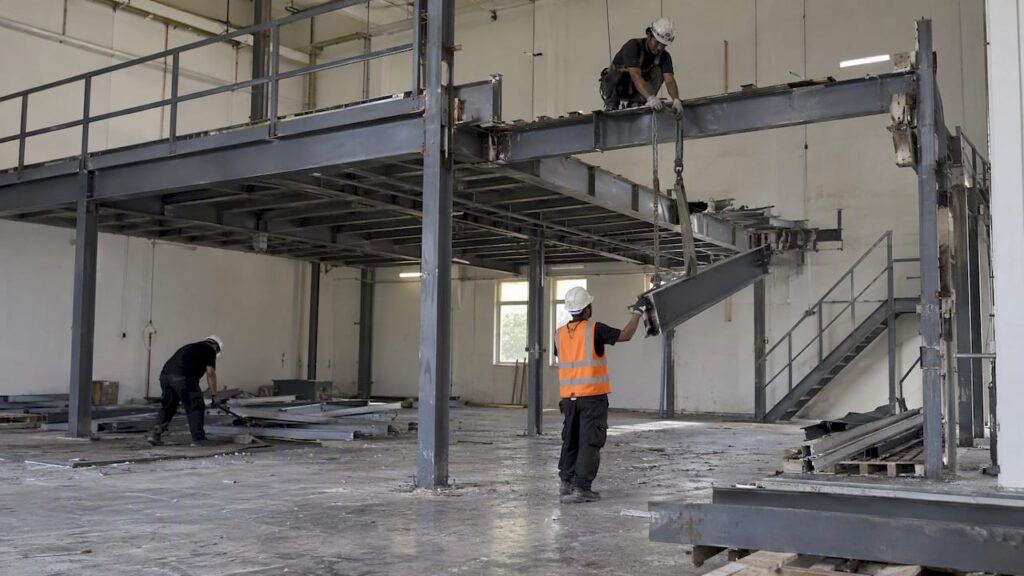
JTC requires every lessee to reinstate the premises before returning it on the lease expiry date, and the extent of that reinstatement is set by the lease agreement together with JTC’s site return guideline and a joint inspection held roughly six months before expiry. Works that are incomplete on the expiry date, or continued occupation beyond it, expose the lessee to double rent. This article sets out the sequence of obligations, the technical scope that is most often underestimated, the role of the Qualified Person (QP) and a working schedule that fits inside the available window.
TL;DR
- JTC states that reinstatement must be completed before the lease expiry date, and that double rent applies from that date if works are unfinished or the lessee stays on.
- JTC sends a reminder one year ahead and arranges the joint site inspection approximately six months before expiry, so the requirements are confirmed late relative to the lead time of the works.
- The scope depends on your lease clauses and on JTC’s site return guideline, and may include demolition of additions, apron drain removal, backfilling and an Environmental Site Assessment.
- Structural, fire safety and change-of-use elements generally require a QP and authority submissions, which should be started before the inspection rather than after it.
Table of Contents
- What “reinstatement” means for a JTC premises
- The JTC timeline and why it is tighter than it looks
- What the site return guideline asks for
- Environmental Site Assessment
- The role of the Qualified Person
- A practical reinstatement schedule
- Reinstatement works versus preparing premises for lease end
- Our perspective
- How Stellar Structures supports lessees
- Frequently asked questions
- Sources
What “reinstatement” means for a JTC premises
Reinstatement is the obligation to return the premises in the condition the lease specifies, which is not always the condition in which it was first handed over in practice. JTC’s own guidance describes it as dependent on the reinstatement obligations in the individual lease agreement, and the requirements it issues after inspection take those obligations into account. Two tenants in neighbouring units may therefore receive different instructions.
The practical consequence is that the lease document is the first reference, not a generic checklist. For land leases, JTC’s published standard terms and tender lease conditions refer to the reinstate, vacate and deliver obligation at the end of the term, and direct the lessee to comply with JTC’s guideline on site return. Factory and warehouse tenancies in multi-tenant buildings are usually narrower in scope, typically centred on removing tenant-installed additions, but the same principle applies: read the clauses first.
Common categories of reinstatement scope
| Category | Typical items | Who normally needs to be involved |
|---|---|---|
| Tenant additions | Partitions, mezzanines, raised floors, platforms, signage | Contractor, QP where structural |
| Services | Mechanical and electrical fit-out, ducting, dedicated power or gas lines | M&E engineer, licensed contractors |
| Fire safety | Sprinkler and detection changes made for the fit-out | SCDF-related professionals |
| Site works (land leases) | Demolition of buildings, apron drains, backfilling, turfing, as-built survey | Contractor, QP, surveyor |
| Environmental | Assessment where pollutive materials were used | Environmental consultant |
The table is a planning aid, not a statement of what your lease requires. Your own scope is whatever JTC confirms in writing after the inspection, read against the lease.
The JTC timeline and why it is tighter than it looks
The sequence published by JTC is short:
- One year before expiry: JTC sends a reminder by email.
- About six months before expiry: JTC contacts the lessee to arrange a joint site inspection.
- After the inspection: JTC informs the lessee of the reinstatement requirements, taking the lease obligations into account.
- Before the expiry date: all reinstatement works must be completed.
- From the expiry date: double rent is payable if works are incomplete or the lessee remains in occupation.
All five steps are described on JTC’s page on returning your premises upon lease expiry. The difficulty is arithmetic. If the formal requirements arrive at month six, the lessee has at most six months to appoint consultants, obtain quotations, secure any authority approvals, mobilize a contractor, execute the works and clear the final inspection. For a unit with a mezzanine, altered fire protection and decommissioned process equipment, that is rarely comfortable.
The recommended response is to treat the one-year reminder as the start of the project, not as a notice. Between months twelve and six, a lessee can review the lease, survey existing additions against the approved plans, identify which items will need a QP and begin the decommissioning of equipment.
Double rent exposure
JTC’s position is explicit: reinstatement works must be completed before the expiry date, and double rent is payable from that date if they are not, or if the lessee continues to stay on the premises. The exposure therefore accrues daily and is calculated on the rent, not on the cost of the works. A short delay in a high-rent unit can cost more than the incremental expense of accelerating the contractor’s programme, which is the sensible basis on which to decide whether to pay for overtime or parallel work fronts.
What the site return guideline asks for
Where buildings are demolished and the site is returned as a land parcel, JTC publishes a guideline covering demolition, earthworks, turfing and as-built survey. One representative item illustrates the level of detail: the lessee is to inspect the property and remove apron drains and drain outlets that have no further use after demolition, and to backfill with suitable material to the existing platform level. Backfilling and compaction details are specified in the same document, and the guideline should be read in full by whoever prepares the method statement.
Because the guideline is a dated document, confirm with JTC that the version you hold is the one applicable to your lease. Where the unit is an internal tenancy rather than a land lease, only some parts of it will be relevant, and the post-inspection requirements letter remains the governing instruction.
Items that are routinely missed
- Unapproved or legacy additions. A mezzanine or platform installed years ago without a corresponding approval cannot simply be left or removed informally. It needs to be regularized or removed with proper structural supervision. Our note on JTC mezzanine approval and lease reinstatement covers how these items are treated.
- Services penetrations and slab openings. Removal of equipment leaves openings and anchor points that may need making good.
- Fire protection modifications. Sprinkler heads, detectors and compartmentation altered for a fit-out should be checked against the fire code before and after works. Background is available in our overview of Singapore Fire Code compliance.
- Change of use. If an area was converted to an ancillary use during the tenancy, it may have to be reverted. See our guide to change of use applications in JTC developments.
Environmental Site Assessment
JTC notes that a lessee may need to conduct an Environmental Site Assessment (ESA) before returning the premises if its business activities involved pollutive materials. JTC’s ESA page explains when an assessment is required, and lists lease-related events, including changes of usage to include pollutive activities, as triggers.
The ESA is the item with the least predictable duration, because findings can lead to further investigation or remediation. Any lessee that handled chemicals, fuels, solvents, metal finishing or similar materials should ask JTC at the earliest opportunity whether an ESA will be required, rather than waiting for the six-month inspection. Early baseline information, where it exists, simplifies the comparison.
The role of the Qualified Person
Reinstatement frequently involves works that Singapore regulations treat as building works: removal of a mezzanine, alteration of a structural slab, modification of a fire-protected area. These need a QP, meaning a registered architect or professional engineer in the relevant discipline, to design, submit and supervise where approval is required. Our explanation of why every structural work in Singapore requires a QP sets out the legal consequences of proceeding without one.
For a JTC premises, structural alterations and some other works also pass through JTC’s plan consent process before or alongside other authority submissions. We describe the stages in our guide to JTC plan consent submission, and the wider submission requirements in building plan submission in Singapore.
If the premises is also subject to a URA change of use, the cost and timing matter. URA’s page on changing the use of a property states that a change of use application is subject to contextual evaluation and may be approved or disapproved, and advises applicants not to commit to tenancy or renovation works before receiving a decision. The same caution applies to reverting a use at lease end: confirm the position before committing a contractor.
A practical reinstatement schedule
The following schedule is based on the JTC milestones above and assumes a lease with one year remaining. Durations are indicative and depend on the lease and the extent of additions.
| Period before expiry | Action |
|---|---|
| 12 months | Receive JTC reminder. Retrieve lease, approved plans and past approvals. Assess the lease clauses on reinstatement. |
| 12 to 9 months | Survey existing additions against approvals. Appoint a QP where structural, fire or use-related items exist. Ask JTC about ESA applicability. |
| 9 to 6 months | Prepare draft reinstatement scope and method statement. Start decommissioning of process equipment. Begin any needed submissions. |
| 6 months | Joint site inspection with JTC. Obtain written requirements. Reconcile with your draft scope. |
| 6 to 3 months | Tender and appoint contractor. Obtain approvals. Order long-lead items. |
| 3 to 1 months | Execute works. QP supervision and records. |
| Final month | Pre-inspection by QP, rectify defects, request final inspection, clear the premises. |
Some owners procure the survey, design and works under a single integrated contract. The structure of such contracts differs by jurisdiction; for an illustration of how an integrated design-and-build form allocates responsibilities, this Dutch explainer on UAV-GC contracts is a useful comparison, although Singapore practice follows its own standard forms.
Reinstatement works versus preparing premises for lease end
Two different aims are sometimes conflated. Reinstatement removes what the lease requires to be removed. Preparation for lease end may also include repairs, cleaning and, if a renewal is sought, alterations and additions that the lessee wishes to keep with the landlord’s consent. A lessee seeking renewal might retain some features only if they are properly approved, whereas a lessee exiting will need to remove them. Our comparison, reinstatement works versus preparing JTC premises for lease end, sets out the decision points.
Our perspective
In our work on JTC premises, the recurring cause of overruns is not the technical complexity of the works but the late start. Lessees treat the six-month inspection as the commencement of the exercise, whereas the inspection should be the confirmation of a scope that has already been surveyed and costed. We therefore recommend that the structural condition of every addition be assessed by a Professional Engineer in the first quarter after the one-year reminder, with a written register that states, for each item, whether it is approved, whether an approval is missing and whether it must be removed under the lease.

We also advise lessees to separate three questions that are often merged: what the lease requires, what JTC requires after inspection, and what the authorities require for the works themselves. The first two determine scope, the third determines sequence. A removal of a mezzanine, for example, is a scope item under the lease but, as a structural alteration, also demands a QP and proper submissions. Our services cover the submissions to JTC, BCA, SCDF and the other statutory boards, as well as structural design checks, so that these three streams are coordinated by one team.
Finally, we would caution against negotiating reinstatement scope informally with the contractor. Written confirmation from JTC of the scope, and written close-out confirmation after the final inspection, are the records that matter if a dispute arises over double rent.
— Aman
How Stellar Structures supports lessees
Stellar Structures provides JTC submissions and JTC audit regularisation, structural and geotechnical consultation, and BCA, SCDF and URA submissions for industrial and commercial premises in Singapore. For a lease ending within the next twelve months, the most useful first step is a structural and approvals review of existing additions against the lease. Details of the services are on our services page, and enquiries can be made through the Stellar Structures website.
Frequently asked questions
Does JTC always require the premises to be returned bare?
Not necessarily. JTC states that the requirements it issues after the joint inspection take into account the reinstatement obligations in your lease agreement. The result depends on your lease and the condition of the premises, so confirm the scope in writing.
When will I know exactly what JTC requires?
JTC arranges the joint site inspection approximately six months before the lease expires and informs the lessee of the requirements afterwards. A reminder is sent one year earlier. Starting preparation at the reminder avoids compressing the works into the last six months.
What happens if the works are not finished on the expiry date?
JTC states that double rent is payable from the expiry date if reinstatement works are not completed before it, or if you continue to stay on the premises beyond it. Early appointment of a contractor and a QP is the practical safeguard.
Is an Environmental Site Assessment always required?
No. JTC indicates that it may be needed where business activities involved pollutive materials. Ask JTC early whether your premises falls within that category, since the assessment can add time.
Sources
- Returning your premises upon lease expiry, JTC
- Site return guidelines for demolition, earthworks, turfing and as-built survey, JTC
- Lease conditions, tender for 9A Serangoon North Avenue 5, JTC
- Environmental Site Assessment, JTC
- Changing the use of your property, URA
Recommended
- Reinstatement Works vs Preparing JTC Premises for Lease End: A Guide
- How to Plan Office Reinstatement Properly
- JTC Guidelines for Mezzanine Installations and Lease Reinstatement
- JTC Submission Requirements Explained