




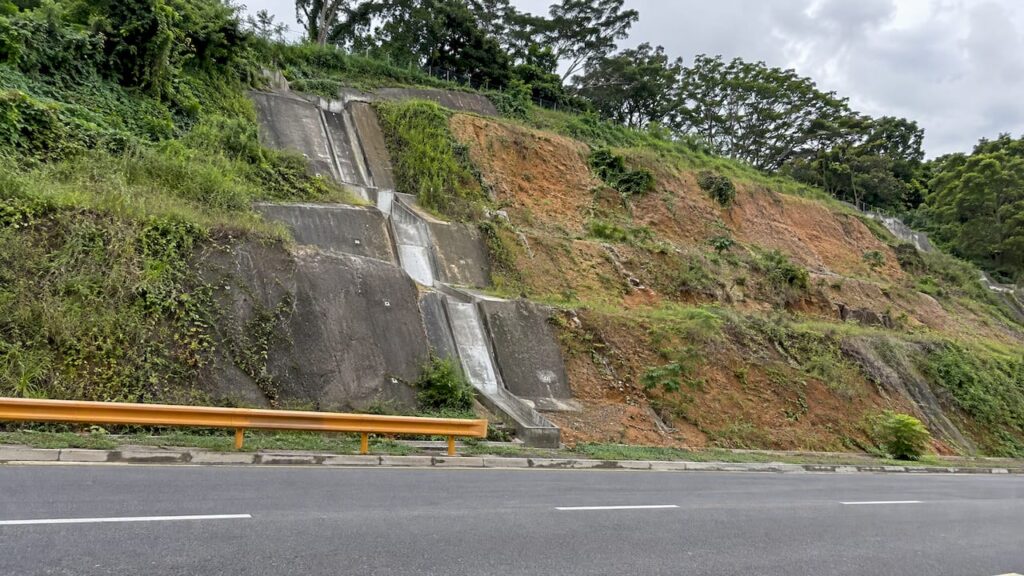
Slope stability analysis is the engineering evaluation of whether a natural or constructed slope can resist sliding or collapse, and it is normally expressed as a factor of safety (FoS): the ratio of the shear strength available along a potential failure surface to the shear stress acting on it. In Singapore, where intense rainfall, residual soils and tight sites make cut and fill slopes common, the analysis also feeds directly into authority submissions. This article sets out how the analysis is performed, which methods suit which conditions, which factors govern the result, and when a Qualified Person must be involved.
TL;DR
- The primary output is the factor of safety, the ratio of shear strength to shear stress along a potential failure surface. A value below 1.0 indicates an unstable slope (Matec Web of Conferences, 2017).
- Limit equilibrium methods (Bishop, Janbu, Morgenstern-Price) cover most routine slopes. Finite element or finite difference modeling is used when the failure mode is not well represented by them.
- Slope geometry, soil shear strength, groundwater, pore-water pressure and rainfall infiltration drive the outcome, so site investigation quality determines the quality of the analysis.
- In Singapore, slope works classified as Geotechnical Building Works require plan submission and the appointment of a QP(Geo) and an AC(Geo).
Table of Contents
- What slope stability analysis determines
- Slope stability methods
- Factors that affect slope stability
- Site data required for a reliable analysis
- Design codes and submission requirements in Singapore
- Interpreting the results
- Our perspective
- Support for slope and geotechnical submissions
- FAQ
- Sources
What slope stability analysis determines
The analysis answers two questions. First, how close is the slope to failure under the loads, groundwater conditions and soil properties that can reasonably be expected? Second, where and how would failure occur? The second question matters as much as the first, because the mechanism (a shallow translational slide, a deep rotational slip, a wedge controlled by joints in rock) determines which method is appropriate and what remedial measure is effective.
The core quantity is the factor of safety. Along a trial failure surface, the engineer computes the resisting force (the soil’s shear strength) and the driving force (the shear stress caused by self-weight, surcharge and water). Their ratio is the FoS, and the analysis searches many trial surfaces to find the critical one with the lowest value (Matec Web of Conferences, 2017).
A FoS of exactly 1.0 means resistance equals the driving force. Design practice therefore requires a value comfortably above that threshold, with the required margin set by the governing code, the consequence of failure, and the confidence in the ground model. A slope that supports a road or sits beside an occupied building is judged against a more demanding target than a temporary, low-consequence cut.
Slope stability methods
Methods fall into three broad groups: simplified checks, limit equilibrium methods (LEM) and numerical modeling. A competent assessment often uses more than one, so that a quick check validates a detailed model.
Limit equilibrium methods
Limit equilibrium methods divide the soil mass above a trial surface into slices and solve for equilibrium of forces, moments, or both. They differ in how they treat the forces between slices. Comparative studies examine the Bishop simplified, Janbu simplified and Janbu generalized procedures against the Morgenstern-Price method, and note that these approaches are well established and still commonly used in practice (ResearchGate comparison of limit equilibrium methods). The same study stresses that selecting the method is critical because the accuracy of the result depends on the failure mechanism.
| Method | Typical use | Main assumption or limitation |
|---|---|---|
| Fellenius (ordinary method of slices) | Preliminary checks, hand calculation | Simplest treatment of interslice forces; generally conservative |
| Bishop simplified | Circular slip surfaces in soil | Satisfies moment equilibrium; interslice shear forces neglected |
| Janbu simplified or generalized | Non-circular and composite surfaces | Force equilibrium based; a correction factor is applied in the simplified form |
| Morgenstern-Price, Spencer | Detailed design, complex geometry | Satisfy both force and moment equilibrium; require an assumed interslice force function |
Finite element and finite difference methods
When the failure mode is not well modeled by limit-equilibrium techniques, finite element or finite difference programs such as FLAC may be needed, as noted in the Iowa Department of Transportation slope stability design guidance. Typical triggers include stress-dependent stiffness, progressive failure, interaction with retaining structures or piles, and staged construction. Numerical models also allow coupled seepage and stress analysis, which is valuable where rainfall is the governing trigger.
Choosing between them
A practical workflow follows the consequence and complexity of the slope:
- Establish geometry, ground model and groundwater conditions from the site investigation.
- Run limit equilibrium analyses on circular and non-circular surfaces, using effective stress parameters for long-term conditions and total stress parameters for short-term, undrained conditions where relevant.
- Compare at least two LEM procedures to confirm the results are consistent.
- Move to numerical modeling where structures, staged excavation, or unusual failure modes are involved.
- Check the design against the code-required FoS for each load case, including rainfall and surcharge.
Factors that affect slope stability
Every input into the FoS calculation corresponds to a physical factor on site. The principal ones are listed below.
- Slope geometry. Height and inclination control the driving shear stress. Steeper and taller slopes carry higher driving forces (Geoengineer.org, Mechanics of Slope Stability).
- Soil and rock shear strength. Cohesion and friction angle govern the resisting force. Weathered and residual profiles can vary sharply over short distances, so a small number of tests rarely tells the full story.
- Unit weight and additional loads. The self-weight of the ground, together with surcharges from stockpiles, vehicles or neighboring structures, increases the driving force.
- Groundwater and pore-water pressure. Higher pore pressure reduces effective stress and therefore shear strength. This is often the decisive factor.
- Rainfall infiltration. Infiltration can reduce matric suction and raise groundwater and pore-water pressure, lowering shear strength. Unsaturated analysis can capture the transient changes during and after a storm (Matec Web of Conferences, 2017).
- Earthquakes and dynamic loading. Rainfall and earthquakes can both reduce the factor of safety (Geoengineer.org).
- Construction activity. Excavation at the toe, loading at the crest, blocked drainage and vegetation removal change the balance during works, which is why temporary stages need their own checks.
For a closer look at ground-related risks on active sites, our field guide to geotechnical hazards on construction sites covers how these factors appear in practice.
Site data required for a reliable analysis
A sophisticated model cannot compensate for a weak ground model. The analysis is only as reliable as the borehole data, laboratory testing and groundwater monitoring behind it.

Under Regulation 31 of Singapore’s Building Control Regulations, design Qualified Persons are required to carry out adequate site investigation so that meaningful data on ground stratification and groundwater levels is available for stability assessment (BCA reminder to design QPs, 2023). The same reminder points to the GeoSS Site Investigation Guide and Eurocode 7 for guidance on minimum borehole numbers and depths, and it emphasizes that the ground model should be maintained and updated throughout the investigation so that uncertainties are identified and decisions on further investigation are sensible.
Singapore Technical Reference 26 notes that deep excavations are complex because of ground uncertainty, limitations in sampling, testing and modeling, complex soil behavior, building response and soil-structure interaction (SS TR 26). These uncertainties apply equally to slopes cut for basements, pools and platforms.
A minimum data set for a slope assessment typically includes:
- A topographic survey showing existing and proposed levels.
- Boreholes with standard penetration tests and soil or rock classification.
- Laboratory strength tests on representative samples.
- Groundwater or piezometer readings, with allowance for the wet-season water table.
- Records of adjacent structures, services and existing retaining walls.
Our guide on when geotechnical studies are needed for construction explains how to scope this work at the start of a project.
Design codes and submission requirements in Singapore
Geotechnical design in Singapore follows SS EN 1997-1 (Eurocode 7). Its Singapore National Annex mandates Design Approach 1 for the STR and GEO limit states (SS EN 1997-1 National Annex). In practice, this means partial factors are applied to actions and to soil parameters in defined combinations, rather than relying on a single global factor alone. The wider framework of actions and combinations sits in the Eurocode basis of design, summarized in our guide to SS EN 1990.
On the regulatory side, BCA’s Geotechnical Building Works requirements treat slope works as a regulated category. Slope works that are classified as Geotechnical Building Works require plan submission and the appointment of a QP(Geo) and an AC(Geo). For additions and alterations to existing slopes that materially affect global stability, BCA sets slope-height thresholds that determine whether a submission is needed and whether the specific QP(Geo) and AC(Geo) appointments become mandatory. Because those thresholds are revised from time to time, confirm them against the current BCA document before designing; our article on geotechnical submission requirements and process walks through the sequence.
Slope and earthworks projects often involve several agencies at once. The earthworks approval process in Singapore sets out the agencies, steps and timelines, and the BCA submission journey from building plan to TOP shows where the geotechnical submission sits in the overall programme.
Interpreting the results
A calculated FoS is not a pass or fail number on its own. Four questions should accompany it.
- Which parameters were used? Characteristic values, design values and back-analyzed values give different outcomes, and the code framework specifies which applies.
- Which groundwater condition governs? A slope that passes with a low water table may fail under a perched or rain-raised one.
- Is the critical surface realistic? A search may find a shallow, surface-only slip that is controlled by a few centimeters of weathered soil, or it may miss a deeper surface that follows a weak layer.
- Is the margin consistent with the consequence? Slopes next to occupied buildings, roads or utilities warrant a higher margin and monitoring during construction.
When the result falls short, the usual remedies are regrading to a flatter profile, adding drainage to lower pore pressure, introducing retaining structures or soil nails, and surface protection against erosion and infiltration. The cost-effective choice depends on the site, and the stronger option is often a combination, for example drainage plus modest regrading. Where excavations require temporary support, value engineering of steel strutting is one example of how design refinement reduces cost without reducing the safety margin.
Our perspective
In our experience as a Singapore design and engineering practice, slope problems rarely begin with the calculation. They begin earlier, when a project proceeds on an incomplete ground model, an assumed groundwater level, or a drawing that does not show the slope at all.
We therefore treat slope stability as part of the submission strategy from the first day. Our team is led by a Professional Engineer with decades of experience in Singapore infrastructure, and we align the analysis, the choice of QP(Geo) and AC(Geo) appointments, and the authority requirements so that the design reviewed by BCA is the design that is built.
For landed homeowners planning additions, alterations or rebuilds, and for developers and contractors working with cut and fill, we favor feasible, cost-effective solutions: confirm the ground conditions early, test the slope against rainfall-driven groundwater, and select the remedial measure that satisfies both the factor of safety and the construction sequence.
Aman
Support for slope and geotechnical submissions
Stellar Structures provides structural and geotechnical engineering consultation, structural and geotechnical design checks, and authority submissions to BCA, URA, HDB, JTC, SCDF, PUB, LTA, NEA and NParks. For projects involving slopes, excavation or earthworks, we coordinate the engineering and the submissions so that the technical basis and the regulatory file stay consistent. Pricing is project-specific and is not published.

Property owners, developers, contractors and architects can review the full range on our engineering and authority submission services page, or reach us through the Stellar Structures website to discuss a project.
FAQ
What is a safe factor of safety for a slope?
A value below 1.0 indicates an unstable slope, so the design target must be above it. The required margin depends on the governing code, the load case, the consequence of failure and the quality of the ground data. Your Qualified Person confirms the target for each case under SS EN 1997-1 and the Singapore National Annex.
Which slope stability method should be used?
Limit equilibrium methods such as Bishop and Morgenstern-Price suit most soil slopes and are well established in practice. Finite element or finite difference modeling is used when the failure mode is not well represented by limit equilibrium, for example with structure interaction or staged excavation. Comparing two methods is a sound way to confirm the result.
Does rainfall affect slope stability analysis?
Yes. Rainfall infiltration can reduce matric suction and raise groundwater and pore-water pressure, which reduces shear strength. For this reason, analyses for Singapore sites should consider wet-season groundwater and, where warranted, unsaturated seepage modeling.
Does a slope in a landed property need a BCA submission?
Slope works classified as Geotechnical Building Works require plan submission and appointment of a QP(Geo) and AC(Geo). For existing slopes, the need depends on whether the works materially affect global stability and on the slope height. Consult a Qualified Person and the current BCA requirements for your site.
Sources
- Saturated and unsaturated stability analysis of slope, Matec Web of Conferences (2017)
- Slope Stability Evaluation by Different Limit Equilibrium Methods, ResearchGate
- 200F-1: Slope Stability, Iowa Department of Transportation
- Mechanics of Slope Stability, Geoengineer.org
- Reminder for design Qualified Persons to carry out site investigation, BCA (2023)
- SS TR 26 (2013), Singapore Standards eShop
- National Annex to SS EN 1997-1, Singapore Standards eShop
Recommended
- Soil Improvement for Singapore’s Challenging Ground
- Soil Investigation Report Preparation: Singapore Guide