





A routine addition-and-alteration project typically clears BCA approval in six to twelve weeks from submission to Permit to Carry Out Building Works, while complex schemes involving conservation status, basement works, or change of use can run considerably longer. The three variables that move this clock most are whether Urban Redevelopment Authority (URA) clearance runs in parallel with BCA review, how many Plan Reject Letters (PRLs) the submission draws, and whether an Accredited Checker (AC) is engaged. Appoint a Qualified Person (QP) before you do anything else.
TL;DR:
- Routine projects without conservation or basement works typically complete approval within six to twelve weeks if URA and BCA processes run in parallel and no PRLs are triggered.
- The first plan check response from BCA usually takes between 14 and 28 working days, with Structural Plan processing ranging from 7 to 14 days depending on accreditation status.
- Most schedule delays stem from rejection rounds, which can add 14 to 28 days each, often caused by incomplete submissions or coordination gaps, making thorough pre-lodge checks critical.
- Engaging an Accredited Checker and coordinating submissions early can significantly shorten approval timelines without sacrificing compliance.
- Monitoring real-time status through CORENET X and the Construction Gateway portal helps avoid delays, as responding promptly to RFIs and PRLs keeps approvals on track.
Table of Contents
- BCA Approval Timeline at a Glance: Routine vs Complex Projects
- What Happens at Each Stage of the Approval Cycle?
- Which BCA Service Standards Should You Plan Around?
- Why Do Plan Reject Letters Happen, and How Much Time Do They Cost?
- How Can You Compress the BCA Approval Timeline?
- Who Handles What: QP, AC, and Document Checklist
- How Do You Track Your Application Status?
- What Property Owners Consistently Get Wrong About This Timeline
- Get Your BCA and URA Submissions Handled Without the Guesswork
- Official Pages Worth Bookmarking
- Sources
- FAQ
BCA Approval Timeline at a Glance: Routine vs Complex Projects
A landed addition-and-alteration (A&A) project with no basement, no conservation constraints, and clean documentation generally moves from submission to Permit to Carry Out Building Works (PCBW) in several weeks to a few months, assuming URA Written Permission runs alongside the BCA review rather than after it. Projects touching conservation shophouses, deep basements, or a change of use routinely stretch past 4 to 6 months, largely because they trigger more inter-agency queries and a higher likelihood of resubmission.
Several service-standard figures anchor these ranges:
- BCA’s first plan-check response on a Building Plan submission typically falls between 14 and 28 working days, according to industry timeline data.
- Structural Plan (ST) processing runs 7 working days without an Accredited Checker, or 10 to 14 working days with one.
- Standard TOP/CSC processing takes 7 working days on complete documentation.
- Express TOP inspection, where accepted, is processed within 1 working day for a $3,000 fee, and virtual inspections are typically reviewed within about 3 working days.
Pro Tip: Budget your site start date against the slower of the BCA and URA tracks, not the faster one. Parallel processing only saves time when both agencies actually receive complete, coordinated submissions on the same day.
What Happens at Each Stage of the Approval Cycle?
The path from concept to occupation follows a defined sequence, and skipping steps rarely saves time. It usually costs it.
- Pre-application and Design Advisory Panel (DAP). For projects that qualify, a pre-submission DAP session under CORENET X typically takes 15 to 20 working days to schedule once materials are complete, with session minutes issued roughly 10 working days later. Most projects use no more than two sessions.
- URA Written Permission. Routine landed A&A applications commonly receive a first URA response within 6 to 8 weeks. This step must clear before certain BCA approvals can be finalized, though the two can often be lodged concurrently.
- BCA Building Plan (BP) submission. The first plan-check response arrives within 14 to 28 working days. A high share of first submissions draw at least one query, which is why coordination before lodging matters more than speed after it.
- Structural Plan (ST) submission. Processing runs 7 working days without an AC, 10 working days for a first AC-certified submission, 14 working days for later rounds, and up to 20 working days when reviewed jointly through the Construction Gateway.
- PCBW issuance. Once BP and ST approvals, plus any outstanding agency clearances, are in hand, BCA issues the Permit to Carry Out Building Works. Contractors should not mobilize before this is confirmed in writing.
- TOP/CSC booking and inspection. Once construction nears completion, applicants book inspection through the TOP/CSC portal, with standard processing at 7 working days.
Which BCA Service Standards Should You Plan Around?
BCA and the Inter-Agency Coordinating Committee (IACC) publish specific working-day targets that function as the closest thing to a guarantee in this process. These numbers are the ones to write into your project schedule.
| Submission or permit | Processing standard |
|---|---|
| Structural Plan, no Accredited Checker | 7 working days |
| Structural Plan, first submission with AC | 10 working days |
| Structural Plan, subsequent submissions with AC | 14 working days |
| Construction Gateway joint submission | Up to 20 working days |
| Permit to carry out structural works | 7 working days |
| TOP/CSC standard processing | 7 working days |
| Express TOP inspection (fee applies) | 1 working day |
| Virtual inspection review | ~3 working days |
| BCA inspection arrangement (post confirmation) | 14 working days |
The 14 working day figure for inspection arrangements comes directly from the IACC’s harmonized service standards, which standardizes how long agencies have between confirming an inspection slot and actually conducting it. That gap alone can determine whether a tight handover date is realistic.
Why Do Plan Reject Letters Happen, and How Much Time Do They Cost?
Most schedule overruns trace back to a small set of recurring problems, not to BCA moving unusually slowly. Each PRL round typically adds another 14 to 28 working days to the total clock, according to Lee & Co’s timeline analysis, which makes avoiding even one round more valuable than any acceleration tactic applied afterward.
- Incomplete submissions: missing forms, unendorsed certificates, or absent QP appendices.
- Noncompliance with technical codes covering accessibility, fire safety, or structural detailing.
- Coordination gaps between architectural, structural, and M&E disciplines that surface only during review.
- A QP’s history of weaker past submissions, which can invite closer scrutiny on new ones.
- Multi-agency queries raised through CORENET X when URA, PUB, SCDF, NParks, or LTA flag conflicting requirements.
Pro Tip: Run an internal “pre-lodge” review that cross-checks your structural and M&E drawings against the architectural set before anything goes to CORENET X. Catching a discipline conflict internally costs an afternoon. Catching it via a PRL costs three to four weeks.
How Can You Compress the BCA Approval Timeline?
None of these tactics involve cutting corners. They involve doing the coordination work earlier rather than later.
- Use DAP pre-submission consultation and cap it at two sessions. This surfaces design conflicts before they become abortive rework after formal lodging.
- Engage an Accredited Checker where your project qualifies. AC-certified submissions get faster, more predictable Structural Plan processing and tend to draw fewer technical queries.
- Submit coordinated drawings and complete appendices in one package to avoid requests for information that reset the review clock.
- Parallelize URA and BCA submissions wherever the project type allows it, but confirm your QP has flagged any dependency between the two before you rely on this.
- Reserve express TOP or virtual inspection requests for projects where documentation is genuinely complete. Paying $3,000 for an express slot on an incomplete file wastes the fee.
Pro Tip: Ask your QP directly, at kickoff, how many PRL rounds their last three comparable submissions drew. Past performance on similar project types is a better predictor of your timeline than any published service standard.
Who Handles What: QP, AC, and Document Checklist
The Qualified Person carries overall design responsibility and signs off on submissions to BCA and URA. The Accredited Checker independently verifies structural design where engaged, which is what unlocks the faster AC-track processing times. The contractor’s role begins in earnest only after PCBW is issued, though early involvement in constructability review helps avoid late-stage design changes.
Core documents to have ready include:
- Endorsed QP certification appendices for structural and architectural works.
- Form BPD_CSC02 and BPD_CSC07, or their current e-form equivalents (BCA-CSC-CSPBW and BCA-CSC-CSCDQP), for TOP/CSC applications.
- Accredited Checker certification, where applicable, submitted alongside the ST package.
- Complete architectural, structural, and M&E drawing sets lodged together through CORENET X rather than piecemeal.
How Do You Track Your Application Status?
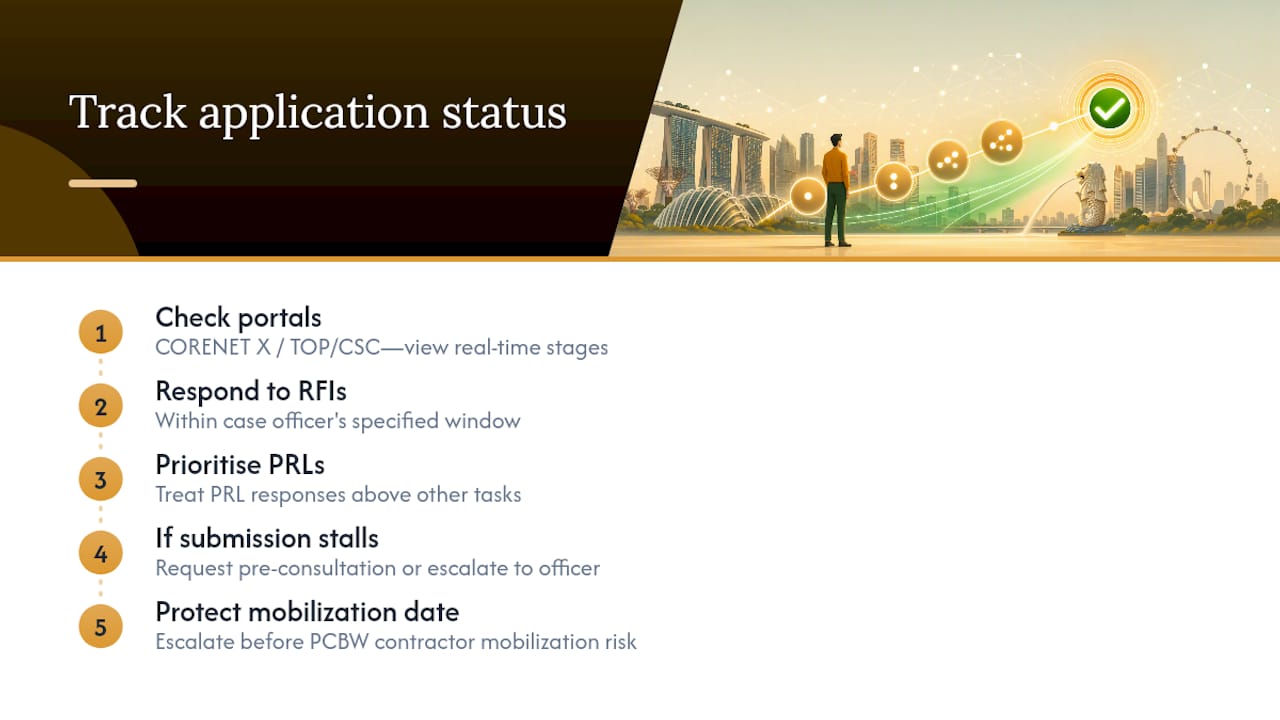
Check submission status directly through the CORENET X / Construction Gateway portal and the TOP/CSC portal, both of which show real-time review stages. Respond to any Request for Information within the window the case officer specifies, and treat PRL responses as priority items over other project tasks. If a submission stalls without explanation, request a pre-consultation call or escalate to the assigned case officer before your PCBW-dependent contractor mobilization date is at risk.
What Property Owners Consistently Get Wrong About This Timeline
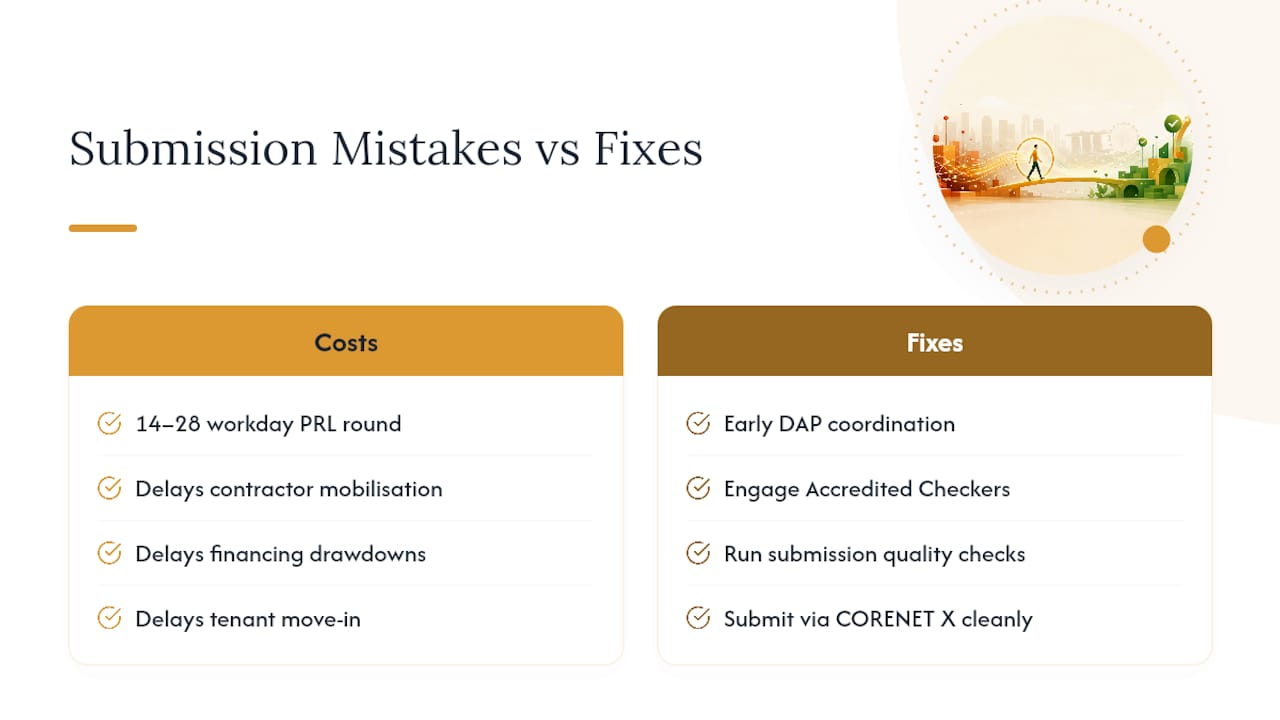
The biggest misjudgment we see isn’t about BCA moving slowly. It’s owners and even some project teams underestimating how much a single uncoordinated submission costs in real weeks. A 14 to 28 working day PRL round doesn’t just delay paperwork. It delays contractor mobilization, financing drawdowns, and often a tenant’s move-in date, all from one missing appendix or one unresolved clash between structural and M&E drawings.
Authority submissions benefit from coordinating DAP sessions early, engaging Accredited Checkers where projects qualify, and running submission quality checks before anything reaches CORENET X. The goal isn’t just approval. It’s approval on the first pass.
— Aman
Get Your BCA and URA Submissions Handled Without the Guesswork
An alternative to piecing together your own submission team project by project is a single firm managing BCA submissions and approvals, URA submissions, and Accredited Checker coordination under a single engagement, backed by a Professional Engineer with extensive Singapore infrastructure experience.
Before your first meeting, gather your existing architectural drawings, any prior correspondence with BCA or URA, and your intended project timeline. The service provider reviews these to flag likely PRL risks before submission rather than after, and coordinates TOP/CSC scheduling once construction nears completion. If you also need periodic structural or façade inspections down the line, that work folds into the same relationship. You can request a project review through the services page to get a realistic timeline for your specific submission.
Official Pages Worth Bookmarking
Keep BCA’s applications and licenses portal, the CORENET X gateway process guide, and the IACC’s TOP/CSC service standards circular on hand for direct reference throughout your project.
Sources
- Structural Plan submission | Building and Construction Authority
- CORENET X — refinements to the new submission process
- Circular on agencies’ service standards for TOP/CSC inspection arrangements and post-inspection response time (IACC)
FAQ
How Long Does a BCA Submission Take?
A routine Building Plan submission typically gets a first response from BCA within 14 to 28 working days, though the full approval clock through PCBW usually runs several weeks to a few months once URA clearance and any PRL rounds are factored in, per industry timeline tracking.
What Documents Does BCA Require for TOP/CSC Applications?
BCA requires completed e-forms such as BCA-CSC-CSPBW and BCA-CSC-CSCDQP alongside QP certification confirming the works match approved plans. Standard TOP/CSC processing takes 7 working days once documentation is complete.
How Many Working Days Does Structural Plan Approval Take in Singapore?
Structural Plan approval takes 7 working days without an Accredited Checker, or 10 working days for a first AC-certified submission and 14 working days for later rounds, according to BCA’s published standard. Joint Construction Gateway reviews can take up to 20 working days.
How Do I Check My BCA Application Status?
Application status is tracked through the CORENET X / Construction Gateway portal for plan submissions and the TOP/CSC portal for occupation permits. Both show current review stage and any outstanding queries the case officer has raised.
Can Stellar Structures Handle My BCA and URA Submissions Together?
Yes. Stellar Structures coordinates BCA and URA submissions as part of a single engagement, which is designed to reduce the coordination gaps that typically trigger PRLs when submissions are handled separately.
Recommended
- Stages of New Build Construction in Singapore: 2026 Guide
- Avoid BCA Rejection: Singapore Temporary Building Permit Requirements
- BCA Fines vs Regularisation Costs: Why Early Plan Submission is Cheaper
- Mezzanine Floor Approval Guide Singapore 2026