





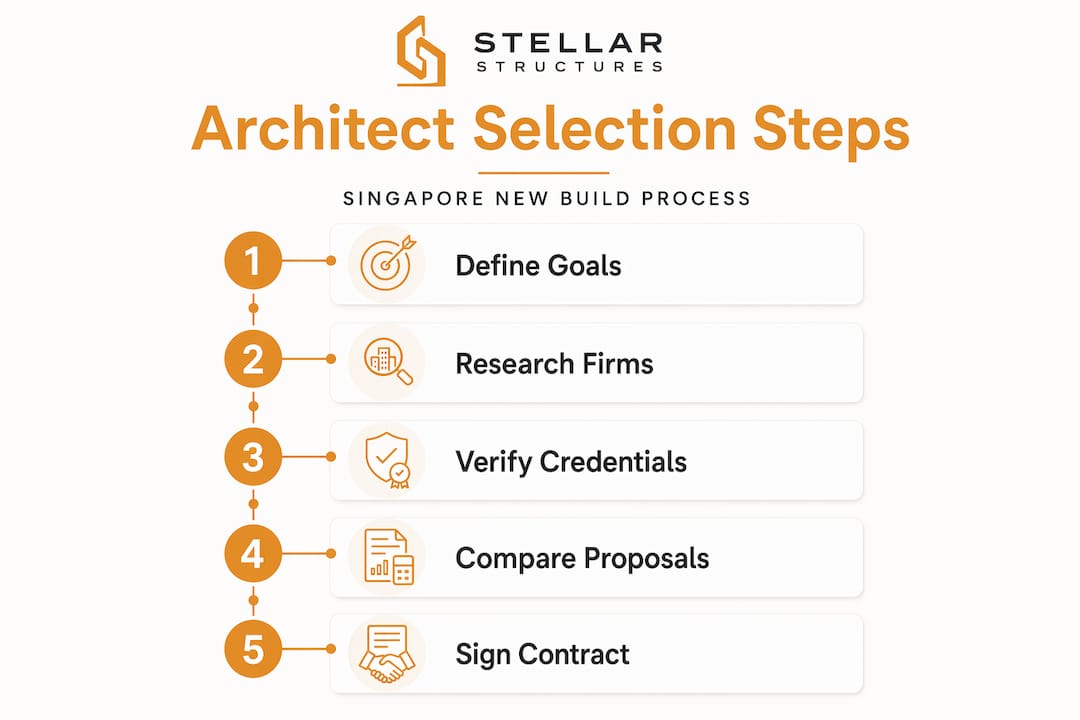
Choosing an architect for a new build in Singapore is one of the most consequential decisions you will make as a property owner. Get it right, and the process from design to completion runs with clarity, compliance, and budget discipline. Get it wrong, and you face redesigns, regulatory delays, and cost overruns that could have been entirely avoided. Singapore’s building regulations are precise, approval agencies are numerous, and the construction market is competitive. This guide walks you through every step, from clarifying your project goals to reviewing contracts, so you can make an informed choice and protect your investment from the start.
Table of Contents
- Key takeaways
- Choosing an architect for your new build in Singapore: start here
- How to research and shortlist residential architects
- Evaluating credentials, communication, and professional fit
- Checking references and understanding construction involvement
- Contract considerations before finalizing your choice
- My perspective on what really matters when choosing an architect
- How Stellar Structures supports your new build in Singapore
- FAQ
Key takeaways
| Point | Details |
|---|---|
| Define your goals first | Clarify design style, budget, and timeline before approaching any architect. |
| Verify BOA registration | Only architects registered with the Board of Architects Singapore can legally practice. |
| Match specialization to project | An architect’s portfolio must reflect experience in the specific build type you need. |
| Assess fees and fee structure | Architect fees in Singapore typically range from 5% to 10% of construction costs. |
| Review contracts carefully | Contracts must clearly define scope, payment schedules, deliverables, and termination terms. |
Choosing an architect for your new build in Singapore: start here
Before you contact a single firm, you need to know exactly what you are building and why. This sounds obvious, yet most project conflicts trace back to a homeowner who handed vague instructions to an architect and expected the vision to translate perfectly. It does not work that way.
Start by documenting your design preferences. Are you drawn to a tropical modern aesthetic, a minimalist concrete expression, or a more traditional landed style? Beyond aesthetics, consider how you actually live. Do you need a multi-generational home with separate entrances and shared communal areas? A home office that requires acoustic separation? A sustainable design that reduces energy consumption? All of these functional requirements will influence which building design professionals are the right fit for your project.
Consider the following before reaching out to any architect:
- Design style: Identify at least three reference projects or homes that reflect your preferred aesthetic.
- Functional requirements: List specific rooms, spatial relationships, and features that are non-negotiable.
- Sustainability goals: Determine whether Green Mark certification or passive cooling strategies are priorities.
- Budget range: Establish a realistic construction budget, not just a land and fees estimate.
- Timeline: Factor in design, regulatory approvals, tender, and construction phases. A new build in Singapore rarely completes in under two years.
Pro Tip: Set your maximum budget before your first architect meeting, not during it. Architects design to the brief you give them. If you leave budget open-ended, proposals will fill that space.
Clear goals also improve how you evaluate proposals later. When an architect presents a concept, you have a concrete reference point. Without one, every option looks equally plausible, and decision fatigue sets in quickly.
How to research and shortlist residential architects
Singapore has no shortage of architectural firms, but not every firm is suited to residential new builds, and not every residential firm handles the type of custom home you are planning. The selection process demands structured research, not just browsing Instagram portfolios.

The foundation of your search is the Board of Architects Singapore. BOA registration is required for any architect practicing legally in Singapore. You can verify registration directly on the BOA website before scheduling any meeting. This single check eliminates unqualified candidates immediately and is non-negotiable for compliance purposes.
From there, narrow your list by specialization. An architect who has delivered luxury landed properties in Bukit Timah operates with a different methodology, contractor network, and design vocabulary than one focused on compact urban infill homes in Toa Payoh. Matching specialization to your project type directly improves outcomes. When reviewing portfolios, look for:
- Completed projects of a similar scale and type to yours
- Evidence of URA, BCA, and relevant authority submissions handled by the firm
- Photographs of built work, not just renders (renders can mask execution quality)
- Recognition from the Singapore Institute of Architects or other credible bodies
Beyond online research, ask your network for referrals. A recommendation from someone whose completed home you have visited carries more weight than any award citation. If possible, visiting completed projects provides a level of confirmation that no portfolio image can replicate. You see material finishes, spatial proportions, and construction quality firsthand.
Evaluating credentials, communication, and professional fit
Credentials and communication quality are separate filters, and both must pass before you proceed. An architect with impeccable qualifications but poor communication habits will create friction throughout a multi-year project.
Start with formal credential verification. Confirm that the architect holds a valid practicing certificate issued by BOA. A significant regulatory development to note: Singapore is progressing plans to extend practicing certificate validity from one year to three years, a change expected to improve planning certainty for both architects and clients. This 2026 shift means credential verification processes may evolve, so confirm the current status of any certificate at the time of engagement.
Membership in the Singapore Institute of Architects is a useful additional indicator of professional standing and commitment to continued practice standards, though it is not a legal requirement for practice.
On communication, architects who ask insightful questions and explain technical concepts in accessible terms are significantly easier to work with. During your initial meeting, assess whether the architect listens before proposing, acknowledges constraints honestly, and explains their design process clearly.
Use the following comparison to evaluate fee structures before signing:
| Fee model | How it works | Best suited for |
|---|---|---|
| Percentage of construction cost | Architect charges 5%–10% of the total construction cost | Most residential new builds |
| Fixed lump sum | Agreed flat fee for defined scope of work | Well-defined, smaller-scale projects |
| Hourly rate | Billed by hours worked, typically for consultations | Feasibility studies and early-stage advice |
Pro Tip: Ask each architect to break down what the fee covers: schematic design, development design, authority submissions, tender documentation, and construction supervision are separate phases. Many homeowners assume the fee covers everything, only to receive additional invoices later.
Pay attention to red flags in initial meetings. Reluctance to provide references, vague answers about regulatory submission experience, or pressure to sign a letter of appointment immediately are all signals worth taking seriously.
Checking references and understanding construction involvement
Due diligence does not end with a portfolio review and a good meeting. Contacting previous clients and understanding how the architect operates through construction are steps that many homeowners skip, and often regret.
When speaking to past clients, structure your questions to get specific answers:
- Did the project complete within the original timeline, and if not, what caused the delays?
- How accurately did the final cost track against the initial budget?
- How did the architect respond when problems arose during construction?
- Was the authority submission process handled competently and without unnecessary delays?
- Would you engage the same architect again for a future project?
The architect’s role does not end at design delivery. Architect involvement extends to regulatory submissions and construction supervision, and the depth of that involvement matters considerably for your project’s outcome. An architect who conducts regular site inspections can catch construction deviations early. One who disappears after submitting plans leaves you exposed to misinterpretation by contractors.
Understanding building plan submission requirements in Singapore is complex. BCA, URA, SCDF, and other agencies each impose their own requirements, and your architect’s experience navigating this network directly affects approval timelines.
“Understanding client vision deeply leads to innovative yet buildable designs.” Architects who maintain close client contact through construction tend to produce results that align with the original design intent, not just the approved drawings.
Contract considerations before finalizing your choice
A well-structured contract is your legal protection throughout a project that will span years and hundreds of thousands of dollars. Many homeowners treat contract review as a formality. It is not.
Key contract elements must include the scope of architectural services in explicit detail, a payment schedule tied to project milestones, a list of deliverables with formats and submission dates, a clearly defined timeline with agreed review periods, and a termination clause that specifies conditions and consequences for both parties.
Pay particular attention to authority submission responsibilities. Confirm in writing which agencies the architect will submit to on your behalf and what happens if submissions are rejected or require revision. Singapore requires approvals from agencies such as BCA, URA, SCDF, and others depending on your project type. Each has distinct requirements, and delays in one can cascade across the entire program.
Consider the following contract review checklist before signing:
- Confirm that scope explicitly covers all design phases from schematic through construction documentation
- Verify that intellectual property clauses are addressed, particularly who owns the design drawings
- Check that dispute resolution mechanisms are specified
- Confirm whether the architect carries professional indemnity insurance
Consulting a lawyer to review architectural contracts is recommended, particularly for first-time homeowners unfamiliar with construction legal terminology. Legal review fees are a minor cost relative to the exposure of signing a poorly structured agreement on a multi-million dollar project.
Pro Tip: Request that the contract reference the SIA Conditions of Appointment as a baseline. This Singapore Institute of Architects standard document provides a recognized framework and ensures the contract aligns with industry norms.
Familiarity with your legal obligations under the Building Control Act will also clarify what responsibilities remain with you as the property owner, separate from what the architect assumes.
My perspective on what really matters when choosing an architect
I have worked alongside architects and structural engineers on new build projects across Singapore long enough to form a clear view on what separates successful projects from those that struggle. Credentials matter. Portfolio quality matters. But neither of those factors predicts success as reliably as communication behavior does.
The architects whose projects run well are consistently the ones who communicate proactively, flag problems before they become crises, and treat the client relationship as a collaboration rather than a transaction. I have watched technically accomplished firms produce poor outcomes because they treated client feedback as an obstacle. I have also seen boutique practices produce exceptional homes because the principal architect stayed personally engaged from concept through completion.
The 2026 shift toward three-year practicing certificates is a positive development that should bring more stability to the credentialing environment. But it does not change the fundamentals of selection. You are still choosing a person, not just a license.
Trust and rapport with your architect increase the likelihood of project success in ways that are difficult to quantify but consistently observable. When you meet an architect whose thinking aligns with yours and whose communication style matches your expectations, that alignment is worth significant weight in your final decision.
Do not ignore your instincts. If something feels off during the interview process, investigate it. If everything checks out and the connection feels right, that is a strong foundation.
— Aman
How Stellar Structures supports your new build in Singapore

Selecting the right architect is a critical first step. Ensuring that your project moves through design, structural engineering, and regulatory approvals with precision is what follows. Stellar Structures provides residential architectural design services and structural engineering support specifically tailored to new builds in Singapore, including BCA, URA, and SCDF authority submissions handled by experienced professionals.
Their team works directly alongside architects and property owners to provide civil and structural design checks, geotechnical assessments, façade engineering, and authority submission services that keep projects compliant and on schedule. Whether you are in the early design stage or approaching the tender phase, Stellar Structures offers practical technical support that complements your architect’s work and reduces approval risk. Contact Stellar Structures for a consultation tailored to your project’s specific requirements.
FAQ
How do I verify an architect’s registration in Singapore?
Verify registration directly on the Board of Architects Singapore website. BOA registration is a legal requirement for any architect practicing in Singapore, and this check should be completed before any formal engagement.
What are typical architect fees for a new build in Singapore?
Architect fees typically range from 5% to 10% of the total construction cost, depending on project complexity and the scope of services included. Always confirm what phases the fee covers before signing.
What is the architect’s role during construction?
Beyond design, architects can manage regulatory submissions to agencies such as BCA and URA, and may also conduct construction supervision to verify that the build aligns with approved drawings. Confirm the extent of this involvement in your contract.
Should I hire a lawyer to review my architect’s contract?
Yes. Legal review is recommended, particularly for homeowners unfamiliar with construction contracts. The cost of a legal review is minimal relative to the financial exposure of a poorly structured agreement on a high-value project.
How does Singapore’s 2026 regulatory change affect architect selection?
Singapore is progressing plans to extend architect practicing certificates from one year to three years. This change is expected to improve planning certainty for clients and reduce credential verification complexity over the course of long projects.
Recommended
- Why hire an architect for your new build in Singapore
- Hiring a Structural Engineer for Renovation in Singapore
- Design and build contracts: Singapore developer guide
- Singapore A&A Works (2025): Essential Guide to Hiring a BCA-Certified Builder