




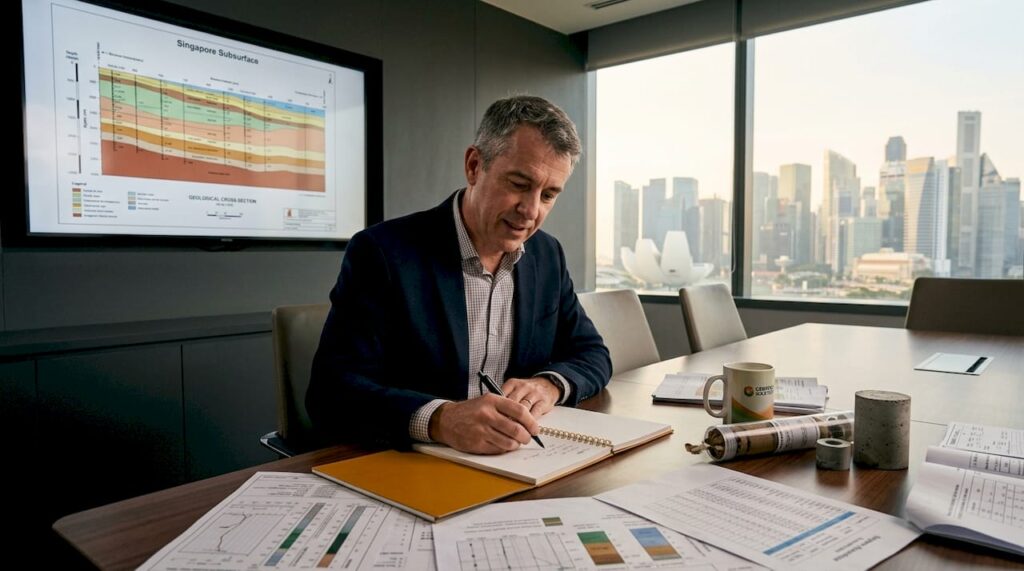
Many property developers treat soil investigation as a formality, a box to check before construction begins. That assumption is precisely where costly building projects go wrong. The role of geotechnical engineer in a building project extends far beyond collecting soil samples. In Singapore, where ground conditions shift from soft marine clay in reclaimed land zones to weathered granite in the central highlands, this professional is the critical link between what lies beneath a site and what can safely be built above it. Miss that link, and you risk foundation failure, regulatory rejection, and significant financial liability.
Table of Contents
- Understanding the geotechnical engineer’s role in Singapore’s unique geology
- Key responsibilities of geotechnical engineers throughout building projects
- Choosing the right foundation: how geotechnical engineers guide design decisions
- Legal and regulatory importance of geotechnical engineering in Singapore
- Practical applications and benefits of early geotechnical involvement in building projects
- Why early and integrated geotechnical expertise is the game changer for Singapore construction
- How Stellar Structures supports your geotechnical engineering needs
- Frequently asked questions
Key Takeaways
| Point | Details |
|---|---|
| Critical for safety | Geotechnical engineers assess complex ground conditions critical to building safety in Singapore. |
| Early involvement | Engaging geotechnical experts early improves design efficiency and risk management. |
| Foundation choice | Proper foundation selection depends on thorough soil investigation by specialists. |
| Legal compliance | Accurate geotechnical data is essential to avoid legal risks and meet BCA standards. |
| Sustainability benefits | Specialist input helps reduce construction carbon footprint and supports sustainable projects. |
Understanding the geotechnical engineer’s role in Singapore’s unique geology
Singapore’s subsurface is not uniform. The island sits on a geological patchwork that includes Old Alluvium, Jurong Formation sedimentary rocks, Bukit Timah Granite, and the soft marine clays that dominate much of the reclaimed southern and western coastlines. Each formation presents distinct engineering challenges. Singapore’s geology ranges from soft marine clay to hard granite, and finding the right engineering balance for each site demands expert interpretation, not just standard testing.
Geotechnical engineers function at the intersection of geological science and civil engineering. They interpret borehole logs, cone penetration tests (CPT), and laboratory soil analysis to build a ground model that structural engineers and architects can design against. Without that model, foundation design is essentially guesswork, and guesswork in a dense urban environment like Singapore carries serious consequences.
For projects involving underground structures such as MRT-adjacent basements, deep utility corridors, or subterranean carparks, the stakes are amplified. Ground movement during excavation can affect neighboring structures, buried utilities, and adjacent road infrastructure. The need for detailed geotechnical site investigation in Singapore is therefore not discretionary on such projects. It is the foundation of every downstream design decision.
Key site conditions that geotechnical engineers assess include:
- Depth and thickness of compressible soil layers, particularly soft marine clay
- Location and profile of the underlying rock surface, known as bedrock depth
- Groundwater levels and fluctuation patterns, which affect excavation support design
- Presence of boulders or obstructions in Old Alluvium zones, common in the east
- Site history, including prior land use that may have introduced fills or contaminants
“Singapore’s geology ranges from soft marine clay to hard granite, requiring expert balance in engineering solutions.” — Darren Chian, National University of Singapore, IPUR
That balance requires judgment. No two sites in Singapore are identical, and geotechnical engineers carry the technical responsibility of translating subsurface complexity into design parameters that ensure structural safety.
Key responsibilities of geotechnical engineers throughout building projects
The geotechnical engineer’s responsibilities span the full project lifecycle, from feasibility through to post-construction monitoring. This is not a role confined to the pre-design stage, and property developers who treat it as such typically encounter avoidable problems during construction.
Here is how geotechnical engineers assist projects at each stage:
-
Pre-design site investigation. The engineer scopes and supervises the field investigation program, specifying borehole locations, depths, and test types based on the proposed structure. For a high-rise with deep piles, this differs significantly from the program required for a single-story industrial shed.
-
Geotechnical report and design parameters. Following testing, the engineer produces a factual site investigation report and an interpretive geotechnical report, providing soil parameters such as shear strength, compressibility, and bearing capacity for use by the structural design team.
-
Foundation system recommendation. The geotechnical engineer advises on appropriate pile types, pile lengths, and foundation configurations suited to the actual ground conditions rather than generic assumptions. Understanding when you need a geotechnical engineering consultant is essential here.
-
Review of contractor methods. During construction, the engineer reviews piling records, confirms pile set criteria, and assesses any anomalies encountered during installation. Pile rejection due to inadequate set is far cheaper to manage on-site than after the structure is loaded.
-
Construction monitoring and instrumentation. For deep excavations or sites near sensitive structures, the engineer manages real-time monitoring of ground movements, wall deflections, and groundwater drawdown.
-
Regulatory submissions and compliance. In Singapore, a Professional Engineer in the Geotechnical discipline (PE Geo) must endorse geotechnical aspects of certain projects. Knowing when PE Geo is required during construction is a regulatory obligation, not an optional consideration.
Early involvement of geotechnical specialists improves design efficiency and measurably reduces both project risk and carbon footprint, a point the industry is increasingly formalizing through procurement standards and contract structures.
Pro Tip: Bring your geotechnical engineer into initial feasibility discussions before purchasing a site. Ground conditions significantly affect whether a proposed building configuration is even viable, and discovering that at the design development stage rather than the sales agreement stage changes the entire project economics.
Choosing the right foundation: how geotechnical engineers guide design decisions
Foundation selection is one of the most consequential decisions on any building project, and it belongs to the geotechnical engineer to lead. The choice of pile type depends on the soil profile, soil strength, and project requirements, and this selection directly determines foundation performance over the life of the structure.
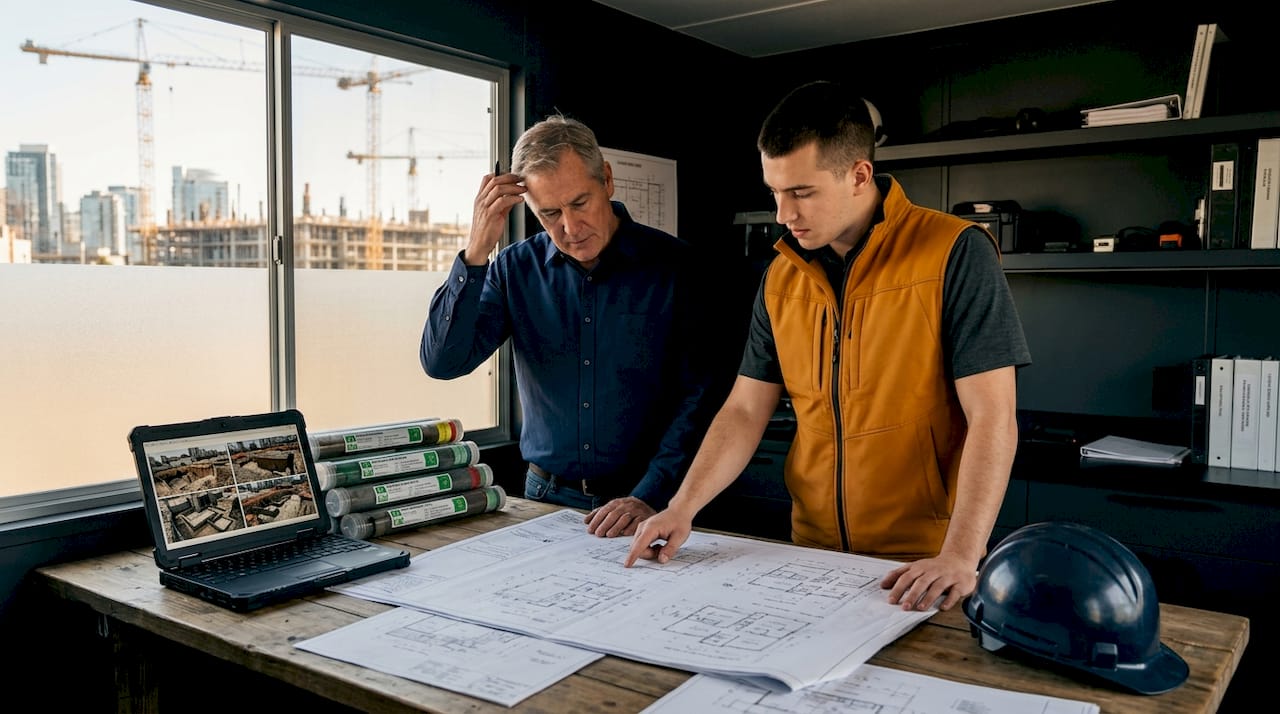
The following table outlines common foundation types used in Singapore and the ground conditions that govern their selection:
| Foundation type | Suited ground conditions | Key considerations |
|---|---|---|
| Bored cast-in-situ piles | Soft marine clay over rock | Minimal vibration, suitable near existing structures |
| Driven precast piles | Medium-dense to dense soils, Old Alluvium | Cost-effective, but generates noise and vibration |
| Micropiles | Constrained access, variable or rocky ground | Useful for underpinning and retro-fit projects |
| Raft foundation | Shallow competent soils, low to medium loads | Only viable where settlements can be controlled |
| Caissons | Rock-socketed applications, high-load columns | Used for major infrastructure and tall buildings |
The selection process involves more than matching soil to pile type. It incorporates:
- Structural loads and column spacing, which determine individual pile capacity requirements
- Site access constraints that may rule out large rotary rigs needed for bored piles
- Proximity to existing buildings or underground structures, where vibration limits apply
- Project schedule, since driven piles install faster but require noise permits in sensitive areas
- Long-term settlement tolerances, particularly important for differential settlement in mixed ground
Geotechnical surveys conducted early allow the design team to evaluate these factors before the structural engineer fixes the foundation layout. Changing pile specifications after structural drawings are issued is costly and time-consuming. Solutions that address soil improvement in Singapore sites, such as preloading or ground treatment before piling, also require early geotechnical assessment to plan effectively.
For developers requiring an end-to-end view of this process, the Singapore foundation engineering guide provides detailed coverage of design considerations, cost drivers, and geotechnical factors specific to local projects.
Legal and regulatory importance of geotechnical engineering in Singapore
The importance of geotechnical engineering in Singapore extends into the legal domain in ways many developers do not anticipate until a dispute arises. A landmark Singapore High Court case established a principle that has direct implications for every project.
In Resource Piling Pte Ltd v Geospecs Pte Ltd [2013] SGHC 231, the court found that contractors and developers must satisfy themselves regarding actual ground conditions and cannot simply rely on soil data provided by third parties without verification. Using outdated borehole records from adjacent sites or earlier investigations exposes developers and their contractors to liability when ground conditions differ from what was assumed.
The practical implications for building projects in Singapore include:
- Project-specific investigations are legally defensible. A geotechnical report prepared specifically for the site and the proposed structure provides the documentary basis to demonstrate due diligence.
- BCA mandates technical compliance standards. The Building and Construction Authority requires specific geotechnical documentation as part of structural plan submissions, and these requirements vary by project type and structural system.
- Waterproofing compliance involves geotechnical input. BCA waterproofing requirements for wet areas specify testing standards such as water ponding, and the geotechnical context of the site, including groundwater conditions, informs how these are specified and verified.
- PE Geo endorsement is not optional for qualifying projects. For projects involving temporary earthworks exceeding certain depths, or geotechnical risks above defined thresholds, PE Geo endorsement is a statutory requirement under the Building Control Act.
Pro Tip: When preparing for BCA structural design approvals, ensure your geotechnical report is current and site-specific. Submissions referencing generic or outdated data are a common cause of BCA queries that delay plan approvals.
Practical applications and benefits of early geotechnical involvement in building projects
Geotechnical engineering best practices converge on a single principle: engage early, investigate thoroughly, and maintain that expertise through construction. Projects where geotechnical specialists are brought in at the concept stage consistently perform better on cost, schedule, and safety outcomes than those where the discipline is treated as a late-stage requirement.
The specific benefits of early engagement include:
- Risk identification before design commitment. Knowing that a site has a deep layer of highly compressible clay changes the entire foundation strategy. Identifying this at concept stage, rather than during piling, prevents expensive redesign.
- Reduced material usage through optimized design. When ground conditions are accurately understood, engineers can specify pile lengths and diameters with greater precision, avoiding the conservative over-design that adds cost and embodied carbon without adding safety.
- Fewer construction surprises. Unexpected ground conditions discovered during piling or excavation are among the most common causes of construction cost overruns and program delays in Singapore. Thorough site investigation reduces this risk materially.
- Contribution to sustainability targets. The geotechnical analysis in construction enables foundation systems that use less concrete and steel, supporting Singapore’s Green Building Masterplan objectives. Exploring green concrete sustainability options is more feasible when ground conditions are well understood from the outset.
“Early specialist involvement reduces ground risk, improves design, and lowers whole-life carbon footprint.” — Ground Engineering, 2026
Early specialist involvement also positions the project team to incorporate newer technologies more effectively. Ground modeling software, automated pile monitoring systems, and AI-assisted anomaly detection in monitoring data all deliver greater value when the underlying geotechnical framework is well-established. Technology accelerates good geotechnical practice. It does not substitute for it.
Why early and integrated geotechnical expertise is the game changer for Singapore construction
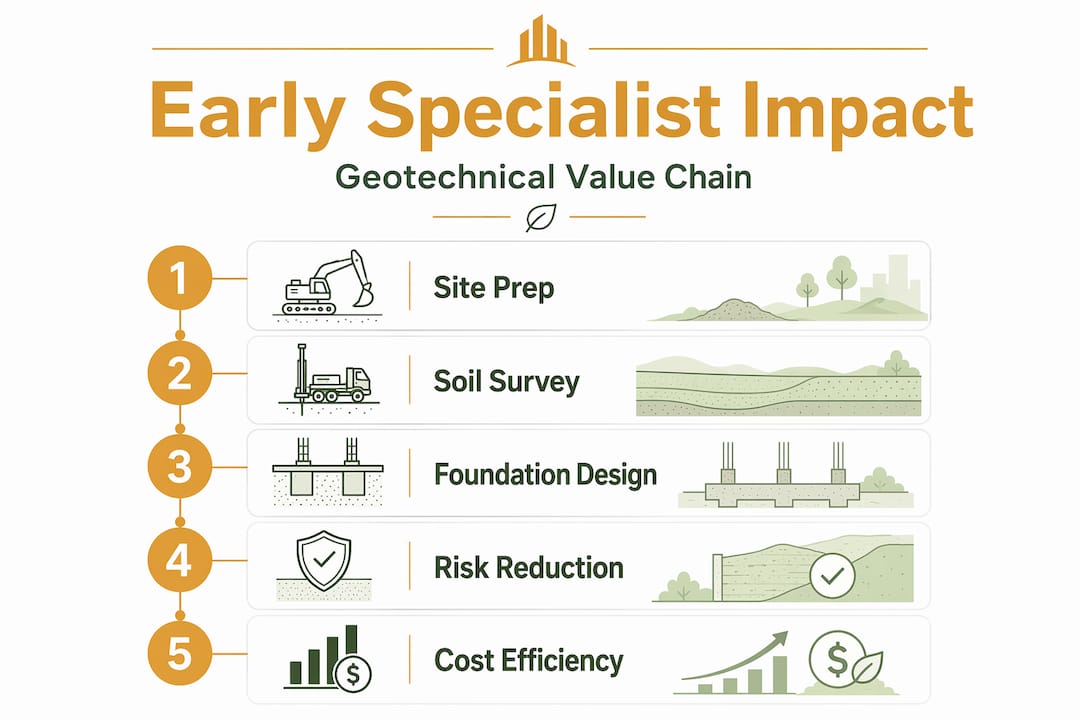
There is a persistent pattern across the Singapore construction market. Geotechnical work is procured late, scoped minimally, and tendered primarily on price. The result is site investigations that are technically compliant but commercially compromised, with borehole spacing too wide to detect localized problem zones and laboratory testing programs too limited to characterize consolidation behavior accurately.
This pattern reflects a misunderstanding of where geotechnical value actually lies. It does not lie in the soil report. It lies in the decision-making that good geotechnical data enables, decisions about pile type, pile length, excavation method, dewatering strategy, and monitoring intensity. When those decisions are made with poor data, the cost savings from the cheaper investigation are invariably recovered in construction problems, redesign fees, and schedule overruns.
Industry experts stress the overlooked value of early specialist engagement for both technical excellence and sustainability outcomes. That observation is particularly relevant in Singapore, where the BCA Green Mark scheme, the net zero construction goals, and the Urban Redevelopment Authority’s density requirements are collectively pushing projects toward greater underground development. Deeper basements, tighter excavation tolerances, and heavier structural loads all demand a higher standard of geotechnical input, not a minimal one.
The most successful projects we see in Singapore share a common characteristic: the geotechnical specialist has a seat at the design table from day one, participates in design reviews, and maintains technical oversight through to practical completion. Their geotechnical site investigations are not standalone documents filed with the authorities. They are living references that inform decisions across the full project lifecycle.
Technology will continue to expand the geotechnical toolkit, but it will not remove the need for experienced engineering judgment in interpreting ground behavior or communicating risk to project stakeholders. That judgment is the irreplaceable core of the role.
How Stellar Structures supports your geotechnical engineering needs
Stellar Structures provides specialized geotechnical consulting services designed for Singapore’s construction environment, where regulatory compliance and ground complexity demand technical precision from the earliest project stages.

Our geotechnical engineering consultant services support property developers and civil engineers through site investigation planning, foundation system advisory, PE Geo submissions, and construction-stage monitoring. We conduct and interpret site investigation services tailored to your project’s structural loads, site constraints, and regulatory requirements. Our integrated approach links geotechnical findings directly to civil and structural design checks, ensuring that foundation performance aligns with structural intent and BCA compliance standards. With Stellar Structures, developers and engineers have a single technical point of accountability across geotechnical and structural disciplines throughout the project lifecycle.
Frequently asked questions
What are the main responsibilities of a geotechnical engineer in building projects?
Geotechnical engineers conduct soil and site investigations, recommend appropriate foundation systems, monitor construction for ground safety, and ensure compliance with Singapore’s regulatory standards. Early specialist involvement is recognized as a critical factor in improving design outcomes and reducing construction risk.
Why is early involvement of geotechnical engineers critical in Singapore?
Singapore’s geologically variable ground conditions require informed foundation design decisions made early, before structural systems are committed to, to prevent costly construction problems and ensure that authority submissions meet BCA requirements.
What legal risks exist if soil investigations are outdated or inaccurate?
Developers and contractors face direct liability for construction failures and cost disputes if they rely on data not prepared for the specific project. Contractors and developers are required to satisfy themselves on actual ground conditions under Singapore law, making project-specific investigations a legal necessity.
How does geotechnical engineering contribute to sustainable building practices?
Accurate geotechnical data enables optimized foundation designs that reduce excess concrete and steel usage, directly lowering embodied carbon. Early engagement reduces whole-life carbon footprint of foundation systems, supporting Singapore’s broader net zero construction objectives.
Recommended
- When You Need a Geotechnical Engineering Consultant – Stellar Structures
- Structural vs Geotechnical Engineering – Stellar Structures
- Singapore Foundation Engineering Guide 2025: Geotechnical design, cost, and structural systems
- When is PE (Geo) Required During Construction?