




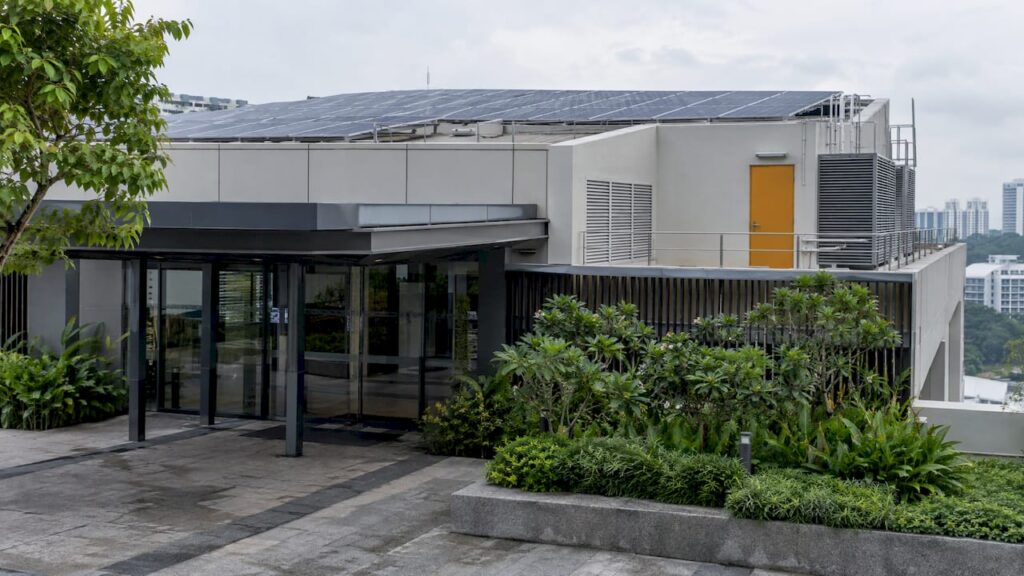
Green Mark is the Building and Construction Authority’s (BCA) national green building rating system, and for most projects in Singapore it is decided at design stage, not at the point of application. The energy, structural, façade, mechanical and electrical (M&E) and authority-submission decisions made early determine which tier a building can reach. This guide sets out what the scheme covers, how GM:2021 is scored, how the application runs, what is changing under Green Mark version 7.0, and how Green Mark compares with LEED.
TL;DR
- Green Mark has been Singapore’s national green building rating system since January 2005, covering new and existing buildings.
- Under GM:2021, energy efficiency is the base, and higher tiers (Gold PLUS, Platinum, Super Low Energy) depend on energy savings and on points from the sustainability sections.
- BCA gives a typical total of 4 to 6 months from application to award, and certificates issued after 1 April 2025 are valid for 3 years.
- Version 7.0 adds an energy-only pathway and portfolio certification, so check which version applies before you commit to a design brief.
- Because tiers are won in the design, structural, M&E and façade work and the authority submissions should be planned around the target rating from the first scheme.
Table of Contents
- What Green Mark certification covers
- When Green Mark is required
- Rating tiers and how GM:2021 is scored
- What a project team has to prepare
- The application and assessment process
- What is changing with Green Mark version 7.0
- Sustainable building materials and Green Mark
- Green Mark compared with LEED
- Examples of Green Mark design decisions that affect engineering
- Perspective
- Planning a Green Mark project with Stellar Structures
- FAQ
- Sources
What Green Mark certification covers
BCA launched the Green Mark Certification Scheme in January 2005 as a rating system that evaluates a building’s environmental impact and performance. It applies to new and existing buildings. Its public Green Mark Directory lists certified offices, homes, schools, hospitals and hotels with their ratings and key features, which is useful when a tenant, lender or investor asks how a comparable building was rated.
The current core scheme, Green Mark 2021 (GM:2021), took effect on 1 November 2021 after an April 2021 pilot, under the Singapore Green Building Masterplan. It applies to new and existing commercial, industrial, institutional and residential buildings. Its 2nd Edition has been effective since 1 January 2024. BCA describes it as tailored to the tropical climate and aligned with the UN Sustainable Development Goals, with added emphasis on maintainability, embodied carbon, smart technologies, climate resilience and healthier environments for building users.
BCA also runs specialised schemes for specific asset types:
- Green Mark for Data Centres (GMDC:2024), a joint scheme with IMDA covering energy performance, carbon efficiency, sustainable operations and digital innovation.
- Green Mark for Transit Stations (TS:2018), for new MRT and light rail stations.
- Green Mark for Districts, with a 5-year validity.
- Green Mark for Interiors (GMI), which unifies five earlier interior schemes.
A developer of a landed rebuild, an industrial owner extending a factory and a landlord retrofitting a commercial tower will therefore meet the scheme in different ways, but all of them are rated on the same logic: measured performance against a defined standard.
When Green Mark is required
Whether certification is mandatory depends on building type, gross floor area (GFA) and ownership, so confirm the threshold for your project with BCA before fixing the design brief. Two rules are worth knowing.
First, for existing buildings, GM:2021 applies to those undergoing major retrofitting that involves the building envelope and building services. Examples include adding or replacing chillers, adding or replacing 50% or more of all air-conditioning condenser units (or 50% or more of their installed capacity), or adding 5,000 sqm or more of GFA.
Second, the terminology in the regulations changed. The Building Control (Environmental Sustainability) (Amendment) Regulations 2025, in operation from 30 September 2025, replaced the term “Green Mark score” with “environmental sustainability score” in the 2008 Regulations. The earlier provisions continue to apply to building works whose planning permission application was submitted before that date. A project that was filed before and after that date can therefore sit under different wording, which a project team should confirm at the outset.
Rating tiers and how GM:2021 is scored
GM:2021 separates energy efficiency, which every project must address, from a set of sustainability sections that decide the tier. Published guidance on the standard gives the following structure.
The scoring allocates 30 points to each of the main sections, 20 points to Advanced Green Efforts and up to 15 points to specialised buildings. Platinum requires at least 70 points, Gold PLUS at least 60 and Gold at least 50, with Gold available only to In-Operation buildings already certified under a previous standard.
Energy thresholds sit alongside the points. Against the 2005 baseline, the same guide lists Gold PLUS at more than 50% energy savings, Platinum at more than 55% and Super Low Energy (SLE) at more than 60%. Against the current reference model including district cooling supply, the equivalent figures are 30%, 35% and 40%. For non-residential data centres and industrial buildings, fixed-metric pathways apply, such as Total System Efficiency of 0.8, 0.74 and 0.68 kW/RT.
| Tier | Points (GM:2021) | Energy threshold vs 2005 baseline |
|---|---|---|
| Gold | 50 or more (In-Operation buildings previously certified) | n/a |
| Gold PLUS | 60 or more | More than 50% |
| Platinum | 70 or more | More than 55% |
| Super Low Energy (SLE) | Energy-focused | More than 60% |
Gold PLUS and Platinum are comprehensive sustainability certifications, while SLE focuses solely on energy efficiency. Under Green Mark International, the Zero Energy and Positive Energy tiers are awarded only where SLE is reached and energy production equals or exceeds consumption: more than 100% from renewables for Zero Energy and more than 115% from onsite renewables for Positive Energy.
Older projects were assessed on five criteria: energy efficiency, water efficiency, environmental protection, indoor environmental quality and other green and innovative features. Those categories still describe the substance of what a building is judged on, even though GM:2021 reorganizes them.
What a project team has to prepare
The criteria translate into design deliverables. Teams commonly need the following before an application is credible:
- Energy model and specifications. BCA’s final assessment draws on documentary evidence such as energy models and specifications. The model is only as good as the design information behind it: envelope, air-conditioning plant, lighting and controls.
- Whole-life carbon information. GM:2021’s whole-life carbon section assesses embodied carbon, the use of sustainable construction or retrofit materials and tenancy fit-out practices.
- Resource stewardship. This section requires a plan toward building carbon neutrality by 2030 and encourages conserving buildings and recovering resources from demolished ones.
- Coordinated authority approvals. Green Mark sits next to, not in place of, the BCA, URA, SCDF, PUB, LTA, NEA and NParks submissions that a project needs anyway. A design change made to earn points, such as a thicker envelope, a rooftop solar array or a revised plant room, can trigger resubmission if it is not coordinated with those approvals.
Our article on BCA compliance for Singapore property projects sets out the approvals that run in parallel, and how BCA approval timelines run is worth reading before a rating target is added to a programme.
The application and assessment process
BCA’s published process follows a consistent order.
- Register. Applicants register on the Green Mark Online portal through CorpPass and submit project details and documents.
- Obtain owner endorsement. Where a consultant files the application, the building owner must endorse it.
- Pay the assessment fee. Fees are paid by bank transfer and vary by project type and scale, so no single figure applies.
- Optional pre-assessment. A pre-assessment can test the design before the final submission.
- Final assessment. BCA reviews the documentary evidence. Processing of a Provisional Letter or Certificate takes about six weeks.
- Award. BCA gives a typical total of 4 to 6 months for the whole process.
Verification follows in two stages. Stage 1 checks the functionality and performance of the green features through documentary evidence and site verification. Stage 2 applies only to Gold PLUS and Platinum non-residential projects with energy modelling, and requires 12 months of actual operation data to demonstrate the committed energy savings. A Platinum target therefore carries an obligation that continues after handover, which should be reflected in the M&E commissioning and metering design.
Validity and renewal
For projects receiving a provisional letter after 1 April 2025, BCA issues a Green Mark certificate valid for 3 years from issuance. Projects that received a letter of award before that date receive a Letter of Clearance, valid for 3 years from the letter of award or Temporary Occupation Permit (whichever is later) for new buildings, and 3 years from the letter of award for existing buildings.

What is changing with Green Mark version 7.0
BCA’s Green Mark Version 7 page describes the next refresh as a response to industry feedback. The announced changes include:
- An energy-only BCA Energy Rating pathway, so more existing buildings can certify on energy performance alone.
- Streamlined maintainability criteria, reduced by about 60%.
- Recognition of commercially viable alternative cooling technologies.
- Portfolio certification of similar buildings.
- A possible extension of validity from 3 to 5 years for sustained performers.
For an owner with several similar buildings, the portfolio route and longer validity change the economics of certification. For a project already in design, the practical question is which version applies at the time of application, and the project’s qualified persons should settle this before the energy model is frozen.
Sustainable building materials and Green Mark
Materials count in two places. The Singapore Green Building Product (SGBP) scheme certifies green building products, and SGBP-certified products are recognised under Green Mark and accrue points toward a project’s rating. Separately, the whole-life carbon section rewards lower embodied carbon and sustainable construction or retrofit materials.
Built examples show the direction. SMU Connexion is a Green Mark Platinum Zero Energy (on-site) building that predominantly uses mass engineered timber, with about 4,500 sqm of rooftop solar panels producing more than 560,000 kWh, covering 95% of its energy use, alongside natural ventilation and DfMA modular construction. Keppel Infrastructure @ Changi was the first building in Singapore to receive Green Mark Platinum Positive Energy certification under GM:2021, with over 4,000 sqm of photovoltaics yielding about 600,000 kWh a year, more than double its consumption.
Both cases carry a structural lesson. Mass engineered timber, rooftop arrays and modular systems change loads, connections and approvals. A material choice made for points has to be checked by the structural engineer before it is fixed in the design.

Green Mark compared with LEED
Green Mark and LEED are both green building rating systems, but they differ in origin and in how they are used locally.
| Criterion | Green Mark | LEED |
|---|---|---|
| Administered by | BCA, Singapore | An international rating system developed in the United States |
| Design basis | Tailored to the tropical climate and Singapore’s regulatory context | A general framework applied across many countries |
| Local role | Linked to Singapore regulations, the Green Building Masterplan and national incentives | Usually pursued where a multinational tenant or investor requires it |
| Ongoing obligation | Verification stage with 12-month operating data for Gold PLUS and Platinum non-residential projects | Set by the LEED version and track chosen |
For a project in Singapore, Green Mark is the scheme that aligns with BCA regulations, and the incentive programmes Singapore has published are tied to it. These include the S$20 million Green Mark Incentive Scheme for New Buildings, the S$100 million scheme for Existing Buildings and bonus gross floor area for higher-tier ratings. Where an international tenant also requires LEED, the design team should map the two sets of credits at concept stage, since many energy, water and materials measures serve both.
Examples of Green Mark design decisions that affect engineering
The following decisions recur in Green Mark projects and each one touches a regulated discipline:
- Rooftop photovoltaics. Require structural capacity checks, fire safety review and often coordination with the building’s roof waterproofing and access.
- Envelope upgrades and façade changes. Alter wind loads, thermal performance and, for older buildings, the periodic façade inspection regime.
- Chiller replacement. Triggers the retrofit threshold noted above and needs M&E design and authority coordination.
- Timber and prefabricated structures. Need structural design verification and, depending on scale, BCA structural submissions.
- Rainwater harvesting and water-efficient fittings. Involve PUB requirements alongside the Green Mark credit.
Older commercial stock raises its own questions, which we cover in retrofitting older commercial buildings for Green Mark certification, and the wider direction of the sector is discussed in the future of sustainable engineering in Singapore.
Perspective
Green Mark is often treated as a document exercise at the end of a project. In our experience of Singapore approvals work, the rating is earned or lost much earlier, when the structural scheme, the M&E strategy and the façade are still being decided.
That is why we align engineering design with the authority submissions from the start. Our team is led by a Professional Engineer with decades of experience in Singapore infrastructure, and we cover civil, structural, geotechnical and M&E engineering, architectural and interior design, and the submissions to BCA, URA, HDB, JTC, SCDF, PUB, LTA, NEA and NParks under one roof. A design that is feasible, cost-effective and approvable on the first pass leaves the project team free to concentrate on the rating itself.
For owners of existing buildings, periodic structural and façade inspections give the condition record that a retrofit or Green Mark upgrade should start from.
Aman
Planning a Green Mark project with Stellar Structures
Stellar Structures provides the engineering, design and submission services that sit around a Green Mark target: civil, structural and geotechnical engineering, M&E engineering design, architectural and interior design, façade design, and authority submissions across the statutory boards. We also carry out BCA periodic structural and façade inspections for existing buildings. Property owners, developers, contractors and architects can see the full range on our services page, and the façade design page covers envelope work that bears directly on energy performance.
For existing buildings, our structural and façade inspections page explains what the inspection regime involves before a retrofit is scoped.
FAQ
What are the requirements for Green Mark certification in Singapore?
Every project must meet the energy efficiency requirements of GM:2021, and the tier depends on additional points from the sustainability sections. Platinum needs at least 70 points and Gold PLUS at least 60, as published in guidance on the standard. Whether certification is mandatory for your project depends on its type, size and ownership, so confirm this with BCA.
How long does Green Mark certification take?
BCA gives a typical total of 4 to 6 months, with about six weeks to process a Provisional Letter or Certificate, as stated on its Green Mark scheme page. Fees vary by project type and scale. Gold PLUS and Platinum non-residential projects with energy modelling also need 12 months of operating data at the verification stage.
How long is a Green Mark certificate valid?
For projects receiving a provisional letter after 1 April 2025, the certificate is valid for 3 years from issuance. Earlier projects hold a Letter of Clearance with its own 3-year validity rule. BCA’s version 7.0 page notes that validity may extend to 5 years for sustained performers.
Is Green Mark better than LEED for a Singapore project?
Green Mark is the scheme built around Singapore’s climate, regulations and incentives, so it is the primary choice for projects here. LEED is usually considered when an international occupier or investor asks for it. Many measures serve both, so the credits can be mapped at design stage.
Sources
- Green Mark Certification Scheme, BCA
- Green Mark 2021, BCA
- Other Green Mark schemes, BCA
- Green Mark Verification, BCA
- Green Mark Version 7, BCA
- Building Control (Environmental Sustainability) (Amendment) Regulations 2025, Singapore Statutes Online
- Green Certification, Singapore, Global Sustainable Buildings guide
- Navigating the Singapore Green Mark 2021 Standard
- Green Mark International energy efficiency R2.1
- GM20 A Green Legacy, SGBC and BCA
- SMU Connexion, BCA e-publication
- Keppel Infrastructure @ Changi Green Mark Platinum Positive Energy
- Capitalising on Energy Efficiency in the Built Environment, Singapore
Recommended
- What Are The Requirements For Building Plan Submission In Singapore
- The Future of Sustainable Engineering in Singapore: Beyond Green Buildings