




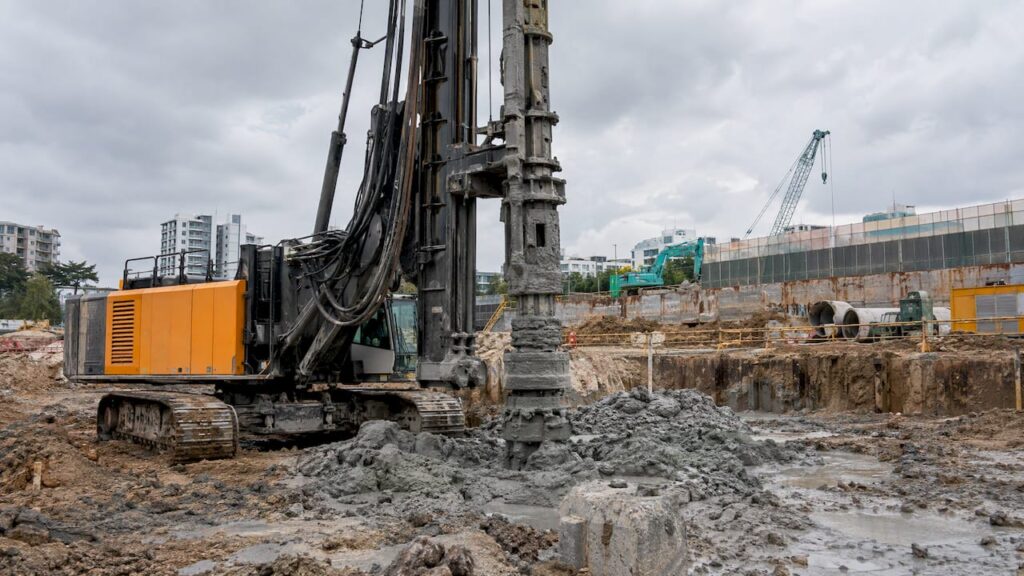
Ground improvement is the set of construction techniques that turn weak, compressible or water-bearing soil into a stable base for foundations, excavations and embankments. In Singapore, where marine clay, reclaimed land and dense urban sites meet strict authority rules, the right method depends on the soil, the site constraints and the approval route, and these three have to be settled together at the design stage. Stellar Structures advises property owners, developers and contractors on structural and geotechnical engineering and on the authority submissions that follow.
TL;DR
- Ground improvement methods fall into a few functional groups: consolidation, densification, reinforcement, soil mixing, grouting and load reduction. Each group suits particular soils.
- In Singapore, soft marine clay is typically treated with jet grouting or deep soil mixing, reclaimed clay with prefabricated vertical drains and surcharge, and clean granular fill with vibro compaction.
- Site constraints such as vibration limits, headroom, utilities and spoil disposal often decide between two technically valid methods.
- BCA guidance treats ground improvement as soil improvement only. It is not to be relied on as part of a retaining wall, and excavations deeper than 6 m fall into geotechnical building works with their own appointments and submissions.
- Settlement monitoring and before-and-after testing are part of the method, not an optional extra.
Table of Contents
- What ground improvement does and why projects need it
- The main ground improvement methods, grouped by function
- Matching the method to Singapore soil conditions
- Site constraints that decide between methods
- Design parameters, monitoring and verification
- Authority requirements in Singapore
- Our perspective
- Getting the engineering and submissions handled together
- FAQ
- Sources
What ground improvement does and why projects need it
Ground improvement modifies in-situ soil so that it can carry the loads a project places on it. The usual problems are low bearing capacity, excessive or slow settlement, liquefaction potential, slope instability and poor drainage. The techniques work by rearranging soil particles, controlling or removing groundwater, adding binding reagents or inserting stiffer elements into the ground, as Geo-Solutions summarizes.
The US Federal Highway Administration’s Ground Modification Methods Reference Manual lists the functions a treatment can serve: increasing shear strength and bearing resistance, increasing density, decreasing permeability, controlling deformation, speeding up drainage and consolidation, reducing imposed loads, providing lateral stability, improving resistance to liquefaction and transferring embankment loads to firmer layers. Naming the function before naming the method is the discipline that keeps a design coherent. “Stabilize the soil” is not a performance requirement. “Limit post-construction settlement of a slab to a stated value” is.
For a landed homeowner planning a rebuild or a basement, the question usually appears as a settlement or excavation problem. For a developer or contractor, it appears as a programme and cost problem on a larger footprint. Both readers benefit from the same starting point: the site investigation report.
The main ground improvement methods, grouped by function
The South Carolina DOT Geotechnical Design Manual (January 2022) organizes methods by what they achieve, which is a practical way to read the long lists found elsewhere. The table below follows that logic and adds the Singapore usage described in the ISSMGE state-of-the-practice report on ground improvement in Singapore.
| Function | Typical methods | How it works | Typical fit |
|---|---|---|---|
| Consolidation | Prefabricated vertical drains (PVDs) with surcharge or vacuum preloading | Drains shorten the drainage path so water leaves soft clay faster under load | Large reclamation and platform areas on soft clay |
| Densification | Vibro compaction, dynamic compaction | Vibration or impact rearranges loose particles into a denser state | Clean, granular soils |
| Reinforcement | Stone columns (vibro replacement), piles | Stiffer columns share load with the surrounding soil | Clayey and mixed soils |
| Soil mixing | Deep soil mixing (DSM), mass mixing | Binder, usually cement, is mechanically mixed into the soil | Soft marine clay, excavation bases |
| Grouting | Jet grouting, compaction grouting, permeation grouting | High-pressure jets cut and mix soil, or grout is injected into voids | Restricted headroom, utilities, localized treatment |
| Load reduction | Lightweight fill, geofoam, foamed concrete | Lower the weight placed on weak ground | Embankments and fills over soft soil |
Several of these overlap. Stone columns, for instance, both densify and reinforce, and many projects combine techniques. The ISSMGE report notes that ground improvement concepts draw on experience, local geology, available parameters, soil-structure interaction, strength and deformation criteria, schedule and equipment availability, and are often used in combination.
Consolidation: PVDs and surcharge
Soft clay releases water slowly, so settlement can continue for years. PVDs are installed in a grid and a fill surcharge is placed on top, which forces the water out faster. A pilot trial at the Pasir Panjang container terminal, reported in a GeoSS conference paper, tested two 50 m by 30 m clusters at 1.5 m and 1.0 m drain spacing. After about four months under full surcharge, surface settlement ranged from 1.13 m to 1.43 m across the two clusters. Settlement prediction methods became highly accurate once recorded data reached at least 60% consolidation.
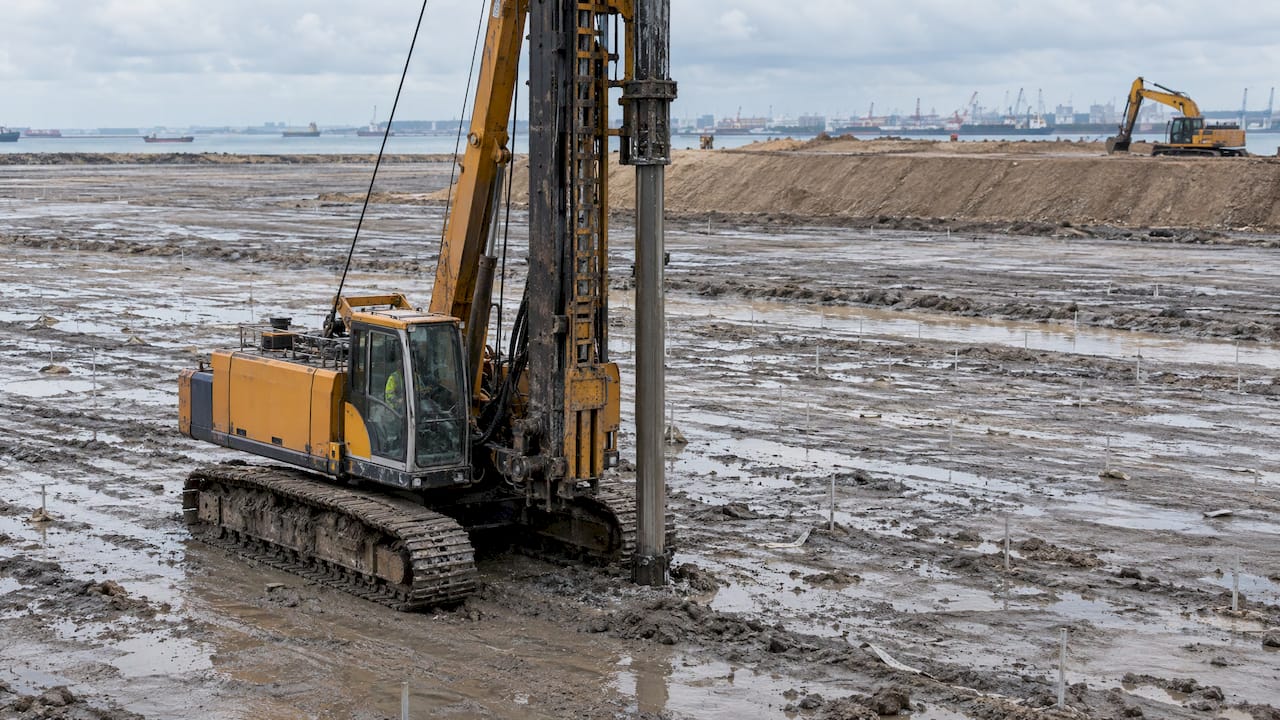
The lesson for any project is that consolidation treatments are time-driven. They suit sites where the programme can absorb a waiting period, and they require careful monitoring.
Densification: vibro compaction
Vibro compaction works on clean granular soil. The ISSMGE report points to fines content as the limiting factor: below 10% fines the method suits well-graded granular soils, and above that it is inhibited. Kirsch and Kirsch give the same limit, roughly 10% silt content, and note that feasibility rests on the soil and groundwater conditions recorded in the site investigation report.
Soil mixing and jet grouting
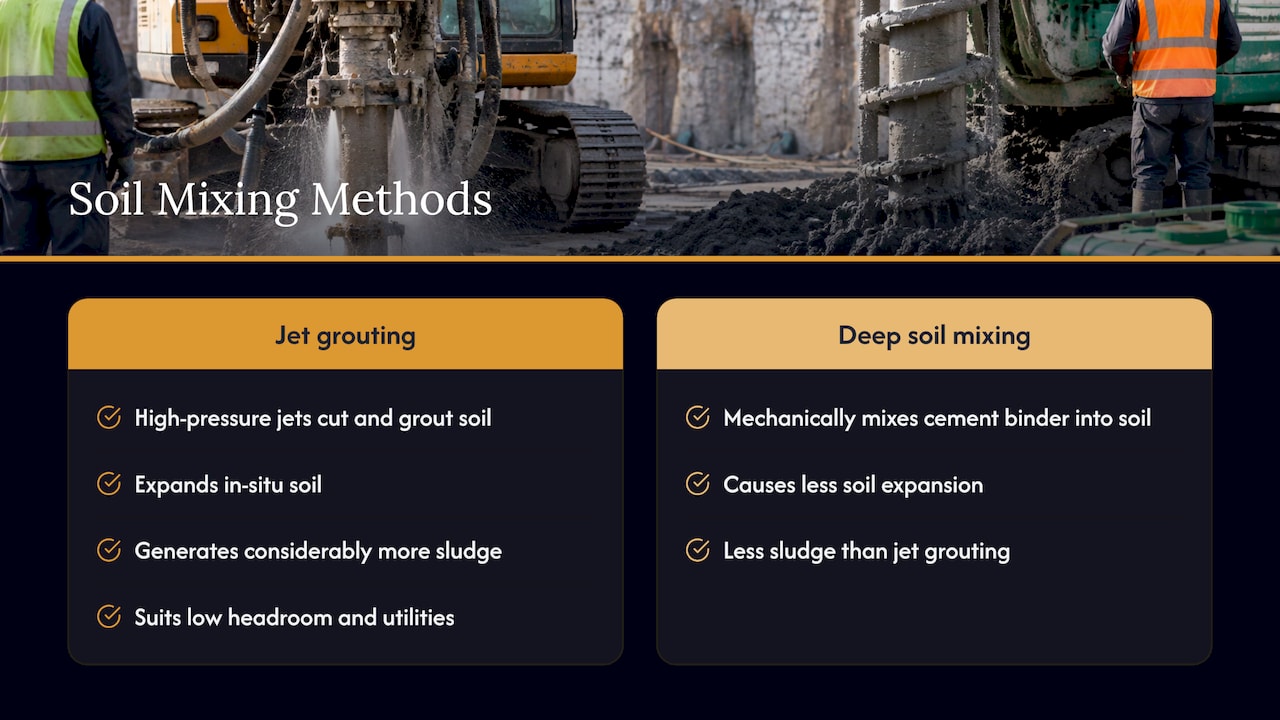
Jet grouting uses high-pressure jets to cut the soil and mix it with grout, while DSM mixes cement binder into the soil mechanically. In Singapore, jet grouting most commonly uses double and triple fluid systems to treat marine clay with a water content of 55% to 70% and shear strength of 10 to 40 kPa, according to the ISSMGE report. The resulting grout slabs or piles can act as horizontal reinforcement at the base of an excavation or as vertical bearing elements under structures.
The same report records that DSM has become a popular alternative in Singapore. Jet grouting’s high-pressure injection can expand the in-situ soil and generates considerably more sludge, whereas DSM causes less expansion. Jet grouting remains the choice where height restrictions or underground utilities require lower equipment height and inclined application. Cement is generally preferred to lime, since storing unslaked lime is problematic in Singapore’s hot, humid weather.
For a plain-language treatment of how these methods meet local ground, see our article on soil improvement for Singapore’s challenging ground.
Matching the method to Singapore soil conditions
Singapore’s ground varies sharply over short distances: old alluvium, the Kallang Formation with its marine clay, and reclaimed land. Each calls for a different logic.
- Soft marine clay. Low strength and high water content make it the classic target for DSM or jet grouting when a stiff base or bearing element is needed. Homeowners dealing with long-term movement on such ground can read our guide to Singapore marine clay and property settlement.
- Reclaimed land over soft clay. PVDs with surcharge accelerate consolidation, as in the container-port example above.
- Loose, clean sand fill. Vibro compaction is the efficient option, provided fines stay under about 10%.
- Mixed or silty fills. Stone columns or mixing methods are more likely, because compaction alone loses effect as fines increase.
These are starting points, not conclusions. A borehole log and laboratory tests decide, and the numbers quoted above describe typical Singapore marine clay, not any particular plot.
Site constraints that decide between methods
Two methods can be technically valid for the same soil. The tie is usually broken by the site. Han’s textbook Principles and Practice of Ground Improvement names the recurring factors: groundwater level, vibration, noise, traffic, water pollution, deformation of existing structures, spoil and headspace.
In practice for Singapore projects:
- Vibration and noise. Dynamic compaction is a poor match next to occupied homes. Landed estates and conservation areas often rule it out.
- Headroom and utilities. Jet grouting’s lower equipment height and inclined application are why it persists in basements, existing buildings and corridors crowded with services.
- Spoil. Wet stone-column methods and jet grouting produce spoil that must be stored and disposed of. On a small plot, a dry method or DSM may be the only workable choice.
- Neighboring structures. Preloading induces settlement that can damage nearby buildings, so it needs distance or a buffer.
- Groundwater. The water table affects almost every option, from mixing quality to the need for dewatering.
The FHWA manual frames the decision as a feasibility evaluation. Teams identify the project conditions needing modification, set performance requirements, assess time, space and environmental constraints and site conditions, identify technology limits, and then consider alternatives such as relocation, deep foundations, removal and replacement, or designing the structure to tolerate the poor ground. That last list is a useful check: ground improvement competes with foundation design, and the structural and geotechnical engineers should evaluate them together.
Developers appraising land, including a white site in Singapore, benefit from commissioning that comparison early, because the choice between improving the ground and deepening the foundation feeds directly into basement depth, cost and the retaining system.
Design parameters, monitoring and verification
Improved ground is only as good as the parameters used to design it and the evidence collected afterwards. The ISSMGE report notes that consolidation parameters can come from laboratory tests, in-situ tests or back-calculation from field measurements, and that settlement should always be monitored during ground improvement works.
Three verification practices recur on well-run projects:
- Pilot trials. The container-port paper describes pilot tests used to determine PVD type, spacing, installation depth and surcharge duration, and to check whether the rig and mandrel suit the ground.
- Before-and-after testing. Comparing undrained strength, moisture content and pre-consolidation pressure before and after treatment shows what the improvement achieved.
- Back-analysis. Monitored excavations can be re-analyzed to refine parameters. A 2019 chapter by Pittaro applies this to a monitored tunnel boring machine shaft in Singapore and notes that different regional codes define ground improvement properties differently.
The FHWA manual also lists general limitations worth planning around: no simple, universally reliable design procedures, performance criteria that are often undefined, uncertainty about long-term performance, and limited availability of equipment and experienced personnel. Defining acceptance criteria in the specification before work starts addresses most of these. For excavations, our note on deep excavation monitoring in Singapore explains what monitoring looks like once works pass the 6 m mark.
Authority requirements in Singapore
Ground improvement itself is rarely a standalone approval. It becomes regulated when it sits inside works the Building Control Act classes as geotechnical building works. The Building Control Act 1989 defines these to include:
- tunnels wider than 2 m;
- works to make caissons, cofferdams, trenches, ditches, shafts or wells deeper than 6 m, and earth-retaining works in or for them;
- slopes higher than 6 m;
- prescribed foundation works for buildings of 30 or more storeys.
Where an excavation or earth retaining and stabilizing structure (ERSS) falls in this category, BCA’s geotechnical building works submission requirements apply. These cover the appointment of qualified persons for structural and geotechnical design, supervision by accredited checkers, a site investigation report certified by a Professional Engineer, a permit to commence work, and monthly ERSS submissions during construction. BCA’s guidance also treats ground improvement as soil improvement work only: it is not to be relied on as part of a retaining wall, and where grout-mixed piles sit within a wall, bending moments and shear forces must be resisted by a separate structural system. Confirm current wording with your appointed qualified person before fixing a design, because circulars are updated.
For the wider picture, see our pages on ERSS design for excavation works, ERSS submissions for landed-house basements, the earthworks approval process and BCA compliance for property projects.
Our perspective
Most ground improvement problems we are asked about are decided before the first rig arrives. The method is chosen from the soil log, but it is justified by the constraints: the neighbor’s wall two meters away, the utility corridor, the headroom, the approval route. When these are weighed together, the design tends to be simpler.
Our team is led by a Professional Engineer with decades of experience in Singapore infrastructure, and our work spans structural, geotechnical, civil and M&E engineering as well as the authority submissions that follow. We value having the engineering and the submission handled in one place, because the retaining wall, the ground treatment and the BCA appointments depend on each other and are best coordinated from the outset.
Our approach is to define the performance requirement first, select the method that meets it within the site’s limits, and plan the monitoring that will show it has worked. That keeps solutions feasible and cost-effective, and it keeps the submission straightforward.
Aman
Getting the engineering and submissions handled together
Stellar Structures provides structural and geotechnical engineering consultation, C&S engineering, structural design checks and authority submissions to BCA, URA, HDB, JTC, SCDF, PUB, LTA, NEA and NParks for residential, commercial, industrial and infrastructure projects in Singapore. For a landed rebuild, an additions and alterations project with a basement, or a developer’s site on soft ground, one engaged team can take the ground question from site investigation through to the approval.
The full list of services is on our services page.

FAQ
What are the main methods of ground improvement?
The main groups are consolidation (PVDs and surcharge), densification (vibro and dynamic compaction), reinforcement (stone columns), soil mixing, grouting (jet, compaction and permeation) and load reduction using lightweight fill. Each is suited to particular soil types and constraints, and many projects combine two of them.
Which method is most used on Singapore’s marine clay?
The ISSMGE report describes jet grouting and deep soil mixing as the main treatments for soft marine clay, with DSM increasingly popular because it expands the soil less and produces less sludge. Jet grouting is still preferred where headroom is restricted or utilities are present.
Is ground improvement the same as ground stabilization or soil improvement?
The terms are used almost interchangeably in practice. Ground improvement is the broader term in geotechnical literature, covering compaction, drainage, reinforcement, mixing and grouting, while soil stabilization often refers to adding binders such as cement.
Does ground improvement need BCA approval in Singapore?
It depends on the works it supports. Excavations and retaining works deeper than 6 m are geotechnical building works under the Building Control Act and carry specific appointments and submissions. BCA guidance also does not allow ground improvement to serve as part of a retaining wall, so your qualified person should confirm the route for your site.
How do I know the treatment worked?
Settlement is monitored during the works, and soil properties such as undrained strength and moisture content are compared before and after treatment. Pilot trials on larger sites help set the design before full-scale installation.
Sources
- Ground Improvement, Geo-Solutions
- Ground Modification Methods Reference Manual, Volume I, FHWA
- State-of-the-Practice in Ground Improvement in Singapore, ISSMGE
- Chapter 19 Ground Improvement, SCDOT Geotechnical Design Manual
- Geotechnical Aspects of Container Port Development, GeoSS10 paper
- Ground Improvement by Deep Vibratory Methods, Kirsch and Kirsch
- Principles and Practice of Ground Improvement, Han, 2015
- Selection of ground improvement parameters from back-analysis, Pittaro, 2019
- Building Control Act 1989, Singapore Statutes Online