





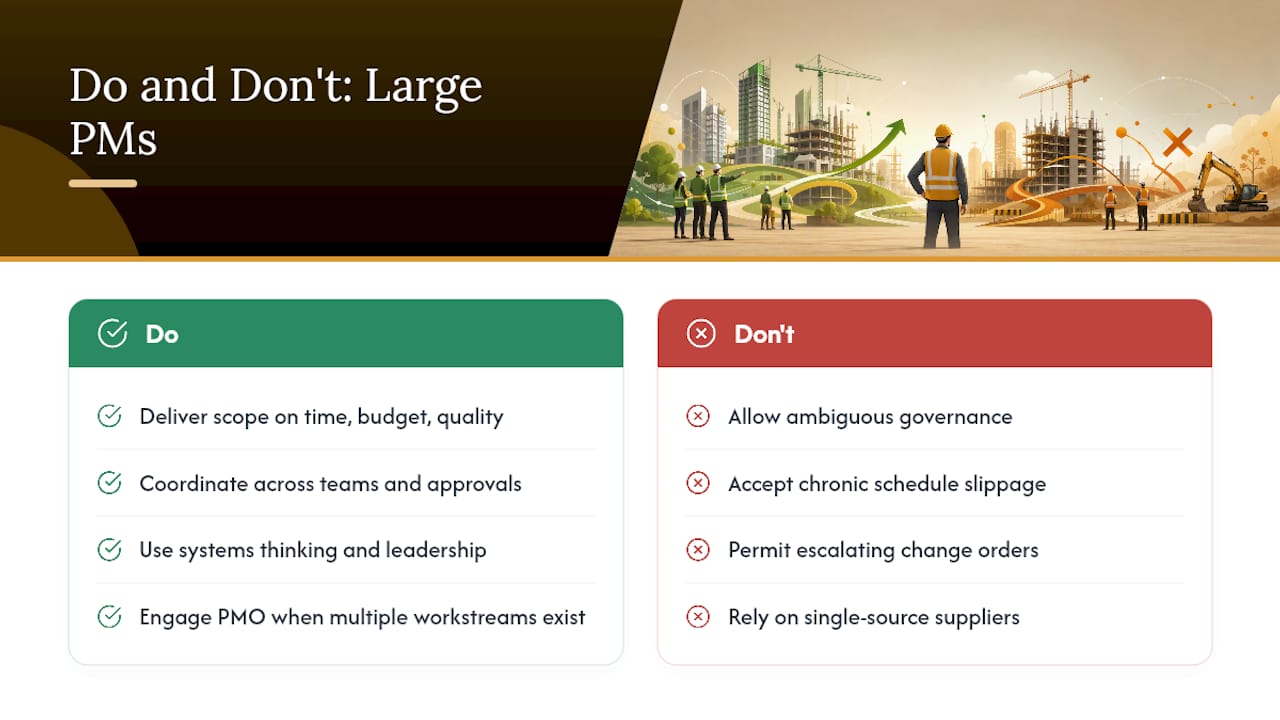
The project manager’s core mandate on a large development is singular: deliver the defined scope on time, on budget, and to specified quality across every team working the program. That sounds simple until the project spans multiple contractors, several authority approvals, and a schedule measured in years, not months. The Project Management Institute (PMI) frames the role around organization, leadership, and communication, but on large-scale developments those skills scale into program-level governance. Research from McKinsey and case analyses published through PMI back this up with practitioner data, and Stellar Structures sees it firsthand on every multi-discipline engagement it supports.
Six responsibilities define the job on large developments:
- Scope control — locking the deliverable and managing every change against it
- Schedule and critical-path management — protecting the sequence that actually drives the completion date
- Budget and cost control — forecasting spend before it becomes a variance
- Resource and procurement coordination — securing labor, materials, and long-lead items before they become bottlenecks
- Stakeholder communication and governance — keeping sponsors, authorities, and contractors aligned on decisions
- Risk and change management — anticipating disruption instead of reacting to it
Key Takeaways
The project manager’s role on a large development is to convert scope, schedule, and budget discipline into a governance structure that survives unforeseen risk.
| Point | Details |
|---|---|
| Six core duties | Control scope, schedule, budget, resources, stakeholder communication, and risk in parallel, not sequence. |
| Governance beats heroics | Clear decision rights and escalation paths outperform individual effort on mega-programs. |
| Leadership scales with size | Systems thinking and stakeholder leadership matter more as team count grows. |
| Red flags compound quietly | Track critical-path slippage, change-order rate, and contingency drawdown to catch problems early. |
| Specialists reduce PM load | Design checks and authority submission packages cut rework and approval delays. |
Table of Contents
- The Role of a Project Manager on Large Development Projects
- How the Project Manager’s Job Changes on Mega and Multi-Team Programs
- Leadership Skills That Separate Good PMs From Great Ones on Big Builds
- Who Owns What: Project Manager, Program Manager, PMO, and Sponsor
- Common Pitfalls and Red Flags on Large Development Projects
- How Specialist Firms Support the Project Manager’s Workload
- Governance First, Everything Else Follows
- Frequently Asked Questions
- Sources
The Role of a Project Manager on Large Development Projects
Every one of those six responsibilities requires its own operating rhythm, and on a large development, informal tracking fails fast.
Scope definition and change control starts with a scope register that names every deliverable and excludes what’s out of bounds. Changes get routed through a formal change-control board, not a hallway conversation. Schedule baseline and critical-path control means establishing a baseline schedule early and tracking variance weekly, not monthly, because on a multi-team program, a two-week slip in structural steel can cascade into a four-week slip in fit-out.
Cost forecasting relies on earned-value management (EVM) reports that compare planned value against actual cost, catching overruns while there’s still time to correct course, supported by advanced project planning and AI tools described in the Buildberry blog. Resource planning and procurement coordination produces a long-lead tracker that flags equipment and materials with order windows exceeding standard delivery, a category that includes M&E plant, structural steel, and facade systems.
Stakeholder engagement depends on a documented RACI matrix so everyone knows who’s accountable versus who’s merely consulted, paired with a reporting cadence the sponsor actually reads. Integrated risk and change management requires a live risk register with named owners for each response, reviewed on a fixed schedule rather than only after something goes wrong.
Pro Tip: Require a one-page dashboard combining schedule variance, cost variance, and top five risks. If a report takes longer than five minutes to read, nobody on the sponsor side will read it consistently.
Coordinating developers, designers, and contractors around a shared scope document prevents most of the disputes that surface later as claims.
How the Project Manager’s Job Changes on Mega and Multi-Team Programs
A single-building project manager makes most decisions directly. On a large development, that same person becomes one node in a decision network spanning multiple project teams, a program manager, and an executive sponsor. Coordination shifts from managing tasks to aligning teams that each run their own schedules and budgets. Decision authority narrows, governance involvement expands, and resilience planning becomes a formal exercise rather than an afterthought.
The PMI framework for managing large complex projects, built on an analysis of 60 capital projects across four continents, found that large projects follow distinct trajectories from front-end shaping through execution, and that institutional structure, technical complexity, and sponsor competence determine which trajectory a project actually follows.
Large capital projects often face multiple unforeseen risks capable of threatening viability. The ones that survive tend to have strong sponsors, a wide range of strategic responses ready, and the flexibility to restructure when conditions shift.
Pro Tip: Build restructuring options into the governance charter before mobilization, not after the first crisis. Resilience is a planning decision, not an improvisation.
Leadership Skills That Separate Good PMs From Great Ones on Big Builds
Technical competence gets a project manager in the room on a large development. Leadership keeps the program on track. McKinsey’s research, based on interviews with 27 practitioners running ultralarge projects, distilled four mind-sets and eight leadership practices that consistently improve delivery outcomes.
The essential skill set includes:
- Systems thinking, to see how a delay in one workstream ripples into others
- Stakeholder leadership, to hold alignment across sponsors, authorities, and contractors
- Commercial acumen, to read contracts and cost implications quickly
- Schedule and cost control discipline, applied without becoming rigid
- Integrated risk thinking, treating risk as a living process rather than a one-time exercise
- Negotiation and conflict resolution, since disputes are routine, not exceptional
- Adaptive decision-making, especially during front-end shaping when information is incomplete
Pro Tip: Run a monthly cross-team alignment workshop even when nothing is visibly wrong. The practice of surfacing friction early is what the McKinsey research links to stronger delivery, not any single tool or template.
Who Owns What: Project Manager, Program Manager, PMO, and Sponsor
Confusion over authority is one of the fastest ways to stall a large development. Roles need explicit boundaries, not assumed ones.
- Project manager — owns day-to-day execution of a defined scope, schedule, and budget within one workstream
- Program manager — oversees multiple project managers, aligns interdependent schedules, and owns program-level risk
- PMO (project management office) — standardizes templates, reporting formats, and governance processes across the program
- Sponsor/executive — holds funding authority, resolves escalations, and owns the business case
- Contractor integration lead — ensures subcontractor and design-build teams report into the same governance structure
Before signing a charter or a major contract, confirm five governance items:
- Decision rights for each authority level, documented in writing
- Escalation paths with defined response timeframes
- Performance metrics the sponsor will actually review
- Funding authority limits at each tier
- Change-control thresholds that trigger board review versus PM-level approval
Governance research from PM World Journal identifies clear allocation of responsibility and strong sponsor engagement as the single biggest differentiator between mega-programs that succeed and those that stall in accountability disputes. As the program scales, resourcing flexibility matters too: a project that starts with a single PM often needs a PMO or a dedicated program manager layered in once the team count crosses a handful of concurrent contracts.
Common Pitfalls and Red Flags on Large Development Projects
Problems on large developments rarely appear suddenly. They accumulate quietly until they can’t be ignored.
Watch for these six warning signs:
- Ambiguous governance, where two parties both believe they hold decision authority
- Chronic schedule slippage against the critical path, even in small increments
- Escalating change orders that outpace the approved contingency
- Single-source dependencies on one supplier or subcontractor for a critical path item
- Poor stakeholder alignment, visible as conflicting instructions from different sponsors
- Weak contract administration, where claims pile up because paperwork lagged the work
For each, the fix has two speeds:
- Immediate (48 to 72 hours): Call a governance clarification meeting, escalate the slippage to the sponsor with a recovery plan, freeze non-critical change orders, or activate a backup supplier conversation.
- Medium-term: Rewrite the charter to close the authority gap, rebaseline the schedule with buffer, tighten the change-control approval chain, or diversify the supply base.
Track slippage against critical path, change-order rate as a percentage of contract value, and contingency drawdown rate. All three tend to move together before a program visibly derails.
How Specialist Firms Support the Project Manager’s Workload

A project manager on a large development doesn’t work in isolation, and the strongest programs lean on specialist design and engineering partners to absorb technical risk before it reaches the critical path.
Support typically includes:
- Civil and structural design checks that catch errors before construction, not during it
- Authority submission packages that anticipate BCA, URA, or SCDF review comments
- Integrated design coordination across architectural, structural, and M&E disciplines
- Façade and building inspections that verify compliance mid-construction
- Specialist technical reviews for complex geotechnical or structural conditions
- Procurement support for long-lead items requiring early technical sign-off
A structural design-check package, for example, lets a PM submit for authority approval with confidence instead of absorbing a rejection cycle mid-schedule. Engage specialists early, during front-end shaping or pre-tender verification, and insist the scope of services explicitly names deliverables and review turnaround times.
Governance First, Everything Else Follows
If a large development gets one thing right before mobilization, it should be governance clarity, because resilience planning depends on knowing who decides what before a crisis forces the question. Run a two-hour governance alignment workshop with the sponsor, program manager, and PMO before the first contract is signed.
Frequently Asked Questions
What is the main role of a project manager on a large development project?
The project manager’s main role is delivering the defined scope on time, on budget, and to quality standards while coordinating across multiple teams, contractors, and authority approvals.
How does the project manager role differ between small and large projects?
On small projects, the PM makes most decisions directly. On large developments, the PM operates within a governance structure alongside a program manager, PMO, and sponsor, with decision authority distributed across defined tiers.
What skills matter most for managing large development projects?
Systems thinking, stakeholder leadership, commercial acumen, and adaptive decision-making consistently separate strong PMs from average ones on ultralarge projects, according to McKinsey’s practitioner research.
What are the biggest red flags a project manager should watch for?
Ambiguous governance, chronic schedule slippage, escalating change orders, and single-source supplier dependencies are the earliest and most reliable warning signs of a program heading toward trouble.
When should a large development bring in a program manager or PMO?
Once a project scales beyond a single workstream into multiple concurrent contracts or teams, a PMO or dedicated program manager becomes necessary to standardize reporting and resolve cross-team conflicts.
Sources
- The art of project leadership: Delivering the world’s largest projects (McKinsey)
- What is a project manager (PMI)
- Governance of Mega and Giga Programs (PM World Journal, Prieto)
Recommended
- Checklist for Developers Contractors Choosing the Right QP S and Supervision Team for Your Next Build in Singapore
- Why Constructability Review Is Important for Your Project
- Engage Er Aman Aboobucker: Your Project’s QP’s Step-by-Step Onboarding
- Beyond Construction: Designing for Safe Maintenance and Facility Management