




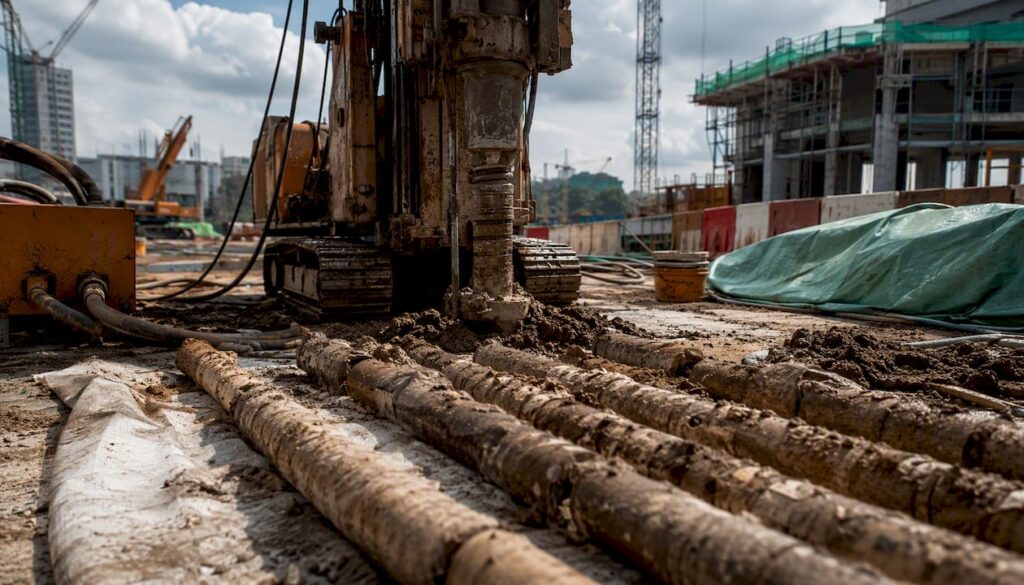
A compliant Ground Investigation Report (GIR) is a single, evidence-backed document that records field work, laboratory test results, interpreted geotechnical design parameters, and the professional endorsement required to commence foundation design. Under Singapore’s regulatory framework, the GIR and its companion Geotechnical Design Report (GDR) together form the technical basis for geotechnical design to Eurocode 7, and designers must justify the rationale for every characteristic ground value they adopt.
Before commissioning or accepting a report, confirm these mandatory items are present:
- Executive summary with site description, scope, and key findings
- Borehole or CPT logs with coordinates, ground levels, termination depths, lithology, and SPT N-values
- Laboratory test results with raw data sheets and calibration certificates
- Interpreted design parameters (bearing capacity, settlement estimates, shear strength, groundwater table)
- Limitations section stating the extent and confidence of the investigation
- Professional endorsement by a qualified geotechnical engineer
- Electronic AGS(SG) file and PDF submission in the prescribed BCA naming convention
On receipt of a draft report, take three immediate steps: (1) verify the professional endorsement and confirm the scope matches the project brief; (2) check that the AGS(SG) electronic file, PDF, AGS checker log, and GI report declaration page are all present with correct file naming; (3) flag any missing raw lab data or absent chain-of-custody statements before the report proceeds to design.
Pro Tip: Request a preliminary field log review after the first two boreholes are completed. Catching unexpected strata early lets you adjust the investigation program before the full mobilization cost is committed.
Key Takeaways
A compliant GIR must include complete field logs, accredited laboratory data, a passing AGS(SG) electronic file, a signed professional endorsement, and explicit design parameters with derivation rationale before it is accepted for foundation design.
| Point | Details |
|---|---|
| Complete field and lab data | Every borehole log, SPT record, and lab sheet must be present with chain-of-custody documentation. |
| AGS(SG) electronic package | Submit PDF GIR, AGS file, AGS checker log, and signed declaration page in BCA’s prescribed naming convention. |
| Professional endorsement | The GIR must carry the seal of a qualified geotechnical engineer who supervised the investigation. |
| Explicit design parameters | Bearing capacity, settlement estimates, and shear strength values must reference the specific test data from which they were derived. |
| Stellar Structures | Provides integrated SI planning, GIR preparation, AGS packaging, and BCA authority submission as a single engagement. |
Table of Contents
- What a soil investigation report must contain — section-by-section checklist
- How to plan the field and laboratory program before investigation begins
- Which standards and codes should the report reference?
- How to read key findings: design parameters and what they mean
- Typical timeline and cost drivers for a Singapore soil investigation
- Who should prepare and sign the report — credentials and responsibilities
- Common errors, omissions, and red flags in submitted reports
- What a professional geotechnical consultant delivers — workflow and deliverables
- Why a thorough soil investigation report protects your project
- Stellar Structures supports your soil investigation and authority submission needs
- Sources
What a soil investigation report must contain — section-by-section checklist
The structure of a GIR follows a logical sequence from project context through to design recommendations. BCA’s guidelines on SI report requirements set out mandatory content in Annex A through Annex E, covering minimum requirements, good practices, borehole log format, geophysical reporting, and material codes. Every section below corresponds to a required component.
| Report Section | What It Must Include | Immediate Query Trigger |
|---|---|---|
| Executive summary | Site address, scope, key strata, critical parameters, and main recommendations | Missing design parameters or absent scope statement |
| Scope of works | Investigation objectives, standards referenced, and limitations of the program | No reference to SS EN 1997-2 or BCA guidance |
| Site description | Location plan, site history, existing structures, utilities, and access constraints | No historical map or utility record |
| Desk study | Previous SI data, geological maps, nearby construction records, and known hazards | Absent or one-paragraph desk study on a complex site |
| Field methods | Borehole or CPT method, rig type, drilling fluid, sampling intervals, and SPT procedure | No description of SPT hammer energy or rod length correction |
| Borehole/CPT/SPT logs | Borehole ID, coordinates, ground level, termination depth, lithology, SPT N-values, sample recovery, groundwater strikes | Missing sample recovery percentages or groundwater data |
| Laboratory test results | Test type, sample ID, depth, raw data sheets, and calibration certificates | Absent calibration certificates or missing raw sheets |
| Interpreted parameters | Characteristic unit weight, phi/c’, undrained shear strength, allowable bearing pressure, settlement estimates | Parameters stated without derivation rationale |
| Design recommendations | Foundation type, depth, bearing capacity, settlement limits, earthworks, dewatering | Generic recommendations not tied to specific strata |
| Limitations | Spatial coverage, seasonal groundwater variation, untested zones, and data confidence | No limitations section at all |
| Appendices | Raw lab data, photolog, calibration records, monitoring data, AGS(SG) file reference | Appendices listed but not attached |
Each borehole log must carry, at minimum: a unique borehole ID, easting and northing coordinates, reduced level at collar, total depth, water strike depth, and a column-by-column record of lithology, SPT N-values at 1.5 m intervals, sample type, and recovery percentage. Published sample SI reports demonstrate how SPT results, thin-walled tube sampling, Atterberg limits, particle size, UU triaxial, and direct shear tests are presented alongside borehole logs to support foundation design.
Raw laboratory data sheets should appear in a dedicated appendix, not embedded in the body text. Each sheet must reference the sample ID, depth, and test date, and must be traceable to the chain-of-custody record.
A GIR that presents interpreted parameters without the underlying raw data and derivation logic cannot be independently verified. Reviewers at BCA and design teams alike will request the raw data before accepting the report for design use. Submitting a complete, traceable package from the outset eliminates that cycle entirely.
How to plan the field and laboratory program before investigation begins
Thorough preparation before mobilization determines whether the delivered GIR contains the data the design team actually needs. The sequence below applies to most Singapore building projects.
-
Conduct the desk study. Collect geological survey maps, previous SI reports for adjacent sites, utility records, and any available as-built drawings. Under Regulation 31, the Design Qualified Person must carry out a proper desk study as the first step of a compliant site investigation program.
-
Define investigation objectives. Specify the foundation type under consideration (pad, raft, pile), the anticipated loads, any basement or excavation depth, and the groundwater sensitivity of the design. These objectives drive every subsequent decision.
-
Plan borehole and CPT layout. For a simple urban lot, a minimum of three to four boreholes at corners and center is typical. Complex sites with variable fill, nearby deep excavations, or suspected soft marine clay require closer spacing. Depth should reach competent bearing stratum plus at least 5 m, or to refusal on rock, whichever governs.
-
Select test types and sample categories. Specify undisturbed samples (thin-walled Shelby tubes or piston samplers) for soft cohesive layers and disturbed SPT split-spoon samples for granular zones. Identify which strata require consolidation tests, triaxial shear, or pressuremeter testing.
-
Prepare the scope of works document. Issue a written brief to the SI contractor covering borehole locations, target depths, sampling intervals, SPT frequency, groundwater monitoring requirements, and the required AGS(SG) electronic data format.
-
Execute field work and enforce chain of custody. Each sample must be labeled immediately on extraction with borehole ID, depth, and sample number, sealed to prevent moisture loss, and transported in a padded sample box. Clear sampling instructions and documented chain-of-custody procedures materially affect the reliability of laboratory results.
-
Submit samples to an accredited laboratory with a test schedule. Provide the lab with a completed submission form specifying sample ID, depth, test type, and required turnaround. Matching submission instructions to the project’s specific soil conditions, rather than using a generic test package, produces more relevant results.
-
Conduct an interim data review. After the first round of borehole logs and preliminary lab results are available, the geotechnical engineer should review the data before the remaining boreholes are completed. This step allows the investigation program to be adjusted if unexpected strata are encountered.
-
Compile and interpret the full dataset. Once all field and laboratory data are received, the geotechnical engineer derives characteristic values, prepares the interpreted parameter table, and writes the design recommendations.
-
Assemble the GIR and electronic submission package. The final report must include the PDF GIR, AGS(SG) data file, AGS checker log, and GI report declaration page, all named in accordance with BCA’s prescribed convention.
Pro Tip: Stage the investigation in two phases for large or complex sites. Phase 1 covers the full footprint at wide spacing to identify major strata variations. Phase 2 targets specific zones identified as critical, concentrating resources where the design risk is highest.
Key decisions that reduce cost without sacrificing data quality:
- Combine SPT with undisturbed sampling in the same borehole rather than drilling separate holes
- Use CPT for continuous profiling in soft ground and reserve boreholes for sampling and lab testing
- Specify standard lab turnaround (five to ten working days) unless a critical path deadline requires express processing
- Limit pressuremeter or vane shear tests to strata where standard SPT or triaxial data are insufficient for design
Which standards and codes should the report reference?
A compliant GIR cites the standards that governed the investigation program, the testing methods, and the derivation of design parameters. Reviewers at BCA and design QPs will check these references against the methods described in the report.
- SS EN 1997-2 (Eurocode 7 Part 2): The primary standard for planning and reporting ground investigations in Singapore. It covers field and laboratory test selection, interpretation of results, and derivation of geotechnical parameters for design. Every GIR prepared for a Singapore building project should cite this standard.
- SS EN 1997-1 (Eurocode 7 Part 1): Governs geotechnical design, including the determination of characteristic values and the application of partial factors. The GDR, which draws on the GIR, must demonstrate compliance with this standard.
- BCA Guide on Ground Investigation and Geotechnical Characteristic Values to EC7: Provides Singapore-specific guidance on how to apply Eurocode 7 to local ground conditions, including the derivation of characteristic values and the relationship between GIR and GDR content.
- BCA Circular on Guidelines for SI Report Submission: Sets the mandatory submission format, file naming convention, and Annex A through E content requirements. A valid citation in the report reads as “prepared in accordance with BCA Guidelines on Requirements for Site Investigation Reports.”
- AGS(SG) Data Format Standard: Specifies the electronic data transfer format for borehole logs and laboratory results. The AGS checker log confirms the file passes validation before submission.
- BS 5930 (Code of Practice for Ground Investigations): Widely referenced for field logging conventions, soil description terminology, and sampling practice. Many Singapore SI contractors use BS 5930 soil description alongside SS EN 1997-2 test selection.
- ASTM field and laboratory standards: Specific ASTM methods (D1586 for SPT, D2216 for moisture content, D4318 for Atterberg limits, D2850 for UU triaxial) are commonly cited in lab test reports and should match the methods described in the GIR.
Statistic callout: BCA’s Annex A through Annex E framework covers five distinct areas of SI reporting: minimum requirements, good practices, borehole log format, geophysical survey reporting, and material codes. A report that omits any of these annexes risks a formal query during authority review.
A valid standard citation in the report body reads as: “Standard Penetration Tests were conducted in accordance with ASTM D1586 and interpreted following SS EN 1997-2 Clause X.X.” A citation that names only the standard number without the clause or edition is insufficient for a BCA reviewer to verify compliance.
How to read key findings: design parameters and what they mean
The interpreted parameters section is where the raw field and laboratory data become usable design inputs. Understanding what each parameter means allows owners and project managers to have informed conversations with their structural and geotechnical engineers before foundation design is finalized.
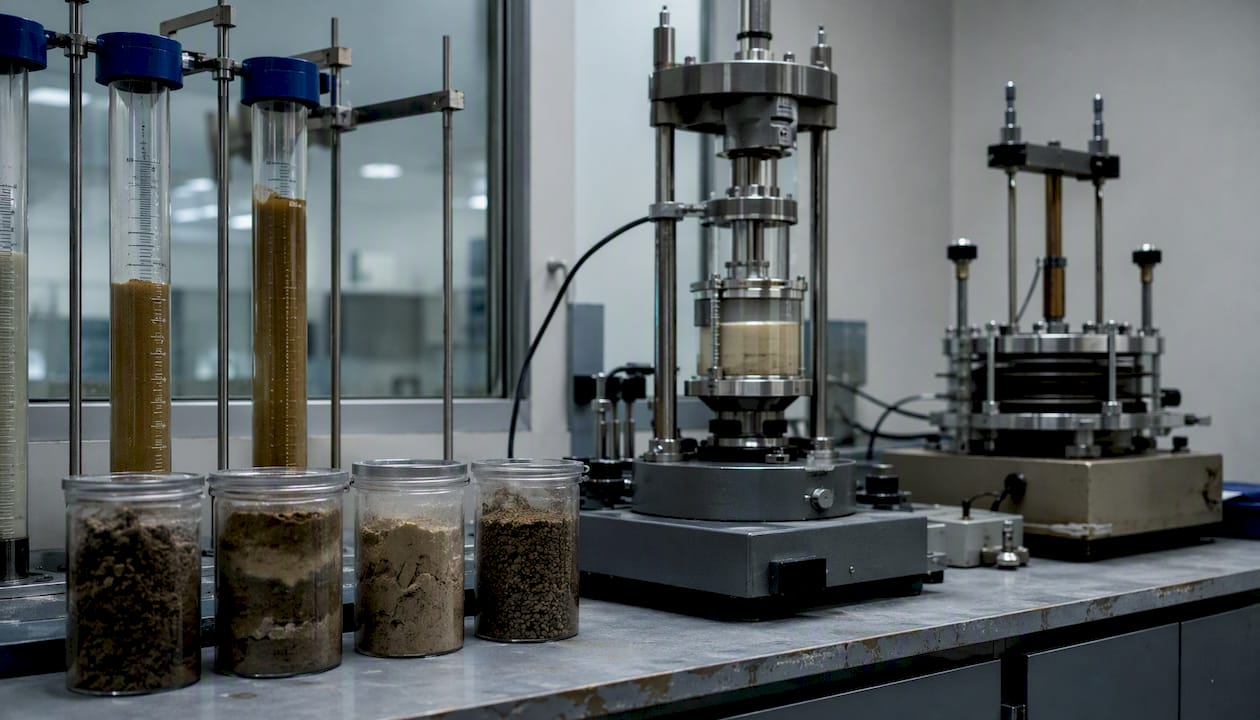
Characteristic unit weight (γ) is the soil’s bulk density, typically expressed in kN/m³. It governs the self-weight of the soil mass and feeds directly into lateral earth pressure calculations for retaining walls and basement design.
Effective friction angle (φ’) and cohesion intercept (c’) describe the shear strength of granular and cohesive soils respectively. A dense sand with φ’ of 35° supports a significantly higher allowable bearing pressure than a loose fill with φ’ of 28°, and the difference can determine whether a shallow pad foundation is viable or whether piling is required.
Undrained shear strength (Su) applies to saturated clays loaded faster than drainage can occur, which is the condition during rapid construction. Soft marine clay in Singapore typically has Su values below 30 kPa in the upper layers, which often rules out shallow foundations and drives the need for driven or bored piles.
Allowable bearing pressure is the net pressure the foundation can apply to the soil without exceeding settlement or shear failure limits. The GIR should state this value for the recommended foundation depth, along with the factor of safety applied.
Estimated settlement is as important as bearing capacity for most Singapore projects. A foundation that satisfies bearing capacity but settles 80 mm differentially will damage the structure. The GIR should provide both total and differential settlement estimates for the recommended foundation type and load.
Groundwater table depth affects excavation support design, dewatering requirements, and the effective stress used in all strength calculations. Seasonal variation should be noted, and the GIR should state the highest recorded and design groundwater level.
Questions to ask the design team about each parameter:
- What factor of safety was applied to derive the allowable bearing pressure, and is it consistent with the foundation type?
- Are settlement estimates based on consolidation test data, or on empirical correlations from SPT N-values alone?
- Does the groundwater level stated reflect the wet season condition, and has artesian pressure been ruled out?
- For piled foundations, what is the basis for the pile capacity calculation, and has negative skin friction been considered where fill is present?
- Are the characteristic values derived from the site-specific data, or have regional defaults been substituted where test data are sparse?
The relationship between geotechnical report findings and foundation design decisions is direct: a GIR that provides well-documented, site-specific parameters reduces the number of conservative assumptions the structural engineer must make, which typically reduces foundation cost.
Typical timeline and cost drivers for a Singapore soil investigation
The duration and cost of a site investigation vary considerably with site complexity, access constraints, and the depth and number of boreholes required. The figures below reflect typical urban Singapore conditions for a straightforward residential or commercial development lot.
| Milestone | Simple Urban Lot | Complex Redevelopment |
|---|---|---|
| Desk study and program preparation | 3–5 working days | 5–10 working days |
| Field mobilization and borehole drilling | 3–7 working days | 10–20 working days |
| Laboratory testing (standard turnaround) | 10 working days | 15 working days |
| Draft GIR preparation | 5–7 working days | 10 working days |
| Review, revision, and final GIR | 3–5 working days | 5–10 working days |
| Total elapsed time | 5–7 weeks | 9 weeks |
Major cost drivers that owners and developers should understand before budgeting:
- Borehole depth and quantity: Each additional meter of borehole depth in hard ground or rock adds drilling time and casing cost. Deep boreholes for high-rise foundations can reach 60 m or more.
- Site access constraints: Restricted access requiring hand-augering, mini-rigs, or traffic management adds mobilization cost and extends the field program.
- Special in-situ tests: Pressuremeter tests, field vane shear, or piezocone dissipation tests add time and equipment cost but may eliminate the need for expensive laboratory consolidation testing.
- Groundwater monitoring: Installing standpipe piezometers and reading them over multiple visits adds cost but is often required for basement and excavation design.
- Express laboratory turnaround: Requesting results in three to five working days rather than the standard ten to fifteen typically carries a premium.
- Traffic management: Boreholes in public roads or footways require traffic control plans and permits, which add both cost and lead time.
Value decisions that reduce cost without losing critical data:
- Use CPT profiling to identify strata boundaries before committing to borehole locations, reducing the chance of drilling in the wrong position
- Specify standard lab turnaround unless the project program genuinely requires express results
- Combine groundwater monitoring with the borehole program rather than returning for a separate mobilization
For a detailed breakdown of how foundation type and ground conditions affect overall project cost, the Singapore Foundation Engineering Guide provides practical reference data for developers and project managers.
Who should prepare and sign the report — credentials and responsibilities
The preparation, supervision, and endorsement of a GIR involve several distinct professional roles, each with defined accountability. Owners and developers should confirm these roles are filled before accepting a report for design use.
Design Qualified Person (QP): The QP registered with BCA is responsible for commissioning and accepting the site investigation. Under Regulation 31, the QP must carry out proper and adequate site investigation in accordance with the Building Control Regulations and Eurocode guidance. The QP does not necessarily conduct the investigation personally but is accountable for its adequacy.
Supervising geotechnical engineer: A professional engineer with geotechnical competence who plans the investigation program, supervises field work, reviews laboratory results, and prepares or endorses the GIR. This engineer’s professional seal on the report certifies that the scope was appropriate, the methods were correctly applied, and the interpreted parameters are supported by the data.
Accredited SI contractor: The firm that conducts the drilling, sampling, and in-situ testing. The contractor must hold relevant accreditation and must supply calibration certificates for all field equipment, including SPT hammer energy measurement records.
Accredited laboratory: The laboratory conducting soil classification, strength, and consolidation tests must hold SAC-SINGLAS accreditation for the specific test methods performed. The lab report must reference the accreditation number and the applicable test standard.
Structural designer: The structural engineer who uses the GIR and GDR to design the foundation. The handoff between geotechnical and structural engineering at this stage is where incomplete or ambiguous GIR parameters most often cause delays.
Credential checklist for report acceptance:
- Professional engineer’s seal and registration number on the GIR cover or endorsement page
- SAC-SINGLAS accreditation number for the testing laboratory on each lab report sheet
- Calibration certificates for SPT hammer, load cells, and CPT cone, dated within the validity period
- Chain-of-custody record linking each sample from extraction to lab receipt
- AGS checker log confirming the electronic file passes validation
Pro Tip: *Ask the SI contractor to provide the SPT hammer energy ratio (Er) measurement report.
Common errors, omissions, and red flags in submitted reports
A GIR that reaches the design team with significant gaps will either delay the project while additional investigation is commissioned or, worse, result in a foundation design based on insufficient data. The following red flags warrant immediate follow-up before the report is accepted.
Frequent omissions found in submitted reports:
- Raw laboratory data sheets absent from appendices, with only summary tables in the body
- Calibration certificates missing for SPT hammer, CPT cone, or laboratory testing equipment
- Borehole spacing too wide to characterize lateral variability, particularly on sites with known fill or variable marine clay thickness
- No groundwater monitoring data, or groundwater level recorded only at the time of drilling rather than after equilibration
- Sample recovery percentages not recorded, making it impossible to assess whether the SPT N-values reflect the actual in-situ condition or a disturbed zone
Red flags that require immediate follow-up:
- Unexplained discontinuities in strata between adjacent boreholes with no discussion of possible causes (fault, old drainage channel, variable fill)
- Missing chain-of-custody documentation for undisturbed samples, raising questions about sample integrity before lab testing
- Inconsistent test methods cited in the report body versus the lab sheets (e.g., report states BS 1377 but lab sheet cites ASTM D4318)
- SPT N-values that show no variation with depth in a profile that should show increasing density, suggesting equipment malfunction or data transcription errors
- Design parameters stated without any derivation rationale or reference to the specific test data from which they were derived
- A limitations section that is absent entirely, or that contains only a single generic disclaimer
Acceptance checklist for owners and QPs:
- All borehole logs present with complete columns (no blank cells for recovery, groundwater, or sample type)
- Laboratory test results traceable to specific sample IDs and depths
- Calibration certificates attached and within validity dates
- Chain-of-custody records present for all undisturbed samples
- Interpreted parameters accompanied by derivation notes or cross-references to specific test data
- AGS(SG) file present, named correctly, and accompanied by a passing AGS checker log
- GI report declaration page signed by the endorsing engineer
If any item on this checklist is missing, return the report to the SI contractor or geotechnical consultant with a written query before releasing payment or proceeding to design.
What a professional geotechnical consultant delivers — workflow and deliverables
A reputable geotechnical consultant structures the investigation as a managed process with defined interim deliverables, not simply a drilling contract followed by a report. The workflow below reflects the standard of service that owners should specify in procurement contracts.
Briefing and scope definition: The consultant reviews the project brief, existing site data, and proposed foundation concept, then prepares a written investigation scope that specifies borehole locations, depths, test types, sampling intervals, and electronic data requirements.
Desk study memo: A short written summary of existing geological, geotechnical, and utility data, identifying known hazards and informing the field program. This is delivered before field mobilization, not buried in the final GIR.
Field supervision and daily logs: The consultant’s engineer attends the site during drilling to verify borehole locations, supervise sampling, and complete field logs in real time. Daily borehole logs are issued to the project team within 24 hours of completion.
Interim data review memo: After the first phase of drilling and preliminary lab results, the consultant issues a brief memo summarizing findings and recommending any program adjustments. This prevents the project from proceeding on incomplete data.
Draft GIR: The full report in PDF format, issued for QP and design team review before finalization. Comments are incorporated and the report is reissued as the final GIR.
Final deliverables package: The complete submission set that the owner should require in the contract:
- PDF GIR named in accordance with BCA convention (SGO_SI_xxxx.pdf)
- AGS(SG) electronic data file (SGO_SI_xxxx.ags)
- AGS checker log confirming file validation
- GI report declaration page signed by the endorsing engineer
- Laboratory test certificates with SAC-SINGLAS accreditation references
- Borehole photolog (core boxes or sample photographs)
- Field equipment calibration certificates
- Groundwater monitoring records and standpipe installation details
Specifying these deliverables explicitly in the SI contract, rather than accepting whatever the contractor provides by default, is the single most effective step an owner can take to avoid a second mobilization. A contract that lists only “site investigation report” as the deliverable gives the contractor latitude to omit the AGS file, photolog, and calibration records — all of which BCA reviewers and design teams will request.
Quality checklist for SI procurement contracts:
- Deliverables list specifies PDF GIR, AGS(SG) file, AGS checker log, and declaration page
- Laboratory accreditation (SAC-SINGLAS) required for all test methods
- Chain-of-custody procedure described and required as a contract deliverable
- Interim data review meeting specified as a contract milestone
- Calibration certificates required for all field equipment before mobilization
- Contractor required to notify the supervising engineer of any unexpected strata within 24 hours
Why a thorough soil investigation report protects your project
The most consistent pattern in projects that encounter foundation-related delays or cost overruns is not difficult ground conditions. It is an investigation that was too shallow, too sparse, or too poorly documented to support the design decisions that followed.
A GIR that omits raw laboratory data or presents interpreted parameters without derivation logic forces the structural engineer to apply larger conservative factors, which increases foundation size and cost. When the conservatism later proves unnecessary, the project has already paid for it. When it proves insufficient, the cost of remediation, which may include underpinning, ground improvement, or redesign after construction has started, is an order of magnitude higher than the cost of a more thorough initial investigation.
The framing that serves project teams best is straightforward: a complete, well-documented GIR is not an administrative requirement. It is the technical foundation on which every subsequent design decision rests. Spending adequately on the investigation, and insisting on the full deliverables package described above, is the most cost-effective risk management available at the pre-design stage. The decision of when to commission a geotechnical consultant and what to require in the scope is where project risk is most effectively managed, not during construction.
Stellar Structures supports your soil investigation and authority submission needs
Soil investigation report preparation in Singapore requires coordinating field contractors, accredited laboratories, electronic data packaging, and BCA submission requirements simultaneously. Stellar Structures manages this entire process as a single integrated engagement, from desk study and field supervision through to final GIR preparation and authority submission support, eliminating the coordination gaps that arise when owners manage multiple separate contractors.

The firm’s geotechnical team prepares GIRs and GDRs that meet BCA’s Annex A through E requirements, packages AGS(SG) electronic files with passing checker logs, and coordinates directly with the Design QP and structural team to ensure interpreted parameters are fit for design use. For developers managing multiple concurrent projects or complex redevelopments, a single consultant handling integrated design and engineering from investigation through to authority approval reduces review cycles and keeps the program on schedule. To request a scope review or proposal for your project, contact Stellar Structures directly through the website.
Sources
The following documents are the primary references for SI report preparation and submission in Singapore. Standards are best consulted for technical detail on test methods and parameter derivation; BCA circulars govern submission format and mandatory content.
- Guidelines on requirements for site investigation reports (BCA circular)
- Reminder for Design Qualified Persons to carry out SI (TUCSS circular)
- Eurocode 7: Geotechnical design (SS EN 1997-2 preview)
Recommended
- Geotechnical Site Investigation in Singapore:
- Soil Improvement for Singapore’s Challenging Ground
- Building a Swimming Pool in Your Landed Home: A Structural Engineer’s Perspective
- ERSS Design for Excavation works in Singapore