




Ultimate Guide to Structural Vibration Control Design in Buildings
Introduction to Structural Dynamics and Vibration Mitigation
Structural vibration control design in buildings mitigates destructive dynamic forces. These dynamic forces originate from severe wind and earthquakes.
They also come from human activity and industrial machinery. Excessive vibrations severely threaten overall structural integrity. Furthermore, they compromise occupant safety and human comfort.
Engineers must implement highly robust vibration control solutions. Understanding structural dynamics is absolutely critical for architectural success. The basic terminology includes free, forced, sinusoidal, and random vibrations.1
Free vibration occurs immediately after an initial physical impact. The structure responds based entirely on internal mechanical properties.1 Forced vibration results from a continuous external excitation function.1
Sinusoidal vibration follows a highly predictable, repeating mathematical wave pattern.1 Conversely, random vibration features irregular fluctuations commonly found in nature.1
The fundamental vibration characteristics dictate structural movement. These include natural frequency, modal mass, and modal damping.2
Natural frequency dictates the inherent, unforced structural oscillation rate.2 Modal mass represents the specific participating mass during movement.2 Mode shape describes the physical deformation pattern under dynamic stress.2
Modal damping measures the internal energy dissipation capacity.2 Engineers utilize complex mathematical equations to model dynamic behaviors. The general equation of motion describes linear mechanical system vibrations.3 This framework relies on specific structural property matrices.
In this equation, represents the global mass matrix.3 The variable represents the structural damping matrix.3
The variable represents the gyroscopic force matrix.3 Furthermore, defines the overall structural stiffness matrix.3 The variable represents the circulatory force matrix.3 Analyzing these complex matrices requires sophisticated computational frameworks.3
Simple assessments evaluating isolated beams are generally insufficient today.4 A holistic perspective is rigorously required for complex building structures.4
Vertical and horizontal vibration responses strongly interact under loading.4 Consequently, specialized structural dynamics analysis remains absolutely essential.
Sources of Structural Vibration in the Built Environment
Vibrations originate from diverse internal and external energy sources. Most problematic building vibrations are felt directly through floor systems.5 Internal sources include heavy HVAC equipment and elevator systems.5
Massive fluid pumping equipment generates continuous internal dynamic loads.5 Furthermore, standard human activities generate highly significant rhythmic vibrations.2 Walking, dancing, and aerobic exercises induce substantial structural stress.5
These specific actions create brief, repeated impacts with every step.6 External forces include severe wind buffeting and underground traffic.2
Heavy industrial environments face entirely unique dynamic force challenges. Facilities utilizing rotating machinery face constant, severe operational vibrations.4 Industrial crushers, screens, and compactors generate massive dynamic forces.4
Simplified traditional engineering design methods often fail here.4 Traditional methods evaluate natural frequencies of isolated supporting beams.4 This outdated approach fails to capture system-wide structural responses.4
Uncontrolled dynamic forces damage critical structural load-bearing components.5 These failures increase the likelihood of future expensive structural retrofits.4
The Physical Consequences of Unmitigated Vibrations
Excessive vibrations cause severe and costly physical disruptions.4 They reduce machinery efficiency and drastically shorten equipment lifespans.4 Occupants experience severe discomfort and reduced productivity.5
Large amplitude oscillations induce motion sickness in tall skyscrapers.7 High-frequency structural vibrations disturb sensitive medical and scientific equipment.5
Unmitigated resonance phenomena cause catastrophic low-cycle structural fatigue.7 Bending and torsional galloping lead to highly dangerous resonant vibrations.7 Uncontrolled flutter vibrations can completely destroy structural deck systems.7
The famous Tacoma Narrows Bridge collapsed due to similar causes.8 Excessive vibrations also threaten the structural safety of modern stadiums.9
Therefore, comprehensive structural vibration control is a fundamental requirement. Effective mitigation protects long-term infrastructure investments.
It prevents catastrophic failures during severe environmental events. Without damping, structures suffer from drastically reduced lifespans. Therefore, advanced vibration control design is mandatory.
International Building Codes and Standardized Criteria
Engineers rely heavily on strict international building codes and standards. These comprehensive codes define acceptable vibration limits for structures. The DIN 4150-3 standard outlines precise structural damage thresholds.10
This standard utilizes the Peak Particle Velocity (PPV) measurement method.10 Fast Fourier Transform (FFT) analysis defines the dominant frequency.10
| Building Category | Frequency Range | Allowable PPV Limit |
| Commercial and Industrial | 1 Hz to 100 Hz | 20 mm/s to 50 mm/s 10 |
| Residential Structures | 1 Hz to 100 Hz | 4 mm/s to 20 mm/s 10 |
| Vibration-Sensitive Heritage | 1 Hz to 100 Hz | 3 mm/s to 10 mm/s 10 |
The British Standard BS 7385-2 assesses structural damage probabilities.10 It categorizes buildings into reinforced frameworks and unreinforced light structures.10 A frequency-independent safe limit of 51 mm/s evaluates unacceptable vibrations.11
ISO 10137 provides rigorous guidance regarding human comfort levels.12 It utilizes the Vibration Dose Value (VDV) measurement metric.13 For office environments, a VDV limit of 0.4 ensures comfort.14
| ISO 10137 Zone Class | Day Limit (Au) | Night Limit (Au) |
| Exclusively Commercial | 0.4 | 0.6 15 |
| Mainly Commercial | 0.3 | 0.4 15 |
| Residential Area | 0.15 | 0.2 15 |
| Protected Area | 0.1 | 0.15 15 |
ASCE 7-22 outlines comprehensive serviceability criteria for American structures.16 Appendix C limits structural deflections, dynamic drift, and vibrations.16 This standard emphasizes critical climate adaptation and structural resilience.17
It updates extreme wind, snow, and seismic load data.17 It also accommodates high-performance concrete and fiber-reinforced polymers.17 Furthermore, ASCE 7-22 encourages using advanced finite element modeling.17
Vibration Criteria (VC) Curves for High-Tech Facilities
High-tech semiconductor facilities require significantly stricter vibration regulations.19 The semiconductor industry utilizes specific Vibration Criteria (VC) curves.10
Eric Ungar and Colin Gordon originally developed these generic curves.21 VC curves specify maximum RMS velocity limits for sensitive instruments.23
| VC Curve Standard | RMS Velocity Limit | Typical Application Environment |
| VC-A | 50 µm/s | General laboratories and microscopes 23 |
| VC-B | 25 µm/s | Lithography equipment 23 |
| VC-C | 12.5 µm/s | Electron microscopes up to 30,000x 23 |
| VC-D | 6.25 µm/s | Demanding semiconductor tools 23 |
| VC-E | 3.12 µm/s | Un-isolated nanotechnology equipment 23 |
| VC-F | 1.56 µm/s | Extremely quiet research spaces 23 |
| VC-G | < 1.5 µm/s | Highly sensitive nanoscale precision instruments 23 |
Achieving VC-G ratings exponentially increases engineering difficulty and costs.23 General office buildings easily accommodate 4,000 micro-inches per second.24
However, specialized laboratories require deeply rigorous vibration control integration.24 The NIST-A criterion provides further stringent standards for metrology.21
Adhering to these strict standards ensures functionality for nanotechnology.21 Equipment manufacturers rely entirely on these standardized operational curves.22
Passive Vibration Control Systems and Historic Innovations
Passive vibration control systems operate entirely without external electrical power. They utilize inherent mechanical properties to dissipate destructive kinetic energy.7
Base isolation fundamentally separates the building structure from ground motions.25 Apple Park utilizes massive base isolation technology for seismic resilience.26
It contains approximately 700 friction pendulum surface isolators.26 Consequently, the superstructure can shift four feet during major earthquakes.25
Base isolation typically requires constructing a large physical perimeter moat.27 This moat accommodates the extreme lateral structural displacements during earthquakes.27
Tuned Mass Dampers (TMD) represent another critical passive engineering technology.7 A traditional TMD consists of a suspended mass, springs, and dashpots.7
The internal system oscillates precisely out of phase with the building.28 This counter-movement safely absorbs and dissipates structural kinetic energy.28 Tuned Liquid Column Dampers (TLCD) substitute solid masses with fluid.29
Fluid sloshing efficiently dissipates massive amounts of dynamic energy.31 The Comcast Center contains a massive 1,300-ton TLCD system.30 Passive systems remain highly reliable due to mechanical simplicity.33
Case Study: The Taipei 101 Skyscraper
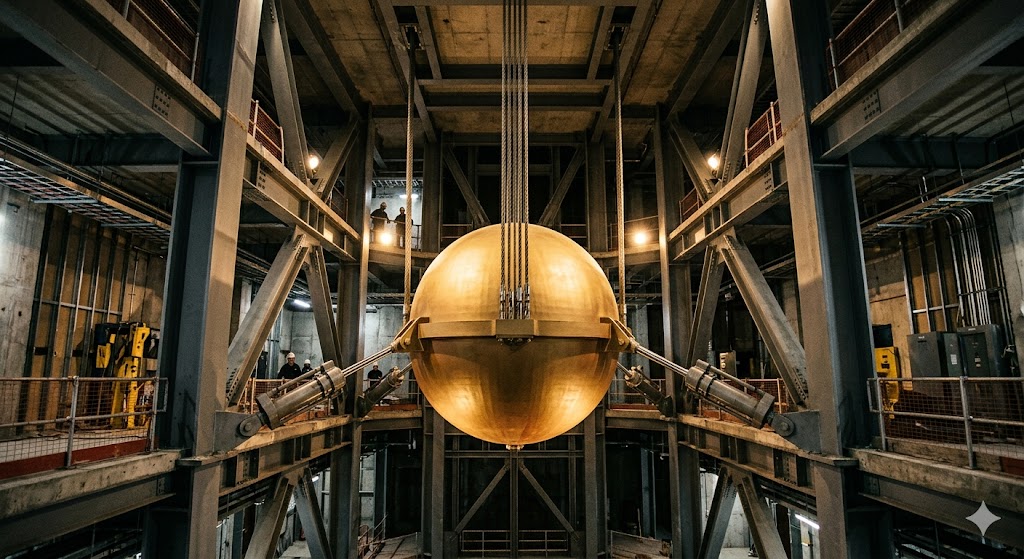
Taipei 101 features a globally renowned structural vibration control system.31 It utilizes a massive 660-tonne spherical tuned mass damper.31
This massive steel pendulum hangs between the 87th and 92nd floors.8 It effectively limits uncomfortable building sway during severe typhoon winds.31 The sphere weighs approximately 0.24 percent of the total building mass.31
During Typhoon Soudelor, the damper displaced a full meter.28 Dashpots provide a lockdown effect during sudden severe earthquakes.31
Furthermore, Taipei 101 utilizes internal core-outrigger systems for stability.31 The central core consists of sixteen heavy steel box columns.31
Eight super columns actively support the external building perimeter.31 These contain high-strength 10,000 psi structural concrete fill.31 Massive outrigger trusses connect the core to these super columns.31
Belt trusses distribute heavy axial loads across multiple perimeter columns.31 Sawtooth corners reduce dangerous crosswind reactions by up to 40%.31 Reduced beam sections ensure superior seismic structural flexibility and ductility.31
Case Study: The Citicorp Center Engineering Crisis
The Citicorp Center featured the first skyscraper TMD in America.34 It employed a massive 400-ton concrete block on hydraulic springs.36 This historic building faced a severe, secret engineering crisis.35
Structural engineer William LeMessurier designed the innovative framing system.36 The building rested on four central offset stilts.35 Inverted chevron braces directed extreme wind loads safely downward.35 The original design explicitly required strong welded steel joints.35
However, the builder secretly substituted weaker bolted joints instead.35 This change saved significant construction time and labor costs.37
LeMessurier did not review this critical structural change initially.35 Later, an engineering student questioned the building’s structural integrity.35 Diane Hartley investigated quartering winds hitting the building corners.35
LeMessurier recalculated the entire building’s dynamic stress parameters quickly.35 Quartering winds increased structural chevron brace stress by 40%.35
The bolted joints faced a dangerous 160% load increase.35 The active TMD was absolutely critical for preventing total collapse.35
A power failure would completely disable the active damper.35 This created a massive risk of imminent structural failure.35 Engineers performed secret structural joint repairs during the night.35 The Red Cross planned a massive emergency neighborhood evacuation.35 Fortunately, the structural retrofits were completed before any hurricane hit.35
Case Study: Burj Al Arab and Additional Implementations
The luxurious Burj Al Arab hotel required precise vibration control.28 Its exoskeleton bow faced severe wind vortex shedding challenges.28
Architects adamantly refused to alter the iconic building shape.28 Altering the shape would destroy the conceptual sailboat image.28 Therefore, engineers installed eleven scattered 5-ton horizontal TMDs.28 These dampers were placed throughout the external building features.28
The Millennium Bridge in London experienced severe wobbly vibrations.30 Synchronized pedestrian footfalls caused unexpected and severe structural sway.30 Dampers were quickly fitted to successfully eliminate this human-induced vibration.30
At 111 West 57th Street, the heaviest solid damper weighs 800 tons.30 The Berlin Television Tower houses a damper in its spire.30 High-rise buildings increasingly utilize these massive passive mechanical systems.30 They preserve architectural aesthetics while guaranteeing essential structural stability.28
Human-Induced Vibrations in Stadiums and Public Assemblies
Stadiums face unique human-induced vibration challenges during events.9 Synchronized crowd movements cause highly dangerous structural resonance phenomena.9 Rhythmic activities like aerobics generate massive dynamic forces continuously.39
Modern lightweight floors easily suffer from excessive human-induced vibration.40 Modern open floor layouts lack partitions to dampen these vibrations.40 Engineers evaluate natural frequency to prevent uncomfortable physical resonance.40
Computational frameworks enhance precise structural frequency analysis capabilities.9 Structural tuning effectively mitigates dangerous stadium crowd dynamics safely.9 Advanced damping mechanisms reduce the dynamic effects of jumping crowds.9
Engineers utilize random vibration analysis methods for human-structure interaction.41 The British Standard provides a worked example for rhythmic activities.43 Retrofit strategies are commonly needed after stadium construction completes.43
Damping ratios range from 0.5% for fully welded steel staircases.43 Ratios reach 4.5% for floors with appropriately located partitions.43
Active and Semi-Active Structural Control Systems
Active vibration control systems provide dynamic, real-time counter-force applications.44 These advanced systems utilize inertial sensors, digital controllers, and mechanical actuators.45 Controllers apply precise feedback or feedforward electronic control loops.45
Actuators rapidly apply equal and opposite forces against the structure.19 Active mass dampers (AMD) neutralize problematic micro-vibrations highly effectively.46
They function exceptionally well at extremely low vibration frequencies.19 Passive systems are generally ineffective against such low-frequency disturbances.19
Multi-input multi-output algorithms simultaneously manage six degrees of freedom.19 However, active systems require substantial continuous electrical power supplies.48 Advanced control algorithms strictly dictate internal actuator force responses.49
Linear Quadratic Regulator (LQR) algorithms provide mathematical optimal structural control.49 Fuzzy logic controllers manage uncertain mathematical building models highly effectively.49 They process approximate reasoning rather than strictly rigid binary logic.49
Neural networks accurately predict complex structural responses to optimize damping.50 Artificial intelligence dynamically tunes the LQR state-weighting matrices.50 Semi-active control systems strike a highly practical engineering balance.48
They offer superior adaptive control without massive external energy requirements.48 Integrating active algorithms with semi-active devices maximizes overall structural resilience.48 These advanced hybrid methods represent the cutting edge of engineering.48
Smart Materials: Shape Memory Alloys and MR Fluids
Smart materials provide incredible advantages for semi-active vibration control.53 Magnetorheological (MR) fluids change their internal viscosity almost instantly.48 Magnetic fields precisely control the MR fluid’s physical thickness.55 This allows dynamic modification of internal structural damping properties.48
Shape Memory Alloys (SMA) utilize unique crystalline phase transformations.53 SMAs exhibit incredible superelasticity and the shape-memory effect.53 Nitinol undergoes rapid martensitic crystalline phase transformations under stress.53
This phase shift provides high inherent damping for building structures.53 SMAs revert to original shapes after enduring severe physical deformations.56 This allows the material to recover entirely from large deformations.53
Ambient temperature significantly impacts SMA superelastic damping performance.53 Environmental conditions and strain-amplitude heavily influence the physical results.53
Numerical frameworks model this complex thermo-mechanical behavior using constitutive laws.53 SMAs enhance seismic isolation capabilities in modern bridge engineering.53
Emerging Horizons: Inerters and Seismic Metamaterials
Inerters represent a groundbreaking vibration control technology for modern buildings.33 An inerter generates force directly proportional to relative terminal acceleration.33 This unique mechanical property is known as structural inertance.58
Inerters mechanically amplify inertial forces using internal gears and ball screws.57 For instance, a 2kg physical flywheel can mimic 350kg.57 This amplification allows engineers to utilize much lighter damping devices.57
Tuned Mass Damper Inerters (TMDI) drastically reduce required physical mass.33 They achieve superior structural damping with significantly lighter physical footprints.58 Tuned Viscous Mass Dampers (TVMD) combine inerters with viscous elements.57
TVMDs connect directly to the primary vertical structural framing system.57 The TMDI leverages nonlinear device behavior for enhanced response mitigation.58 Combined negative stiffness dampers (NSD) and inerter systems outperform traditional dampers.59 They drastically reduce inter-storey drifts and maximum floor accelerations.59
Seismic metamaterials physically block incoming earthquake waves from foundations.61 They create precise frequency bandgaps within structural foundation systems.57 Metamaterial plates consist of horizontally arranged internal resonance elements.62
Engineers design the bandgap to match the earthquake’s fundamental frequency.61 Consequently, destructive seismic energy never enters the vulnerable superstructure.57
Physical testing shows they filter over 50% of seismic energy.63 This technology effectively protects historic buildings without invasive structural modifications.62
High-Tech Environments: Semiconductor Fabs and Laboratories
Semiconductor fabrication facilities represent the pinnacle of precise vibration control.19 The semiconductor manufacturing process remains exceptionally sensitive to physical disturbances.64
Internal sources like foot traffic, ventilation fans, and pumps disrupt manufacturing.64 External sources include nearby highway traffic, construction, and seismic events.64 Even minor vibrations significantly disrupt nanometer-level production yields.64
Consequently, structural isolation joints create completely independent internal buildings.19 These independent structures sit on elastomeric pads or massive springs.19
Cleanrooms utilize highly specialized box-in-box construction for total isolation.19 Finding rogue vibration sources in these massive facilities is challenging. One notable case study involved a mysterious 16 Hz vibration tone.65
This disruptive tone exceeded strict vibration criteria on the production floor.65 Engineers initially suspected internal rotating mechanical equipment like pumps.65 However, rigorous testing ruled out the usual internal mechanical suspects completely.65 Investigations eventually located a vibrating blast gate inside an exterior duct.65
This vibrating gate was located over 400 feet away.65 The vibration propagated directly along the exterior ductwork into the building.65
Semiconductor equipment is increasingly moved into less optimal general environments.66 This shift exacerbates operational challenges regarding quality control and precision.66
Implementing active vibration isolation systems becomes an absolute commercial necessity.66 Advanced measurement systems detect P-waves to predict damaging S-waves.64 This early warning allows sensitive equipment to shut down safely.64
AI-Driven Structural Health Monitoring (SHM) Systems
Modern skyscrapers function increasingly as smart, sensor-driven technological ecosystems.67 Structural Health Monitoring (SHM) ensures continuous, real-time building safety assessment.67 Wireless IoT sensors capture precise real-time dynamic structural responses.67
Accelerometers and strain gauges constantly record structural vibrations and displacements.68 High-frequency sampling accurately captures precise micro-vibrations and frequency shifts.68 Sensors operate between 100 Hz and 200 Hz for ultimate precision.68 Advanced AI models process this massive, continuous volume of data.68
Convolutional Neural Networks (CNN) identify hidden, microscopic structural damage patterns.68 They detect early-stage deterioration that traditional manual inspections miss.68 Recurrent Neural Networks (RNN) deeply analyze time-series dynamic response data.68
They accurately forecast future structural degradation under repeated wind loads.68 Digital twin technology simulates precise building performance under extreme conditions.67
Edge computing drastically minimizes latency during critical data transmission processes.68 It processes essential safety data locally within the building framework.67
Federated learning algorithms allow highly secure collaborative AI data training.68 Stakeholders seamlessly share predictive models without compromising sensitive structural data.68
Predictive analytics enable highly timely, cost-effective preventative maintenance interventions.70 Machine learning identifies stress points and material fatigue incredibly early.67
Continuous monitoring permanently replaces outdated periodic manual physical inspections.67 It significantly reduces total building lifecycle maintenance and inspection costs.70
AI integrates seamlessly with modern automated building fire management systems.67 Intelligent monitoring represents an indispensable component of modern high-rise engineering.70
Sustainability and Comprehensive Life Cycle Assessment (LCA)
Sustainable building design strongly prioritizes total carbon footprint reduction strategies. The global construction sector remains the largest systemic carbon emitter.71 Life Cycle Assessment (LCA) evaluates environmental performance across the building lifespan.71
LCA methodology tracks Global Warming Potential (GWP) and Embodied Energy (EE).72 Embodied carbon accounts for material extraction, transportation, and heavy construction.71
Operational carbon previously dominated environmental discussions regarding modern commercial buildings.71 However, energy-efficient operations highlight the massive impact of embodied carbon.73
Advanced structural vibration control directly enhances overall structural sustainability metrics.46 Highly efficient dampers reduce maximum structural displacements and destructive accelerations.46
Consequently, structural engineers can safely optimize and reduce framing sizes.46 Passive and active damping systems enable massive reductions in steel usage.46 This structural optimization decreases pre-use carbon dioxide emissions by 20%.46
Horizontal floor structures represent up to 80% of total building weight.72 Therefore, utilizing lighter structural floors significantly lowers the total environmental impact.72
Long-span composite steel floors offer excellent inherent vibration damping capabilities.2 They maintain structural sustainability while perfectly ensuring required human comfort.2 Recycling end-of-life structural steel components improves LCA metrics even further.72
Procuring materials from sustainable electric arc furnaces reduces GWP substantially.72 This specific manufacturing choice reduces GWP by an impressive 30%.72 Furthermore, it concurrently reduces total structural embodied energy by 20%.72
A comprehensive study compared 60-story and 120-story tall building structures.72 Concrete scenarios generally performed worse regarding GWP in 60-story buildings.72 Composite diagrids offered the best GWP for massive 120-story towers.72
Material transportation generally accounts for only 2.5% of total GWP.72 Implementing mass timber structures provides another viable low-carbon engineering alternative.74
Sustainable skyscraper design increasingly depends on highly intelligent vibration management solutions.47 Minimizing physical mass through inerters perfectly aligns with modern sustainability goals.57
Strategic SEO for Structural Engineering Content Visibility
Digital visibility is absolutely crucial for modern structural engineering firms.75 Search Engine Optimization (SEO) efficiently connects technical expertise with global clients.75 General industry keywords like “construction company” are excessively broad.76
They reach a wide audience but face extreme online market competition.76 Conversely, long-tail keywords target highly specific, high-intent client search queries.77
Phrases like “structural vibration control design in buildings” perform exceptionally well. They contain three or more descriptive words.78
Long-tail keywords feature lower absolute search volumes but high conversion rates.77 They account for over 91% of all internet web searches.77 Users searching long-tail phrases are generally ready to engage services.77
Effective semantic SEO requires building comprehensive, interconnected topic clusters.77 A central pillar page covers broad topics like advanced seismic engineering.77 Surrounding cluster pages address specific niches like active mass dampers.77 Strategic internal linking perfectly connects these pages, boosting domain authority.76
Optimizing metadata, tags, and titles further improves search engine rankings.32 Engineering firms must deeply analyze competitor keywords and search demand curves.78 Utilizing AI tools visualizes search questions and long-tail keyword possibilities.82
High-intent niche keywords easily bypass fierce competition for broad head terms.77 Voice search compatibility strongly relies on natural, long-tail conversational phrasing.77 Generative AI tools utilize long-tail keywords to construct technical responses.77
Consequently, precision-targeted SEO strategies drive highly qualified B2B engineering leads.84
Analyzing personal keyword difficulty helps identify the most profitable search terms.83 Integrating User-Generated Content naturally expands the available long-tail keyword vocabulary.77
Creating case studies loaded with specific technical keywords builds digital authority.75 Strict keyword parameters eliminate wasted advertising and marketing budget spend.84
Google Search Console tracks website search engine visibility and keyword success.82 Regularly updating content ensures continued visibility despite shifting search engine algorithms.76
Mastering long-tail SEO strategies fundamentally guarantees sustained commercial structural engineering growth.82
Synthesis and Future Outlook
Structural vibration control design represents a profound multidisciplinary engineering triumph. It merges classical structural mechanics with advanced materials and artificial intelligence. Traditional simplified design methods are increasingly obsolete in complex modern environments.
Massive dynamic loads require holistic, system-wide structural evaluations to ensure safety. Passive systems like tuned mass dampers provide reliable, massive kinetic energy dissipation.
Historic implementations in skyscrapers perfectly demonstrate their structural and commercial value. The Citicorp Center and Taipei 101 prove the necessity of damping.
Active and semi-active systems offer unparalleled engineering precision and dynamic adaptability. Actuators, fuzzy logic controllers, and smart materials redefine structural response mitigation.
Furthermore, inerters and seismic metamaterials are fundamentally revolutionizing traditional damping paradigms. They deliver superior seismic resilience with significantly reduced physical structural mass.
Real-time AI monitoring ensures continuous structural integrity, predictive maintenance, and safety. Massive data processing allows structures to actively anticipate and mitigate damage. Optimized damping systems heavily reduce global embodied carbon footprints through material efficiency.
Integrating advanced vibration control perfectly promotes highly sustainable global construction practices.
Communicating this technical expertise requires highly sophisticated digital marketing and SEO strategies. Semantic topic clusters and long-tail SEO ensure critical knowledge reaches target audiences.
Optimized digital content directly drives industry growth, collaboration, and engineering innovation. The future of high-rise construction depends entirely on these integrated, multidisciplinary approaches.
Utilizing inerters, AI, and metamaterials ensures structures remain efficient and adaptable. Buildings will become significantly lighter, taller, smarter, and infinitely safer overall. Structural vibration control design remains the ultimate guardian of modern infrastructure.
Works cited
- Basics of Structural Vibration Testing and Analysis – Crystal Instruments, accessed April 29, 2026, https://www.crystalinstruments.com/basics-of-structural-vibration-testing-and-analysis
- Floor vibrations – SteelConstruction.info, accessed April 29, 2026, https://www.steelconstruction.info/Floor_vibrations
- Active and Passive Vibration Control of Structures, accessed April 29, 2026, https://behsazpolrazan.com/wp-content/uploads/2020/09/Active-and-Passive-Vibration-Control-of-Structures.pdf
- Vibration Design and Control in Heavy Industrial Buildings – RTM Engineering Consultants, accessed April 29, 2026, https://rtmec.com/vibration-design-and-control-in-heavy-industrial-buildings/
- Vibrations in buildings – Designing Buildings Wiki, accessed April 29, 2026, https://www.designingbuildings.co.uk/wiki/Vibrations_in_buildings
- facts-for-steel-buildings-5-vibrations.pdf – AISC, accessed April 29, 2026, https://www.aisc.org/media/a24dtcdo/facts-for-steel-buildings-5-vibrations.pdf
- Vibration Control of Tall Buildings – MAURER, accessed April 29, 2026, https://www.maurer.eu/fileadmin/downloadcenter/PROS_0438_EN_MAURER_Vibration_Control_of_Tall_Buildings.pdf
- Vibration control in a 101-storey building using a tuned mass damper – ResearchGate, accessed April 29, 2026, https://www.researchgate.net/publication/287363836_Vibration_control_in_a_101-storey_building_using_a_tuned_mass_damper
- Managing Stadium Vibrations Effectively | PDF – Scribd, accessed April 29, 2026, https://www.scribd.com/document/946044097/Group-7-Human-Induced-Vibrations-on-Floors-and-Stadiums
- Building vibration I Measure I Standard I Criteria I Effects I PPV, accessed April 29, 2026, https://svantek.com/applications/building-vibrations/
- Tolerable Limits of Construction Vibrations | Practice Periodical on Structural Design and Construction | Vol 20, No 2 – ASCE Library, accessed April 29, 2026, https://ascelibrary.org/doi/10.1061/%28ASCE%29SC.1943-5576.0000223
- Serviceability Evaluation of High-Rise Buildings Exposed to Typhoon Proximity Effects Using ISO10137 and ISO6897 – MDPI, accessed April 29, 2026, https://www.mdpi.com/2075-5309/13/8/2119
- A Review of Evaluation Methods of Standards for Structural Vibration Serviceability under Crowd Walking – MDPI, accessed April 29, 2026, https://www.mdpi.com/2075-5309/14/3/675
- Vibration Serviceability Evaluation of Office Building Floors Due to Human Movements | Journal of Performance of Constructed Facilities | Vol 34, No 4 – ASCE Library, accessed April 29, 2026, https://ascelibrary.org/doi/10.1061/%28ASCE%29CF.1943-5509.0001457
- Vibration comfort of floors: State-of-the-art 1 Introduction – ORBi, accessed April 29, 2026, https://orbi.uliege.be/bitstream/2268/261492/2/RCM%20Article%201%20(State-of-the-art).pdf
- ASCE/SEI 7-10 | Serviceability Considerations | ASCE Amplify, accessed April 29, 2026, https://amplify.asce.org/content/standard/9780784412916/part/provisions/back-matter/appc
- Asce 7 22 | CLaME, accessed April 29, 2026, https://clame.nyu.edu/uploaded-files/E037FH/311538/asce__7-22.pdf
- ASCE/SEI 7-22 | Serviceability Considerations, accessed April 29, 2026, https://amplify.asce.org/content/standard/9780784415788/part/provisions/back-matter/appc
- Vibration Control in Semiconductor Manufacturing Facilities – Future Bridge Americas, accessed April 29, 2026, https://future-bridge.us/vibration-control-in-semiconductor-manufacturing-facilities/
- Monitoring and Assessment of Vibration Impact on Ultraprecision Equipment in a Hospital throughout a Whole Construction Period – ASCE Library, accessed April 29, 2026, https://ascelibrary.org/doi/10.1061/JPCFEV.CFENG-4268
- Vibration Criterion (VC) Curves-Charts | Minus K Vibration Isolation Technology, accessed April 29, 2026, https://www.minusk.com/content/technology/vc_curves_minus_k_vibration_isolation.html
- Evolving criteria for research facilities: vibration – Colin Gordon Associates, accessed April 29, 2026, https://colingordon.com/research/evolving-criteria-for-research-facilities-vibration/
- Vibration control in laboratory construction: Adaptable approach to precision-sensitive facilities – exigere, accessed April 29, 2026, https://exigere.co.uk/assets/documents/Insight-May-2025.pdf?v=1747231280
- How To Minimize Vibration In Laboratory Areas – HCD Magazine, accessed April 29, 2026, https://healthcaredesignmagazine.com/trends/minimizing-vibration-sensitive-laboratory-areas/1494/
- AC2 Campus (Apple Park) Project: Skudo Products Used, accessed April 29, 2026, https://www.skudousa.com/projects/ac2-campus-apple-park/
- Structures / Apple Park – The Hensolt SEAONC Legacy Project, accessed April 29, 2026, https://legacy.seaonc.org/structure/apple-park/
- Prioritizing Seismic Resiliency in Design – AIA San Diego, accessed April 29, 2026, https://aiasandiego.org/posts/2023/4/3/6zeyjnbuxy9mf6s7z49cvwubyf3d4i
- The mechanism and applications of a Tuned Mass Damper (TMD) – BSBG, accessed April 29, 2026, https://bsbgroup.com/blog/the-mechanism-and-applications-of-tuned-mass-damper-tmd
- Single and Multiple Tuned Liquid Column Dampers for Seismic Applications – National Institute of Standards and Technology, accessed April 29, 2026, https://nvlpubs.nist.gov/nistpubs/Legacy/IR/nistir5920.pdf
- Tuned mass damper – Wikipedia, accessed April 29, 2026, https://en.wikipedia.org/wiki/Tuned_mass_damper
- Dynamic Loading Solutions in Taipei 101 – Structure Magazine, accessed April 29, 2026, https://www.structuremag.org/article/dynamic-loading-solutions-in-taipei-101/
- Design Optimization of a Hybrid Vibration Control System for Buildings – MDPI, accessed April 29, 2026, https://www.mdpi.com/2075-5309/13/4/934
- Inerter-Based Vibration Control Systems for Seismically Resilient Structures-A Review – iarjset, accessed April 29, 2026, https://iarjset.com/wp-content/uploads/2025/05/IARJSET.2025.125176.pdf
- Failures – Citicorp Center – Penn State Engineering, accessed April 29, 2026, https://www.engr.psu.edu/ae/thesis/failures/MKP/failures/failures.wikispaces.com/Citicorp_Center.html
- Citicorp Center engineering crisis – Wikipedia, accessed April 29, 2026, https://en.wikipedia.org/wiki/Citicorp_Center_engineering_crisis
- (RE)EXAMINING THE CITICORP CASE: Ethical Paragon or Chimera – Department of Civil & Systems Engineering, accessed April 29, 2026, https://www.ce.jhu.edu/perspectives/handouts_unprotected/citicorp_reexamined.pdf
- The Citicorp Building – PEimpact – Recognizing the impact of PEs, accessed April 29, 2026, https://peimpact.com/the-citicorp-building/
- citicorp center: a close call – structural engineering blog, accessed April 29, 2026, https://robbievanleeuwen.github.io/engineering%20journalism/citicorp-center/
- Floor Vibrations – Due to Human Activity – ResearchGate, accessed April 29, 2026, https://www.researchgate.net/profile/Luis-Hueicha/post/Dynamic_loading_of_humans_on_structural_components/attachment/59d6234ac49f478072e99603/AS%3A272115855495170%401441888884238/download/Design_Guide+11_Floor+Vibrations+Due+To+Human+Activity.pdf
- Vibrations of Steel-Framed Structural Systems Due to Human Activity – O Calculista de Aço, accessed April 29, 2026, http://calculistadeaco.com.br/wp-content/uploads/2020/09/DG11-Vibrations-2nd_Ed.pdf
- (PDF) human induced vibration in structures – ResearchGate, accessed April 29, 2026, https://www.researchgate.net/publication/262415889_human_induced_vibration_in_structures
- Human-Induced Vibration Serviceability: From Dynamic Load Measurement towards the Performance-Based Structural Design – MDPI, accessed April 29, 2026, https://www.mdpi.com/2075-5309/13/8/1977
- Design of Floors for Vibration: A New Approach – SteelConstruction …, accessed April 29, 2026, https://www.steelconstruction.info/images/5/5a/SCI_P354.pdf
- Active Vibration Isolation Systems, accessed April 29, 2026, https://www.techmfg.com/learning/technicalbackgroundindex/activevibrationisolationsystems
- Active Vibration Control vs. Passive Vibration Control – Part 1, accessed April 29, 2026, https://www.techmfg.com/learning/tmc-academy-new/2022/january/active-vibration-control-vs-passive-vibration-control-part-1
- The Reduction of Embodied Carbon in Steel Structures Through the Implementation of Control Systems – MDPI, accessed April 29, 2026, https://www.mdpi.com/2075-5309/15/3/482
- Adaptive Pendulum-Tuned Mass Damper Based on Adjustable-Length Cable for Skyscraper Vibration Control – MDPI, accessed April 29, 2026, https://www.mdpi.com/2071-1050/17/14/6301
- State-of-the-Art Review of Structural Vibration Control: Overview and Research Gaps – MDPI, accessed April 29, 2026, https://www.mdpi.com/2076-3417/15/14/7966
- Construction of an Active Control System for Seismically Excited Structures Using Fuzzy Logic Techniques, accessed April 29, 2026, https://www.iitk.ac.in/nicee/wcee/article/13_2654.pdf
- Hierarchical Fuzzy-Adaptive Position Control of an Active Mass Damper for Enhanced Structural Vibration Suppression – MDPI, accessed April 29, 2026, https://www.mdpi.com/2227-7390/13/17/2816
- (PDF) Predictive active control of building structures using LQR and artificial intelligence, accessed April 29, 2026, https://www.researchgate.net/publication/379934264_Predictive_active_control_of_building_structures_using_LQR_and_artificial_intelligence
- a reinforcement learning framework for active structural control – arXiv, accessed April 29, 2026, https://arxiv.org/pdf/2103.07616
- VIBRATION CONTROL WITH SHAPE-MEMORY ALLOYS, accessed April 29, 2026, https://run.unl.pt/bitstream/10362/5610/1/Santos_2011.pdf
- The Utilization of Shape Memory Alloy as a Reinforcing Material in Building Structures: A Review – MDPI, accessed April 29, 2026, https://www.mdpi.com/1996-1944/17/11/2634
- Application of Shape Memory Alloy Actuators to Vibration and Motion Control of Structural Systems: A Review, accessed April 29, 2026, https://scholarworks.bwise.kr/kumoh/bitstream/2020.sw.kumoh/26213/1/Application%20of%20Shape%20Memory%20Alloy%20Actuators%20to%20Vibration%20and%20Motion%20Control%20of%20Structural%20Systems%20%20A%20Review.pdf
- Application and modelling of Shape-Memory Alloys for structural vibration control – MOST Wiedzy, accessed April 29, 2026, https://mostwiedzy.pl/pl/publication/download/0/application-and-modelling-of-shape-memory-alloys-for-structural-vibration-control-state-of-the-art-r_202502191303516535771.pdf
- Bandgap Characteristics and Seismic Applications of Inerter-in …, accessed April 29, 2026, https://ascelibrary.org/doi/10.1061/%28ASCE%29EM.1943-7889.0001642
- Optimal design and assessment of nonlinear inerter vibration absorbers for earthquake response mitigation of building structures – City Research Online, accessed April 29, 2026, https://openaccess.city.ac.uk/id/eprint/32250/
- Seismic Performance of the Inerter and Negative Stiffness–Based Dampers for Vibration Control of Structures – Frontiers, accessed April 29, 2026, https://www.frontiersin.org/journals/built-environment/articles/10.3389/fbuil.2021.773622/full
- What kinds of inerter systems are included? Which is more useful for structural control in civil engineering? | ResearchGate, accessed April 29, 2026, https://www.researchgate.net/post/What_kinds_of_inerter_systems_are_included_Which_is_more_useful_for_structural_control_in_civil_engineering
- Where Do We Stand on Metamaterial-Based Seismic Design of Engineering Structures?, accessed April 29, 2026, https://www.cive.uh.edu/research/beyer-distinguished-lecture/202401/where-do-we-stand-metamaterial-based-seismic-design
- Seismic metamaterial protects buildings from earthquake damage – AIP.ORG, accessed April 29, 2026, https://www.aip.org/scilights/seismic-metamaterial-protects-buildings-from-earthquake-damage
- Seismic metamaterials as foundations for buildings subjected to incident plane and bending waves: Simulation and experiment | Request PDF – ResearchGate, accessed April 29, 2026, https://www.researchgate.net/publication/395381490_Seismic_metamaterials_as_foundations_for_buildings_subjected_to_incident_plane_and_bending_waves_Simulation_and_experiment
- Micro-Vibration Measurement System Ensures Semic – Advantech, accessed April 29, 2026, https://www.advantech.com/en-eu/resources/case-study/micro-vibration-system-ensures-semiconductor-fab-safety-during-earthquakes
- Case Study – Vibration Source Investigation in Large Semiconductor Fab Facility, accessed April 29, 2026, https://colingordon.com/research/case-study-vibration-source-investigation-in-large-semiconductor-fab-facility/
- Vibrations Podcast – Challenges of Moving Semiconductor Equipment, accessed April 29, 2026, https://www.techmfg.com/learning/tmc-academy-new/2024/october/challenges-of-moving-semiconductor-equipment-podcast
- Wireless Skyscraper Safety: Smart Monitoring and AI-Driven Structural Resilience | Uplatz, accessed April 29, 2026, https://www.youtube.com/watch?v=EJwCNGlJBKk
- AI-Assisted Structural Health Monitoring for Foundations and High …, accessed April 29, 2026, https://www.preprints.org/manuscript/202509.1196
- AI in Civil Infrastructure & Structural Health Monitoring – Encardio Rite, accessed April 29, 2026, https://www.encardio.com/blog/artificial-intelligence-civil-infrastructure-health-monitoring
- AI-BASED STRUCTURAL HEALTH MONITORING SYSTEMS: IMPROVING SAFETY AND REDUCING MAINTENANCE COSTS IN HIGH-RISE BUILDINGS, accessed April 29, 2026, https://insightsep.com/index.php/ISEP/article/download/29/29
- Systematic Review of Embodied Carbon Assessment and Reduction in Building Life Cycles, accessed April 29, 2026, https://tsapps.nist.gov/publication/get_pdf.cfm?pub_id=958514
- A Whole LCA of the Sustainable Aspects of Structural … – ctbuh, accessed April 29, 2026, https://global.ctbuh.org/resources/papers/download/2801-a-whole-lca-of-the-sustainable-aspects-of-structural-systems-in-tall-buildings.pdf
- A Comparative Study of Traditional vs. Automated BIM-LCA Methods for Embodied Carbon Assessment | Engineering Future Sustainability – University of West London, accessed April 29, 2026, https://uwlpress.uwl.ac.uk/efs/article/id/265/#!
- Case Studies in Cost-Effective Low Embodied Carbon Buildings – RMI, accessed April 29, 2026, https://rmi.org/case-studies-in-the-economics-of-low-embodied-carbon-buildings/
- 100+ Best SEO Keywords for Architects in 2026 | Complete Guide – Vivek ChhimPa, accessed April 29, 2026, https://vivekchhimpa.com/blog/seo-keywords-for-architects/
- Construction Company Keywords That Attract Potential Clients – ITVibes, accessed April 29, 2026, https://www.itvibes.com/blog/search-engine-optimization/construction-company-keywords/
- Long-Tail Keywords: The Ultimate 2026 Guide – Yotpo, accessed April 29, 2026, https://www.yotpo.com/blog/long-tail-keywords-guide/
- The Ultimate Guide on Long-Tail Keywords for SEO | Sure Oak, accessed April 29, 2026, https://sureoak.com/insights/long-tail-keywords
- Long-Tail Keywords and Their Importance to SEO – FMG Knowledge Base, accessed April 29, 2026, https://help.fmgsuite.com/en/articles/4707714-long-tail-keywords-and-their-importance-to-seo
- How Semantic SEO and Keyword Grouping Strengthen Your Content Strategy, accessed April 29, 2026, https://www.americaneagle.com/insights/blog/post/semantic-seo-keyword-and-topical-grouping
- The Best SEO Keywords for Construction – SEOpital, accessed April 29, 2026, https://www.seopital.co/blog/seo-keywords-for-construction
- Top 10 SEO Keywords for Designers and Architects – Duke Renders, accessed April 29, 2026, https://www.dukerenders.com/blog/top-10-seo-keywords-for-designers-and-architects
- Long-Tail Keywords: The Ultimate Guide for 2025 – Semrush, accessed April 29, 2026, https://www.semrush.com/blog/how-to-choose-long-tail-keywords/
IVC Technologies: +315% Top 3 Keywords in Niche Industrial Market – Four Dots, accessed April 29, 2026, https://fourdots.com/case-studies/ivc-technologies-315-top-3-keywords-in-niche-industrial-market