




Visual vs. Full Structural Investigation: When Must a Professional Engineer Dig Deeper?
SEO Metadata Profile
SEO Title: Visual vs. Full Structural Investigation: A Guide for Engineers
Focus Keyphrase: Visual vs. Full Structural Investigation
Meta Description: Discover differences between a visual structural assessment and a full structural investigation. Learn when a Professional Engineer must dig deeper.
Tags: structural engineering, professional engineer, visual structural assessment, full structural investigation, forensic inspection, intrusive testing, non-destructive testing, building inspection.
Keyword Density: High targeting on “visual structural assessment,” “full structural investigation,” “professional engineer,” “structural engineering,” “intrusive testing,” “forensic inspection,” and “structural engineer near me.”
Introduction to Structural Engineering Inspections
A building represents a massive financial and safety investment.1 Therefore, safeguarding its structural integrity is absolutely essential.1 Over time, building components suffer from natural degradation.2 Consequently, structural engineering assessments become strictly necessary.2 These specific inspections assess the current condition of buildings.2 They help property owners make informed maintenance decisions.2
However, not all structural engineering inspections are identical.3 There are two primary types of professional evaluations.3 The first is a visual structural assessment.4 The second is a full structural investigation.3 Each approach serves a distinct purpose in property management.3 Understanding this fundamental difference is critical for professionals. A Professional Engineer must know when to escalate inspections.5 They must determine when surface observations remain insufficient.5 This exhaustive report details these specific methodologies thoroughly. It explores the exact triggers for deeper forensic inspection.
The Visual Structural Assessment Defined
A visual structural assessment forms the baseline evaluation.4 It remains the most common type of building inspection.4 A Professional Engineer performs this assessment primarily through observation.3 The primary goal is confirming general structural component soundness.4 Inspectors carefully examine all primary load-bearing components.4 These critical components include foundations, joists, beams, and columns.1 Furthermore, roof trusses and rafters are visually evaluated.1
During this process, the engineer looks for visible distress.2 They systematically search for cracks, settlement, and widespread corrosion.3 Additionally, they assess sloping floors or bowing walls.4 This assessment relies entirely on non-destructive observation techniques.3 It does not involve damaging the building fabric whatsoever.3 Inspectors utilize flashlights, cameras, and basic measuring tools. The visual approach is cost-effective and relatively rapid.
Limitations of Visual Inspections
However, visual structural assessments have significant inherent limitations.5 They only reveal surface-level symptoms of structural distress.5 The actual root cause of a defect remains hidden.5 Therefore, a visual check might miss severe internal degradation.5 Surface imperfections might camouflage catastrophic underlying failures.6
When significant uncertainty exists, the Professional Engineer must escalate.5 This escalation naturally leads to a full structural investigation.5 Relying solely on visual checks invites substantial liability.7 A forensic inspection requires much deeper scientific analysis.5 Property owners searching for a “structural engineer near me” need thoroughness.8 They require an engineer willing to probe hidden defects.9
The Full Structural Investigation Defined
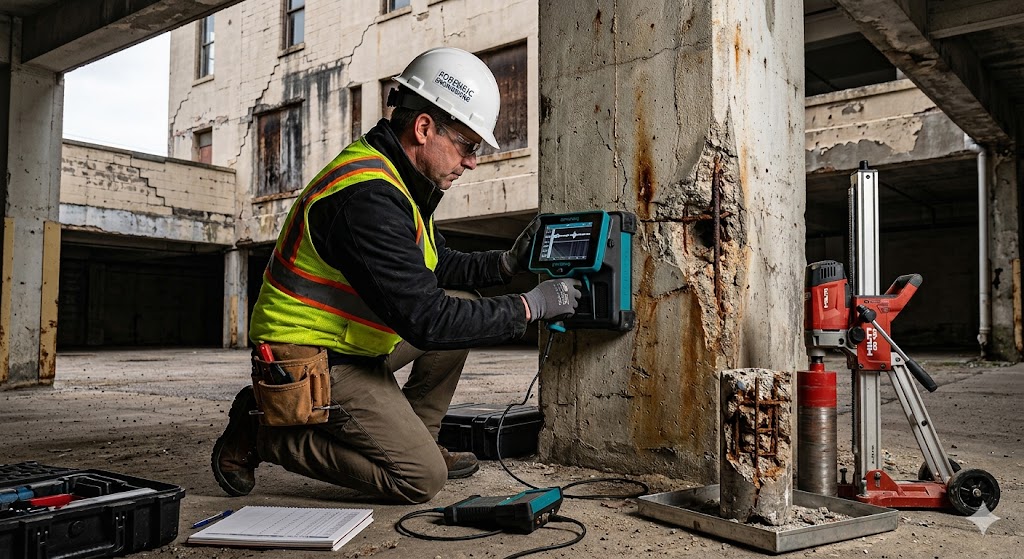
A full structural investigation is a comprehensive diagnostic process.3 It moves aggressively beyond mere surface-level visual observations.5 This forensic inspection aims to uncover hidden structural flaws.9 It very often involves highly intrusive testing procedures.3 Engineers may literally need to break down building walls.3 They might systematically expose hidden steel structural connections.3
This advanced level of investigation utilizes diverse testing methodologies.10 A Professional Engineer deploys sophisticated diagnostic equipment for this task. They extract physical concrete core samples for laboratory analysis.11 They perform extensive ground-penetrating radar scans.11 They routinely analyze steel coupons in metallurgical laboratories.12
This exhaustive approach provides definitive evidence regarding building performance.5 It eliminates dangerous assumptions and relies on hard data.5 Structural engineering demands this high level of absolute certainty.13 Finite element analysis may supplement the physical testing data.14
Visual vs. Full Investigation: Comparative Analysis
The clear distinction between these two approaches is vital. The table below summarizes the key methodological differences.
| Feature | Visual Structural Assessment | Full Structural Investigation |
| Primary Method | Surface-level visual observation.3 | Intrusive and physical testing.5 |
| Building Damage | None. Completely non-invasive.3 | May involve breaking walls or coring.3 |
| Equipment Used | Flashlights, cameras, measuring tools. | GPR, core drills, laboratory analysis.11 |
| Depth of Insight | Identifies symptoms of physical distress.2 | Identifies specific root causes of failure.5 |
| Cost Profile | Lower overall cost, faster completion. | Higher overall cost, extended project timeline. |
Triggers for Escalating an Inspection
A visual structural assessment often uncovers specific red flags. These immediate red flags necessitate a full structural investigation. A Professional Engineer must recognize these critical warning signs instantly. Escalation is absolutely required when defects suggest deeper instability.16 Geotechnical engineering principles often guide these specific evaluations.14
Foundation Cracking and Settlement
Minor foundation settlement cracks are common in older homes.4 However, significant foundation cracking demands immediate professional attention. Horizontal cracks are considered particularly dangerous structural indicators.4 They indicate excessive lateral soil pressure on foundation walls.4
Furthermore, step cracks in masonry raise immediate structural concerns.4 When these appear, a full structural investigation becomes mandatory. A foundation assessment specialist must evaluate the underlying soils.17 They must deploy specific geotechnical engineering testing methods.14 Settlement concerns often require invasive soil boring analysis.4
Structural Deflection Analysis
Deflection refers to the sagging or bending of components. Sagging ceilings strongly indicate compromised or failing roof trusses.16 Sloping floors suggest failing floor joists or severe settlement.4 Visual observation can easily detect the surface deflection.4
However, highly intrusive testing is needed to find causes.5 Engineers must open ceilings to inspect the compromised beams.5 They must measure the exact deflection against original designs. Temporary columns in a basement indicate prior deflection issues.4 These temporary fixes always trigger a full structural investigation.4
Chronic Water Intrusion Risks
Moisture is the ultimate enemy of structural component integrity.9 Water intrusion rapidly weakens concrete and rots wooden framing.9 If an engineer observes severe water stains, they must probe.9 Chronic moisture very often leads to hidden, dangerous mold.9
More importantly, water corrodes embedded reinforcing steel rapidly.15 Corrosion forces the steel to expand with tremendous pressure.18 This immense pressure causes explosive concrete spalling and delamination.18 A full structural investigation maps this dangerous hidden corrosion.19
Regulatory Mandates: Florida Senate Bill 4-D
Sometimes, local or state law dictates a full investigation. Recent catastrophic building collapses have changed regulatory landscapes permanently.20 Jurisdictions now demand deeper forensic inspections for aging buildings.20 Florida currently leads these incredibly strict regulatory safety efforts.20 A Professional Engineer must navigate these complex legal frameworks perfectly.
In June 2021, the Champlain Towers South collapsed tragically.20 This specific disaster prompted sweeping legislative changes in Florida.20 In May 2022, Florida enacted the rigorous Senate Bill 4-D.20 This new law mandates milestone inspections for specific buildings.21 Subsequent legislation, including HB 1021 and HB 913, refined requirements.20
The Milestone Inspection Program
The milestone inspection program ensures aging buildings remain safe.20 It specifically applies to condominiums and cooperative association buildings.20 The mandate applies to buildings reaching 25 years of age.22 Furthermore, the building must be three stories or taller.6 First-floor garage spaces are not considered habitable stories.23
After the initial inspection, renewals occur every 10 years.22 These mandatory inspections must be performed by a licensed engineer.20 A licensed architect may also perform the official inspection.20 The milestone inspection involves a strict two-phase process.6
Phase 1: Visual Structural Assessment
Phase 1 is a qualitative visual structural assessment process.6 The inspector visually examines habitable and non-habitable building areas.6 They assess all major structural components for visible distress.6 The explicit goal is identifying substantial structural deterioration.6 If no significant deterioration exists, the inspection process ends.6
Defining Substantial Structural Deterioration
Florida Statute 553.899 explicitly defines this critical legal term.24 It means structural distress negatively affecting a building’s integrity.6 However, the specific law excludes basic surface aesthetic imperfections.6 Routine minor cracks, minor sagging, and peeling finishes are excluded.6
They only count if they signal deeper structural failure.6 The Professional Engineer makes this highly critical legal determination.6 Their judgment dictates whether the inspection escalates further.6
Phase 2: Full Structural Investigation
If Phase 1 finds substantial structural deterioration, Phase 2 begins.6 Phase 2 is essentially a full structural investigation.25 It strictly requires the Professional Engineer to dig deeper.10 This intensive phase involves destructive or non-destructive testing methodologies.10
The engineer must assess specific areas of structural distress.10 They must definitively confirm the building is safe for use.10 The resulting report dictates all necessary structural remediation work.6 Building owners must address these repairs within set timeframes.25
Florida SIRS Requirements and Deadlines
Senate Bill 4-D also introduced the mandatory SIRS requirement.26 SIRS stands for Structural Integrity Reserve Study.26 This vital study evaluates long-term structural repair costs.26 It combines structural engineering analysis with precise financial forecasting.26 Associations must fully fund reserves for key structural components.22
Components requiring mandatory financial reserve funding include the following.
- Roof structures and complete roof replacements.27
- Load-bearing walls and underlying foundation systems.27
- Fireproofing and critical fire protection systems.27
- Plumbing and electrical structural pathways.27
- Waterproofing systems and exterior building painting.27
- Windows and exterior building doors.27
Previously, unit owners could simply vote to waive reserves.22 Senate Bill 4-D explicitly eliminated this dangerous financial loophole.22 The strict reserve waiver prohibition took effect on December 31, 2024.27 Associations underfunding reserves face severe regulatory agency penalties.22 Association board members may even face direct personal liability.22
Funding options now include special assessments or securing loans.23 Associations may also utilize lines of credit for funding.23 Initial SIRS reports must be completed by December 31, 2025.27 Furthermore, associations must create online accounts with Florida DBPR.27
| Florida SIRS Compliance Deadline | Specific Legal Requirement |
| December 31, 2024 | Reserve waiver prohibition officially takes effect.27 |
| July 1, 2025 | Create online accounts with Florida DBPR.27 |
| December 31, 2025 | Complete initial Structural Integrity Reserve Study.27 |
| January 1, 2026 | Provide digital access to records for owners.27 |
Regulatory Mandates: NYC Local Law 11
New York City enforces its own rigorous facade inspection protocols.28 The Facade Inspection & Safety Program dictates these specific rules.28 This program is commonly known as Local Law 11.28 It focuses heavily on evaluating exterior building envelopes thoroughly.29
The program’s origins date back to a deadly 1979 event.28 A loose masonry piece fell and killed a 17-year-old girl.28 This massive tragedy led to Local Law 10 in 1980.28 Initially, it only required inspecting street-facing building facades.28 The law was amended drastically in 1998 into Local Law 11.28 It now mandates inspecting all facades, regardless of orientation.28
FISP Inspection Cycle Details
Local Law 11 requires extensive structural inspections every five years.28 It strictly applies to buildings taller than six stories.28 Cycle 10 of this specific program began in February 2025.28 The rigorous cycle will officially conclude in February 2030.28
A Qualified Exterior Wall Inspector must perform the building assessment.28 This QEWI is typically a licensed Professional Engineer or Architect.28 The QEWI files a highly detailed report with the DOB.28
Visual and Physical Facade Evaluation
The QEWI always begins with a visual structural assessment.28 They meticulously inspect the facade from the street level.28 They also view it from adjacent rooftops and nearby balconies.28 The inspector evaluates side and rearward-facing facades very carefully.28 These specific hidden areas are often neglected by building owners.28
The structural engineer searches for specific known physical defects.28 Displaced, cracked, or broken masonry are prime inspection targets.28 Deflection in steel window lintels is a major structural concern.28 Rusted lintels expand greatly and crack surrounding brickwork violently.28 Terracotta elements receive extreme scrutiny due to inherent extreme fragility.28
When specific visual anomalies arise, the QEWI digs much deeper.28 They immediately initiate a full structural investigation of the facade.28 They may order special physical tests to determine defect causes.30 Property owners must repair unsafe structural conditions within 90 days.29 Failure to comply results in mandatory, expensive sidewalk shed installation.29
Recently, Thornton Tomasetti conducted a massive facade engineering study.29 This study aims to reduce unnecessary sidewalk sheds safely.29 It utilizes evidence-based building science to modernize older FISP regulations.29
Case Study: Algo Centre Mall Collapse
History perfectly demonstrates the danger of relying solely on visual assessments. Ignoring signs that demand a full structural investigation leads to tragedy. Two prominent catastrophic case studies highlight this extremely stark reality.
On June 23, 2012, the Algo Centre Mall collapsed suddenly.31 This deadly disaster occurred in Elliot Lake, Ontario, Canada.31 A large portion of the rooftop parking garage caved in.31 Two people died horribly, and twenty others were severely injured.31
A rigorous forensic structural engineering investigation immediately followed.31 The NORR engineering firm produced a massive 700-page report.31 The root cause of the collapse was overwhelming and undeniable.31 A single, heavily rusted steel beam weld failed catastrophically.31 The weld was severely weakened by decades of chronic water intrusion.31
Salty slush and winter rain seeped through the concrete continuously.31 The building possessed a 32-year history of severe, unmitigated leaks.32 Over three decades, multiple visual structural assessments routinely occurred.32 Every single inspection completely missed the impending catastrophic steel corrosion.32
The massive water penetration should have triggered a full structural investigation.32 Shockingly, an inspection occurred just ten weeks before the collapse.32 The inspector only performed a basic, highly flawed visual assessment.7 Furthermore, this specific engineer had a legally suspended professional license.7
The engineer actually doctored the final structural report intentionally.32 He changed the report at the specific request of the owner.7 He declared the mall structurally sound despite obvious severe distress.32 This led directly to severe criminal negligence charges against him.7 A full structural investigation using intrusive testing would have saved lives.
Case Study: Champlain Towers South Collapse
The Champlain Towers South tragedy remains equally harrowing and instructive.33 The 12-story condominium collapsed incredibly suddenly on June 24, 2021.33 The National Institute of Standards and Technology immediately investigated deeply.33 NIST deployed elite experts to perform a forensic structural evaluation.33
NIST published preliminary engineering findings after exhaustive scientific research.34 They concluded that severe design and construction defects existed originally.34 These initial defects compromised key structural elements from the very beginning.34 Furthermore, highly ineffective maintenance allowed severe deterioration to occur rapidly.34
The condominium building showed outward signs of impending structural collapse.34 These signs were clearly visible weeks before the actual disaster.34 A visual structural assessment noted severe concrete spalling previously. However, a timely full structural investigation was not executed effectively.
NIST utilized highly advanced testing to understand the collapse mechanics.35 Dr. Ferraro’s research group at the University of Florida assisted.36 They analyzed the original construction concrete mixture design extensively.36 They then recreated trial concrete mix designs for physical testing.36
Engineers built full-scale physical replicas of the concrete slabs.35 They tested these large models at the University of Minnesota.35 The University of Washington also performed extensive structural testing simultaneously.36 This forensic inspection highlighted the extreme dangers of concrete degradation.37 It proved that ignoring visual warning signs yields catastrophic, deadly results.
Introduction to Non-Destructive Testing (NDT)
When a visual assessment identifies issues, engineers use Non-Destructive Testing.19 NDT perfectly bridges the gap between visual and intrusive inspections.19 It evaluates internal structural integrity without damaging the building materials.19 This is crucial for maintaining structural safety during diagnostic testing.19
A Professional Engineer utilizes various advanced NDT scientific methodologies.19 Each specific method targets specific material properties and hidden defects.15
Ground Penetrating Radar (GPR) Applications
Ground Penetrating Radar is a highly effective, common NDT method.11 It uses high-frequency radar pulses to image the dense subsurface.11 GPR accurately identifies solid objects and voids hidden inside concrete structures.11
Engineers frequently use GPR to locate embedded reinforcing steel quickly.11 It easily finds hidden post-tension cables and electrical conduits.11 Mapping these vital elements is mandatory before cutting or drilling concrete.11
GPR delivers immediate, real-time data directly to the Professional Engineer.11 It is significantly safer and more efficient than traditional X-ray methods.11 GPR also locates broad areas of suspected internal concrete deterioration.15 However, GPR data requires highly skilled interpretation by trained technicians.11
Rebound Hammer and UPV Testing
The rebound hammer test assesses concrete surface hardness non-destructively.11 It is very commonly referred to as the Schmidt hammer test.11 A spring-loaded metal mass directly impacts the concrete surface hard. The device measures the exact extent of the mass’s rebound.18
Higher rebound values strongly indicate harder, structurally stronger concrete. Lower values clearly suggest highly porous or severely degraded concrete material. The test is completely non-destructive and highly portable for field use.15
However, it only evaluates the very outer surface concrete layer.15 It cannot detect deep internal voids or deep structural cracks.15 Engineers must correlate rebound data with actual compressive strength tests.15
Ultrasonic Pulse Velocity testing assesses internal concrete uniformity thoroughly.15 An instrument sends ultrasonic waves through the solid concrete matrix.15 The equipment precisely measures the time taken for wave transit.15
Dense, high-quality concrete transmits ultrasonic waves very quickly indeed. Conversely, internal cracks or voids slow down the ultrasonic waves significantly. Engineers use UPV to determine concrete thickness and locate internal flaws.15
Half-Cell Potential Testing (ASTM C876)
Corrosion of reinforcing steel destroys concrete structures from the inside.38 Half-cell potential testing evaluates this specific dangerous corrosion risk directly.38 The rigorous procedure is standardized internationally under ASTM C876.38 It determines the mathematical probability of active corrosion within rebar.38
The test measures the electrical corrosion potential difference directly.39 It compares the internal rebar to a standard surface reference electrode.40 Engineers typically use a copper-copper sulfate reference electrode for testing.40 They meticulously map the electrical potentials across the entire concrete surface.41
Interpreting ASTM C876 Data
ASTM C876 provides highly specific guidelines for interpreting potential readings.41 The numerical results are specifically expressed in millivolts (mV).41
- Greater than -200 mV: 90% probability of no active corrosion.41
- Between -200 mV and -350 mV: Uncertain probability of active corrosion.41
- More negative than -350 mV: 90% probability of active corrosion.41
However, local environmental conditions heavily influence these sensitive electrical readings.40 Concrete moisture content drastically impacts internal electrical resistivity measurements.40 Wet concrete lowers resistivity and makes recorded potentials much more negative.40
Therefore, relying solely on absolute threshold values is highly risky.40 A Professional Engineer must analyze the specific potential gradients carefully.40 They must consider local moisture conditions during the entire field evaluation.40 Misinterpreting this complex data leads to unnecessary and highly costly repairs.40
| NDT Methodology | Primary Structural Application | Primary Methodology Limitations |
| GPR Mapping | Locating rebar, internal voids, and cables.11 | Requires highly skilled data interpretation.11 |
| Rebound Hammer | Assessing concrete surface hardness rapidly.11 | Only tests the outermost surface layer.15 |
| UPV Testing | Finding hidden internal voids and cracks.15 | Requires physical access to two surfaces. |
| Half-Cell Potential | Determining rebar corrosion probability mathematically.38 | Highly sensitive to concrete moisture.40 |
Intrusive and Destructive Testing Methods
NDT clearly provides excellent preliminary forensic data for the engineer. However, a full structural investigation often requires extracting physical samples.18 Destructive testing provides definitive, absolute proof of specific material properties.42 It allows engineers to perform rigorous, controlled laboratory analysis.42
Concrete Core Sampling Protocols
Core sampling is absolutely essential for deep structural defect diagnosis.18 Engineers extract solid cylindrical concrete samples directly from the structure.11 They use a specialized, water-cooled, diamond-tipped core drill rig.18
The exact physical coring locations are chosen extremely carefully beforehand.18 Engineers thoroughly review GPR data to avoid cutting embedded rebar.11 Extracted cores undergo rigorous compressive strength testing in specialized laboratories.43
They are physically crushed in massive machines to determine load capacity.11 The resulting data validates the original architectural structural design assumptions.15 Samples are also subjected to density and absorption laboratory testing.43
Petrographic Examination of Concrete (ASTM C856)
Concrete petrography is a detailed microscopic examination of hardened concrete.44 The precise process follows the strict ASTM C856 testing standard.44 A highly qualified petrographer performs this incredibly specialized scientific analysis.45
Petrography reveals the deeply hidden chemical and physical history of concrete.46 The engineer must provide the laboratory petrographer with extensive context.45 They must explicitly detail the core’s original location and orientation.45
Furthermore, they must detail the specific age of the structure.45 They must also clearly explain the observed symptoms of structural distress.45 Section 4 of ASTM C856 covers specific qualifications for the petrographer.45 Section 14 mandates exactly how the final report is prepared.45
Applications of ASTM C856
Petrographic analysis uncovers numerous deeply hidden concrete structural deficiencies.44
- It accurately determines the original water-to-cement mixture ratio.44
- It measures microscopic air content and overall paste porosity.44
- It visually identifies highly destructive Alkali-Silica Reactions internally.44
- It definitively confirms historical freeze-thaw damage or severe fire damage.44
- It clearly reveals physical aggregate segregation and improper concrete curing.44
The microscopic examination follows a very systematic, multi-step process.47 First, the petrographer prepares the specimen carefully for viewing.47 Next, they perform a comprehensive visual and stereomicroscope examination.47
Finally, they utilize a powerful polarizing microscope for detailed analysis.47 They study the intricate paste features and complex crack morphology.48 Fluorescent dyes highlight microscopic structural fractures brightly under ultraviolet light.48 Point counter devices make automated statistical traverses across the sample.48
For chemical analysis, sample volumes must meet specific minimums.46 Samples must be five times the volume of a large aggregate.46 Testing for chloride content requires a minimum of 50 grams.46
Concrete Carbonation Testing Details
Carbonation is a massive primary driver of steel reinforcement corrosion.49 Healthy concrete is highly alkaline, chemically protecting the embedded steel.46 However, atmospheric carbon dioxide reacts slowly with the concrete over time.49 This insidious reaction lowers the pH and destroys the alkaline protection.46
Engineers systematically test for carbonation depth on freshly cut cores.46 They spray the exposed surface with a phenolphthalein pH indicator.46 The immediate chemical reaction provides instant, highly visual testing results.49
If the pH is highly alkaline (above 9.5), it turns magenta.49 Magenta indicates the concrete is healthy, alkaline, and totally uncarbonated.46 If the concrete remains perfectly clear, deep carbonation has occurred.49 Clear areas indicate a dangerously lowered pH and high corrosion risk.49
Porous, poorly mixed concrete carbonates very rapidly in certain environments.49 Conversely, dense concrete takes many decades to carbonate deeply.49 Petrographers can also verify carbonation precisely using thin section microscopy.49 This intense microscopic analysis provides maximum diagnostic testing accuracy.49
Structural Steel Coupon Testing (ASTM A370)
Testing structural steel directly is vital in full forensic engineering. The ASTM A370 standard strictly governs mechanical testing of steel products.50 A full structural investigation may require physically cutting steel test coupons.50 These coupons are machined test specimens extracted directly from the structure.51
Extracting test coupons obviously damages the existing structural production casting.51 The structure strictly requires repair welding to replace the removed metal.51 Therefore, this highly destructive testing is a necessary measure of last resort.
Coupons undergo incredibly severe tension testing in universal test frames.12 The laboratory applies massive pulling forces until the steel specimen fractures.12 This rigorous testing determines crucial mechanical and physical steel properties.12
- Yield Stress: The exact point where permanent plastic deformation begins.12
- Tensile Strength: The absolute maximum stress the steel can withstand.12
- Elongation: The exact percentage the steel stretches before catastrophic failure.12
- Elastic Modulus: A highly precise mathematical measurement of steel stiffness.12
The ASTM double-legged keel block is a very common standard coupon.51 These test legs are typically exactly 1.25 inches thick.51 Testing ensures the existing steel meets the original architectural design specifications.51 It definitively proves whether the structural steel remains safe for continued use.51
Evaluating Water Leakage (ASTM E2128)
Severe water leakage causes catastrophic and rapid structural degradation.52 The tragic Algo Centre Mall collapse proved this reality definitively.31 A Professional Engineer must evaluate building water intrusion rigorously and systematically.53 The ASTM E2128 standard provides the ultimate forensic evaluation methodology.53
ASTM E2128 evaluates massive water leakage through exterior building walls specifically.53 It acts as a comprehensive technical field guide for exterior wall consultants.53 The standard treats the entire exterior wall as a holistic system.53 It comprehensively includes claddings, fenestrations, structural components, and interior finishes.53
The Water Intrusion Hierarchy
ASTM E2128 clearly defines different specific types of moisture movement.54
- Incidental Water: Unplanned infiltration penetrating beyond the primary weather barrier.54 It evaporates safely without causing adverse structural consequences.54
- Water Absorption: Material absorbs water directly into internal pores without transmission.54
- Water Infiltration: Water passes between materials into totally unintended hidden spaces.54
- Water Leakage: Uncontrolled water entry causing visible, actionable building damage.54
- Water Penetration: Moisture breaching the entire building envelope assembly completely.54
- Water Permeation: Vapor transmission through supposedly solid building materials.54
The Seven-Step Water Evaluation Methodology
ASTM E2128 mandates a highly systematic, seven-step evaluation protocol strictly.55 This empirical method ensures rational and completely defendable leakage investigations.56
Step 1: Review of Project Documents: The engineer studies original architectural plans extensively.54 They look very closely for inherent design flaws regarding waterproofing systems.55
Step 2: Evaluation of Design Concept: The engineer assesses the intended water management strategy.54 They evaluate whether the barrier system concept is fundamentally sound.55
Step 3: Determination of Service History: The inspector interviews building occupants and maintenance staff.54 They directly correlate historical leak occurrences with specific historical weather events.54
Step 4: Inspection: This is the baseline visual structural assessment phase.55 The engineer examines specific known leak-prone building locations very thoroughly.54
Step 5: Investigative Testing: The PE physically recreates the leaks systematically.53 They utilize standardized, calibrated water spray tests on the exterior facade.53 They may remove cladding to expose internal hidden structural damage.53
Step 6: Analysis: The structural engineer evaluates all gathered physical data.54 They develop and systematically verify hypotheses regarding the exact intrusion mechanisms.54
Step 7: Report Preparation: The engineer produces a comprehensive document detailing the failure.55 The final report outlines the exact scope of necessary structural repairs.57
This strict methodology eliminates incompetent, highly speculative structural engineering evaluations.56 It provides total accountability and clear direction for structural rehabilitation.56
Commercial Building Inspection Protocols
Commercial buildings constantly require massive structural engineering professional oversight. A commercial building inspection differs significantly from residential home assessments.58 The operational structural loads are exponentially higher and vastly more complex.59
A Professional Engineer utilizes exhaustive, detailed checklists during commercial inspections.59 They evaluate absolutely every aspect of the massive building’s physical condition.60 The NAICS code 541350 classifies these specific building inspection professional services.60
Structural Framing and Foundations
The engineer physically inspects the primary massive structural framing systems.59 They critically evaluate huge steel columns, concrete beams, and load-bearing walls.59 They search meticulously for any microscopic evidence of settling or shifting.59 Any signs of severe structural distress trigger a full investigation instantly.59
Building Systems Integration
Commercial structures contain massive, heavy mechanical and electrical support systems.59 These heavy systems often interact directly with sensitive structural load points.59
- HVAC Systems: Extremely heavy rooftop HVAC units stress the roof structure.59
- Plumbing: Leaking commercial supply lines cause extremely rapid structural deterioration.59
- Elevators: Large elevator shafts represent highly critical central structural cores.59
- Fire Protection: Massive sprinkler systems add immense dead loads to ceilings.59
The inspector must definitively ensure these systems do not compromise integrity.59 If heavy equipment causes roof deflection, intrusive testing follows immediately.
Accessibility and Code Compliance
Commercial inspectors also actively evaluate building accessibility barriers.61 They rigorously review accessible routes for individuals with severe physical disabilities.61 While not strictly structural initially, modifications for access affect load paths.61
Cutting solid concrete floors for new accessibility ramps requires structural engineering approval.61 Inspecting active meeting stiles on double doors ensures safety compliance.61 They evaluate building environmental hazards adhering to ACGIH safety standards.61
ASCE Guidelines for Existing Buildings
The American Society of Civil Engineers provides massive governing structural standards. A Professional Engineer relies heavily on these specific peer-reviewed technical standards. ASCE 11 is the Guideline for Structural Condition Assessment of Existing Buildings.62 ASCE 30 is the Guideline for Condition Assessment of the Building Envelope.63
These massive documents dictate exact statistical procedures for structural evaluation.42 They guide engineers in conducting highly complex structural condition surveys.42 The standards explain exactly how to interpret NDE structural testing results.42
Furthermore, they dictate protocols for highly complex demolition engineering.30 They provide rules for safely designing complex building underpinning systems.30 A Professional Engineer must adhere to ASCE 11 during a full structural investigation.62 It serves as the ultimate resource document for structural engineering professionals.62
Conclusion
Understanding the vast difference between visual and full structural investigations is paramount. A visual structural assessment provides an excellent, cost-effective baseline overview.3 It successfully identifies surface-level distress relatively rapidly and very efficiently.4 However, it simply cannot uncover deeply hidden, highly dangerous internal degradation.5
A highly skilled Professional Engineer must recognize when to escalate an inspection.5 Severe foundation cracking, structural deflection, and water intrusion are massive red flags.9 Strict regulatory mandates like Florida SB 4-D enforce much deeper investigations legally.20 New York City Local Law 11 absolutely mandates rigorous exterior facade scrutiny.28
Ignoring clear visual warnings routinely leads to catastrophic, deadly structural failures. The tragic Champlain Towers and Algo Centre Mall collapses prove this fact.31
A full structural investigation utilizes incredibly advanced scientific engineering methodologies.2 Ground Penetrating Radar and Half-Cell Potential mapping find deeply hidden flaws.11 Physical core sampling and petrographic examinations prove material deficiencies definitively.18 Steel coupon tension testing validates structural load capacity directly and physically.50 Methodologies like ASTM E2128 locate highly destructive building water intrusion sources.53
Ultimately, overall public safety depends entirely on the diligence of the Professional Engineer. They must utilize every scientific tool available to ensure absolute structural stability. When surface evidence clearly suggests underlying danger, they must dig much deeper. They must initiate a highly comprehensive full structural investigation without any hesitation.
Works cited
- Home Structural Inspection: What Every Homeowner Should Know – LB Engineering, accessed May 21, 2026, https://lbengineer.com/blog/home-structural-inspection-what-every-homeowner-should-know
- What You Need to Know About Structural Assessments – Fleis & VandenBrink, accessed May 21, 2026, https://www.fveng.com/structural-assessment-guide/
- Structural Survey Vs. Structural Inspection: What’s The Difference? – Brisbane Structures, accessed May 21, 2026, https://brisbanestructures.com.au/structural-survey-vs-structural-inspection/
- When Do I Need A Structural Inspection? – Bustamante Engineers, accessed May 21, 2026, https://www.bustamanteengineers.com/when-do-i-need-a-structural-inspection
- A Practical Guide to When an Intrusive Structural Survey Is Required – Firntec, accessed May 21, 2026, https://firntec.com/blog/when-is-an-intrusive-structural-survey-required-a-practical-guide
- Between a Rock and a Hard Place: Condominiums with Substantial …, accessed May 21, 2026, https://www.bilzin.com/we-think-big/insights/publications/2022/10/condos-with-substantial-structural-deterioration
- Root Cause Analysis Case Study: Missing the Indicators – Fatal Parking Garage Collapse, accessed May 21, 2026, https://blog.thinkreliability.com/case-study-fatal-parking-garage-collapse
- Top Engineering Keywords | Free SEO Keyword List | KeySearch, accessed May 21, 2026, https://www.keysearch.co/top-keywords/engineering-keywords
- How Structural Engineer Home Inspections Uncover Hidden Issues, accessed May 21, 2026, https://structural-innovations.com/how-structural-engineer-home-inspections-uncover-hidden-issues/
- CONDO MILESTONE INSPECTIONS | Saint Augustine Beach FL, accessed May 21, 2026, https://www.staugbch.com/building/page/condo-milestone-inspections
- A Guide to Non-Destructive Concrete Inspection Methods – Xradar, accessed May 21, 2026, https://xradar.com/blog/a-guide-to-non-destructive-concrete-inspection-methods/
- Tensile Testing of a Steel Coupon – YouTube, accessed May 21, 2026, https://www.youtube.com/watch?v=o9617vU1rtw
- Understanding Structural Engineering House Inspections, accessed May 21, 2026, https://www.easternengineeringgroup.com/understanding-structural-engineering-house-inspections/
- The Best Engineering SEO Keywords – SEOpital, accessed May 21, 2026, https://www.seopital.co/blog/the-best-engineering-seo-keywords
- Implementation of Ground Penetrating Radar (GPR) and Complementary Non-Destructive Testing on Concrete Structures – Georgia Southern Commons, accessed May 21, 2026, https://digitalcommons.georgiasouthern.edu/cgi/viewcontent.cgi?article=3913&context=etd
- Why Residential Structural Inspections Matter for Homeowners – Anderson Engineering, accessed May 21, 2026, https://www.andersoneng.com/why-residential-structural-inspections-matter-for-homeowners/
- Structural Engineering SEO – Ranktracker, accessed May 21, 2026, https://www.ranktracker.com/blog/structural-engineering-seo/
- Guidebook on non-destructive testing of concrete structures – Scientific, technical publications in the nuclear field | IAEA, accessed May 21, 2026, https://www-pub.iaea.org/mtcd/publications/pdf/tcs-17_web.pdf
- What Is Non-Destructive Testing of Concrete? – Format NDT, accessed May 21, 2026, https://www.formatndt.co.uk/what-is-non-destructive-testing-of-concrete/
- The Complete Guide to Florida Milestone Inspections (2025-2026), accessed May 21, 2026, https://www.m2e.com/blog/florida-milestone-inspections-guide/
- SB 4-D – Florida Senate, accessed May 21, 2026, https://www.flsenate.gov/Session/Bill/2022D/4D/BillText/e1/HTML
- Structural Integrity Reserve Study (SIRS) Services – M2E Consulting Engineers, accessed May 21, 2026, https://www.m2e.com/services/structural-integrity-reserve-study/
- Florida Structural Integrity Reserve Studies (SIRS) – UES, accessed May 21, 2026, https://www.teamues.com/florida-structural-integrity-reserve-studies-sirs-keeping-your-condo-safe/
- SECTION 553.899, F.S. – E – Florida Building Code, accessed May 21, 2026, https://www.floridabuilding.org/fbc/commission/FBC_0324/EBIWG/Comments_from_Jim_Schock-1.pdf
- Understanding the Senate Bill 4D (SB4D) Building Safety Law – Intertek, accessed May 21, 2026, https://www.intertek.com/building/sb4d/
- Structural Integrity Reserve Study Explained for Florida Condominiums, accessed May 21, 2026, https://flengineeringllc.com/structural-integrity-reserve-study-florida/
- Florida Senate Bill 4-D: What You Need to Know – Rimkus Consulting Group, accessed May 21, 2026, https://rimkus.com/article/what-sb-4-d-means-for-your-condo-a-closer-look-at-floridas-safety-legislation/
- Safety & Sidewalk Sheds – Local Law 11 Inspections …, accessed May 21, 2026, https://cooperatornews.com/article/local-law-11-inspections
- Facade & Local Law – Buildings – NYC.gov, accessed May 21, 2026, https://www.nyc.gov/site/buildings/safety/facade-local-law.page
- STRUCTURAL CONDITION ASSESSMENT AS A TOOL FOR SAFE CONSTRUCTION – NYC.gov, accessed May 21, 2026, https://www.nyc.gov/assets/buildings/pdf/2019-structural-condition-assessment.pdf
- Elliot Lake inquiry: Surveillance footage pinpoints exact cause of mall collapse, accessed May 21, 2026, https://macleans.ca/news/canada/elliot-lake-inquiry-surveillance-footage-pinpoints-exact-cause-of-mall-collapse/
- Failures – Algo Centre Mall Collapse – Penn State Engineering, accessed May 21, 2026, https://www.engr.psu.edu/ae/thesis/failures/MKP/failures/failures.wikispaces.com/Algo_Centre_Mall_Collapse.html
- Champlain Towers South Collapse | NIST – National Institute of Standards and Technology, accessed May 21, 2026, https://www.nist.gov/disaster-failure-studies/champlain-towers-south-collapse
- The Collapse of Champlain Towers South: Review of a Forensic Engineering Investigation | Proceedings | Vol , No – ASCE Library, accessed May 21, 2026, https://ascelibrary.org/doi/10.1061/9780784485798.050
- News and Updates | NIST, accessed May 21, 2026, https://www.nist.gov/disaster-failure-studies/champlain-towers-south-collapse/news-and-updates
- NIST – Concrete Materials Research – University of Florida, accessed May 21, 2026, https://concrete.essie.ufl.edu/research/current-research/nist/
- Champlain Towers South Investigation Team Provides Update to Structural Engineers, accessed May 21, 2026, https://www.nist.gov/news-events/news/2025/04/champlain-towers-south-investigation-team-provides-update-structural
- Half-Cell Potential Test: Measurement and Devices – Giatec Scientific Inc., accessed May 21, 2026, https://www.giatecscientific.com/education/what-is-the-half-cell-potential-test/
- C876 Standard Test Method for Corrosion Potentials of Uncoated Reinforcing Steel in Concrete – ASTM, accessed May 21, 2026, https://www.astm.org/c0876-15.html
- Influence of Concrete Moisture Condition on Half-Cell Potential Measurement – Purdue e-Pubs, accessed May 21, 2026, https://docs.lib.purdue.edu/context/icdcs/article/1140/viewcontent/1_1140_Influence_of_Concrete_Moisture_Condition_of_Half_Cell_Potential_Measurement.pdf
- Tunnel – Half-Cell Potential (HCP) – FHWA InfoTechnology, accessed May 21, 2026, https://infotechnology.fhwa.dot.gov/half-cell-potential-hcp-2/
- Structural-Condition Assessment of Existing Structures – ASCE, accessed May 21, 2026, https://www.asce.org/education-and-events/explore-education/in-person-courses/structural-condition-assessment-of-existing-structures
- EXHIBIT A-9: LABORATORY TESTING – Charleston-sc.gov, accessed May 21, 2026, https://charleston-sc.gov/DocumentCenter/View/12237
- Concrete Petrography ASTM C856 – SGS TEC Services, accessed May 21, 2026, https://www.tecservices.com/testing/petrography-concrete-laboratory-petrograph/
- Petrographic Analysis of Concrete Deterioration – PDH Online, accessed May 21, 2026, https://www.pdhonline.com/courses/s177/s177content.pdf
- Chemical and Lab Testing | GBG Group Australia, accessed May 21, 2026, https://www.gbg-group.com.au/methods/chemical-and-lab-testing
- C856 Standard Practice for Petrographic Examination of Hardened Concrete – ASTM, accessed May 21, 2026, https://www.astm.org/c0856-14.html
- Petrographic Methods of Examining Hardened Concrete – Federal Highway Administration, accessed May 21, 2026, https://www.fhwa.dot.gov/publications/research/infrastructure/pavements/pccp/04150/04150.pdf
- Concrete Carbonation: Significance and Proper Testing – Wiss, Janney, Elstner Associates, accessed May 21, 2026, https://www.wje.com/assets/pdfs/articles/WJE-PRIMER-Carbonation-v3.pdf
- A 370 – 07a – Standard Test Methods and Definitions for – Mechanical Testing of Steel Products1 – Regbar Construction, accessed May 21, 2026, https://regbar.com/wp-content/uploads/2019/09/ASTM-A370.pdf
- TEST COUPONS AND CASTING PROPERTIES – Steel Founders’ Society of America, accessed May 21, 2026, https://www.sfsa.org/publications/testcoupons/tc.pdf
- ASTM E2128 Water Leak Testing of Existing Building Walls – Building Envelope Allies, accessed May 21, 2026, https://envelopeallies.com/astm-e2128-water-leak-testing-existing-building-walls/
- ASTM E 2128 | Water Intrusion Testing – Building Diagnostics Group, accessed May 21, 2026, https://www.bdg-usa.com/astm-2128.html
- Evaluating Water Leakage of Building Walls – AIA Central NJ, accessed May 21, 2026, https://aiacnj.starchapter.com/blog/waterleakage
- Overview of ASTM E2128 (standards Guide for Evaluating Water Leakage Of Building Walls), accessed May 21, 2026, https://iibec.org/publication-post/2010-01-haughton-murphy2/
- Using ASTM E2128 – Standard Guide for Evaluating Leakage of Building Walls – AIA Detroit, accessed May 21, 2026, https://aiadetroit.com/wp-content/uploads/2015/02/Kudder-BEC-Symposium-Presentation.pdf
- Evaluating Water Leakage of Buildings – Pete Fowler Construction Services, accessed May 21, 2026, https://pfcs-cq.squarespace.com/s/Evaluating-Water-Leakage-of-Buildings-PDF-Package-2016-09-02-A.pdf
- Building Inspection Expert Witnesses – SEAK, Inc., accessed May 21, 2026, https://www.seakexperts.com/keywords/building-inspection-expert-witness
- The Complete Guide to Commercial Building Inspection – Reliable Structural Engineers, accessed May 21, 2026, https://www.reliablestructuralengineers.com/blog/the-complete-guide-to-commercial-building-inspection
- 541350 – NAICS Code Description, accessed May 21, 2026, https://www.naics.com/naics-code-description/?code=541350
- Glossary of Commercial Property Inspection Terms – CCPIA, accessed May 21, 2026, https://ccpia.org/glossary-of-commercial-property-inspection-terms/
- Guideline for Structural Condition Assessment of Existing Buildings – ANSI Webstore, accessed May 21, 2026, https://webstore.ansi.org/preview-pages/asce/preview_9780784404324.pdf
Guideline for Condition Assessment of the Building Envelope | Books – ASCE Library, accessed May 21, 2026, https://ascelibrary.org/doi/book/10.1061/9780784413258