





A design intent drawing is the documented explanation of what a project must achieve and why, expressed in terms of systems, outcomes, and performance criteria before detailed technical solutions are finalized. In construction and architecture, this document type sits between the approved concept and the full set of construction drawings. It answers the question every contractor, engineer, and property owner eventually asks: what exactly are we trying to build, and to what standard? Tools like Autodesk Revit BIM models, annotated floor plans, and performance specification sheets are all common formats for capturing and communicating this intent.
What is a design intent drawing, exactly?
A design intent drawing is defined as the documented framework that guides project goals, aligns stakeholder vision, and sets performance requirements before construction details are locked in. The industry also refers to this document type as “design intent documentation” or “intent drawings,” and both terms are used interchangeably across architectural and engineering practice.
The core purpose is alignment. Before a contractor prices a job or an engineer sizes a structural member, everyone on the project needs to agree on what success looks like. A design intent drawing captures that agreement in writing and in graphic form. It describes systems, not just products. It states outcomes, not just preferences.

Stellar Structures uses this type of documentation on civil, structural, and architectural projects across Singapore to prevent scope drift and protect the original design vision through every phase of delivery. When you understand what these drawings contain and why they exist, you are better positioned to manage your project, evaluate contractor proposals, and catch problems before they become expensive.
Design intent drawings vs. construction drawings: key differences
These two document types serve different purposes and are used at different stages of a project. Confusing them is one of the most common sources of miscommunication between design teams and contractors.
Construction drawings are a detailed evolution of the initial design intent documentation. They carry legal and regulatory standing, contain precise dimensions, material specifications, and code compliance data, and are submitted to authorities like BCA or URA for approval. Design intent drawings do not carry that legal weight. They carry the project’s vision and performance logic.
Pro Tip: If your contractor is asking for construction drawings before design intent has been agreed upon, stop. Resolve the intent first. Pricing a job without agreed intent leads to inflated bids and scope disputes.
The table below summarizes the practical differences between the two document types.
| Attribute | Design Intent Drawing | Construction Drawing |
|---|---|---|
| Primary focus | Why and what the project must achieve | How to build it precisely |
| Level of detail | System-level performance and outcomes | Exact dimensions, materials, and codes |
| Timing in project | Early design and development phase | Late design and pre-construction phase |
| Legal standing | No regulatory standing | Submitted to authorities; legally binding |
| Primary users | Owners, designers, project managers | Contractors, engineers, authority reviewers |
| Flexibility | High; allows design development | Low; locked for construction |
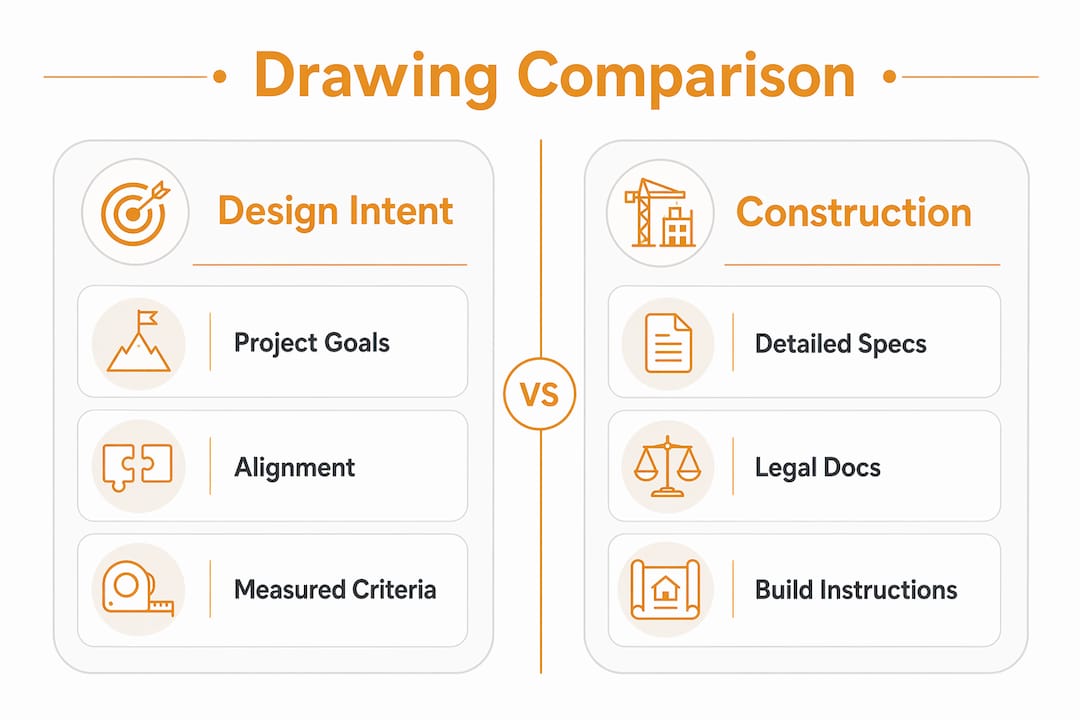
Construction drawings cannot be produced well without a clear design intent foundation. The intent drawing sets the targets. The construction drawing shows how those targets will be met in physical form.
What are the main purposes of design intent drawings?
Insufficient or missing design intent documentation leads to contractor assumptions, inflated bids, and unexpected change orders. That single fact explains why intent drawings exist. They protect the project from the cost and delay consequences of ambiguity.
The purposes of design intent drawings fall into four categories.
- Establishing performance standards: Intent drawings define measurable criteria such as acoustic ratings for partition walls, thermal resistance values for facades, or load capacity requirements for structural slabs. These criteria give contractors and engineers a clear target to price and design toward.
- Enabling accurate contractor pricing: When contractors understand the performance requirements, they price to meet them rather than padding bids to cover unknown risks. Proper design intent drawings reduce risks, improve pricing accuracy, and clarify scope for all parties.
- Preventing scope and vision loss: During construction, value engineering and substitution decisions can erode the original design. Intent drawings give the design team a defensible reference point for evaluating whether a proposed change still meets project goals.
- Aligning all stakeholders: Property owners, architects, structural engineers, M&E consultants, and contractors all read the same intent document. Misalignment between disciplines is identified and resolved before it becomes a construction problem.
Typical contents of a design intent drawing set include annotated floor plans, partition plans, reflected ceiling plans, furniture layouts, interior elevations, and key structural or assembly details. Each element carries notes that explain the design rationale, not just the geometry.
Pro Tip: Treat your design intent drawing as a living document during design development. Update it when decisions change. A stale intent document is almost as harmful as no document at all.
How to create effective design intent drawings
Design intent drawings are most effective when based on system-level performance targets rather than product names. Specifying “a partition system achieving STC 50 acoustic rating” is more defensible than specifying a particular manufacturer’s product. It allows technical substitution without losing the intent.
The following process produces intent drawings that hold up through design development and construction.
- Define each system clearly. For every major building system, document what it is, where it occurs in the building, and how it functions. A structural transfer beam, for example, needs a description of the loads it carries, the spans it covers, and the performance it must deliver, not just its location on a plan.
- Set measurable performance criteria. Replace vague preferences with quantified targets. Thermal resistance, acoustic performance, structural capacity, and fire rating are all measurable. Vague language like “high quality” or “premium finish” creates disputes. Specific criteria create accountability.
- Limit detail to what defines success. Experts recommend limiting design intent drawings to key details that define success criteria rather than overloading them with full construction details early. Over-specifying too early removes flexibility and increases the cost of design changes.
- Conduct iterative reviews. Circulate draft intent drawings to all discipline leads, including structural, M&E, and architectural teams, before finalizing. Conflicts between disciplines are far cheaper to resolve on paper than on site.
- Integrate with BIM workflows. In Autodesk Revit or similar BIM platforms, design intent can be embedded directly into model elements as parameter data. This links the intent to the geometry and makes it accessible throughout the project lifecycle.
- Document design rationale alongside decisions. Successful projects require both explicit design rationale and design intent, which help project managers explore alternative solutions while maintaining project goals. Record why decisions were made, not just what was decided.
Treating design intent as a defensible system with measurable criteria rather than vague preferences facilitates fair value engineering discussions. When a contractor proposes a substitution, the intent document tells you objectively whether the substitution meets the project’s requirements. That objectivity protects both the owner and the design team. For more on managing specification changes during this process, the guide on value engineering in design-build projects provides practical context.
Examples of design intent drawings across project types
Design intent in structural design refers to the purpose, function, and performance requirements guiding material choices, load paths, and connections. It explains the logic behind structural decisions and expected building behavior under various conditions. That definition applies equally to architectural and interior design intent drawings, where the logic behind spatial decisions, material selections, and system configurations is documented with the same rigor.
The following table shows common design intent drawing types and their practical purpose across project phases.
| Drawing Type | What It Documents | Who Uses It |
|---|---|---|
| Annotated floor plan | Room functions, adjacency requirements, circulation logic | Architects, owners, contractors |
| Partition plan with key notes | Wall types, acoustic ratings, fire ratings by zone | Structural engineers, contractors |
| Reflected ceiling plan | Lighting zones, acoustic treatment, service integration | M&E engineers, interior designers |
| Interior elevation with rationale | Material intent, finish standards, spatial proportions | Interior designers, contractors |
| Structural system summary | Load paths, transfer elements, performance criteria | Structural engineers, project managers |
| M&E performance schedule | Ventilation rates, cooling loads, electrical capacity | M&E consultants, contractors |
Design intent drawings serve a coordination function across all project phases. During design development, they align discipline consultants before detailed drawings are produced. During procurement, they give contractors the context to price accurately. During construction, they give the site team a reference for resolving field queries without escalating every decision back to the design team.
Designers emphasize that detailed design intent documentation gives owners greater control over the final outcome, reducing the risk of divergence from the original vision. For property owners in particular, this control is the primary value of intent documentation. You do not need to understand every technical detail of a construction drawing. You do need to understand and approve the intent drawing, because that document represents your project goals.
Design intent drawings also allow progressing documentation in days rather than weeks by concentrating on high-impact elements. That efficiency benefit is significant on fast-track projects where design and procurement overlap. Software formats commonly used include AutoCAD for 2D documentation, Autodesk Revit for BIM-integrated intent, and PDF annotation tools for distributing marked-up drawings to project teams. For context on how intent drawings relate to the broader project documentation record, the guide on as-built drawings explains where intent documentation sits in the full project lifecycle. Incomplete documentation at any stage is also a leading factor in submission delays, making early intent clarity a practical risk management measure.
Key takeaways
A design intent drawing is the foundational project document that defines performance criteria, aligns all stakeholders, and protects the original vision from concept through construction.
| Point | Details |
|---|---|
| Definition and purpose | Design intent drawings document what a project must achieve and why, before construction details are finalized. |
| Distinct from construction drawings | Intent drawings focus on goals and performance; construction drawings carry legal standing and precise build instructions. |
| Core contents | Annotated floor plans, partition plans, reflected ceiling plans, interior elevations, and system performance criteria. |
| Creation best practice | Use measurable performance criteria and system descriptions rather than product names to allow fair value engineering. |
| Owner benefit | Detailed intent documentation gives property owners direct control over project outcomes and reduces costly scope disputes. |
Why design intent documentation is underused and undervalued
Most project disputes I have seen trace back to the same root cause: the design intent was never written down clearly. Everyone assumed they understood the goal. The architect thought the owner wanted a certain aesthetic. The contractor priced to a different standard. The structural engineer designed to minimum code. All three were technically correct within their own frame of reference. None of them were aligned.
The misconception I encounter most often is that design intent drawings are only relevant on large or complex projects. Property owners on smaller residential or commercial fit-out projects frequently skip this step, assuming the concept drawings are sufficient. They are not. A concept drawing shows what something looks like. An intent drawing explains what it must do and to what standard. Those are fundamentally different documents.
The other common mistake is treating intent drawings as a one-time deliverable produced at the start of design and never revisited. Design intent evolves as the project develops. When a structural constraint forces a layout change, or when a budget review requires a specification review, the intent drawing must be updated to reflect the revised goals. A frozen intent document that no longer reflects current project decisions is actively misleading.
The industry trend toward BIM-integrated project delivery is improving this. When intent is embedded in model parameters within Autodesk Revit or similar platforms, it travels with the geometry through every design iteration. That integration reduces the risk of intent and documentation falling out of sync. For property owners and professionals working on projects in Singapore, establishing clear design intent early is also directly relevant to authority submission quality. Submissions to BCA, URA, and HDB that are grounded in well-documented intent tend to progress more predictably through review.
— Aman
How stellar structures supports your design intent
Stellar Structures brings engineering precision to the design intent process across civil, structural, and architectural projects in Singapore. When your intent drawings need to be tested against real structural constraints, load requirements, or regulatory standards, the firm’s civil and structural design checks service provides the technical validation that keeps your documentation accurate and your project on track.

Clear intent documentation leads to accurate contractor pricing, fewer change orders, and authority submissions that reflect what you actually intend to build. Whether you are a property owner defining project goals or a construction professional aligning a multidisciplinary team, Stellar Structures provides the engineering expertise to support your design intent from documentation through delivery. Contact the team to discuss your project requirements.
FAQ
What is the design intent definition in construction?
Design intent is the documented explanation of what a project must achieve, expressed in terms of systems, performance criteria, and outcomes rather than final technical specifications. It guides all design and construction decisions without prescribing the exact method of delivery.
How do design intent drawings differ from construction drawings?
Design intent drawings focus on project goals and performance requirements, while construction drawings provide the precise dimensions, materials, and compliance data required to build. Construction drawings carry legal and regulatory standing; intent drawings do not.
What are the key elements of a design intent drawing?
Key elements include annotated floor plans, partition plans with acoustic and fire ratings, reflected ceiling plans, interior elevations with material rationale, and system performance summaries covering structural, M&E, and architectural requirements.
Why does missing design intent documentation cause problems?
Missing intent documentation leads contractors to make assumptions when pricing and building, which produces inflated bids, scope disputes, and unexpected change orders. Clear intent drawings reduce these risks by giving all parties a shared, measurable reference.
When should design intent drawings be produced?
Design intent drawings are produced during the early design and development phase, after concept approval but before detailed construction drawings begin. Updating them throughout design development maintains alignment as project decisions evolve.
Recommended
- What Is an As-Built Drawing? A Professional Guide
- What Is a Structural Drawing? A Guide for Property Owners
- What Is a Design Build Contractor Role: A Clear Guide
- What Is a Design Build Program: A Developer’s Guide