





An independent checking engineer (ICE) is defined as a qualified, third-party professional who verifies that construction designs, systems, and completed works meet technical, safety, and regulatory standards without any conflict of interest. For property owners, developers, and construction professionals in Singapore, the question of why engage an independent checking engineer has a direct answer: unbiased expert oversight protects your project from costly errors, regulatory failures, and lender disputes that internal teams cannot objectively prevent. Singapore’s regulatory bodies, including the Building and Construction Authority (BCA), operate within frameworks that recognize the critical value of independent verification. Engaging an ICE early is not a procedural formality. It is a technical and financial safeguard that shapes project outcomes from design through completion.
Why engage an independent checking engineer for your project?
The core benefit of engaging an independent checking engineer is early risk identification. Independent review leads to measurable ROI by catching design conflicts during the planning phase, where corrections cost a fraction of what field rework demands. A design error identified on paper takes hours to fix. The same error discovered during construction can cost weeks of delay and significant capital.
The benefits of independent checking engineers extend well beyond error detection:
- Unbiased design verification. An ICE reviews drawings and specifications without loyalty to the designer or contractor, producing objective findings that internal teams cannot replicate.
- Regulatory compliance assurance. ICE reviews confirm alignment with BCA building codes, structural standards, and permit conditions before works proceed, reducing the risk of enforcement action.
- Conflict of interest elimination. Contractors and original designers have commercial incentives to minimize reported problems. An independent party has none.
- Lender certification support. Many project financing arrangements require ICE sign-off before drawdown payments are released, directly linking independent verification to cash flow.
- Improved design coordination. ICE reviews surface clashes between structural, civil, and M&E systems before they become field problems, improving cross-discipline coordination.
The cost of engaging an ICE is negligible compared to potential project losses from failure, rework, or non-compliance. That cost comparison alone justifies early engagement on any project of meaningful scale.
Pro Tip: Engage your ICE during the schematic design phase, not after construction documents are finalized. The earlier the review, the lower the cost of any corrections identified.
How does an independent checking engineer differ from other project engineers?
The distinction between an ICE and other engineering roles is one of purpose and loyalty. Understanding this difference clarifies the specific value an independent checking engineer brings to any project team.

| Role | Primary Obligation | Scope of Work | Independence Level |
|---|---|---|---|
| Original designer | Client (design quality) | Produce compliant design | Low (author of the work) |
| Contractor’s engineer | Contractor (execution) | Resolve site issues | Low (commercial interest) |
| Owner’s engineer | Owner (project advocacy) | Monitor progress, advise | Moderate (client-aligned) |
| Independent checking engineer | Technical standards | Verify and certify | High (no project stake) |
The original designer cannot objectively check their own work. The contractor’s engineer has a commercial interest in minimizing reported deficiencies. The owner’s engineer advocates for the client’s position, which may not always align with impartial technical judgment. Independent engineers produce certification documents that govern lender decisions, a function that is entirely distinct from advisory or execution roles.
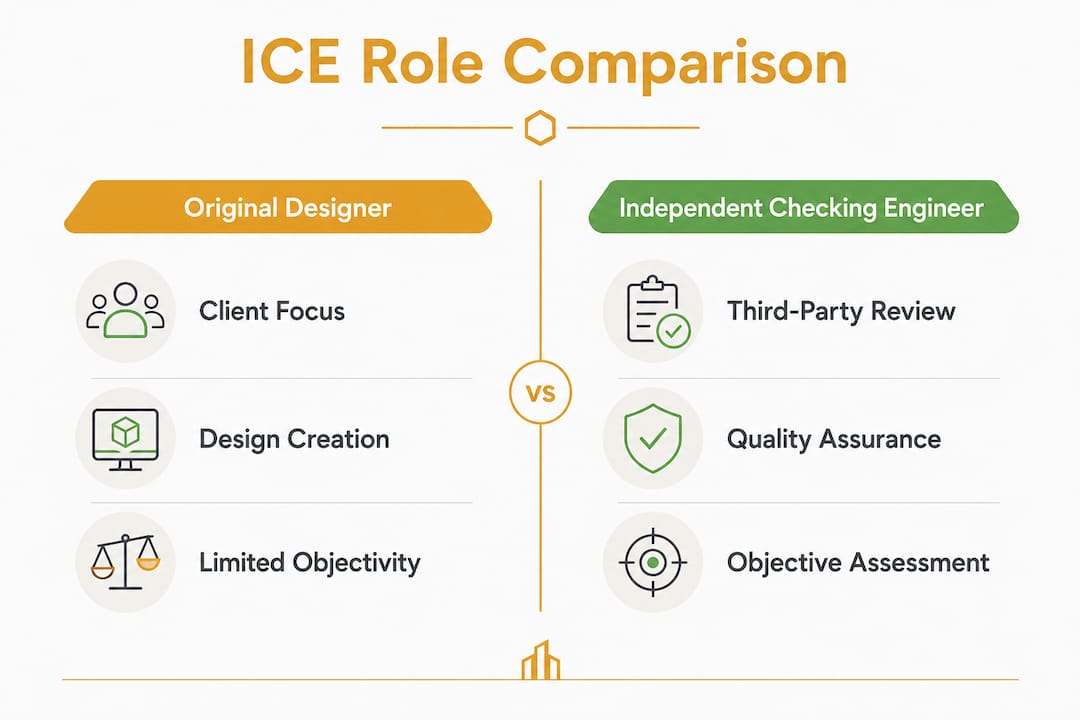
Modern construction contracts, including those structured under FIDIC frameworks, reflect an inherent tension between serving the employer and making impartial technical determinations. Independent engineers resolve this tension by providing external validation that protects all parties from the consequences of biased reporting. This is especially relevant in Singapore, where structural design checks must satisfy BCA requirements and where authority submissions carry legal weight.
Pro Tip: When briefing your ICE, provide complete design packages including geotechnical reports and M&E coordination drawings. Incomplete submissions are the single most common cause of review delays.
What is the ICE’s impact on project financing and regulatory compliance in Singapore?
The relationship between ICE certification and project financing is direct and consequential. Lenders and regulatory frameworks increasingly require independent engineering verification to manage systemic project risks and control drawdown payments. This means your ICE’s certification schedule is not a separate administrative track. It is embedded in your funding timeline.
The practical implications for Singapore developers and property owners are significant:
- Drawdown dependency. Lenders release construction funds in tranches tied to verified milestones. ICE certification of each milestone is the trigger. Delays in ICE sign-off directly stall payments.
- BCA compliance verification. ICE reviews confirm that structural and civil works comply with Singapore’s building codes and approved permit conditions at each stage of construction.
- Objective progress reporting. Institutional lenders expect independent engineers to act as impartial circuit breakers against contractor self-reporting bias. This protects lenders and owners equally.
- Insurance and financial viability. Independent validation sustains project trust with insurers and financiers, reducing risk premiums and improving overall project bankability.
- Documentation integrity. ICE reports create a verified paper trail that supports authority submissions to BCA, URA, HDB, JTC, and other Singapore regulatory bodies.
The IE certification cycle is the primary driver of project cash flow. Delays in documentation can stall drawdown payments and cause severe working capital pressure. That pressure compounds quickly on large projects where monthly financing costs are material. Treating ICE engagement as a procedural obligation rather than a core technical milestone is the most common and most expensive mistake developers make.
Singapore’s regulatory environment adds another layer of urgency. The BCA mandates specific checking requirements for structural works, and non-compliance carries enforcement consequences that extend beyond financial penalties to project suspension. An ICE familiar with Singapore’s authority submission processes, including those for accredited checking requirements, provides a material advantage in navigating these obligations efficiently.
When and how should you engage an ICE to maximize project benefits?
Timing is the single most controllable variable in ICE engagement. Skipping early independent design review leads to hidden design conflicts and costly field corrections that impact both schedule and budget. The right time to engage an ICE is during the design development phase, before construction documents are issued for tender.
The following practices define effective ICE integration:
- Appoint early. Bring the ICE on board during schematic or design development. Fresh eyes on early-stage drawings catch coordination gaps before they are locked into construction documents.
- Integrate review milestones into the project schedule. ICE review periods must appear on the master program as fixed durations, not as floating tasks that get compressed when other activities run late.
- Assign a dedicated liaison. One person on the project team should own the ICE relationship, managing document submissions, responding to queries, and tracking certification status.
- Treat reviews as technical checkpoints. Independent verification ensures systems meet performance standards without bias. Approaching ICE reviews as quality gates rather than bureaucratic hurdles changes how project teams prepare submissions.
- Avoid late engagement. Engaging an ICE after construction has started limits the value of independent review to deficiency identification rather than prevention. Prevention is always cheaper.
The importance of independent engineers is amplified when projects involve complex structural systems, phased construction, or multiple authority submissions. In these scenarios, ICE involvement from the outset provides continuity of technical oversight that protects the project across its full lifecycle. Firms with experience in Singapore’s regulatory environment, such as those managing submissions to BCA, URA, and JTC, bring additional value by aligning ICE review outputs with authority submission requirements from the start.
Pro Tip: Build a two-week ICE review buffer into every major design submission milestone. This buffer absorbs query response time without pushing the overall program.
For developers working with international engineering education and professional development standards, resources from organizations like IET Hamburg provide useful context on global best practices for independent technical verification in construction projects.
Key Takeaways
Engaging an independent checking engineer from the design phase is the most cost-effective way to protect project quality, regulatory compliance, and lender confidence throughout construction.
| Point | Details |
|---|---|
| Engage early in design | ICE involvement during design development prevents costly field corrections and rework. |
| ICE drives cash flow | Lender drawdown payments depend on ICE certification, making review timelines a financing issue. |
| Independence eliminates bias | ICEs have no commercial stake in the project, producing objective findings contractors cannot. |
| BCA compliance is non-negotiable | ICE reviews confirm alignment with Singapore building codes and authority permit conditions. |
| Late engagement costs more | Appointing an ICE after construction starts limits review to deficiency detection, not prevention. |
The case for treating ICE engagement as a project priority, not a formality
From my experience working across Singapore construction projects of varying scale and complexity, the pattern is consistent: teams that treat independent checking as a box-ticking exercise pay for it later. The payment comes in the form of stalled drawdowns, rework orders, and authority queries that could have been resolved at the design stage for a fraction of the cost.
What I have observed is that the most successful project teams do not view the ICE as an external critic. They treat the ICE as a technical resource whose findings improve the quality of the final product. That shift in mindset changes how teams prepare submissions, how quickly they respond to queries, and how much value they extract from the review process.
The cultural resistance to independent checking often comes from a misplaced concern about cost. The ICE fee is real. The cost of a single major rework event, a delayed drawdown, or a BCA enforcement notice is orders of magnitude larger. Developers who have experienced one of those events rarely question the value of independent verification again.
My advice is straightforward: build the ICE into your project governance structure from day one, give them complete information, and treat their review schedule as a critical path item. Projects that do this consistently outperform those that do not, on budget, on schedule, and on compliance.
— Aman
Engineering solutions that support independent project oversight
Property owners and developers who want to align their project teams with Singapore’s regulatory and technical requirements benefit from working with firms that understand both the design and the compliance dimensions of construction.

Stellar Structures provides integrated design engineering services in Singapore that complement independent checking engineer requirements across civil, structural, geotechnical, and M&E disciplines. The firm manages authority submissions to BCA, URA, HDB, JTC, SCDF, and other regulatory bodies, ensuring that design outputs are structured to support ICE review and approval processes from the outset. For developers seeking a coordinated approach to structural and design checks, Stellar Structures brings the technical depth and regulatory familiarity that complex Singapore projects demand.
FAQ
What is an independent checking engineer?
An independent checking engineer (ICE) is a qualified third-party professional who verifies that construction designs and completed works meet technical, safety, and regulatory standards without any conflict of interest or commercial stake in the project outcome.
Why do lenders require an independent checking engineer?
Lenders require ICE certification to control drawdown payments and manage project risk. Independent engineer sign-off on verified milestones is the primary mechanism lenders use to confirm that funds are released only for completed, compliant work.
When should you engage an independent checking engineer?
Engage an ICE during the design development phase, before construction documents are issued for tender. Early engagement allows the ICE to identify design conflicts when corrections are least expensive and most effective.
How does an ICE differ from the project’s structural engineer?
The project’s structural engineer produces the design and has a professional stake in its acceptance. The ICE reviews that design independently, with no obligation to the designer or contractor, producing objective findings that govern certification and lender decisions.
Is ICE engagement required under Singapore building regulations?
Singapore’s BCA mandates independent checking for structural works on qualifying projects. Engaging an accredited checker or independent checking engineer is a legal requirement for many building categories, not an optional quality measure.
Recommended
- Professional Engineer Singapore: Qualifications and Role
- Why Engage a Structural Checker for Your Project
- Hiring a Structural Engineer for Renovation in Singapore
- The Professional Engineer in Singapore: A Definitive Guide to Endorsement, Responsibilities, and Liabilities