





Scaffolding inspection is mandatory in Singapore under the Workplace Safety and Health (Scaffolds) Regulations 2011, which establish legally binding obligations for all construction sites where scaffolds are erected, used, or dismantled. Every scaffold must be inspected by a trained scaffold supervisor upon completion and at intervals not exceeding 7 days, or sooner if the structure has been exposed to weather conditions likely to have affected its stability. For complex scaffold types, a Professional Engineer (PE) must conduct the inspection and issue a formal certificate. Inspection results must be recorded in a register maintained at the workplace, and a safety status notice must be displayed on the scaffold immediately after each inspection.
The core reasons scaffolding inspection is required in Singapore are:
- Legal obligation: Regulation 26 of the Workplace Safety and Health (Scaffolds) Regulations 2011 mandates periodic inspection by a trained scaffold supervisor.
- Structural safety: Inspections verify that the scaffold remains fit for use and identify defects before they cause accidents.
- PE certification: Certain scaffold types, including cantilevered and jib support scaffolds, require inspection and certification by a Professional Engineer.
- Documentation: Inspection registers and safety notices must be maintained and made available to authorities on request.
- Enforcement: Non-compliance exposes the occupier to severe legal penalties.
Why scaffolding inspection is required under Singapore law
The Workplace Safety and Health (Scaffolds) Regulations 2011, enacted under the Workplace Safety and Health Act, apply to every workplace in Singapore where a scaffold is constructed, erected, installed, used, repositioned, altered, maintained, repaired, or dismantled. This scope is deliberately broad. Under Singapore law, the term “scaffold” encompasses even small aluminum tower scaffolds used as access or working platforms, meaning inspection requirements apply regardless of the structure’s height or apparent simplicity.
Regulation 26 is the operative provision. It prohibits any scaffold from being put into use unless a trained scaffold supervisor has inspected it upon completion and thereafter at intervals not exceeding 7 days, or after any event likely to have affected its stability, whichever comes first. The occupier of the workplace carries primary legal responsibility for compliance. Failure to observe these intervals or to maintain the required inspection register can result in severe legal penalties for the occupier.
For complex scaffold configurations, the regulatory obligations are more demanding. Cantilevered or jib support scaffolds, defined as structures projecting beyond a fulcrum or point of attachment without direct ground support, must be constructed in accordance with design documentation prepared by a Professional Engineer. The PE must examine the scaffold for safety and issue a certificate before the structure is put into use, with periodic PE inspections required at least every 3 months thereafter. PE design documents and inspection certificates must be kept on site and produced to authorities upon request.
The Singapore Standard Code of Practice for Scaffolding, SS 659:2020, supplements the statutory requirements by providing technical guidance on scaffold design, erection, and inspection procedures. While SS 659:2020 is a standard rather than a statute, the Ministry of Manpower references it as the benchmark for technical compliance, and adherence to its checklists supports a defensible compliance position during regulatory audits.
Key legal obligations at a glance:
- All scaffolds must be inspected by a trained scaffold supervisor upon completion and at intervals not exceeding 7 days.
- Inspections must also occur after any event affecting scaffold stability, such as severe weather.
- Cantilevered and jib support scaffolds require PE design, PE inspection, and a PE-issued certificate before use.
- PE inspections for complex scaffolds must occur at least every 3 months.
- Inspection results must be entered into a register before the scaffold is put into use.
- The register must be maintained at the workplace and produced to inspectors on request.
- A safety status notice must be displayed on the scaffold immediately after each inspection.
How inspections protect workers and site integrity
The safety rationale behind mandatory scaffold inspections is direct: scaffolding failures are largely preventable, and most incidents result from defects that a trained inspector would have identified. Small issues in connections, load distribution, or base plate settlement can escalate quickly under working loads, particularly when site conditions change or weather events occur.

Pro Tip: Treat the 7-day inspection interval as a minimum, not a schedule. The Singapore Standard SS 659:2020 explicitly encourages trained scaffold supervisors to conduct pre-use checks by workers as an additional layer of safety culture, beyond what the regulations strictly require.
Only trained scaffold erectors under the immediate supervision of a qualified scaffold supervisor may construct, alter, or dismantle scaffolds. This personnel requirement is not administrative. It reflects the regulatory recognition that competence at the point of erection directly determines the safety of the structure throughout its service life. Integrating construction safety best practices into daily site operations reinforces this principle beyond the minimum inspection cycle.
Common defects identified during scaffold inspections include:
- Missing or improperly secured guardrails and toe boards.
- Inadequate or displaced base plates and sills.
- Loose or missing couplers and connections.
- Damaged, corroded, or deformed tubes and frames.
- Overloaded platforms or materials stored beyond load limits.
- Inadequate ties to the permanent structure.
- Blocked or missing access ladders and stairways.
- Incomplete or missing bracing at required intervals.
A standard inspection checklist under SS 659:2020 addresses each of these categories systematically, covering structural components, platform integrity, access provisions, load capacity, and the condition of all connections. Inspectors also verify that the scaffold configuration matches the approved erection drawing and that load capacity postings are current and visible.
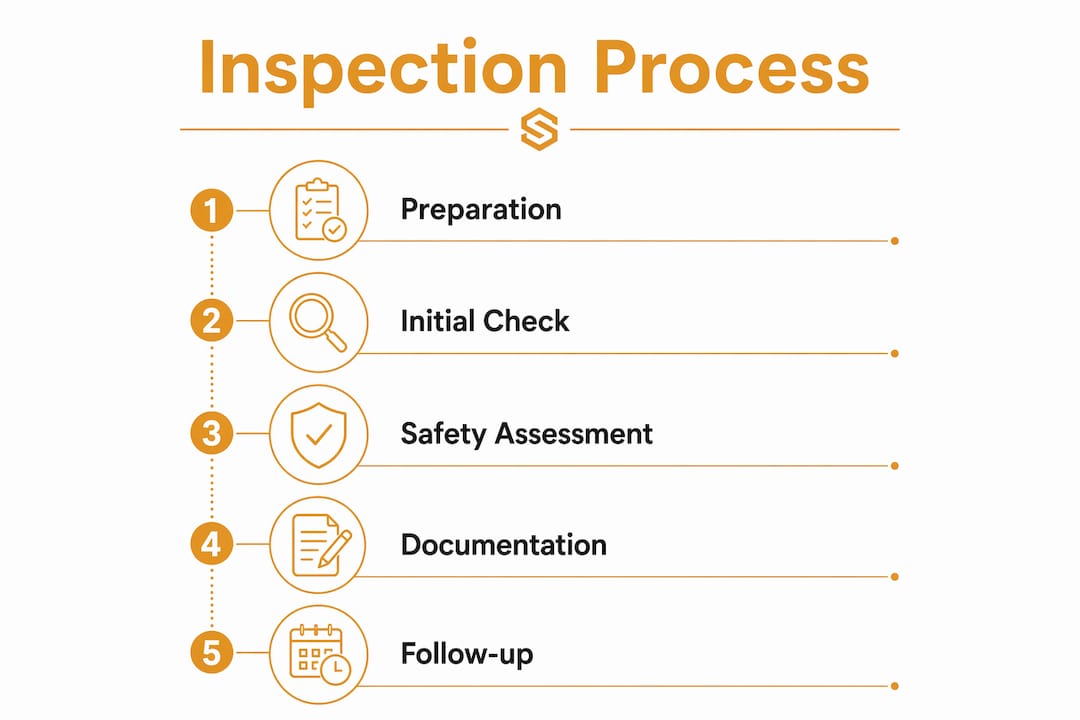
Documentation and labeling requirements after each inspection
Post-inspection documentation is not a formality. It is a legal requirement with direct enforcement consequences. Immediately after each inspection, the scaffold supervisor must display a safety status notice on the scaffold, communicating to all site personnel whether the structure is safe for use. This notice must be updated after every inspection cycle.
The inspection register is the primary compliance record. Every inspection, including ad-hoc inspections conducted after weather events or incidents, must be entered into the register with the date, findings, and the name of the inspector. Periodic 7-day inspections alone are insufficient if post-weather checks are not also recorded. Failure to document ad-hoc inspections weakens the legal defense during Ministry of Manpower audits and can constitute a separate regulatory breach.
Documentation requirements in practice:
- Safety status notice displayed on the scaffold immediately after each inspection.
- Inspection register maintained at the workplace with entries for every inspection.
- Register entries must include date, findings, and inspector identification.
- Post-weather and post-incident inspections recorded separately from periodic checks.
- For PE-inspected scaffolds, PE certificates and design documents kept on site.
- All records produced to authorities upon request without delay.
Proper documentation also functions as a project management tool. When construction scheduling software integrates inspection records with project timelines, site managers can track compliance status across multiple scaffold structures and flag overdue inspections before they become violations.
Expert perspective on compliance and safety culture from Stellar Structures
Compliance with Singapore’s scaffolding inspection requirements depends on more than knowing the regulations. It requires trained personnel, locally recognized certification, and a site culture that treats inspections as operational necessities rather than administrative obligations.
Training and certification carry particular weight in Singapore’s regulatory framework. The Ministry of Manpower recognizes specific WSQ courses, namely the “WSQ: Perform Metal Scaffold Erection Course” and the “WSQ: Supervise Metal Scaffold Erection Course,” as the acceptable qualifications for scaffold erectors and supervisors respectively. Generic or overseas training does not fulfill these requirements. Foreign credentials may not reflect the scaffold types and site conditions common in Singapore, and relying on them exposes both the worker and the occupier to compliance risk.
Stellar Structures advises construction professionals and property owners to approach the mandatory 7-day inspection as a floor, not a ceiling. Pre-use checks by workers, encouraged under SS 659:2020, create an additional layer of hazard identification that formal inspections alone cannot replicate. The role of a Professional Engineer in certifying complex scaffold types adds a further verification layer that protects both structural integrity and legal standing.
Key compliance principles:
- Scaffold supervisors and erectors must hold locally recognized WSQ qualifications.
- Overseas or in-house training does not satisfy Ministry of Manpower requirements.
- Pre-use checks by workers supplement, but do not replace, formal supervisor inspections.
- Documentation practices should be treated as a project management discipline, not a compliance afterthought.
- PE involvement for complex scaffolds must be planned at the design stage, not retrofitted after erection.
Scaffolding inspection in Singapore is required by law, grounded in structural safety principles, and enforced through documentation and certification obligations that apply to every scaffold on every workplace. The Workplace Safety and Health (Scaffolds) Regulations 2011 set the minimum standard; SS 659:2020 provides the technical framework; and trained, locally certified personnel execute both. Non-compliance carries legal penalties for occupiers and, more critically, places workers at direct risk.
For projects requiring structural compliance support, Stellar Structures provides civil and structural design checks that help construction professionals and property owners meet Singapore’s regulatory requirements from design through inspection.

Key Takeaways
Scaffolding inspection in Singapore is a statutory obligation under the Workplace Safety and Health (Scaffolds) Regulations 2011, requiring trained supervisors to inspect every scaffold at intervals not exceeding 7 days and after any stability-affecting event.
| Point | Details |
|---|---|
| Legal basis | Regulation 26 of the WSH (Scaffolds) Regulations 2011 mandates inspection upon completion and at intervals not exceeding 7 days. |
| PE requirement | Cantilevered and jib support scaffolds require PE inspection, certification, and periodic PE checks at least every 3 months. |
| Documentation | Every inspection must be recorded in a register at the workplace; safety status notices must be displayed immediately after each check. |
| Personnel standards | Only WSQ-certified scaffold erectors and supervisors meet Singapore’s Ministry of Manpower requirements; overseas training does not qualify. |
| Penalties | Failure to maintain inspection intervals and registers exposes the occupier to severe legal penalties under Singapore law. |
Recommended
- Structural & Façade Inspections in Singapore
- Building Owners in Singapore Must Conduct Periodic Facade Inspections Regularly Now – Stellar Structures
- Importance Of Regular Facade Inspections For Building Owners In Singapore To Prevent Accidents – Stellar Structures
- Periodic Facade Inspection for CBD buildings in Singapore – Stellar Structures