




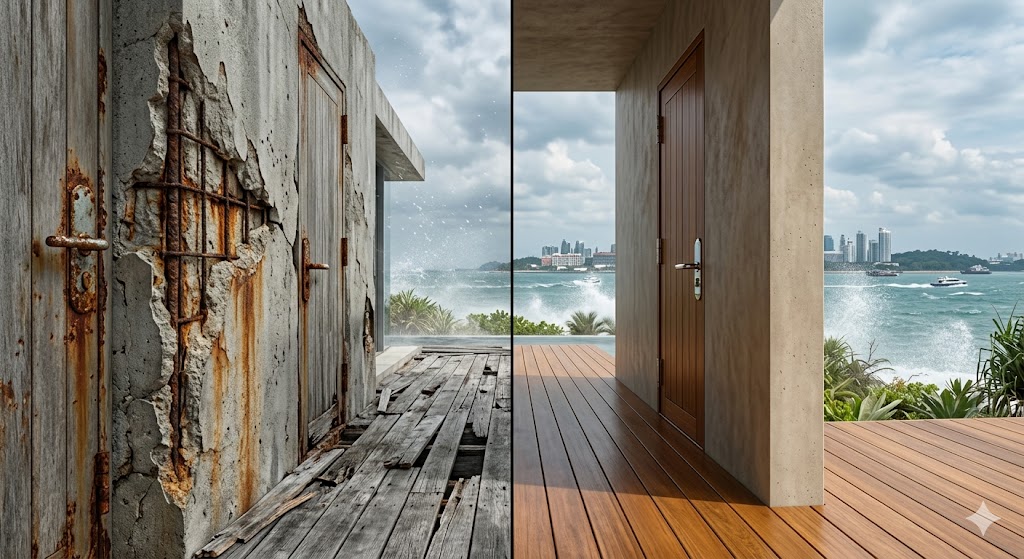
How Coastal Salt Air Affects Structural Integrity: A Guide For East Coast And Sentosa Property Owners
Introduction To Coastal Environmental Hazards
Understanding how coastal salt air affects structural integrity is vital. East Coast and Sentosa property owners face severe environmental challenges. Singapore features a highly punishing tropical marine climate. This unique climate drastically accelerates material degradation processes.
High humidity and oceanic winds create a perfect storm. Consequently, building materials decay much faster here than elsewhere. Coastal salt air carries corrosive chloride ions far inland. These airborne particles settle onto building facades daily.
Over time, moisture facilitates the ingress of these ions. This invariably leads to severe structural degradation.
Sentosa property owners must proactively manage these environmental threats. Ignoring these risks leads to catastrophic structural failures. Furthermore, property maintenance costs escalate rapidly without early intervention. East Coast residents face identical coastal weathering phenomena daily.
Strong monsoon winds deliver relentless corrosive salt spray.1 Thus, preserving structural integrity requires comprehensive scientific knowledge. This guide provides an exhaustive analysis of coastal degradation. It thoroughly details mechanisms, repair strategies, and preventive maintenance.
The Microclimate Of Singapore Coastal Zones
The specific microclimate dictates how coastal salt air behaves. Singapore’s coastline experiences distinct and aggressive meteorological patterns. High moisture levels define the local corrosive atmosphere perfectly.
Wind Patterns And Salt Transport
Wind is the primary delivery mechanism for salt air. Sentosa wind speeds vary significantly throughout the day.2 Speeds frequently range between 2.2 and 8.9 mph.2 Furthermore, gusts regularly reach up to 6.7 mph.2
The wind direction in Sentosa is primarily East.2 The southwest monsoon brings incredibly strong coastal winds.1 These specific winds transport aerosolized salt particles inland.3
The wind blows predominantly from the south or south-east.1 This seasonal weather occurs mainly between June and September.1
East Coast properties receive direct exposure to these winds. The National Environment Agency recorded massive flotsam increases here. Flotsam volumes increased by almost 90 percent recently.1 This perfectly illustrates the power of monsoon wind currents.
The northeast monsoon also brings strong easterly winds.4 These winds blow intensely from November to April.4 Consequently, exterior building envelopes accumulate heavy salt deposits constantly.
Recent Sentosa Cove Weather Anomalies
Extreme weather events exacerbate standard coastal degradation issues. Sentosa Cove recently experienced highly unusual pink waters.5 Heavy and constant rainfall triggered massive algae blooms.5
The rain washed terrestrial nutrients directly into the water.6 This highlights the intense environmental runoff coastal properties endure. These chemical runoffs severely impact local marine microclimates.6 Consequently, Sentosa property owners must monitor environmental shifts closely.
Humidity And Temperature Factors
Singapore maintains exceptionally high atmospheric humidity levels year-round. Average humidity consistently hovers around 80 to 100 percent.7 Dew points frequently measure at 81 degrees Fahrenheit.7
High humidity creates a continuous microscopic film of moisture. This moisture rests permanently on all exposed structural surfaces. Consequently, electrochemical corrosion processes never truly stop.8 Sentosa property owners constantly battle this relentless atmospheric moisture.
Furthermore, high daily temperatures accelerate chemical reaction rates significantly. The mean daily temperature in Singapore is 27 degrees Celsius.9 This is significantly higher than temperate climates.9
Therefore, coastal salt air affects structural integrity much faster here. The Sentosa Development Corporation acknowledges these severe urban heat issues. They recently initiated the comprehensive Cooling Sentosa Roadmap.10 This roadmap utilizes the Physiological Equivalent Temperature metric.10 It targets a noticeable 4-degree Celsius improvement locally.10
Table 1 summarizes the Singapore coastal microclimate parameters.
| Microclimate Factor | Measured Data | Impact on Structures |
| Sentosa Wind Speed | 2.2 – 8.9 mph (6.7 mph gusts) 2 | Drives salt deep into porous materials. |
| Southwest Monsoon | South/South-East winds (Jun-Sep) 1 | Heavy seasonal salt spray accumulation. |
| Average Humidity | 80% – 100% 7 | Continuous electrochemical corrosion enablement. |
| Mean Temperature | 27 degrees Celsius 9 | Exponential acceleration of chemical degradation. |
The Chemistry Of Coastal Salt Air Degradation
Understanding the chemistry is essential for structural preservation. Coastal salt air affects structural integrity through specific reactions. Chloride ions and carbon dioxide are the primary culprits.
Chloride-Induced Steel Corrosion
Airborne chlorides are highly destructive to structural metals. Oceanic winds carry sodium chloride particles inland endlessly. These salt particles settle on concrete and metal surfaces.11 Salt acts as a powerful natural desiccant environmentally.3 It pulls vital moisture out of surrounding building materials.3
When dissolved in water, chloride ions penetrate porous surfaces.11 They migrate inward through intricate concrete capillary networks.11 Upon reaching embedded steel reinforcement, total destruction begins immediately.
Chlorides break down the steel’s natural protective passivation layer.12 Free chloride ions directly cause severe reinforcing steel corrosion.11 The oxidation of iron creates iron oxide, or rust. This process is highly expansive and structurally destructive. Rust expands up to seven times its original volume.13 This incredible expansion generates massive internal structural pressure continuously.
The Role Of Carbonation
Carbonation compounds the immense dangers of chloride-induced corrosion. Carbon dioxide from the atmosphere penetrates porous concrete.13 It reacts with calcium hydroxide inside the concrete matrix.13 This specific chemical reaction forms dense calcium carbonate.13 This reaction significantly lowers the concrete’s internal pH level.13
Fresh concrete possesses high alkalinity that protects internal steel.12 Carbonation entirely strips away this excellent oxidation barrier.12
In Singapore, the measured carbonation rate is exceptionally high.9 Tropical temperatures accelerate the rapid diffusion of carbon dioxide.9 Carbonation rates reach 5.5 to 8.6 mm/year^0.5.9 Temperate climates measure only 1 to 3 mm/year^0.5.9
When carbonation meets chloride ingress, corrosion rates multiply exponentially. A Portuguese study confirmed these combined deterioration effects comprehensively.14 The chloride threshold value ranges from 0.97 to 2.3 percent.15 Therefore, East Coast property owners face immense dual chemical threats.
Crevice And Localized Corrosion
Coastal environments foster highly specific types of localized corrosion. Crevice corrosion destroys metallic components very rapidly.16 Metal oxidation allows aggressive cation accumulation inside tight spaces.16 Chlorides transport directly into the occluded space seamlessly.16
This chemical movement maintains the charge neutrality perfectly.16 These autocatalytic cycles cause incredibly fast localized corrosion.16 Intermittent salt spray approximates true marine conditions perfectly.8 Wet and dry cycles accelerate these deterioration mechanisms heavily.8
Concrete Spalling: The Coastal Concrete Cancer
Concrete spalling is the most visible sign of structural failure. Industry professionals frequently refer to it as concrete cancer.13 Coastal salt air affects structural integrity primarily through spalling.
Mechanisms Of Concrete Spalling
Concrete spalling follows a highly predictable and preventable path.17 In chloride-rich climates, moisture infiltrates concrete very easily.17 Hairline cracks and surface porosity allow rapid water entry.17
Once moisture reaches the steel reinforcement, hidden corrosion initiates.17 As previously established, corroding steel expands massively internally.17 This massive expansion forces the surrounding concrete outward violently.17 The internal pressure physically breaks the solid concrete matrix.11
Cracking, flaking, and chunks breaking away are visible results.17 Surface delamination leaves the internal steel completely exposed.18 This direct exposure accelerates further corrosion and decay.18
Sentosa property owners must recognize these warning signs early. Progressive structural failure can ultimately compromise entire building safety.18 Substandard or incompatible building materials trigger rapid electrochemical reactions.13 Poor rebar placement drastically accelerates this entire destructive process.13
Visible Warning Signs
Identifying early warning signs prevents expensive structural rehabilitations. East Coast and Sentosa property owners should conduct regular inspections. The breakdown of steel-reinforced concrete exhibits specific visual indicators.13
Discolouration and staining are prominent early warning signs.18 Efflorescence deposits leave white salt stains behind.18
Owners must watch for reddish or brown rust stains.13 Look for rust leaking directly out of the concrete.13 Flaking, chipping, or peeling concrete surfaces indicate failure.19 Bubbling or blistering of the exterior concrete render happens.13 Visible exposure of rusting reinforcement steel is extremely dangerous.13 A hollow sound when tapping the surface indicates delamination.13
BCA Guidelines And Owner Liability
In Singapore, building structural safety is strictly regulated legally. The Building and Construction Authority enforces rigid safety guidelines.18 Spalling concrete represents a critical structural maintenance safety concern.18
The BCA requires property owners to maintain safe conditions.18 Falling concrete fragments create severe injury risks for pedestrians.18
Consequently, building owners hold significant personal legal liability.13 Delaying necessary repairs increases both risk and liability exposure.17 Furthermore, BCA mandates strict periodic building and facade inspections.20
Buildings above 20 years old require inspections every seven years.21 Buildings taller than 13 meters require these identical inspections.21 Owners must engage BCA-licensed contractors for structural repairs.18 Sentosa property owners must strictly adhere to these requirements.
The Cost Of Spalling Repairs
Understanding repair costs helps owners budget for property maintenance. The cost of repairing spalling concrete varies very widely. It depends entirely on damage severity and property type. For a simple HDB toilet spalling issue, costs remain low. The total cost averages around $300 in Singapore.22
The HDB co-pays 50 percent under the GRA scheme.21 This assistance covers up to $300 per flat.21 The Home Improvement Programme covers spalling for older flats.23 However, private coastal properties face vastly different financial realities. Sentosa property owners possess large, multi-story luxury estates.
Structural repair costs for private coastal homes escalate quickly. Deep structural epoxy injections and full-depth patching are expensive.18 Scaffolding and specialized marine-grade materials increase overall project costs. Postponing repairs guarantees that financial costs will double.17 Early stage damage requires only localized patching and preparation.17 Advanced damage demands comprehensive structural engineering interventions.18
Professional Concrete Repair Methodologies
Effective concrete repair requires highly specialized techniques and materials. Patching the surface without treating the steel is useless. Coastal salt air affects structural integrity deep within the matrix. Therefore, a comprehensive structural restoration approach is absolutely mandatory.13
Step-By-Step Spalling Repair Process
The industry-standard repair process involves several highly critical stages. East Coast property owners should understand this professional workflow perfectly. Contractors must strictly follow these structural restoration procedures.24
- Inspection: Engineers assess the depth and severity of damage.18
- Removal: Contractors hack away all loose and unsound concrete.13
- Preparation: The corroding reinforcing steel is fully exposed.13
- Treatment: Rust is removed, and anti-corrosion primers are applied.13
- Bonding: An acrylic bonding agent is applied to substrates.18
- Reinstatement: High-build, shrinkage-compensated repair mortar is troweled on.13
- Curing: The applied repair compound is allowed to cure.18
- Waterproofing: A protective waterproof coating is applied to finish.18
- Replastering: Walls are replastered and repainted for aesthetic matching.24
Material Selection For Concrete Repair
Choosing the correct repair compound is structurally vital. Different structural locations dictate very different material requirements entirely. Polymer-modified repair mortar is ideal for overhead ceilings.18 It offers superior adhesion and exceptional long-term durability.18
Epoxy resin is required for load-bearing structural repairs.18
It provides incredibly high compressive bond strength internally.18 Polyurethane sealants manage active thermal movement and prevent cracking.18 Hydraulic cement stops active water leaks almost immediately.18 CWP Waterproofing provides excellent professional concrete remediation services.18 Sentosa property owners must ensure contractors use marine-grade compounds.
Table 2 compares standard concrete repair materials used in Singapore.
| Repair Material | Best Application | Key Structural Advantage |
| Polymer-Modified Mortar | Ceilings, walls, columns 18 | High adhesion and structural flexibility. |
| Epoxy Resin | Load-bearing structural zones 18 | Extreme compressive bond strength. |
| Polyurethane Sealant | Moving cracks, dynamic joints 18 | High elongation and thermal flexibility. |
| Hydraulic Cement | Active water leaks 18 | Rapid hardening under water flow. |
Timber Degradation In Coastal Environments
Wood provides beautiful luxury aesthetics for modern coastal properties. However, coastal salt air affects structural integrity of timber rapidly. The marine environment is notoriously challenging for structural wood.25 Perpetual moisture exposure causes constant dimensional changes internally.25 Wood expands and shrinks, resulting in severe material weakness.25
The Desiccant Effect Of Salt
Salt acts as a powerful natural desiccant on wood.3 Airborne salt works its way into microscopic timber cracks.3 When ocean moisture evaporates, salt crystals remain behind permanently.3 These salt crystals expand and exert massive internal pressure.3
This internal pressure forces the wood fibers apart mechanically. Consequently, the affected timber appears noticeably fuzzy or frayed.26
The defibration of wood accelerates structural decay heavily.26 Furthermore, salt strips away natural protective wood oils.3 This leads to severe surface cracking, splitting, and silvering.3
On painted timber, trapped salt causes extreme bubbling.3
It also causes the paint layer to peel away.3 This leaves the underlying timber completely vulnerable to rot.3 Sentosa property owners with timber decks must remain vigilant. Marine organisms also attack and degrade submerged wood quickly.25
Nail Sickness And Fastener Corrosion
Timber deck collapse is a severe coastal safety hazard. “Nail sickness” is a primary cause of these failures.27 Rain floods the deck’s butt joints with corrosive water.27 Rainwater mixed with coastal saltwater cannot dry quickly.27
This creates ideal conditions for extreme fastener corrosion locally.27 The metal nail shanks lose diameter due to rust.27 Simultaneously, wood decay enlarges the surrounding nail hole.27 The fastener completely loses its structural grip on timber. This progressive failure inevitably leads to sudden deck collapse.27 East Coast property owners must utilize marine-grade stainless fasteners.
Timber Protection And Maintenance Strategies
Timber decking requires exceptionally high levels of ongoing protection.28 The level of required maintenance is extremely high.28 Sentosa property owners must actively remove accumulated salt crystals.28 Frequent power rinsing is required to wash salt away.28 Moist salt air challenges even the best luxury timber.28
After cleaning, applying a high-quality wood sealer is essential.29 Standard stains often trap moisture and cause premature rot.28 Marine-grade products like Cutek Extreme CD50 are highly recommended.28 These sealers penetrate deeply to protect wood from within.28 They keep corrosive salt air and sea-spray out effectively.28
Seal Once Marine is another excellent waterproofing wood sealer.29 It provides an eco-friendly, non-toxic formula for coastal homes.29 It is safe for marine life and coastal plants.29 Woodoc provides excellent water-borne marine deck maintenance waxes.30 Mretty engineers premium wood solutions for Singapore luxury homes.31 They use hydrophobic sealants and marine-grade alloys effectively.31
Metal Corrosion In Marine Atmospheres
Metals are highly susceptible to severe coastal environmental damage. Coastal salt air affects structural integrity of architectural metals aggressively. Atmospheric corrosion rates vary significantly by specific geographic location.32
Atmospheric Corrosion Rates
Marine environments feature extremely high atmospheric metal corrosion rates. Carbon steel corrodes incredibly rapidly in coastal atmospheres.33 An Italian study compared urban and marine corrosion rates.33 Carbon steel exposed to marine air degraded incredibly fast.33 Marine exposure reached corrosivity classes C4-C5 very easily.33
High chloride concentrations promote severe localized pitting corrosion.34 This localized pitting can perforate metallic materials and pipelines.34 In some marine environments, zinc corrosion rates are huge. They often exceed 10 micrometers per year locally.32 This is two orders of magnitude higher than indoors.32 Therefore, galvanized steel degrades very quickly on the coast.32 A G60 galvanized steel coating lasts only one year.32
Choosing Marine-Grade Materials
Material selection is the ultimate defense against metal corrosion. Coastal homes require specific marine-grade architectural metals for survival.35 Standard chrome-plated fixtures have extremely poor corrosion resistance.36 A typical chrome plating resists salt spray poorly.36 It only lasts 150 to 200 hours under testing.36
The chrome plating develops micro-cracks very easily and quickly.36 In salt-saturated environments, metal rusting speeds up significantly.36 Iron electrons shift quickly in these wet salt environments.36 Therefore, East Coast property owners must upgrade materials entirely.
Table 3 compares common architectural metals for coastal use.
| Material Type | Structural Strength | Corrosion Resistance | Coastal Suitability Notes |
| Stainless Steel (316) | High | Very High 37 | Best option for all marine architectural elements.37 |
| Stainless Steel (304) | High | Medium 37 | Prone to tea-staining; use 316 instead.38 |
| Galvanized Steel | Medium | Low-Medium 37 | Zinc coating degrades very quickly on coasts.32 |
| Aluminum | Medium | Medium 37 | Good for windows if specifically marine-treated.35 |
| Solid Brass / Bronze | Very High | Very High 37 | Superior luxury alternative to standard chrome fixtures.36 |
Type 316 stainless steel is the true gold standard.37 It contains molybdenum, which dramatically resists chloride pitting corrosion.38 For interior and exterior plumbing fixtures, solid brass excels.36
Brass contains negligible iron, rendering it highly corrosion-resistant.36 Polished brass requires sealing with a high-quality lacquer coating.36 While more expensive, it ensures long-term structural integrity.36 For minor metals like BBQs, use WD40 spray frequently.38
Masonry Damage: Efflorescence And Subflorescence
Masonry structures also succumb to coastal salt air degradation. Brick, stone, and grout are naturally porous building materials. They absorb salt-laden moisture from the humid coastal atmosphere.
The Mechanics Of Salt Weathering
Salt weathering is a major cause of masonry deterioration.39 Dissolved salts travel deeply through the pores of masonry.40 As the water evaporates, salts crystallize on the surface.40 This leaves a visible white, powdery deposit called efflorescence.40 While unsightly, surface efflorescence is mostly a cosmetic issue.41 However, it clearly indicates active moisture intrusion within properties.41
Subflorescence poses a far more severe structural threat entirely. Subflorescence occurs when salt crystallizes just beneath the surface.40 This dangerous process is formally known as cryptoflorescence.42 During crystallization, salts expand their volume by 1000 percent.40 This generates immense internal pressure within the rigid masonry.40
The internal crystallization pressure can reach 800 atmospheres easily.40 Disjoining pressure creates highly supersaturated solutions within the pores.42 Sodium sulphate creates irregular-sided crystals of mirabilite internally.42
A 1.5 nanometer liquid film separates the walls chemically.39 Crystallization pressure ranges from 41 to 73 MPa.43 This immense pressure easily destroys concrete, brick, and stone.40 Scandinavian neo-Gothic brick buildings display this specific damage frequently.44 Alveolar weathering creates clusters of depressions in stone surfaces.42
Identifying And Treating Efflorescence
Sentosa property owners must address efflorescence issues immediately. Ignoring it leads to structural damage and severe mold.41 Removing it requires a systematic and professional approach entirely.
Table 4 outlines the professional efflorescence treatment steps.
| Step Number | Treatment Action | Purpose and Description |
| Step 1 | Dry Brushing | Use stiff brushes to remove loose surface salts.41 |
| Step 2 | Acid Washing | Apply mild acid or vinegar to dissolve stains.45 |
| Step 3 | Source Repair | Identify and fix broken plumbing and wall cracks.41 |
| Step 4 | Waterproofing | Apply comprehensive non-hacking waterproofing to the surface.41 |
| Step 5 | Sealing | Apply specialized protective sealants to reduce porosity.41 |
Cleaning only treats the visual symptoms of the problem.41 Identifying the underlying water source is absolutely mandatory.41 Improve ventilation to reduce indoor humidity and moisture levels.45
Triton Construction provides excellent non-hacking waterproofing solutions in Singapore.41 9reno offers professional tile cleaning and efflorescence removal services.45
Advanced Concrete Protection: Silane-Siloxane Sealers
Protecting concrete from coastal salt air requires advanced chemistry. Standard acrylic sealants degrade rapidly under tropical UV rays. Acrylic concrete sealers require replacement every six to 36 months.46 Silane-siloxane water repellents offer superior long-lasting surface protection.47
The Science Of Hydrophobic Impregnation
Silane-siloxane sealers provide deep-penetrating protection for vulnerable concrete.47 They function as a highly effective invisible hydrophobic treatment.47 These molecules penetrate deeply into the concrete capillary network.48 They chemically bond with the silica in the concrete. This creates a highly effective, long-lasting water-repellent barrier.
Crucially, these advanced sealers allow water vapor to escape.47
Treated surfaces continue to “breathe” naturally without trapping moisture.48 Trapped moisture causes internal pressure and subsequent coating failure. Breathability prevents efflorescence, staining, and severe internal concrete spalling.47 They do not impair the natural characteristics of the surface.48 These sealers typically last up to ten years easily.48
Sikagard 705 L: The Marine Standard
For extreme marine environments, specialized Sika products are necessary. Sikagard 705 L is a premium reactive passive corrosion inhibitor.49 It is formulated specifically for reinforced concrete in marine environments.49 Sentosa property owners should mandate its use for exteriors.
Sikagard 705 L boasts a 99 percent active ingredient.49 It is based entirely on high-quality alkoxy silanes.49 It provides excellent penetration depth, exceeding 10 millimeters deep.49 It conforms to EN 1504-2 Class II penetration depth.49 This sealer is fully resistant to harsh sea water.49 Most importantly, it drastically reduces chloride ion diffusion rates.49
Testing highlights a significant reduction in chloride diffusion rates.49 Untreated concrete showed 13.1 x 10^-12 diffusion rates.49 Treated concrete dropped to 1.2 x 10^-12 diffusion rates.49 It prevents chloride migration from reaching the internal steel.49 Furthermore, it mitigates the active corrosion rate of steel.49 It drastically increases the electrical resistivity of the concrete.49 This effectively halts the electrochemical corrosion currents from flowing.49 It has a low VOC content of 327 g/l.49
Table 5 summarizes the technical specifications of Sikagard 705 L.
| Specification | Technical Measurement | Certification Standard |
| Active Ingredient | 99% Alkoxy silanes 49 | Polymer Institute Ref 49 |
| Penetration Depth | >10 mm (Class II) 49 | EN 1504-2 49 |
| VOC Content | ~327 g/l 49 | ASTM D 3960 49 |
| Water Vapor Permeability | 40 x 10^3 s/m 49 | EN ISO 12 572 49 |
Comprehensive Coastal Property Maintenance Checklist
Proactive maintenance saves millions in structural repair costs eventually. How coastal salt air affects structural integrity depends on vigilance. East Coast and Sentosa property owners need strict maintenance routines. Regular inspections catch minor defects before major structural failure.
BCA Compliance And Facility Inspection
Singapore law mandates strict compliance for large building facilities. InfoDeck outlines comprehensive BCA compliance facility inspection guides clearly.50 Monthly visual inspections from the ground are strictly required.50
Quarterly detailed inspections monitor accessible areas much more closely.50 After heavy rain, managers must monitor for water ingress.50 Semi-annually, strict cladding security checks must be conducted professionally.50
Table 6 outlines the InfoDeck BCA compliance inspection frequencies.
| Inspection Activity | Frequency | Required Documentation |
| Visual ground inspection | Monthly 50 | Logs with photos 50 |
| Detailed accessible inspection | Quarterly 50 | Written defect reports 50 |
| Water ingress monitoring | After heavy rain 50 | Leak reports 50 |
| Cladding security checks | Semi-annually 50 | Inspection certificates 50 |
| BCA official reporting | Every 7 years 50 | Comprehensive report 50 |
Exterior Maintenance Protocols
The building envelope takes the brunt of the coastal assault. Exterior maintenance must be performed systematically and very frequently. Routine power washing removes corrosive salt buildup from facades.51
Power wash driveways, patios, and decks to prevent mildew.52 Inspect external walls for paint damage and new cracks.53 Hairline cracks must be sealed with polyurethane sealants immediately.18
Check exterior metal door handles, hinges, and light fixtures.53 Clear gutters of coastal storm debris and dead leaves.51 Inspect the roof for loose tiles and damaged waterproofing.53 Inspect rubber window seals, tracks, and hardware components frequently.53
Inspect timber balconies for loose boards or failing fasteners.53 Monitor the foundation perimeter for cracks or water pooling.53 Coastal soil erosion can undermine structural foundations very severely.54
Interior Maintenance Protocols
Coastal humidity deeply affects the interior of Sentosa properties. Moisture management is crucial for internal structural preservation efforts.53 Use air conditioning and high-capacity dehumidifiers consistently and daily.53
This prevents internal mold growth and massive metal oxidation.53 Ensure excellent cross-ventilation throughout the entire coastal house.53
Run exhaust fans during and after hot bathroom showers.52 Verify that all bathroom seals remain totally watertight completely.53
Check under sinks for hidden salt-induced plumbing pipe corrosion.53 Check kitchen and laundry appliances for internal metal rust.53 Clean or replace HVAC air conditioning filters every month.53 Salt air degrades condenser coils very rapidly without maintenance.51
The Hidden Costs Of Maintenance Delays
Delaying maintenance in a coastal environment is incredibly expensive. Coastal salt air affects structural integrity relentlessly and silently. Concrete looks permanent, making spalling easy to ignore initially.17
However, every month without repair adds significant corrosion risk.17
Early-stage damage requires only localized patching and surface preparation.17 This is highly affordable and minimally disruptive to residents.17
If ignored, the damage progresses into the structural reinforcement.17 Fixing advanced concrete cancer requires major structural engineering interventions.13 Extensive hacking, heavy scaffolding, and structural epoxy grouting become mandatory.18
Furthermore, widespread deterioration heavily depreciates luxury property market values. A compromised facade drastically reduces buyer confidence during resale. Therefore, engaging a qualified coastal contractor early is prudent.17 Preventative maintenance is always cheaper than reactive structural rehabilitation.18
Engineering Resilient Coastal Structures
Designing structures near the sea requires specialized engineering solutions.54 Future renovations should incorporate resilient coastal engineering principles effectively. Stellar Structures specializes in advanced aqua and hydro engineering.54 They tackle unique coastal building challenges in Singapore expertly.54
Advanced material selection is the foundation of coastal resilience. Reinforced concrete must utilize specialized low-permeability mix designs always.
Applying anti-corrosive coatings to internal rebar prevents future expansion.54 Stainless steel must be prioritized for all exposed structures.54 Drainage and water management cannot be overlooked during design. French drains redirect excess groundwater away from structural foundations.54
Sloped landscaping prevents water from pooling near the building.54 Advanced stormwater management systems control heavy rainfall runoff safely.54 Moisture barriers must be installed inside walls and ceilings.54 These barriers block coastal humidity from seeping into interiors.54
Marina Bay Sands utilized robust corrosion-resistant materials during construction.54 Sentosa Cove Residences implemented elevated foundations to prevent damage.54 By understanding the forces at play, property owners remain protected. Coastal salt air affects structural integrity through undeniable chemistry. However, with superior materials, buildings survive indefinitely.
Conclusion
The impact of coastal salt air on structural integrity is profound. East Coast and Sentosa property owners face relentless adversaries. High humidity, severe wind patterns, and aerosolized chlorides compound decay.
Concrete spalling, timber rot, and metal corrosion are continuous threats. Airborne chlorides penetrate concrete, destroying steel reinforcement through pressure. Masonry suffers from destructive crystallization pressures leading to severe subflorescence.
However, total structural degradation is entirely preventable and manageable. Proactive property owners must implement rigorous, specialized maintenance protocols. Regular washing removes corrosive salt deposits from facades and timber.
Early visual inspections catch hairline cracks before moisture penetrates deep. Upgrading to marine-grade materials like 316 stainless steel prevents failures. Furthermore, applying advanced silane-siloxane sealants provides ultimate concrete protection permanently. By executing these targeted strategies, property owners ensure lasting safety.
Works cited
- Agencies, volunteers step up cleaning efforts as monsoon season brings more trash to S’pore’s southern coastlines | The Straits Times, accessed May 24, 2026, https://www.straitstimes.com/singapore/environment/agencies-volunteers-step-up-cleaning-efforts-as-monsoon-season-brings-more
- Sentosa Wind Forecast: wind speed & gusts – Windy.app, accessed May 24, 2026, https://windy.app/forecast2/spot/5284233/Sentosa
- Protecting Your Coastal Home From Winter Salt Air Damage – Vineyard Power Washing, accessed May 24, 2026, https://vineyardpowerwashing.com/protecting-your-coastal-home-from-winter-salt-air-damage/
- CHAPTER 3 PROTECTION FROM WIND AND SALT SPRAY, accessed May 24, 2026, https://www.fao.org/4/ag127e/ag127e08.htm
- Sentosa Cove’s pink waters likely due to algae bloom triggered by recent heavy rainfall: NEA – CNA, accessed May 24, 2026, https://www.channelnewsasia.com/singapore/sentosa-coves-pink-waters-likely-due-algae-bloom-triggered-recent-heavy-rainfall-nea-5658506
- Sentosa Cove waters turn pink, smell rotten; one resident calls it an ‘environmental disaster’ : r/singapore – Reddit, accessed May 24, 2026, https://www.reddit.com/r/singapore/comments/kwnm70/sentosa_cove_waters_turn_pink_smell_rotten_one/
- Weather for Sentosa Island, Singapore – Time and Date, accessed May 24, 2026, https://www.timeanddate.com/weather/@1880272
- Marine Atmospheric Corrosion of Carbon Steel: A Review – PMC, accessed May 24, 2026, https://pmc.ncbi.nlm.nih.gov/articles/PMC5506973/
- The carbonation of concrete structures in the tropical environment of Singapore and a comparison with published data for temperate climates – ResearchGate, accessed May 24, 2026, https://www.researchgate.net/publication/250072299_The_carbonation_of_concrete_structures_in_the_tropical_environment_of_Singapore_and_a_comparison_with_published_data_for_temperate_climates
- Sentosa Development Corporation launches island-wide cooling roadmap to enhance guest experience through innovation and partners, accessed May 24, 2026, https://www.sentosa.gov.sg/files/resources/news/20251007_Cooling_Sentosa_Media_Release__For_upload_.pdf
- What Salt Air Does to Concrete Slabs Near the Coast in NYC – Seaside Sustainability, accessed May 24, 2026, https://www.seasidesustainability.org/post/what-salt-air-does-to-concrete-slabs-near-the-coast-in-nyc
- WHAT IS SPALLING? – Dulux Protective Coatings, accessed May 24, 2026, https://www.duluxprotectivecoatings.com.au/media/3015/138-concrete-spallingdoc_web.pdf
- CONCRETE CANCER REPAIR – CONCRETE IN SINGAPORE …, accessed May 24, 2026, https://waterproofing.com.sg/concrete-cancer-repair-concrete-in-a-coastal-environment/
- Concrete carbonation and chloride penetration in a marine environment – RILEM, accessed May 24, 2026, https://www.rilem.net/images/publis/CSAE01209.pdf
- Durability life evaluation of marine infrastructures built by using carbonated recycled coarse aggregate concrete due to the chloride corrosive environment – Frontiers, accessed May 24, 2026, https://www.frontiersin.org/journals/marine-science/articles/10.3389/fmars.2024.1357186/full
- Corrosion of Buried Infrastructure – Coastal Subsurface Monitoring, accessed May 24, 2026, https://coastal-subsurface.fiu.edu/the-project/motivation/the-problem/corrosion-of-buried-infrastructure/
- The Hidden Costs of Postponing Spalling Concrete Repairs, accessed May 24, 2026, https://roofdoctors.com.sg/the-hidden-costs-of-postponing-spalling-concrete-repairs-in-multi-story-buildings/
- Spalling Concrete Repair Singapore: The Complete Guide, accessed May 24, 2026, https://www.cwp.com.sg/blog/spalling-concrete/
- Comprehensive Guide to Concrete Repairs and Spalling Concrete Solutions – Waterproofing Specialist Singapore, accessed May 24, 2026, https://proseal.com.sg/comprehensive-guide-to-concrete-repairs-and-spalling-concrete-solutions/
- Periodic Facade Inspection (PFI) – Building and Construction Authority, accessed May 24, 2026, https://www1.bca.gov.sg/safety-and-standards/periodic-building-inspections/periodic-facade-inspection/
- Falling concrete in flats: Who is responsible for maintenance — town council, HDB, or homeowner?, Singapore News – AsiaOne, accessed May 24, 2026, https://www.asiaone.com/singapore/falling-concrete-flats-who-responsible-maintenance-town-council-hdb-or-homeowner
- Cost of repairing spalling concrete in Singapore – XRY Waterproofing & Plumbing Pte. Ltd., accessed May 24, 2026, https://xry.com.sg/cost-of-repairing-spalling-concrete-in-singapore/
- Written Answer by Ministry of National Development on the inspection of HDB flats more than 40 years old and assistance to owners for maintenance works, accessed May 24, 2026, https://www.mnd.gov.sg/newsroom/speeches/view/written-answer-by-ministry-of-national-development-on-the-inspection-of-hdb-flats-more-than-40-years-old-and-assistance-to-owners-for-maintenance-works
- Spalling Concrete Singapore: Causes, Dangers & Repair Solutions, accessed May 24, 2026, https://www.seepagesolutions.com/post/spalling-concrete-singapore-causes-dangers-repair-solutions
- The Effects of Seawater Treatment on Selected Coniferous Wood Types – PMC – NIH, accessed May 24, 2026, https://pmc.ncbi.nlm.nih.gov/articles/PMC10488350/
- Avast Ye Salty Dogs: Salt Damage in the Context of Coastal Residential Construction and Historical Maritime Timbers – Forest Products Laboratory, accessed May 24, 2026, https://www.fpl.fs.usda.gov/documnts/pdf2016/fpl_2016_kirker004.pdf
- Coastal decks: Red rust on decks is a safety warning – ICC – International Code Council, accessed May 24, 2026, https://www.iccsafe.org/building-safety-journal/bsj-technical/coastal-decks-red-rust-on-decks-is-a-safety-warning/
- Maintaining an Oceanside Deck | CUTEK Timber Protection, accessed May 24, 2026, https://www.cutek.com.au/maintaining-an-oceanside-deck/
- SEAL-ONCE MARINE Premium Wood Sealer, 1 Gallon – Singapore | Ubuy, accessed May 24, 2026, https://www.ubuy.com.sg/product/3UKF4L2J0-seal-once-marine-1-gallon-coastal-gray-premium-wood-sealer
- Wood Maintenance – Coastal Timber Mouldings, accessed May 24, 2026, https://www.coastaltimbermouldings.co.za/collections/wood-maintenance
- Advanced Corrosion Treatment for Luxury Singapore Homes – MRETTY, accessed May 24, 2026, https://www.mretty.com/blogs/maintenance/corrosion-treatment
- Glossary – Zinc Coating Life Predictor, accessed May 24, 2026, https://zclp.galvanizeit.org/glossary
- Atmospheric Corrosion of Different Steel Types in Urban and Marine Exposure – PMC – NIH, accessed May 24, 2026, https://pmc.ncbi.nlm.nih.gov/articles/PMC11679332/
- Research on marine atmospheric corrosion behavior of carbon steel during Western Pacific voyage | Request PDF – ResearchGate, accessed May 24, 2026, https://www.researchgate.net/publication/391970531_Research_on_marine_atmospheric_corrosion_behavior_of_carbon_steel_during_Western_Pacific_voyage
- Ideal materials for coastal homes: Durability, style, and low maintenance, accessed May 24, 2026, https://laquintafachada.com/en/ideal-materials-for-coastal-homes-durability-style-and-low-maintenance/
- 9 Practical Renovation and Furnishing Tips for Abodes Near the …, accessed May 24, 2026, https://www.renonation.sg/articles/9-practical-renovation-and-furnishing-tips-for-abodes-near-the-coastal-sea
- Use of marine-grade materials in architectural projects – SRS Group, accessed May 24, 2026, https://www.srsgroup.co.nz/blog/use-of-marine-grade-materials-in-architectural-projects/
- Problems with beachside living? : r/AusPropertyChat – Reddit, accessed May 24, 2026, https://www.reddit.com/r/AusPropertyChat/comments/1ac1n01/problems_with_beachside_living/
- The Pressure induced by salt crystallization in confinement – PMC – NIH, accessed May 24, 2026, https://pmc.ncbi.nlm.nih.gov/articles/PMC4974634/
- Identifying and Resolving Salt Damage in Masonry Structures – RestoreWorks, accessed May 24, 2026, https://www.restoreworks.com/identifying-and-resolving-salt-damage-in-masonry-structures
- What Is Efflorescence? Causes, Prevention & Solutions in …, accessed May 24, 2026, https://www.tritoncon.sg/blog/what-is-efflorescence-causes-prevention-solutions-in-singapore
- Salt Crystallisation in Masonry – Building Conservation Directory, accessed May 24, 2026, https://www.buildingconservation.com/articles/salt-crystallisation/salt-crystallisation.htm
- Study on Deterioration Law and Mechanism of Gray Brick Due to Salt Crystallization – PMC, accessed May 24, 2026, https://pmc.ncbi.nlm.nih.gov/articles/PMC9024910/
- Understanding Deterioration due to Salt and Ice Crystallization in Scandinavian Massive Brick Masonry – MDPI, accessed May 24, 2026, https://www.mdpi.com/2571-9408/4/1/22
- Say Goodbye to Efflorescence: Expert Tile Cleaning & Prevention in Singapore – 9reno, accessed May 24, 2026, https://9reno.com/say-goodbye-to-efflorescence-expert-tile-cleaning-prevention-in-singapore/
- Armor SX5000 WB Penetrating Silane Siloxane Concrete Sealer and Masonry Water Repellent, accessed May 24, 2026, https://www.foundationarmor.com/SX5000WB/
- Silane/Siloxane Water Repellent – Specialized Coating Systems, accessed May 24, 2026, https://www.speccoats.co.za/silane-siloxane-concrete-sealer.php
- Silane/Siloxane Breathable Concrete Sealer– PROSOCO Siloxane PD, accessed May 24, 2026, https://prosoco.com/product/siloxane-pd/
- Sikagard®-705 L | Concrete Protection – Sika Singapore, accessed May 24, 2026, https://sgp.sika.com/en/construction/engineered-refurbishment/concrete-repair-protection/concrete-protection/sikagard-705-l.html
- Singapore BCA Compliance for Facilities | Infodeck Blog, accessed May 24, 2026, https://www.infodeck.io/resources/blog/singapore-bca-compliance-facilities-guide/
- Coastal Living Home Maintenance Checklist – SAGA Realty & Construction, accessed May 24, 2026, https://homesbysaga.com/coastal-living-home-maintenance-checklist/
- Home Maintenance Checklist for Singapore Homes, accessed May 24, 2026, https://www.handymanservicessingapore.com/home-maintenance-checklist/
- Beach house maintenance tips for coastal homes – Hometime, accessed May 24, 2026, https://www.hometime.io/blog/expert-beach-house-maintenance-tips
Structural Design by the Sea and Salty Water in Singapore, accessed May 24, 2026, https://structures.com.sg/challenges_building_near_the_sea/