




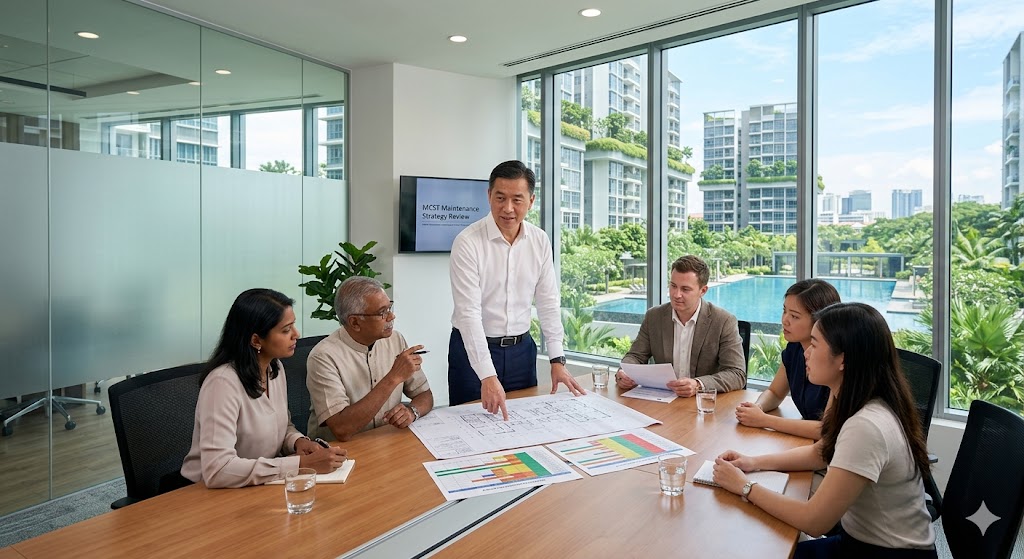
Selecting the Right Engineering Firm for Your MCST: An Exhaustive Guide
Introduction to Strata Management and Engineering
Selecting the right engineering firm for your MCST is absolutely critical. Strata living in Singapore involves highly complex building systems. The Building Maintenance and Strata Management Act regulates these properties. This critical legislation is frequently abbreviated as the BMSMA. The BMSMA outlines the complete legal framework for strata-titled properties.1 It applies uniformly to residential, commercial, and mixed-use developments.1
A Management Corporation Strata Title manages the estate. This statutory body is commonly known as an MCST. The MCST oversees and maintains all shared common property. Proper condo property management Singapore requires significant technical expertise. Building infrastructure inevitably degrades over time due to weather. Consequently, aging infrastructure demands rigorous and predictive maintenance protocols. Building owners constantly face numerous complex engineering challenges. Therefore, engaging competent engineering consultants is an absolute necessity.
Engineering firms provide highly specialized structural diagnostic services. They ensure strict statutory compliance with local regulatory authorities. These authorities include the Building and Construction Authority (BCA). They also include the Singapore Civil Defence Force (SCDF). Furthermore, the Energy Market Authority (EMA) regulates electrical systems. The Public Utilities Board (PUB) strictly oversees water installations.
Non-compliance results in severe financial penalties for the MCST. Additionally, poor maintenance compromises the safety of building occupants. Thus, selecting an appropriate consultant requires very careful consideration. Initial price should never be the sole determining factor. Long-term value, technical expertise, and reliability are far more important.
This exhaustive research report details the entire consultant selection process. It outlines critical questions to ask before hiring professionals. It thoroughly explores all mandatory statutory building inspections in Singapore. Furthermore, it analyzes standard procurement frameworks and contract laws. Consequently, MCSTs can make highly informed, strategic hiring decisions.
Understanding MCST Statutory Maintenance Obligations
The BMSMA enforces extremely strict maintenance duties upon the MCST. Sections 29 and 30 explicitly govern these legal responsibilities.2 The MCST must maintain all common property in good condition. Common property includes structural elements, facades, and shared facilities.1 It also includes mechanical, electrical, and plumbing systems.
The MCST functions as a legally created statutory body.4 It possesses perpetual succession and utilizes a common seal.4 Singapore law applies unique interpretations regarding common property ownership.4 The management corporation holds the property for the unit owners. However, the exact trustee relationship differs from other jurisdictions.4 The management corporation can legally sue and be sued.4 Therefore, liability management is a primary concern for the council.
The MCST must establish highly robust maintenance financial funds. These include the standard management fund and the sinking fund.5 Routine daily maintenance is financed by the management fund. Conversely, large capital expenditures are drawn from the sinking fund. Clear roles protect the financial interests of all subsidiary proprietors.6 These legal guidelines keep council decision-making fair and transparent.6
Proper facility management ensures safety and increases property value.6 A well-maintained building remains highly appealing to prospective buyers.6 However, MCST councils often lack deep technical engineering knowledge. Council members are typically volunteer residents with diverse backgrounds. Therefore, they must rely on external specialized engineering consultants.
These professionals manage complex repair and redecoration (R&R) works. They also handle legal disputes regarding underlying structural defects. By-laws created by the MCST must align with the BMSMA.6 Consultants ensure that all technical specifications meet these strict legal standards. Furthermore, legislative clarity assists MCSTs in pursuing actions in contract.4
The Periodic Structural Inspection (PSI) Regime
Structural integrity is the paramount concern for any building. The BCA actively enforces the Periodic Structural Inspection regime. This mandatory framework is commonly known as the PSI. The PSI ensures buildings remain structurally safe for public use.7 It prevents catastrophic structural failures caused by hidden deterioration.7
Wear and tear significantly impact overall building health over time.7 Excessive overloading and poor maintenance also cause severe structural damage.7 Regular inspection is crucial to protecting structural stability.7 Early detection of defects prevents serious structural safety issues.7 When defects are identified, they must be repaired promptly.7
PSI Frequencies and Exceptions
PSI frequencies depend strictly on the building’s designated usage classification. Non-residential buildings require a thorough PSI every five years.7 Residential buildings require a PSI once every ten years.7 However, certain exclusive residential landed houses are completely exempted.7 Temporary buildings are also legally excluded from this inspection regime.7
| Building Usage Type | Mandatory PSI Frequency |
| Non-Residential Buildings | Once every 5 years |
| Residential Buildings | Once every 10 years |
The Role of the Structural Engineer
The MCST receives a formal PSI notice from the BCA.7 Upon receipt, the MCST must act very promptly. They must appoint a qualified Structural Engineer (SE).7 This appointment must occur within a strictly stipulated timeframe.7 The Building Control Regulations usually mandate appointment within two months.8
The SE conducts a highly comprehensive physical site inspection.7 They meticulously assess the building’s overall structural condition.7 The MCST must actively facilitate this by providing site access.7 The SE identifies specific areas requiring urgent remedial works.7 Subsequently, they submit a detailed inspection report to the BCA.7
Various standardized BCA forms dictate this stringent reporting process. Form D2 is utilized for the official SE appointment.7 Visual inspection certificates include Forms D3 and D4.7 Form D3 officially certifies minor or non-structural defects.7 Form D4 indicates suspected localized structural defects requiring attention.7
If deeper structural inspection is warranted, other specific forms apply. Form D5 applies to defects lacking major structural significance.7 Form D6 applies to highly significant, dangerous structural defects.7 Form D7 is exclusively utilized for the supervision of remedial works.7 Furthermore, a standardized PSI Report Template must be used.7
Selecting a highly competent SE is incredibly critical for MCSTs. The engineer must deeply understand local Singaporean construction methodologies. Moreover, they must identify hidden, non-obvious structural anomalies quickly. Early defect detection prevents disastrous and costly building failures.7 Therefore, the MCST must evaluate the SE’s professional track record carefully.
The Periodic Facade Inspection (PFI) Regime
Building facades degrade significantly due to constant harsh weather exposure. Consequently, falling exterior features pose extreme danger to the public. The BCA recently introduced the Periodic Facade Inspection regime.9 This inspection protocol is commonly abbreviated as the PFI. The PFI officially took effect in January 2022.9 It helps detect dangerous facade deterioration promptly and efficiently.9
PFI Criteria and Inspection Frequencies
Buildings over twenty years old require a mandatory PFI.9 The comprehensive inspection must occur every seven years thereafter.9 The PFI regime applies specifically to buildings taller than 13 metres.9 Temporary buildings and landed residential houses are strictly exempted.9
The MCST receives a formal PFI notice from the authorities.9 They must then appoint an eligible Competent Person (CP).9 Owners who fail to appoint a CP commit a serious offense.9 They are liable upon conviction to a $20,000 fine.9 Therefore, selecting the right engineering firm ensures strict regulatory compliance.
Duties of the Competent Person and Facade Inspector
The Competent Person is usually a registered Professional Engineer.9 Alternatively, they can be a registered Architect in Singapore.9 They must successfully pass a specific facade inspection certification course.9 The Competent Person oversees the entire complex PFI process.9 They may officially appoint Facade Inspectors (FI) for hands-on assistance.9
Facade Inspectors perform the close-range visual inspection work.9 They must operate under the CP’s direct supervision and control.9 The Competent Person provides highly specific inspection methodologies and plans.9 They also supply detailed checklists and risk management protocols.9
Any identified unsafe defects must be reported absolutely immediately.9 The Competent Person must notify the Commissioner of Building Control.9 The inspection methodology itself is exceptionally rigorous and standardized. It requires a 100 percent overall visual inspection of the facade.9 It also mandates a 10 percent close-range physical inspection.9
This close-range inspection involves tactile physical contact with the building.9 Tools like tapping rods and rubber mallets are frequently used.9 These simple tools detect dangerous hollowness in plaster and tiles.9 Non-destructive testing equipment like borescopes may also be deployed.9 The CP eventually classifies the facade as Safe, Require Repair, or Unsafe.9
Incident Reporting for Fallen Facades
Incidents involving fallen exterior facades require immediate regulatory reporting.9 The Reportable Matter Regulations 2025 mandate extremely strict reporting timelines.9 A designated safety incident hotline must be called quickly.9 This emergency call must occur within six hours of discovery.9 Text messages or WhatsApp media are not legally accepted.9
Furthermore, a formal online incident report is legally required.9 This comprehensive report must be submitted within 24 hours.9 The report requires highly detailed information regarding the specific incident.9 Specific categories of exterior features must be accurately identified.9 Providing false information carries a severe $20,000 fine.9
| Feature Category | Description of Exterior Feature (Reportable Matters) |
| Category A | Windows, skylights, glass panels, glass bricks, louvres, glazed doors |
| Category B | Any grille or shutter, with or without movable parts |
| Category C | Tile, cladding, curtain wall, siding, plaster, bracket, or cornice |
| Category D | Gutter, rainwater down-pipe, or part of the roof |
| Category E | Membrane shade structure, awning, or shade device |
| Category F | Green walls partially or completely covered by vegetation |
| Category G | Any screen or screen wall structure |
| Category M | Any external balustrade |
| Category P | Suspended ceiling systems exposed to external rain |
| Category Q | Metal or concrete brackets supporting externally mounted equipment |
Drone Technology in Facade Inspections
Technology significantly enhances the efficiency of the PFI process. Unmanned aircraft systems (UAS), or drones, are frequently utilized.9 Drones allow safe, comprehensive inspections from the ground level.10 This eliminates the need for highly dangerous work at height.10 Consequently, workplace safety for inspectors improves dramatically.10 Furthermore, drone usage significantly reduces overall inspection costs for MCSTs.10
Compliance with TR78:2020 Standards
Drone operations must follow extremely strict safety regulations. The Technical Reference TR78:2020 strictly governs these flight operations.11 TR78:2020 ensures safe and highly ethical drone usage.11 It provides detailed specifications for the entire visual inspection process.11 TR78:2020 mandates strict personal data protection and privacy protocols.11
Residents must receive at least three days of advance notice.9 Drone cameras must only capture relevant facade defects.9 They must never capture private interior footage of residents’ homes.9 Drone service providers must secure all unintentionally captured private data.9 Compliance with the Personal Data Protection Act (PDPA) is mandatory.9
| TR78:2020 Annex | Purpose of the Annex Form |
| Annex A | Form Section A – Risk assessment for airworthiness of UAS |
| Annex B | Form Section B – Risk assessment for required type of operations |
| Annex C | Form Section C – Risk assessment for area of operations |
| Annex D | Building facade inspection report generation guidelines |
| Annex E | Sample of UAS inspection report |
The Competent Person must submit a formal drone approval form.9 They must physically supervise the drone operations on-site.9 Additionally, they must personally review all captured photographic drone data.9 The drone service provider must be officially accredited by the government.9 The Singapore Accreditation Council (SAC) strictly oversees this provider accreditation.9
The integration of artificial intelligence (AI) further modernizes this process. AI software quickly speeds up automatic defect classification.12 Smart drones identify common facade defects with high precision.12 Therefore, selecting an engineering firm utilizing advanced UAS technology is highly recommended. It guarantees a faster, safer, and cheaper inspection for the MCST.
Electrical Safety and LEW Compliance
Electrical systems form the critical, invisible backbone of all buildings. The Energy Market Authority regulates these complex systems very strictly. The EMA mandates the formal licensing of all electrical workers.13 A Licensed Electrical Worker is commonly referred to as an LEW. The MCST must engage a competent LEW for routine maintenance.14 Different LEW license grades permit entirely different operational capacities.13
Understanding LEW License Grades
There are three distinct LEW license grades in Singapore.13 Each grade features specific voltage and electrical load limitations.15 Selecting the appropriate LEW grade is critical for MCST compliance. Most large condominiums require at least a Grade 8 Technician. Massive mixed-use developments often require a Grade 9 Engineer.
| LEW Class | Approved Load Limit | Voltage Level Limit |
| Licensed Electrician (Grade 7) | Not exceeding 45 kVA | 1,000 volts and below |
| Licensed Electrical Technician (Grade 8) | 150 kVA (Design) / 500 kVA (Operation) | 1,000 volts and below |
| Licensed Electrical Engineer (Grade 9) | No limit | Subject to licence conditions |
A Grade 7 Electrician designs and repairs small electrical installations.16 Their legally approved load cannot exceed 45 kVA.16 A Grade 8 Technician safely handles much larger electrical loads.14 They can legally operate installations up to 500 kVA.17 However, their independent design capacity is strictly limited to 150 kVA.15
A Grade 9 Engineer takes full charge of massive installations.14 They handle complex high-voltage systems exceeding 1,000 volts safely.14 High-voltage switching requires extremely specialized safety authorization.14 The LEW conducts regular inspections and rigorous system testing.17 They ensure all protective devices operate safely during electrical faults.17
LEW Academic and Experience Requirements
The EMA mandates strict educational qualifications for each LEW grade. A Grade 7 Electrician requires a National Institute of Technical Education Certificate.16 They also need at least two years of practical experience.16 Alternatively, ten years of experience without academic qualifications is acceptable.16
A Grade 8 Technician requires a Diploma in electrical power engineering.17 They need at least two years of relevant practical experience.17 These rigorous requirements guarantee that the LEW is highly competent. The MCST must actively verify their engineering firm’s LEW credentials. Employing an underqualified LEW invalidates the building’s critical safety insurance.
Fire Safety Compliance and SCDF Certification
Fire safety is an absolute, uncompromising statutory requirement in Singapore. The Singapore Civil Defence Force (SCDF) rigorously enforces the Fire Safety Act.18 Public buildings and large industrial spaces require a Fire Certificate.18 This highly critical document is commonly abbreviated as the FC. Private residential buildings meeting specific criteria also require an FC.18
Public and Industrial Building Criteria
The Fire Safety Act 1993 Section 35 contains exact definitions.18 A public building requires an FC if occupant load exceeds 200.18 Industrial buildings have entirely different, much larger capacity thresholds.18
| Building Type | Criteria Requiring a Fire Certificate (FC) |
| Public Building | Occupant load of more than 200 persons |
| Industrial Building | Occupant load of 1,000 persons or more |
| Industrial Building | Floor area or site area of 5,000 sqm or more |
| Industrial Building | Habitable height of more than 24 metres |
The FC ensures all fire protection systems function perfectly.19 These systems include fire alarms, sprinklers, and designated emergency exits.19 A registered Professional Engineer must thoroughly inspect these critical systems.20 SCDF fire safety certificate renewals were traditionally required annually.19
However, regulations shift to a three-year cycle beginning April 2026.21 Despite this three-year renewal cycle, annual forms remain strictly mandatory.21 The building owner must submit the FC form annually online.21 A Professional Engineer provides certification during the official renewal year.21 Application fees apply only during the formal three-year renewal year.21
Fire Safety Managers and MAA Works
Operating without a valid FC is a very severe regulatory offense. It can lead to complete business closure or massive penalties.19 Furthermore, large MCSTs must officially appoint a Fire Safety Manager.22 The Fire Safety Manager requires specialized refresher training every three years.22 A Company Emergency Response Team (CERT) must also be actively formed.22
The selected engineering firm greatly assists in maintaining these standards. They ensure building plans meet all complex SCDF technical requirements.23 They manage submissions for Minor Addition/Alteration (MAA) Works efficiently.23 MAA Works refer to minor interior modifications not altering structures.23 The engineering consultant ensures these minor works remain fully fire-compliant.
Additionally, they handle Petroleum and Flammable Materials (PF&M) Licences.23 These are required for storing highly flammable chemicals or fuels.23 Proper engineering oversight prevents disastrous, life-threatening fire hazards.
PUB Water Tank Annual Inspections
Clean drinking water is absolutely essential for general public health. The Public Utilities Board (PUB) strictly regulates all water service installations.24 MCSTs are legally and morally responsible for their water storage tanks.24 Mandatory annual tank inspections are a non-negotiable statutory requirement.24 The MCST must engage a competent Licensed Plumber (LP) early.24
The comprehensive inspection ensures the water is fit for consumption.24 It prevents dangerous contamination and hazardous bacterial growth buildup.25 The Licensed Plumber takes water samples for accredited laboratory testing.24 These samples undergo rigorous chemical and bacteriological scientific examinations.24
Furthermore, the plumber checks for subtle structural tank leaks.24 Critical security features are also verified to prevent unauthorized access.25 Failure to certify the water tank is a serious criminal offense.26 Penalties include heavy fines reaching up to $10,000.26 Imprisonment for up to 12 months is also a legal possibility.26
Cleaning Protocols and Confined Space Safety
Water tank cleaning requires extremely strict confined space safety compliance.25 The engineering team must implement stringent workplace safety measures.27 Complete physical isolation protocols deeply protect the maintenance workers.27 The cleaning eliminates dangerous moss, sediment, and bacterial biofilm buildup.25
Water Service Installation (WSI) design works require specialized professionals.28 Complex WSI design works require a registered Professional Engineer.28 Simpler, limited WSI works can be undertaken by a Licensed Plumber.28 Therefore, selecting a medically certified, highly competent plumbing team is vital.25 The engineering firm should seamlessly coordinate these diverse plumbing requirements.
Spalling Concrete and Structural Rectification
Singapore’s harsh tropical climate greatly accelerates building wear and tear. Constant high humidity and heavy rainfall cause specific concrete issues.29 Spalling concrete is a widespread, highly dangerous structural defect.30 It typically occurs when steel reinforcement inside the concrete rusts.30
The Mechanism of Concrete Spalling
This internal rebar rusting causes massive outward physical expansion.30 Consequently, the internal pressure fractures and dislodges the concrete cover.30 The concrete then violently flakes and breaks away from the surface.30 Carbonation and chloride ingress heavily accelerate this destructive corrosion process.30
Carbonation lowers the natural alkalinity of the surrounding concrete structure. This loss of alkalinity removes the passive protective layer around rebar. Left untreated, spalling severely weakens the building’s overall structural integrity.29 It also poses severe life-threatening risks to passing pedestrians.31 Prompt, highly professional concrete repair is therefore an absolute necessity.31
Advanced Repair Methodologies
Top engineering firms utilize highly specialized structural repair methodologies. First, a thorough structural assessment identifies the true damage extent.32 Next, loose and deteriorated concrete is meticulously chiseled away.32 This fully exposes the underlying damaged steel reinforcement bars.32 The rusted rebar is deeply cleaned, chemically treated, or replaced.32
Anti-corrosion chemical treatments prevent future degradation of the steel.32 Subsequently, a high-strength polymer repair mortar is carefully applied.32 This mortar restores the lost structural capacity of the affected element.32 For minor surface shrinkage cracks, PU injection is highly effective.33 Polyurethane (PU) resins are injected to seal and waterproof cracks.33
PU grouting immediately halts water ingress and addresses internal voids.31 The rapidly expanding polyurethane forms a robust, closed-cell waterproof rubber.31 Formwork grouting is used for much more severe honeycombing defects.31 A non-shrink cementitious grout is precisely injected under high pressure.31 Therefore, the chosen engineering firm must master these diverse repair techniques.
Procurement Frameworks: The GeBIZ Standard
Procurement activities in Singapore emphasize total transparency and strict fairness. The Government Electronic Business (GeBIZ) portal sets exceptionally high standards.34 These exact principles apply effectively to private MCST procurement strategies. Singapore’s government procurement regime aligns with international global standards.35
It aligns with the World Trade Organisation’s Agreement on Government Procurement.35 Open and fair competition ensures a completely level playing field.34 All potential suppliers receive the exact same detailed project information.34 Historically, many MCST councils relied heavily on the lowest-bidder approach.
However, selecting the absolute cheapest option often leads to disastrous failure. Poor quality materials and highly inexperienced supervision cause recurring issues.36 Consequently, the modernized procurement approach focuses intensely on value for money.34 Value balances initial capital costs against long-term operational asset benefits.34 Quality, relative risk, timeliness, and reliability are heavily evaluated.34
The Price Quality Method (PQM) Evaluation
The Price Quality Method is an excellent, highly objective evaluation framework.37 It assesses complex tenders based simultaneously on both price and quality.37 PQM translates subjective qualitative attributes into objective quantitative numerical scores.38 This combined final score quickly identifies the most suitable engineering firm.38
For standard building tenders, price weightage ranges from 40% to 60%.37 Quality weightage ranges from 60% to 40% correspondingly for these projects.37 Heavy civil engineering tenders utilize slightly different evaluation weightages.37
| Component Evaluated | Building Tenders (CW01) | Civil Engineering Tenders (CW02) |
| Price Weightage | 40% – 60% | 50% – 70% |
| Quality Weightage | 60% – 40% | 50% – 30% |
The precise price score (P-score) is calculated using a standard mathematical formula.
Provisional sums and nominated subcontracts are specifically excluded from this computation.38 Quality attributes are heavily scrutinized during the comprehensive PQM evaluation.37 Past performance in similar complex projects is critically assessed.37
Timeliness and overall construction quality earn much higher quality points.37 Safety performance records are also carefully and strictly evaluated.37 The Ministry of Manpower’s Safety Demerit Point System informs this score.37 PQM ensures that true technical excellence is adequately and fairly rewarded. Therefore, MCSTs should implement PQM for all major engineering tenders.
Essential Questions to Ask Before Hiring an Engineering Firm
Selecting the appropriate engineering firm requires incredibly rigorous interviewing. The MCST council must ask highly specific, deeply technical questions. Vague or general responses usually indicate limited experience and capability.39 Conversely, highly detailed responses demonstrate profound, practical industry expertise.39 The following ten questions are absolutely essential for the selection process.
1. What is your specific track record with MCSTs?
The firm must deeply understand condo property management Singapore. Residential estates have completely unique operational, financial, and political challenges. The firm should provide detailed examples of similar past projects.39 They must demonstrate profound local knowledge of the construction landscape.39 Experience with strata property ensures highly tailored, effective engineering solutions.
2. Who will be the designated Qualified Person (QP)?
In Singapore, critical engineering projects require a designated Qualified Person.40 The QP assumes massive legal responsibility under the Building Control Act.40 The QP must be a fully registered Professional Engineer (PE).41 They face both criminal and civil liabilities for structural failures.40 Ensure the firm assigns a highly experienced, actively registered PE. Junior staff must never lead complex structural diagnostic assessments.
3. How do you handle strict statutory compliance?
Singapore enforces exceptionally strict regulatory building codes. The firm must navigate BCA, SCDF, EMA, and PUB requirements seamlessly. Ask exactly how they ensure compliance with local building regulations.42 A minor compliance failure can halt a massive project completely. The firm must proactively manage all regulatory submissions and authority approvals.
4. Do you hold adequate Professional Indemnity Insurance?
The Professional Engineers Act strictly mandates professional liability insurance.43 Licensed limited corporations must be adequately insured against professional liability.43 This insurance protects the MCST against severe financial professional negligence.44 The contract should mandate a specific minimum limit of indemnity.44 A $1,000,000 cover is common for professional managing agents.45 Always verify the firm’s insurance certificates before signing any contracts.
5. What specific pricing models do you employ?
Consulting pricing models vary significantly across the engineering industry.46 Some firms charge standard hourly rates or flat monthly retainers.46 Others utilize lump-sum fixed-price contracts for highly specific deliverables.47 Misaligned pricing can severely erode project margins and cause disputes.46 Clear pricing builds immense credibility and sets expectations early.46 Avoid firms with opaque, hidden, or overly complex billing structures.
6. How do you handle project variations and changes?
Construction projects almost rarely proceed exactly as initially planned. Unforeseen structural problems frequently arise during complex execution phases.42 The engineering firm must have a systematic approach to variations.48 Ask precisely how they manage changes to the original project scope.42 They should utilize highly standardized, formal variation orders. This prevents uncontrolled cost overruns and subsequent bitter legal disputes.
7. Do you heavily utilize third-party sub-contractors?
Standard consultancy agreements often restrict unauthorized third-party sub-contracting.49 Ultimate accountability must remain squarely with the lead engineering consultant.49 If sub-contractors are utilized, the primary consultant remains fully liable.49 The sub-contractor is legally considered an agent of the consultant.49 Ensure the firm provides full transparency regarding their exact workforce composition.
8. How do you approach environmental sustainability?
Sustainability is increasingly critical in modern building facility management. Upgrading vertical transportation systems requires highly expert VT consultancy.36 Modernized lifts improve overall energy efficiency and resident user satisfaction.36 Ask the firm extensively about their sustainable engineering design practices.42 They should recommend energy-saving upgrades during routine repair works. This reduces long-term operational utility costs for the MCST.
9. How will you communicate throughout the project?
Effective collaboration dictates the ultimate success of any construction project.50 The consultant must submit draft meeting minutes extremely promptly.45 They should ideally submit these within five working days.45 A proprietary tracking registry automates response times for resident feedback.45 Excellent communication ensures smooth daily operations and fosters community cohesion.
10. How do you optimize cost efficiency and budgeting?
Managing MCST funds requires incredibly strict financial discipline. Cost overruns devastate the estate’s carefully planned sinking fund reserves. Ask how their Quantity Surveyors manage costs across the lifecycle.51 Modern cost consultants leverage Building Information Modelling (BIM) software.51 BIM optimizes resource allocation and mitigates potential financial risks proactively.51
Contractual Frameworks and Risk Mitigation
A robust legal contract is the absolute foundation of success. Verbal agreements are utterly insufficient for complex engineering projects. Singapore utilizes several highly standardized forms of construction contracts.47 The Real Estate Developers’ Association of Singapore provides standard forms.47 This is commonly known within the industry as the REDAS form.47
The Singapore Institute of Architects also publishes standard forms.47 These are widely known as the SIA forms of contract.47 Additionally, the Public Sector Standard Conditions of Contract exist.47 This is legally known as the PSSCOC framework.47 MCSTs should always adopt these standardized, heavily industry-tested contract forms.
The Standard Consultancy Agreement (SCA)
For pure consultancy services, the Standard Consultancy Agreement is prevalent.52 The SCA establishes common terms across various technical engineering disciplines.52 It covers architectural and heavy civil engineering services.52 Mechanical, electrical, and quantity surveying services are also fully included.52
Standardized terms drastically reduce the need for extensive contract negotiations.52 They provide a common legal understanding of liabilities and obligations.52 The SCA ensures a much fairer allocation of project risks.52 The consultant must act as a faithful adviser to the employer.53 They must provide all necessary professional technical advice and skills.53
Confidentiality and Indemnification Clauses
Data protection is highly critical during sensitive engineering projects. The contract must contain extremely strict legal confidentiality clauses.54 The consultant must keep all MCST proprietary information strictly confidential.53 Information must only be disclosed to explicitly authorized recipients.53 Furthermore, strong indemnification clauses are absolutely essential for MCST protection.45
The consultant must fully indemnify the MCST against direct losses.45 These losses may arise from professional negligence or contractual omissions.45 However, the total liability limit is often capped contractually.45 It is usually capped exactly at the professional insured amount.45 This legally balances protection for the MCST with commercial reality.
Project Management of Repairs and Redecoration (R&R)
MCSTs frequently undertake massive Repairs and Redecoration (R&R) projects. These complex R&R works require highly comprehensive project management.55 A qualified Professional Engineer or Chartered Building Surveyor leads this.56 The workflow begins with a highly detailed site study and proposal.55 Next, the consultant prepares technical specifications and complex tender documents.56
They meticulously evaluate the submitted tenders and advise the MCST.56 The consultant subsequently issues the formal legal Letter of Award.56 During construction, they supervise the engaged building contractors very closely.55 They issue interim payment certificates based strictly on work progress.56 This ensures contractors are paid fairly for completed construction stages.
Finally, the expert consultant manages the entire project completion stage.55 They thoroughly review the final account and verify defect corrections.56 This meticulous oversight guarantees projects remain strictly within budget.56 It also ensures strict compliance with standard industry best practices.56 Water seepage surveys and thermographic scanning are frequently included.55
High-Performing SEO and Digital Visibility
In the modern digital era, online visibility matters significantly. Real estate property management relies heavily on digital web presence.57 Search Engine Optimization (SEO) connects engineering firms with MCST clients.58 Property developers and MCSTs frequently search online for engineering services.58 Over 92 percent of property searches actively begin on Google.58
Therefore, engineering firms must deeply optimize their digital content.57 High-intent keywords are absolutely crucial for attracting highly qualified leads.59 Key phrases include “condo property management Singapore” and “spalling concrete repair”.60 Firms must publish informational blogs analyzing local property market trends.59 Mobile optimization is essential for rapid on-the-go smartphone browsing.59
A robust Google Business Profile enhances local map search visibility.59 The MCST can use these digital footprints for firm evaluation. A firm with well-researched, highly technical content demonstrates deep authority. Firms publishing insights on the BCA Periodic Structural Inspection are credible. Similarly, firms discussing the SCDF fire safety certificate showcase compliance knowledge. Content quality often directly reflects the firm’s overall professional meticulousness.
Financial Management and Quantity Surveying
Managing MCST funds requires incredibly strict, uncompromising financial discipline. Cost overruns utterly devastate the estate’s carefully planned sinking fund. Therefore, highly skilled Quantity Surveyors (QS) play a vital role. The QS acts as a highly specialized technical cost consultant.51 They actively manage costs across the entire long project lifecycle.51
The QS helps the MCST set highly realistic project budgets.51 They ensure lucrative contracts are awarded at the appropriate price.51 Modern cost consultants leverage Building Information Modelling (BIM) extensively.51 BIM optimizes resource allocation and mitigates potential financial risks.51 The QS rigorously verifies the actual value of completed construction works.
This prevents dangerous overpayment to contractors during monthly interim claims. Furthermore, the QS ensures goods and services tax is handled correctly. Tender rates are typically quoted completely exclusive of GST.61 The MCST pays the GST separately if the contractor is taxable.61 Proper accounting reports must be submitted to the council monthly.45 This financial transparency builds immense trust between consultants and residents.
Resolving Disputes and Maintaining Community Harmony
High-density strata living inherently involves highly diverse resident opinions. Disputes regarding maintenance priorities and massive expenditures are extremely common. The BMSMA provides proper legal methods to handle disagreements peacefully.6 However, proactively preventing disputes is always better than resolving them. An independent engineering consultant provides highly objective, factual structural data.
When structural defects appear suddenly, angry residents often blame the MCST. An unbiased engineering report completely depersonalizes the highly technical issue. If dangerous facade damage occurs, the Competent Person provides scientific analysis. Their classification of the facade as “Safe” or “Require Repair” is definitive. This objective, scientific stance protects the MCST council from resident backlash.
Furthermore, exceptionally clear communication protocols prevent costly, frustrating resident misunderstandings. The consultant must track all feedback via a Service Level Agreement.45 They should ideally acknowledge and attend to cases within three days.45 Excellent communication ensures smooth daily operations and fosters deep community cohesion.
The Broader Implications of Asset Management
Selecting an engineering firm transcends mere basic statutory legal compliance. It represents a massive strategic investment in the building’s future. Singapore’s beautiful urban skyline is aging very rapidly right now. Consequently, maintenance strategies must urgently evolve from reactive to predictive. Waiting for a pipe to burst or concrete to spall is inefficient.
Predictive maintenance utilizes advanced data to forecast impending system failures. Drones and artificial intelligence perfectly represent this predictive technological shift.12 Thermographic scanning identifies hidden water seepage before damage compounds extensively.55 Upgrading a vertical transportation system prevents recurring, highly costly breakdown repairs.36
The right engineering firm actively champions this proactive asset management philosophy. They fiercely protect the physical infrastructure and the financial reserves simultaneously. Therefore, the MCST must view the consultant as a long-term partner. Ad-hoc, lowest-bidder engagements severely degrade the building’s holistic structural health.
A consistent engineering partner deeply understands the building’s unique historical quirks. They know exactly where previous stubborn leaks occurred historically. They understand the complex idiosyncrasies of the specific mechanical and electrical systems. This deep institutional knowledge is absolutely invaluable during sudden, catastrophic emergencies.
Conclusion
Managing a strata-titled property in Singapore is a formidable responsibility. The MCST council must navigate a highly complex labyrinth of statutory regulations. The Building Maintenance and Strata Management Act establishes the foundational duties. BCA structural and facade inspections demand extremely rigorous technical engineering oversight. SCDF fire safety rules and PUB water regulations enforce uncompromising safety standards. EMA electrical licensing ensures the operational safety of the entire estate.
Selecting the right engineering firm dictates the ultimate success of these obligations. The selection process must prioritize deep technical competence over cheap pricing. The Price Quality Method offers a structured, highly objective evaluation framework. It prevents the hazardous trap of selecting the absolute lowest bidder. MCSTs must ask incisive, probing questions regarding track records and compliance. They must verify Professional Indemnity Insurance and the designated Qualified Person.
Standardized contracts, such as the SCA or REDAS forms, mitigate legal risks. Clear indemnification and confidentiality clauses fiercely protect the management corporation. By engaging a proactive, technologically advanced engineering firm, the MCST thrives. The building’s structural integrity remains highly secure against environmental degradation. Statutory legal compliance is flawlessly maintained year after year. Ultimately, the property value increases, ensuring a safe, harmonious living environment for all residents.
Works cited
- Understanding the Building Maintenance and Strata Management Act (BMSMA) – Cashew, accessed May 24, 2026, https://www.cashew.sg/resources/understanding-the-building-maintenance-and-strata-management-act-bmsma
- Building Maintenance and Strata Management Act 2004 – Singapore Statutes Online, accessed May 24, 2026, https://sso.agc.gov.sg/Act/BSMA2004?ValidDate=20250309&ViewType=Pdf&_=20250926190241
- Building (Strata Management) Act 2004 – Singapore Statutes Online, accessed May 24, 2026, https://sso.agc.gov.sg/Act/30C
- MANAGEMENT CORPORATION: COMMON PROPERTY AND STRUCTURAL DEFECTS – NUS Law, accessed May 24, 2026, https://law.nus.edu.sg/sjls/wp-content/uploads/sites/14/2024/07/2204-2016-sjls-mar-149.pdf
- DISPOSAL OF COMMON PROPERTY IN STRATA SCHEMES – NUS Law, accessed May 24, 2026, https://law.nus.edu.sg/sjls/wp-content/uploads/sites/14/2024/07/2254-2018-sjls-sep-85.pdf
- A Beginner’s Guide to BSMA and Strata Living in Singapore – Abacus Property, accessed May 24, 2026, https://www.abacusproperty.sg/post/bsma-strata-living
- Periodic Structural Inspection (PSI) | Building and Construction …, accessed May 24, 2026, https://www1.bca.gov.sg/safety-and-standards/periodic-building-inspections/periodic-structural-inspection/
- The Ultimate Guide to Structural & Façade Inspections in Singapore: BCA Compliance, Certification, and Rectification for 2025, accessed May 24, 2026, https://structures.com.sg/structural-facade-inspections-singapore/
- Periodic Facade Inspection (PFI) | Building and Construction Authority, accessed May 24, 2026, https://www1.bca.gov.sg/safety-and-standards/periodic-building-inspections/periodic-facade-inspection/
- Oral answer by Ministry of National Development on the use of drones for building inspection, accessed May 24, 2026, https://www.mnd.gov.sg/newsroom/speeches/view/oral-answer-by-ministry-of-national-development-on-the-use-of-drones-for-building-inspection
- TR 78-1:2020+C1:2021 Building facade inspection using unmanned aircraft systems (UAS) – Singapore Standards, accessed May 24, 2026, https://www.singaporestandardseshop.sg/Product/SSPdtDetail/cd12a4dd-10db-4f34-b1b2-e7ed574393ba
- Smart Drones, A Game Changer For Building Façade Inspection – Open Innovation Network, accessed May 24, 2026, https://www.openinnovationnetwork.gov.sg/success-stories/success-stories/smart-drones-a-game-changer-for-building-facade-inspection
- LEW Grades Singapore: Complete Scope and Requirements Guide | Mr Electrician Blog, accessed May 24, 2026, https://mrelectrician.sg/blog/lew-grades-singapore-complete-scope-and-requirements-guide-TEVXIE/
- Licensed Electrical Worker (LEW) Requirements in Singapore – I2R Consulting, accessed May 24, 2026, https://www.i2r.com.sg/the-complete-guide-to-licensed-electrical-worker-lew-requirements-in-singapore-certification-responsibilities-compliance/
- Electrical/Supply Installation Licences – Energy Market Authority, accessed May 24, 2026, https://www.ema.gov.sg/regulations-licences/licences/electrical-supply-installation-licences
- Electrician Licence – Singapore – Energy Market Authority, accessed May 24, 2026, https://www.ema.gov.sg/regulations-licences/licences/worker-licences/electricians-licence
- Electrical Technician Licence – Singapore – Energy Market Authority, accessed May 24, 2026, https://www.ema.gov.sg/regulations-licences/licences/worker-licences/electrical-technicians-licence
- Fire Certificate | Licence & Accreditation – GoBusiness Licensing, accessed May 24, 2026, https://licensing.gobusiness.gov.sg/licence-directory/scdf/fire-certificate
- SCDF Fire Safety Certificate | Inspection & Renewal, accessed May 24, 2026, https://drakofire.com.sg/fire-safety-certificate/
- Fire Certificate – Singapore – SCDF, accessed May 24, 2026, https://www.scdf.gov.sg/fire-safety-services-listing/permits-and-certifications/fire-certificate
- Introduction of Three-Year Fire Certificate Regime from 1 April 2026 – SCDF, accessed May 24, 2026, https://www.scdf.gov.sg/docs/default-source/fire-safety-docs/permits-and-certification/introduction-of-three-year-fire-certificate-regime-from-1-april-2026.pdf?sfvrsn=e66df331_1
- MCST Compliance Checklist Singapore 2026 | BMSMA, BCA, SCDF – Infodeck, accessed May 24, 2026, https://www.infodeck.io/sg/resources/mcst-compliance-checklist/
- FAQ – FireCert.sg, accessed May 24, 2026, https://firecert.sg/faq.php
- Water Storage Tanks | PUB, Singapore’s National Water Agency, accessed May 24, 2026, https://www.pub.gov.sg/Professionals/Requirements/Water-Supply-Services/Water-Storage-Tanks
- Annual Water Tank Cleaning Singapore | PUB-Compliant Service, accessed May 24, 2026, https://www.website.aquatank.com.sg/annual-tank-washing
- Water Tank Maintenance – Poly-Line Pte Ltd, accessed May 24, 2026, https://www.polyline.sg/water-tank-maintenance/
- Water Tank Cleaning Singapore: PUB Compliance Experts, accessed May 24, 2026, https://acebs.com.sg/annual-water-tank-cleaning-sterilization-sg/
- HANDBOOK ON APPLICATION FOR WATER SUPPLY – PUB, accessed May 24, 2026, https://www.pub.gov.sg/-/media/PUB/PDF/Handbook_on_Application_for_Water_Supply_2022.pdf
- Comprehensive Guide to Concrete Repairs and Spalling Concrete Solutions – Waterproofing Specialist Singapore, accessed May 24, 2026, https://proseal.com.sg/comprehensive-guide-to-concrete-repairs-and-spalling-concrete-solutions/
- Professional Concrete Repair Services in Singapore – CWP Waterproofing, accessed May 24, 2026, https://www.cwp.com.sg/concrete-repair/
- Concrete Repair & Waterproofing – Hydro-Seal Engineering Pte Ltd, accessed May 24, 2026, https://www.hydroseal.com.sg/concrete-waterproofing-repair
- Concrete Spalling | Waterproofing Contractor Singapore, accessed May 24, 2026, https://waterproofing.com.sg/pressure-grouting-injection/concrete-spalling/
- Concrete Repair & Injection Systems Singapore | Adcos Asia, accessed May 24, 2026, https://adcosasia.com/injection-systems/concrete-repair/
- Government Procurement Guide for Suppliers – Singapore – GeBIZ, accessed May 24, 2026, https://www.gebiz.gov.sg/docs/Supplier_Guide_Summarised.pdf
- Government Procurement Guide for Suppliers – Singapore – GeBIZ, accessed May 24, 2026, https://www.gebiz.gov.sg/docs/supplier_guide_detailed.pdf
- How to select your VT Consultancy Firm – Elevating Studio, accessed May 24, 2026, https://elevatingstudio.com/how-to-select-your-vt-consultancy-firm/
- Price Quality Method (PQM) Framework | Building and Construction Authority, accessed May 24, 2026, https://www1.bca.gov.sg/growth-and-transformation/procurement/procurement-and-legal-frameworks/price-quality-method-pqm-framework/
- PRICE QUALITY METHOD (PQM), accessed May 24, 2026, https://isomer-user-content.by.gov.sg/338/db99478a-cf40-42a6-a01d-4eb228927a00/pqm-framework-(for-public)_with-effect-from-1-nov-2024_final.pdf
- Top 10 Questions to Ask Your Engineering Consultant Before Hiring: : r/MechanicalEngineering – Reddit, accessed May 24, 2026, https://www.reddit.com/r/MechanicalEngineering/comments/1k6qii0/top_10_questions_to_ask_your_engineering/
- Building Safeguards: Liability Insurance for Construction Professionals – PLUS, accessed May 24, 2026, https://plusweb.org/news/building-safeguards-liability-insurance-for-construction-professionals/
- The Professional Engineer in Singapore: A Definitive Guide to Endorsement, Responsibilities, and Liabilities – Stellar Structures, accessed May 24, 2026, https://structures.com.sg/the-professional-engineer-singapore-guide-endorsement-responsibilities-liabilities/
- 8 Essential Questions to Ask Your Structural Engineer Before Starting a Project, accessed May 24, 2026, https://topstructuralengineersinmiami.com/blog/8-essential-questions-structural-engineer-starting-project
- Licensing Requirements – Professional Engineers Board (PEB), accessed May 24, 2026, https://www1.peb.gov.sg/LC-requirements/
- Professional Engineers Act – Singapore Statutes Online, accessed May 24, 2026, https://sso.agc.gov.sg/Act-Rev/PEA1991/Published?DocDate=19920309&ProvIds=pr36-
- managing agent agreement for mcst – SEC.gov, accessed May 24, 2026, https://www.sec.gov/Archives/edgar/data/1944902/000149315223046576/ex10-12.htm
- Consulting Pricing Models: Strategies, Examples & How to Choose? – Deltek, accessed May 24, 2026, https://www.deltek.com/en/blog/consulting-pricing-models
- Construction & Engineering Law 2020 – Rahmat Lim & Partners, accessed May 24, 2026, https://www.rahmatlim.com/openfile.html?url=media/9114/the-international-comparative-legal-guide-to-construction-engineering-law.pdf
- singapore-construction-cost-handbook-2022.pdf – Arcadis, accessed May 24, 2026, https://media.arcadis.com/-/media/project/arcadiscom/com/perspectives/asia/publications/cch/2022/singapore-construction-cost-handbook-2022.pdf?rev=842b76624b8c40a0affc61f99debde9f
- Consulting Agreement Template (Singapore) – LawDepot, accessed May 24, 2026, https://www.lawdepot.com/sg/business/consulting-agreement/
- Ten Questions to Ask a Structural Engineer Before Hiring a Architectural Design Firm, accessed May 24, 2026, https://www.cadcrowd.com/blog/ten-questions-to-ask-a-structural-engineer-before-hiring-a-architectural-design-firm/
- Cost Consultant: The Resource Strategist – BuildSG, accessed May 24, 2026, https://www.buildsg.gov.sg/cost-consultant/
- Standard Consultancy Agreement | Building and Construction Authority, accessed May 24, 2026, https://www1.bca.gov.sg/growth-and-transformation/procurement/standard-contract-forms/standard-consultancy-agreement/
- AGREEMENT FOR CONSULTANCY SERVICES [COLLABORATIVE CONTRACTING] BETWEEN {EMPLOYER} AND {CONSULTANT} FOR {PROJECT TITLE} Standard, accessed May 24, 2026, https://isomer-user-content.by.gov.sg/338/188c79d2-6328-4b26-a145-98f27adca61f/cc-ar_cs_me_qs-agreement-for-consultancy-services-terms-and-conditions-december-2025.pdf
- Form of Consulting Agreement (Singapore) | Cooley GO Docs, accessed May 24, 2026, https://www.cooleygo.com/documents/form-consulting-agreement-singapore/
- Project Management of Repair & Redecoration (R&R) Works Singapore, accessed May 24, 2026, https://mcstsurvey.com.sg/project-management-of-repair-redecoration-rr-works/
- Project Management of Repair & Redecoration (R&R) Works – P-CON Building Surveyors Pte.Ltd., accessed May 24, 2026, https://p-consurvey.com.sg/our-services/project-management-of-repair-redecoration-rr-works/
- SEO for Real Estate and Property Agent in 2026, accessed May 24, 2026, https://dmb.sg/blog/seo-for-real-estate-and-property-agent-in-2024/
- SEO for Property Developers in Singapore: Build Brand Visibility and Drive Sales, accessed May 24, 2026, https://dynamicwebdevelopment.sg/seo-for-property-developers-in-singapore/
- SEO for Real Estate – Singapore – Incepte, accessed May 24, 2026, https://www.incepte.com/seo-for-real-estate/
- [2026 Guide] Property Management Keywords To Boost Rankings – Goodjuju Marketing, accessed May 24, 2026, https://gogoodjuju.com/keywords-for-property-management/
Pristine Height 6.12.2022 | PDF | Employment | Specification (Technical Standard) – Scribd, accessed May 24, 2026, https://www.scribd.com/document/617976000/Pristine-Height-6-12-2022