





Design-build payment structures are contractual frameworks that define how an owner compensates a design-builder based on agreed payment types, project milestones, and performance triggers. Understanding how the design-build payment structure works is foundational before signing any contract. Three primary models govern most U.S. projects: fixed-price (lump sum), cost-plus-a-fee, and cost-plus with GMP. Payments are tied to construction progress, not calendar dates, and retainage is withheld until final completion as a performance incentive. Industry standards from the Design-Build Institute of America (DBIA) and the American Institute of Architects (AIA) provide the contractual frameworks most U.S. owners and design-builders rely on.
Key components of any design-build payment arrangement include:
- Payment type: Fixed-price, cost-plus, or cost-plus with GMP
- Payment schedule: Milestone-based disbursements tied to completed construction phases
- Retainage: A financial holdback, typically 5–10%, released at final closeout
- Change order provisions: Written procedures for adjusting contract price when scope changes
- Dispute resolution mechanisms: Defined processes for resolving payment disagreements
1. What are the common payment structure types in design-build contracts?
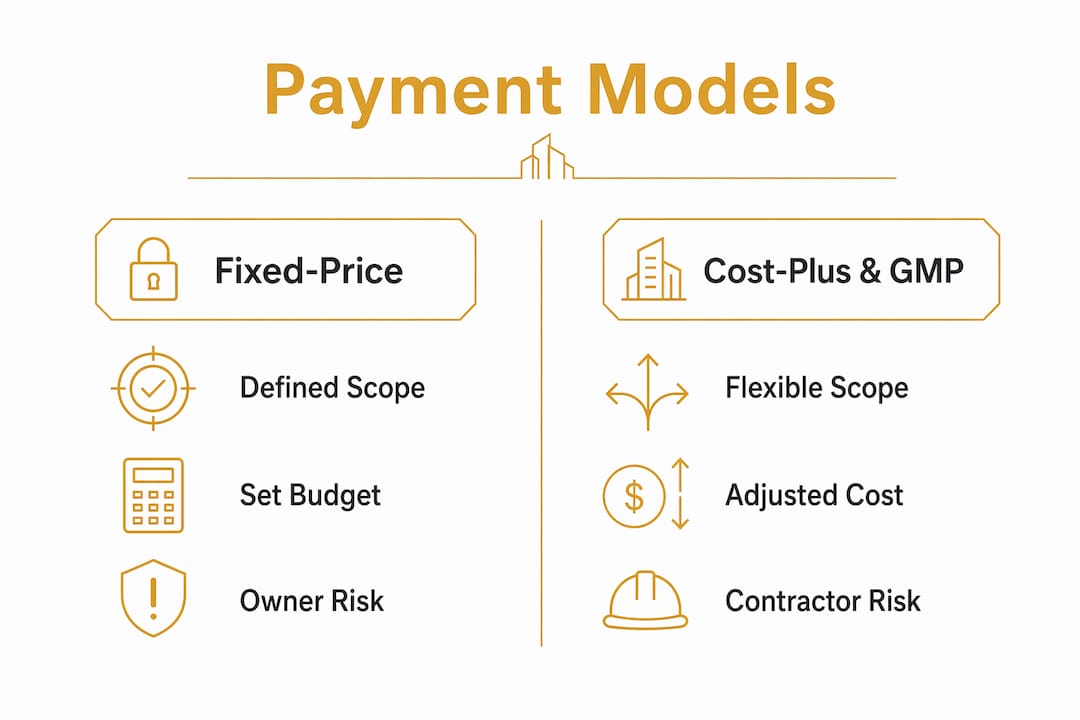
The three standard design-build payment models each allocate cost risk differently between owner and contractor.
Fixed-price (lump sum). The design-builder commits to a total contract price for a defined scope. The owner knows the exact cost upfront, and the contractor bears the risk of any cost overruns within that scope. This model works best when the project scope is fully defined before contract execution. DBIA’s lump sum agreement form reflects this structure, with the owner paying progress applications on a scheduled basis less retainage.
Cost-plus-a-fee. The owner pays all actual project costs, including labor, materials, equipment, and subcontractor fees, plus an agreed fee to the design-builder. The fee may be a fixed amount or a percentage of costs. This is an open-book arrangement: the contractor provides full accounting, and the owner retains audit rights. Cost-plus suits projects where scope is not fully defined at contract signing, though it transfers cost risk to the owner.
Cost-plus with guaranteed maximum price (GMP). The owner pays actual costs plus a fee, but total compensation cannot exceed the agreed GMP. If the design-builder completes the work below the GMP, savings are distributed according to the contract, often split between owner and contractor at a negotiated ratio such as 50-50 or 75-25. GMP is common for projects where existing site conditions or early-stage design uncertainty make a fixed price impractical.
- Fixed-price transfers cost overrun risk to the contractor.
- Cost-plus transfers cost risk to the owner but provides full transparency.
- GMP balances both: the owner gains a cost ceiling while the contractor retains incentive to control costs.
Pro Tip: DBIA advises that well-defined Owner’s Project Criteria are the single most important factor in selecting the right payment model. Clear scope supports lump sum; unclear scope favors cost-plus or GMP.
2. How do milestone-based payment schedules operate?
Construction payments are milestone-based, tied to tangible progress stages rather than calendar dates. This protects both parties: the owner does not pay for work not yet performed, and the contractor receives funds as each phase is completed and verified.

A representative milestone payment schedule for a U.S. design-build project looks like this:
| Milestone | Typical Payment Percentage |
|---|---|
| Contract signing (deposit) | 10–20% |
| Foundation complete | 20–25% |
| Framing and roof complete | 20–25% |
| Rough mechanicals and drywall | 15–20% |
| Finish carpentry and substantial completion | 15–20% |
| Final walk-through and punch list | 5–10% (retainage release) |
One published example structures payments as 20% on signing, 25% on foundation completion, 25% on framing, 20% on drywall and rough-ins, and 10% at final walk-through. Percentages vary by project type and size, but the principle is consistent.
Retainage is the financial holdback applied to each progress payment. At 10% retainage, the contractor receives 90 cents of every dollar billed and collects the withheld balance only after final closeout and punch list resolution. DBIA’s standard lump sum agreement specifies that once a majority of the work is satisfactorily complete, the owner stops withholding additional retainage from subsequent applications.
Contracts may also include provisions for materials stored on-site but not yet installed, allowing those costs to be included in progress payments when proper documentation and security are in place.
- Define “complete” precisely for each milestone. Vague triggers, such as “foundation complete” without specifying whether footings must be poured or inspected, are a primary cause of payment disputes.
- Distinguish the contractor payment schedule from a lender’s draw schedule. If construction financing is involved, coordinate both schedules to avoid cash flow gaps between contractor draws and lender disbursements.
3. What factors influence the choice of payment structure?
Several project-specific variables determine which payment model and schedule best serve the owner’s interests.

Scope certainty. A fully designed and documented project scope supports a fixed-price contract. When design is still evolving at contract execution, cost-plus or GMP models reduce the risk of underpriced bids that generate costly change orders later. Design-build projects average 5–8% in change orders versus 10–15% for traditionally delivered projects, largely because the design-builder integrates construction knowledge from the start.
Risk tolerance and budget flexibility. Owners with fixed budgets and limited contingency typically prefer GMP contracts, which cap exposure. Owners willing to accept cost variability in exchange for full transparency may accept cost-plus arrangements, particularly on complex renovations where conditions are genuinely uncertain.
Site conditions. Unpredictable existing conditions, such as unknown subsurface conditions or concealed structural deficiencies, favor GMP or cost-plus models. A fixed-price contractor will price contingency into the lump sum to cover unknowns; a GMP arrangement lets the owner pay only for what is actually encountered.
Cash flow and financing. Payment scheduling decisions must align with the owner’s financing structure. Construction loans carry their own draw schedules and inspection requirements, which must be coordinated with the contractor’s milestone payment triggers.
Contractual clarity. Payment triggers, change order procedures, and dispute resolution mechanisms must be explicitly defined. Ambiguous contract language is the most common source of payment disagreements on design-build projects. Understanding design-build risk allocation before contract execution reduces exposure on all three payment models.
4. How do advanced payment models and contractual protections work?
Progressive Design-Build (PDB) represents a more sophisticated payment framework suited to large or complex projects. Unlike traditional design-build, PDB uses a Risk Register as a contractual document that identifies specific risk events, defines payment obligations if those events occur, and allows pricing to be established on a near real-time basis as design advances. The GMP is not fixed at contract signing; instead, it is determined progressively, typically at 30%, 60%, and final design milestones, after independent cost review.
“PDB allows design and risk mitigation activities to be advanced before a fixed project price or GMP is established. The goal is to avoid significant contingencies being embedded within the Work Package GMP by optimizing risk allocation and risk mitigation strategies.” — Progressive Design-Build Expanded Whitepaper
The AIA contract form A141 addresses payment structure for design-build delivery in a different way. A141 separates design-phase compensation from construction-phase compensation through a two-part structure: the Agreement, executed at the outset to establish design-phase payment terms, and Exhibit A (the Design-Build Amendment), executed once both parties finalize the construction contract sum. This separation protects owners if the project proceeds through design but construction does not commence.
Key contractual protections owners should negotiate include:
- Phase separation: Explicit terms on design-phase fees and what the owner receives if construction is canceled after design completion.
- Intellectual property rights: Clarity on ownership and licensing of drawings, models, and specifications produced during the design phase.
- Audit rights: In cost-plus and GMP contracts, the owner’s right to audit the design-builder’s accounts, typically for three years after final payment per DBIA Document No. 525 terms.
- Change order pre-negotiation: PDB’s Risk Register approach pre-negotiates unit prices or lump sums for identified risks, reducing disputes when those risks materialize.
- Interest on late payments: DBIA’s standard agreement specifies that unpaid amounts bear interest beginning five days after the payment due date.
Builders risk insurance is a related financial protection worth addressing at contract execution. Coverage for soft costs and stored materials can affect how progress payments are structured when unforeseen losses occur during construction.
5. Why do timely payments matter for project progress?
Timely payments directly affect construction momentum. When an owner delays a progress payment, the design-builder’s ability to pay subcontractors and suppliers is compromised, which can halt material deliveries, slow labor deployment, and push the project off schedule. The financial chain in a design-build project runs from owner to design-builder to subcontractors, and a delay at the top propagates through every tier.
DBIA’s standard lump sum agreement requires the owner to pay within ten days of receiving a properly submitted application for payment. Late payments accrue interest from the due date. These provisions exist because payment delays are among the most common causes of contractor claims and project disputes.
Retainage, when managed fairly, supports the contractor relationship rather than straining it. Releasing retainage promptly after substantial completion, and considering early release for subcontractors who complete their scope ahead of the overall project, reflects the approach DBIA recommends in its standard forms. Owners who manage subcontractor payments equitably tend to maintain stronger contractor relationships and experience fewer disputes at closeout.
A consistent payment record also supports the owner’s position if disputes arise. Documented, on-time payments demonstrate good faith and reduce the contractor’s basis for claims related to cash flow interference.
Key Takeaways
Design-build payment structures allocate cost and risk through three primary models, milestone-based schedules, and contractual protections that must be precisely defined before construction begins.
| Point | Details |
|---|---|
| Three core payment models | Fixed-price, cost-plus, and cost-plus with GMP each allocate cost risk differently between owner and contractor. |
| Milestone-based scheduling | Payments tie to completed construction phases, not calendar dates, with retainage of 5–10% held until final closeout. |
| Scope clarity drives model choice | Well-defined scope supports lump sum; uncertain scope or site conditions favor GMP or cost-plus arrangements. |
| Advanced protections in PDB and AIA A141 | Progressive Design-Build Risk Registers and AIA A141’s two-part structure protect owners through phase separation and pre-negotiated risk pricing. |
| Timely payments protect project continuity | Owner payment delays cascade through the subcontractor chain, disrupting schedules and creating grounds for contractor claims. |
Planning a design-build project and need expert guidance on contract structure and integrated engineering? Explore integrated design engineering services to understand how design and construction phases can be coordinated for cost-effective project delivery.
Recommended
- What Is a Design Build Contractor Role: A Clear Guide
- What Is a Design Build Program: A Developer’s Guide
- Design and Build Contract Structure in Singapore: 2026 Guide
- The Role of Architect Design Build Contracts Explained