




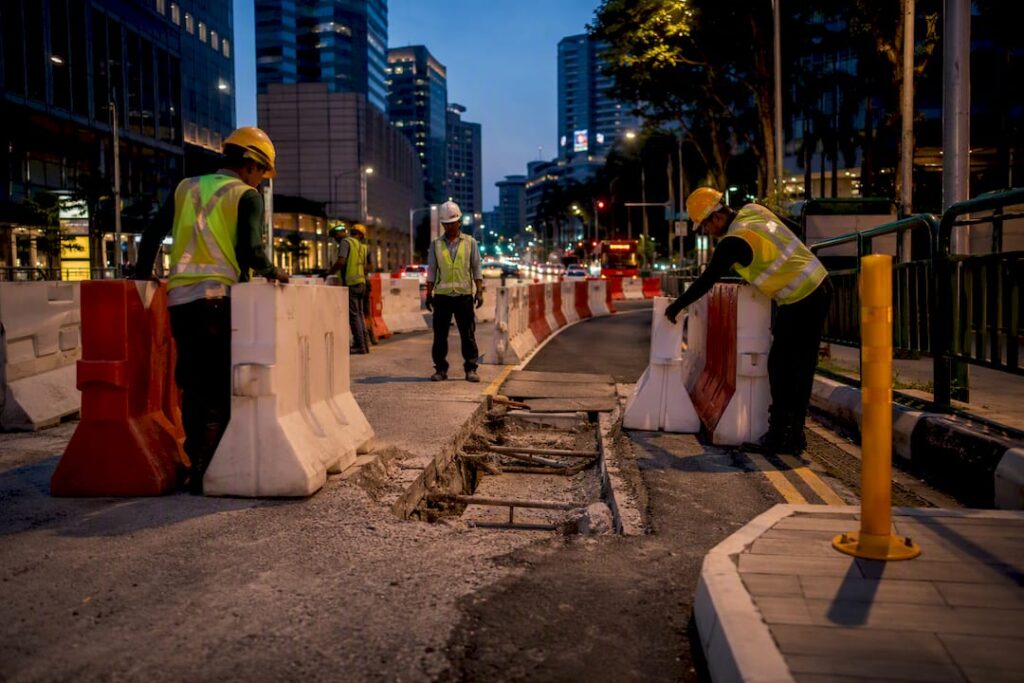
Every road opening permit in Singapore must be obtained through LTA.PROMPT, the Land Transport Authority’s mandatory portal for works on or near public roads. Before applying, confirm your registration category is approved, secure any outstanding agency clearances, and prepare a complete Traffic Management Plan with engineering drawings. Starting excavation or lane works without an approved permit exposes contractors to enforcement action under the Road Traffic Act.
TL;DR:
- Utility offsets, clearances from multiple agencies, and accurate pedestrian diversion routes are the most common reasons for permit rejection.
- Registration of applicants on LTA.PROMPT must be completed early, especially for multi-agency projects, to avoid delays.
- A comprehensive Traffic Management Plan that matches site conditions and includes detailed signage, diversion, and lane transition details is crucial for faster approval.
- Submitting complete, clearly labeled drawings, proof of insurance, and resolving agency approvals before application significantly reduces processing time.
- Coordinating agency approvals in parallel rather than sequentially can cut permit review time from months to weeks.
Table of Contents
- What LTA.PROMPT Covers and When You Need a Permit
- Who Can Apply and How Registration Works on LTA.PROMPT
- Documents, Drawings, and Evidence You Must Attach
- Traffic Management Plan: What LTA Looks For
- Timelines, Fees, and Why Permits Get Delayed
- Step-by-Step: Submitting a Road Opening Permit on LTA.PROMPT
- Expert Checklist and Common Pitfalls From Stellar Structures
- A Consultant’s View on What Actually Gets Permits Approved
- Let Stellar Structures Handle Your LTA.PROMPT Submission
- Official Links and Practical Resources
- Sources
What LTA.PROMPT Covers and When You Need a Permit
LTA.PROMPT governs a wide range of activities on or near Singapore’s public roads, not just excavation. The portal processes permits for lane occupation, footway works, construction access points, utility diversion, temporary signage, and road opening itself, according to LTA’s own Works FAQ. If your project involves cutting into the carriageway, disrupting pedestrian flow, or placing hoarding or equipment within the road reserve, you almost certainly need a permit.
Contractors sometimes assume small-scale works, like a short utility tap-in or a temporary signboard, fall outside LTA’s jurisdiction. They rarely do. Starting works without a valid PROMPT permit is an offense under the Road Traffic Act, carrying fines and the risk of an immediate stop-work order. Given how quickly a stalled site burns through budget and schedule, confirming permit applicability before mobilizing crews is worth the extra day it takes.
Who Can Apply and How Registration Works on LTA.PROMPT
LTA.PROMPT sorts applicants into three registration categories: Applicant, Professional Engineer, Agency or Department, and Contractor. Each category carries different submission rights, and LTA must approve your registration before you can submit any permit application, per the portal’s registration guidance.
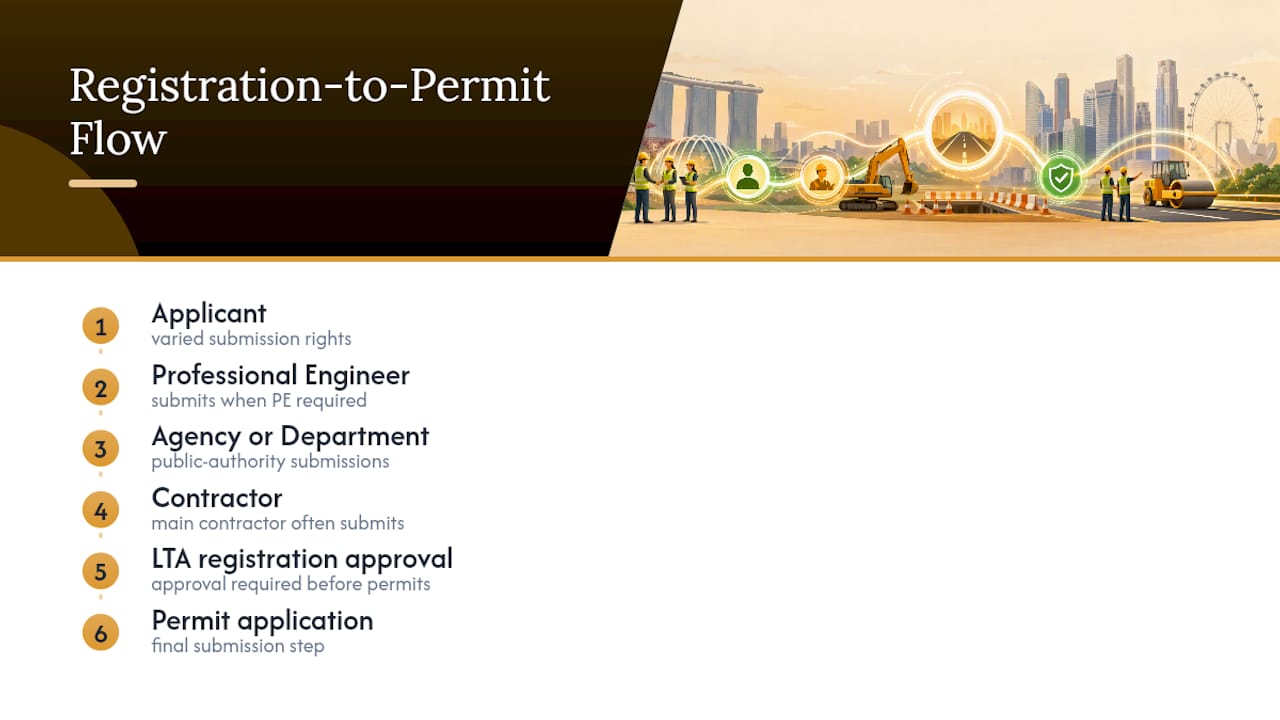
For a typical contractor-led road opening, the submitting party is usually either the main contractor or a nominated Professional Engineer, depending on whether structural endorsement is required for the works. Registration bottlenecks are common and almost always administrative: an incomplete company profile, missing PE credentials, or a category mismatch between the applicant and the actual scope of work. Resolving these early, ideally weeks before you plan to submit, avoids a scramble later when the project timeline is already tight.
Documents, Drawings, and Evidence You Must Attach
A complete submission package determines whether your permit clears review on the first pass or bounces back with technical comments. At minimum, LTA expects:
- A site plan showing the exact location of works relative to the road, kerbline, and nearby intersections
- Detailed excavation or road opening drawings with scale, dimensions, and depth
- A Traffic Management Plan covering the full duration of works
- A method statement describing the excavation and reinstatement sequence
- Utility diversion plans showing offsets from existing services
- Proof of insurance and, where required, a performance bond
- Professional Engineer endorsement for structural or geotechnically sensitive works
Drawings that omit utility offsets or fail to show the relationship between the works and the kerbline are among the most common triggers for a rejection. Reviewers need to see exactly how close you are working to existing services and street furniture, not just where the excavation sits on a general layout.
Traffic Management Plan: What LTA Looks For
A weak Traffic Management Plan is the single biggest cause of repeated review cycles on LTA.PROMPT submissions. LTA expects a TMP to address lane closures, pedestrian detours, signage placement, temporary barriers, the deployment of traffic controllers where needed, and a clear timeline for each phase of works.
Common technical comments center on three things: unclear pedestrian diversion routes, signage that doesn’t match the actual site layout, and merge tapers that don’t meet the expected lane transition distance. A detailed Traffic Management Plan built around LTA’s compliance expectations tends to clear review faster than one assembled from a generic template.
- Map every pedestrian detour to a specific, walkable alternative route
- Match signage schedules to the actual phased sequence of works
- Show merge tapers and lane transitions at the distances LTA expects for the posted speed limit
For high-traffic corridors or multi-phase closures, consider traffic flow simulation tools to model impact before submission rather than after a rejection.
Pro Tip: Draft your TMP as if the reviewer has never seen your site. Label every diversion, barrier, and signage point with a reference number that matches your drawings exactly, since mismatched labels are a frequent, entirely avoidable source of technical comments.
Timelines, Fees, and Why Permits Get Delayed
Turnaround time on LTA.PROMPT varies with the complexity of the works and the completeness of the submission. Straightforward footway or signage permits tend to move faster than road opening applications involving multiple utility agencies. The variables that stretch review time are consistent across projects:
- Incomplete documentation, particularly missing utility clearance letters
- Outstanding approvals from other agencies still in progress
- Unresolved TMP technical comments requiring resubmission
- Registration issues with the applicant’s PROMPT account
Applicants may also face deposits or bonds tied to reinstatement obligations, and enforcement penalties apply if works begin before the permit is formally issued. LTA’s own guidance is direct on this point: planning and agency approvals should be finalized before applying on PROMPT, since the portal issues permits rather than resolving outstanding design or planning queries. Coordinating with agencies like PUB or SP Group early, before your PROMPT submission, is the most reliable way to avoid a mid-review stall.
Step-by-Step: Submitting a Road Opening Permit on LTA.PROMPT
- Confirm scope and secure prior clearances. Resolve any required approvals from URA, PUB, JTC, or HDB before touching PROMPT. The portal is for permit issuance, not planning clearance.
- Register and verify your applicant status. Ensure the contractor or Professional Engineer submitting the application is registered and approved on LTA.PROMPT under the correct category.
- Upload a complete document set. Attach drawings, the Traffic Management Plan, method statements, and proof of insurance or bonds, with files clearly labeled and cross-referenced.
- Track comments and respond quickly. Monitor the portal for LTA’s technical feedback, address each comment specifically, and wait for formal permit issuance before mobilizing any crew on site.
Expert Checklist and Common Pitfalls From Stellar Structures
A standing pre-submission checklist is commonly applied to every street works package: utility clearance verification, an internal TMP peer review, sign-off where structural risk exists, and confirmation of insurance and bond documentation before the file ever reaches LTA.
The mistakes that cost contractors the most time are rarely dramatic. Missing utility offsets on a drawing, vague or unrealistic pedestrian diversion routes, and late PROMPT registration account for a large share of avoidable rejections, based on the firm’s own street works permit checklist.
- Verify utility offsets against the latest service records, not an older survey
- Route pedestrian diversions through paths that actually exist on the ground
- Register your applicant category on PROMPT well before your target submission date
Pro Tip: If your site touches more than two agencies, such as PUB, SP Group, and URA, engage a submission consultant early. Coordinating agency sign-offs in parallel rather than sequentially is usually what separates a four-week approval from a three-month one.
A Consultant’s View on What Actually Gets Permits Approved
The projects that clear LTA.PROMPT fastest aren’t the simplest ones. They’re the ones where the contractor treated agency coordination as a parallel task, not a sequential afterthought, resolving PUB and SP Group clearances while the TMP was still being drafted. That single habit, more than any drawing quality, separates a smooth approval from a three-month back and forth. Secure your permit before a single shovel touches the road.
— Aman
Let Stellar Structures Handle Your LTA.PROMPT Submission
Preparing a road opening permit package while running a live construction schedule is where most delays actually start, not in LTA’s review queue. Stellar Structures manages the document preparation, TMP drafting, Professional Engineer endorsement, and multi-agency coordination that a complete PROMPT submission requires, so your team can stay focused on the site rather than the portal.
This kind of support matters most on complex sites: corridors touching multiple agencies, tight urban footprints, or projects where a rejected TMP would push your whole schedule by weeks. Stellar Structures’ authority submission services cover exactly that scope, from initial document review through to permit issuance and follow-up on technical comments. If your next project needs a road opening permit and you’d rather not learn PROMPT’s quirks under deadline pressure, reach out to Stellar Structures to scope your submission before you file.
Official Links and Practical Resources
- LTA.PROMPT Works FAQ — portal guidance and permit scope
- LTA WhatsApp contact — quick enquiries on permits or portal issues
- ScamShield — verify or report suspicious permit-related requests
- Stellar Structures street works permit checklist — practical preparation guide
Sources
Recommended
- Engineer’s Checklist to Pass LTA for Street Works Permits in Singapore
- Temporary Traffic Diversions in Singapore: The Definitive LTA Compliance Guide
- Navigating BCA Permit to Commence Structural Works (ST Permit): A Step-by-Step Guide
- Risk Management Facilitator LTA Projects