




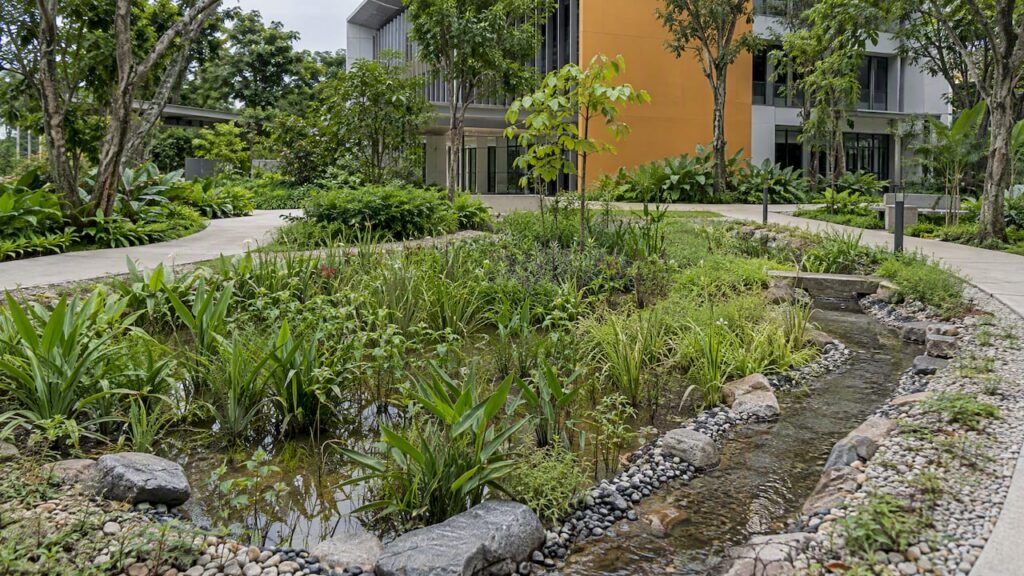
ABC Waters design is the practice of building stormwater management into a development through vegetated, nature-based features, such as swales, rain gardens and constructed wetlands, in place of drainage that only conveys runoff away. It follows PUB’s ABC Waters Design Guidelines and Engineering Procedures, and it affects how a site is planned, how its drainage submission is prepared, and how the finished features are maintained. This article explains the features, the professional and submission requirements, the certification scheme and the maintenance obligations that project teams in Singapore should plan for.
TL;DR
- ABC Waters design uses features such as vegetated swales, bioretention basins and constructed wetlands to detain and cleanse stormwater at or near its source, following PUB’s 2024 guidelines.
- Submissions for vegetated swales, bioretention swales and bioretention basins must include PUB’s templates for design calculations.
- Developers and owners are expected to engage an ABC Waters Professional to design, oversee construction of, and develop a maintenance plan for the features.
- ABC Waters certification is voluntary recognition: 45 points for Certified, 65 points for Gold, with minimum points in the Active, Beautiful and Clean categories.
- The first two years after construction are the most maintenance-intensive, and an annual certificate of inspection is required.
Table of Contents
- What ABC Waters design means in Singapore
- The main ABC Waters design features
- The guidelines and what a submission must contain
- Who must be involved: the ABC Waters Professional
- ABC Waters certification
- Maintenance and monitoring after handover
- Perspective: where projects lose time
- How Stellar Structures supports drainage and submission work
- Frequently asked questions
- Sources
What ABC Waters design means in Singapore
PUB launched the ABC Waters Programme in 2006 as a strategic initiative to improve the quality of water and life by harnessing the full potential of Singapore’s waterbodies. ABC stands for Active, Beautiful, Clean. The programme is also a key element of the City in Nature pillar of the Singapore Green Plan 2030, which places weight on blue-green integration.
“ABC Waters design” therefore refers to the engineering and landscape measures applied at the development scale. PUB’s engineering procedures describe a shift from traditional, conveyance-oriented drainage to an integrated approach that combines quantity and quality management at or near the source, which is considered essential for minimal hydrological impact.
The distinction matters in practice. A conventional drain is sized to remove peak flow quickly. An ABC Waters feature slows, detains and treats the flow, and it does so inside the landscape of the site. That changes land allocation, levels, planting and the maintenance regime, which is why it should be considered at concept stage and not added after the architectural layout is fixed.

The main ABC Waters design features
PUB’s engineering procedures list the common features as vegetated swales, bioretention swales, bioretention basins (rain gardens), sedimentation basins, cleansing biotopes, bioengineering and constructed wetlands. Each has a different role in the treatment train.
| Feature | Principal function | Typical site context |
|---|---|---|
| Vegetated swale | Conveys flow slowly over mild slopes; vegetation slows and distributes flow and encourages coarse sediment to settle | Roadside verges, carpark edges, landscape strips |
| Bioretention swale | Combines conveyance with filtration through a planted filter media | Linear spaces where a swale can double as a treatment strip |
| Bioretention basin (rain garden) | Detains and filters runoff through planted media in a basin | Courtyards, podium edges, open landscape pockets |
| Sedimentation basin | Captures sediment before downstream treatment | Upstream of other features, larger catchments |
| Cleansing biotope | Polishes water using aquatic plants | Ponds and water features with space for planted zones |
| Constructed wetland | Large-scale treatment and detention with landscape and recreational value | Larger developments and public parks |
| Bioengineering | Uses vegetation and natural materials to stabilize banks and channels | Drain and waterway edges |
The functional description of swales comes from PUB’s guidance, which notes that swales use overland flows and mild slopes to convey water slowly downstream. The other rows summarize the feature names in the same document and should be read against the detailed design procedures for sizing and construction criteria.
Choosing between features
Feature selection is usually driven by four constraints:
- Available land. Basins and wetlands need area; swales can fit linear strips.
- Levels and gradients. Swales depend on mild slopes, so site grading must be planned with the drainage engineer.
- Catchment character. Sediment-heavy catchments call for upstream sediment control before planted filter media.
- Maintenance access. PUB advises that a specific maintenance plan and schedule be developed, taking access and likely litter collection points into account.
There is also a land-use argument. PUB’s procedures observe that the multi-purpose benefits of these features, such as recreational and aesthetic value, can offset potential losses in developable land area. A rain garden that also serves as an amenity landscape is not purely a deduction from the usable area.
The guidelines and what a submission must contain
PUB’s ABC Waters Design Guidelines give developers and industry professionals a reference for implementing the features in their developments, and the updated edition was launched on 21 June 2024. Two documents are used together:
- The Design Guidelines, which set out the concept and the range of features.
- The Engineering Procedures for ABC Waters Design Features, which provide detailed guidance on designing, constructing and maintaining the features.
For the drainage submission, the most concrete requirement is documentary: QP design certificate submissions for vegetated swales, bioretention swales and bioretention basins must include PUB’s templates for design calculations. Calculations prepared in an ad hoc format create avoidable queries, so the templates should be adopted at the start of design and not at the point of submission.
For the wider stormwater workflow, including how the QP coordinates the PUB submission with the other drainage requirements, see our guide to stormwater management submissions for Singapore QPs. Where detention is required on smaller sites, the related requirements are covered in our article on on-site detention tanks.
Who must be involved: the ABC Waters Professional
The ABC Waters Professional Programme covers the concept, design, implementation and maintenance of the features. According to PUB’s programme page, professionals who meet the registration criteria of IES, SIA or SILA and complete all four core modules plus two elective modules are eligible to be registered as an ABC Waters Professional. The same page states that, in line with revisions to the Code of Practice on Surface Water Drainage, developers and owners shall engage an ABC Waters Professional to design, oversee the construction of, and develop a maintenance plan for the features.
In practical terms, the project team should confirm early who holds this role. It is not a role that can be filled retrospectively without cost to the programme, because the same person is expected to follow the features from design through construction to the maintenance plan.
ABC Waters certification
Certification is a separate matter from the design requirements. It is a scheme launched by PUB to recognize developments that successfully incorporate ABC Waters design strategies, and it is open to completed projects, projects under construction and projects in the design stage.
Scoring and thresholds
Applicants submit an application form and checklist. Evaluation is based on four categories: Active, Beautiful, Clean and Innovation. PUB’s certification page sets the thresholds as follows:
| Level | Minimum points | Additional condition |
|---|---|---|
| ABC Waters Certified | 45 | Mandatory minimum points in the Active, Beautiful and Clean categories |
| ABC Waters Certified (Gold) | 65 | Treatment of surface runoff from at least 40% of the total site area, plus the category minimums |
Both thresholds and the 40% condition are stated on PUB’s certification page. The mandatory category minimums mean a project cannot reach the threshold with one strong category alone; a development that scores well on aesthetics but treats little runoff will not qualify.
When to apply
Because design-stage projects are eligible, the checklist can be used as a planning tool. Reviewing it during concept design shows which features contribute points and where an inexpensive addition, such as extending the treated catchment, may lift the project from Certified toward Gold. The 40% treated-area condition for Gold is the most design-sensitive item, since it depends on how the site is graded and drained and cannot be changed easily later.
Maintenance and monitoring after handover
ABC Waters features are living systems, and their performance depends on upkeep. PUB’s condensed booklet of engineering procedures notes that swales require routine inspection for sediment deposition, scouring, erosion and damage, together with inspection of inlets and pits for scour, litter and blockages.

The same guidance identifies the establishment period, typically the first two years, as the most intensive maintenance phase, requiring active monitoring of vegetation and sediment levels. Contractors should therefore price this period explicitly, and owners should avoid treating practical completion as the end of the landscape contractor’s involvement.
On an annual basis, developers and owners shall submit a certificate of inspection, endorsed by an ABC Waters Professional if applicable. It declares whether the features have been inspected, are maintained satisfactorily and are functioning well.
A workable maintenance plan typically assigns:
- Inspection frequency for each feature, with a higher frequency in the establishment period.
- A defined person or contractor responsible for litter removal and inlet clearing.
- Triggers for sediment removal and replanting.
- A record format that can support the annual certificate of inspection.
Perspective: where projects lose time
Our view, drawn from the work we do on drainage and authority submissions, is that ABC Waters design rarely fails on technical grounds. It fails on sequence. When the architectural layout, the levels and the landscape plan are fixed before a drainage engineer has tested where a swale or rain garden can physically sit, the feature is squeezed into leftover space, the calculations become difficult to reconcile with the templates, and the submission returns with queries.
We recommend three habits. First, settle the treatment train and the approximate land take at concept stage, alongside the detention strategy. Second, confirm the ABC Waters Professional appointment before design development, since the role extends from design through to the maintenance plan. Third, write the maintenance plan as a design deliverable, not as a handover document, because access and litter collection points are easier to resolve on drawings than on site.
For clients, the commercial logic is straightforward: a feature designed with its maintenance in mind is cheaper to keep compliant, and a project that is planned against the certification checklist can pursue recognition without redesign.
— Aman
How Stellar Structures supports drainage and submission work
Stellar Structures is a Singapore design and engineering firm that handles civil, structural, geotechnical and M&E engineering, together with authority submissions that include PUB, BCA, URA, HDB, JTC and SCDF. For projects where ABC Waters features sit alongside other approvals, we coordinate the engineering design and the submission process so that drainage, structural and architectural information stays consistent.
Property owners, developers, contractors and architects can review the full range of services on our services page, or read how authority submission services are typically organized across the statutory boards.
Frequently asked questions
Is ABC Waters certification mandatory?
No. PUB describes certification as a scheme that recognizes developments that incorporate ABC Waters design strategies, and it is open to completed, under-construction and design-stage projects. The design requirements in the Code of Practice and the Design Guidelines are a separate matter and apply according to the project’s drainage submission.
How many points are needed for ABC Waters certification?
A project needs at least 45 points for ABC Waters Certified and at least 65 points for the Gold level. Mandatory minimum points apply in the Active, Beautiful and Clean categories, and Gold also requires treatment of surface runoff from at least 40% of the total site area.
Which ABC Waters features can be used on a development?
The common features are vegetated swales, bioretention swales, bioretention basins (rain gardens), sedimentation basins, cleansing biotopes, bioengineering and constructed wetlands. The choice depends on available land, site levels, catchment character and maintenance access.
What maintenance is required once features are built?
Features need routine inspection for sediment, scouring, erosion, damage, litter and blockages, with the first two years being the most intensive. Developers and owners also submit an annual certificate of inspection, endorsed by an ABC Waters Professional if applicable.
Do I need an ABC Waters Professional?
PUB’s programme page states that developers and owners shall engage an ABC Waters Professional to design, oversee construction of, and develop a maintenance plan for the features. Confirm the current requirement with PUB for your specific project.
Sources
- About ABC Waters | PUB
- Active, Beautiful, Clean Waters Design Guidelines (PDF)
- Engineering Procedures for ABC Waters Design Features, 2024 Edition (PDF)
- ABC Waters Design Guidelines | PUB
- ABC Waters Professional Programme | PUB
- ABC Waters Professional Programme, annual inspection certificate | PUB
- ABC Waters Certification | PUB
- Condensed Booklet of Engineering Procedures (PDF)