




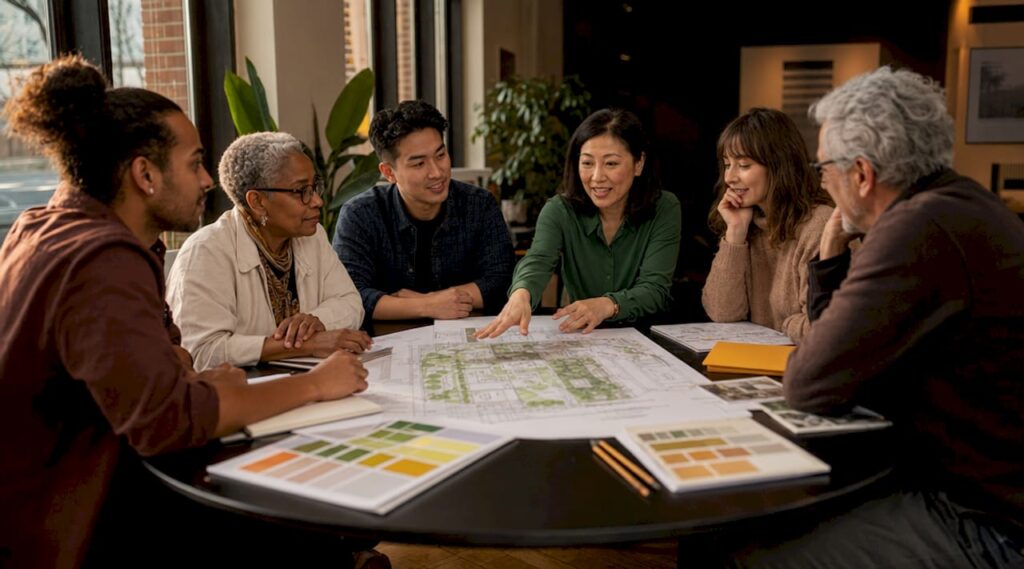
Architectural design considerations for community projects are defined as the integrated set of technical, social, and environmental decisions that determine whether a public space serves its users equitably and durably. Planners who treat these decisions as a checklist rather than a framework consistently produce spaces that underperform socially, fail accessibility standards, or require costly retrofits. The most effective community project architecture combines early participatory engagement, universal design principles, structural safety compliance, and environmental performance from the first design stage. Frameworks from UN-Habitat, Ontario’s 2025 accessibility standards, and recent sustainability research confirm that no single factor operates in isolation.
1. Architectural design considerations community projects demand: early community engagement
Co-design is the recognized industry term for structured participatory design, and it is the single most consequential architectural decision a community project team makes. Co-design embedded early and continuously, rather than applied as a late-stage consultation, strengthens long-term social cohesion and produces spaces that communities actively maintain.
The practical difference between early and late engagement is significant. When residents contribute before the layout is locked, their input shapes spatial relationships, circulation paths, and program mix. When they are consulted after schematic design, they can only react to decisions already made. Sustained community involvement builds relational infrastructure and collective agency, which translates directly into reduced vandalism, higher utilization rates, and stronger stewardship.

Effective engagement is not informal. Formal engagement strategies with clear objectives and mixed methods, including surveys, workshops, and site walks, improve consultation quality and inclusion. Publishing findings back to participants builds trust and demonstrates that input was received and acted upon.
Key methods for embedding community influence include:
- Scheduling co-design workshops before schematic design is finalized
- Using visual tools such as photo surveys and physical models to lower participation barriers
- Establishing iterative checkpoints at design development and construction documentation stages
- Documenting and publishing how community input changed design decisions
Pro Tip: Set a formal co-design checkpoint at the end of concept design, before any structural or MEP coordination begins. This is the last point at which spatial changes are low-cost, and community input has the highest design leverage.
2. Adaptable, inclusive public spaces that serve diverse needs
Well-functioning cities allocate approximately 50% of surface area to public space, with people-centered streets, adaptable zones, and inclusive design as the organizing principles. That figure reflects a deliberate policy choice: public space is not residual land between buildings but a primary civic infrastructure.
Adaptability is the design quality that allows a single space to serve multiple user groups across different times of day and seasons. Temporary installations, movable seating, and demountable structures allow planners to test uses before committing to permanent construction. This approach reduces the risk of designing for an assumed user profile that does not reflect actual community composition.
Inclusivity in design factors for community spaces extends well beyond physical access. UN-Habitat, WHO, and UNICEF identify children’s play and public space as core rights essential for health and development, noting that urbanization is actively shrinking access to these spaces. A community space that lacks dedicated play areas, shaded seating, or quiet zones excludes entire demographic groups by default.
The following elements define a genuinely inclusive public space:
- Seating at regular intervals along primary circulation paths, with back support and armrests
- Shading structures positioned to cover peak-use areas during midday hours
- Dedicated play zones designed to accommodate children of varying physical abilities
- Continuous accessible paths connecting all program areas without level changes
- Wayfinding signage using high-contrast text, tactile indicators, and multilingual labeling
| Design element | Minimum standard | Inclusive standard |
|---|---|---|
| Seating | Benches at entry points | Seating every 30 meters with armrests and back support |
| Lighting | Code-minimum lux levels | Dusk-to-dawn lighting with consistent color temperature |
| Play areas | Standard equipment | Equipment accessible to children with mobility limitations |
| Paths | Ramp at grade changes | Continuous barrier-free path throughout entire site |
Pro Tip: Commission a shadow study during schematic design to map sun and shade patterns across the site at 9 a.m., 12 p.m., and 3 p.m. Shade placement decisions made without this data consistently miss the hours when the space is most used.
3. Integrating sustainability into community architectural design
Energy-positive, carbon-neutral community architecture is achievable through the integration of passive design and photovoltaics, and recent research demonstrates that community input and environmental performance are not competing priorities. When residents are asked what they value in a community space, shaded areas, green spaces, and flexible zones consistently rank highest. These preferences align directly with passive cooling strategies, permeable landscaping, and adaptable programming, which are also the foundations of low-energy design.
The key sustainability considerations for community project architecture include:
- Passive design optimization: Orient buildings and shade structures to minimize solar heat gain in cooling-dominated climates and maximize it in heating-dominated ones. This reduces mechanical system loads before any active technology is specified.
- Photovoltaic integration: Roof surfaces, shade canopies, and pergola structures in community spaces are viable locations for solar panels. Surplus energy generation can power site lighting, irrigation systems, or adjacent community facilities.
- Permeable surfaces: Replace impermeable paving with permeable concrete, gravel, or planted surfaces to manage stormwater on-site and reduce urban heat island effects.
- Material selection: Specify locally sourced, low-embodied-carbon materials. Concrete and steel dominate community project construction, and specifying supplementary cementitious materials such as fly ash or slag reduces embodied carbon without compromising structural performance.
Technical sustainability goals and social design objectives must be integrated early to avoid false trade-offs. A community center designed for net-zero energy performance but without shaded outdoor gathering space will see low utilization, which negates the social purpose of the investment. Sustainable community design succeeds when environmental logic and human behavior reinforce each other.
4. Safety and engineering requirements in community architecture
Architectural planning for communities cannot be separated from structural and hazard engineering. The Klein Dytham architecture project in Noroshi demonstrates this directly: resident and engineer collaboration produced a community facility designed for earthquake resistance and heavy snow loads, conditions that would have been missed by an architecture-only design process. This case confirms that community project architecture requires multidisciplinary input from the earliest design stages.
Safety considerations that must be addressed in the design program include:
- Structural hazard compliance: Identify the seismic zone, wind load category, and snow load requirements for the project location. These parameters determine structural system selection and must be resolved before architectural form is finalized.
- Barrier-free path design: Ontario’s 2025 accessibility standards define accessibility as a combined system, not a single feature. Exterior paths, surface materials, cross-slopes, and grade transitions all require design attention, not just ramp placement at entries.
- Lighting for non-daylight safety: Lighting from dusk to dawn with consistent spacing, adequate brightness, and appropriate color temperature is a safety requirement for outdoor community spaces, not an aesthetic option. Poor lighting is one of the most common accessibility failures in peripheral site infrastructure.
- Code compliance and inspection protocols: Engage a licensed structural engineer for design checks and schedule inspections at foundation, framing, and completion stages. For public facilities, authority submissions to the relevant building authority are mandatory and must be coordinated with the architectural documentation.
Understanding civil engineering inputs for architectural design is particularly relevant here. Geotechnical conditions, drainage requirements, and utility coordination all affect where structures can be placed and how they must be detailed. Planners who treat engineering as a downstream task consistently encounter costly redesigns at construction documentation stage.
5. Culturally responsive and contextually appropriate design
Urban design best practices recognize that community spaces must reflect the cultural identity, social patterns, and historical context of the population they serve. A plaza designed for a community with strong outdoor social traditions requires different spatial organization than one serving a community that prioritizes quiet, contemplative use. Neither is correct in the abstract; both are correct when matched to their context.
Contextual appropriateness is established through research, not assumption. Site analysis should document existing gathering patterns, informal use of adjacent spaces, cultural events that require specific spatial configurations, and the demographic composition of the user population. This information directly informs decisions about program mix, spatial hierarchy, and material character.
Material and aesthetic choices carry cultural meaning. Specifying materials that reference local building traditions, using planting palettes that include culturally significant species, and incorporating public art commissioned from community members all contribute to a sense of ownership that generic design cannot produce. Architectural drawings that communicate these contextual decisions clearly are also essential for community review, because residents can engage with visual representations far more effectively than with technical specifications.
6. Regulatory compliance and authority approvals in community projects
Community projects in Singapore and comparable jurisdictions require authority submissions to multiple agencies before construction can proceed. Relevant authorities include BCA for structural and fire safety, URA for planning permission, NParks for projects affecting green corridors or parks, and PUB for drainage and water management. Each agency has specific submission requirements, and the sequence of approvals affects the project program.
Planners must build authority approval timelines into the project schedule from the outset. A community center that completes design in six months but requires nine months of authority approvals will miss its intended opening date if the overlap is not planned. Experienced architectural and engineering firms manage this process by preparing submissions in parallel with design development rather than sequentially.
Structural design checks are a mandatory component of the authority submission process for public buildings. These checks verify that the structural system meets code requirements for the applicable load combinations and that the design documentation is complete enough for construction. Incomplete submissions are the most common cause of approval delays in community project delivery.
Key takeaways
Effective community project architecture requires integrating participatory design, universal accessibility, environmental performance, and structural safety from the earliest project stage, not as sequential additions.
| Point | Details |
|---|---|
| Start co-design early | Embed community input before schematic design is locked to maximize spatial influence and build ownership. |
| Design for all users | Apply Ontario-standard accessibility principles to paths, lighting, seating, and wayfinding, not just entry ramps. |
| Align sustainability with social goals | Passive design and community preferences for shade and green space are complementary, not competing. |
| Integrate engineering from day one | Structural hazard requirements and geotechnical conditions must inform architectural form before layout is finalized. |
| Plan authority approvals in parallel | Submit to BCA, URA, NParks, and other agencies concurrently with design development to avoid program delays. |
What I’ve learned about designing community spaces that actually work
The most persistent mistake I see in community project architecture is treating participation as a communications exercise rather than a design input. Teams hold a public meeting, document the feedback, and then proceed with the design they had already developed. The community senses this immediately, and the resulting space reflects it: technically compliant, spatially adequate, and socially inert.
The projects that generate genuine community ownership share one characteristic. The design team treated co-design checkpoints as binding constraints, not advisory input. When a community workshop identified that the proposed plaza orientation created an uncomfortable wind corridor, the team revised the layout. That revision cost two weeks of design time and saved years of underutilization.
Sustainability integration follows the same logic. Planners who present environmental performance targets to communities as non-negotiable constraints consistently face resistance. Planners who show communities how passive shading, green roofs, and permeable paving directly improve the comfort and usability of the space they will use every day consistently gain support. The technical outcome is identical. The social outcome is entirely different.
Accessibility is the area where I see the largest gap between professional intent and built reality. Most design teams understand ramp requirements. Far fewer apply the same rigor to lighting continuity, surface texture transitions, and wayfinding legibility across the entire site. These peripheral elements are where accessibility fails in practice, and they are the elements that Ontario’s 2025 standards specifically address. Treating accessibility as a mindset rather than a checklist is the standard that community spaces require.
— Aman
How Stellar Structures supports community architectural design
Stellar Structures provides architectural design services for community and public building projects across Singapore, integrating authority submissions, structural engineering, and accessibility compliance into a single coordinated process. The firm manages submissions to BCA, URA, NParks, PUB, and other relevant agencies, reducing approval delays that commonly affect community project timelines. For planners and community leaders who need a team that understands both the technical requirements and the participatory design process, Stellar Structures brings engineers and architects into the project from concept stage. Contact the team to discuss your community project requirements and receive a feasibility assessment.
FAQ
What are the most critical architectural design considerations for community projects?
The most critical considerations are early community co-design, universal accessibility across the entire site, structural safety compliance, and environmental performance integration. These factors must be addressed simultaneously from the concept stage, not sequentially.
How does co-design differ from standard community consultation?
Co-design embeds community input before spatial decisions are finalized, giving residents direct influence over layout, program, and character. Standard consultation typically occurs after schematic design, limiting input to reactions rather than contributions.
What accessibility standards apply to community public spaces?
Ontario’s 2025 accessibility standards define accessibility as a combined system covering exterior paths, lighting from dusk to dawn, seating, wayfinding, and barrier-free circulation throughout the entire site, not only at building entries.
How should sustainability be integrated into community project architecture?
Passive design and photovoltaic integration can achieve energy-positive performance in community buildings. Sustainability goals should be introduced in the concept stage and aligned with community preferences for shade, green space, and flexible outdoor areas.
When should authority submissions be initiated for community projects in Singapore?
Authority submissions to agencies such as BCA and URA should be prepared in parallel with design development, not after design completion. Early submission initiation prevents approval delays from extending the overall project program.
Recommended
- Architectural Design for Commercial Buildings – Stellar Structures
- Civil Engineering Inputs for Architectural Design: 10 Critical Factors
- Best Architectural Residential Design – Stellar Structures
- Civil and Structural Design Checks for Building Engineering – Stellar Structures