




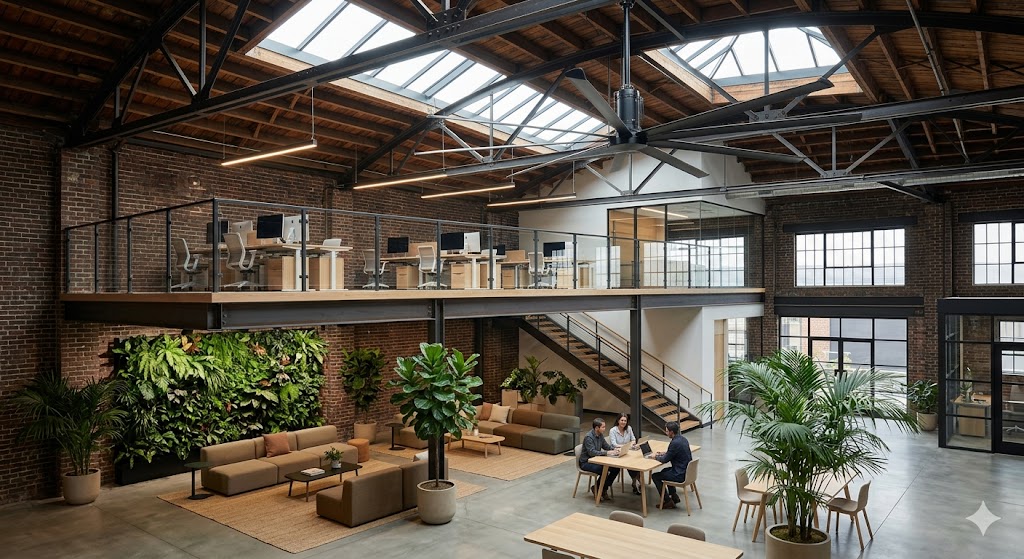
Case Study: Converting High-Ceiling Industrial Units into Functional Mezzanine Offices
Introduction to Industrial Adaptive Reuse
The conversion of industrial units represents a major architectural shift today. Traditional commercial real estate faces unprecedented spatial constraints globally.
Consequently, businesses continually seek innovative solutions for physical expansion. High-ceiling warehouses offer vast amounts of unused vertical space. Therefore, installing mezzanine offices solves critical operational space shortages.1
A mezzanine operates as a freestanding intermediate structural floor. It sits directly above active ground-level daily operations.1 Most importantly, it does not require external building expansion.1
This adaptive reuse trend began in urban artistic communities. Neighborhoods like Jackson Square and SoMa pioneered this specific movement.3
Today, the industrial aesthetic dominates modern corporate office design.3 Exposed brick and steel beams are highly desirable architectural features.3
Ultimately, mezzanines transform raw warehouses into highly functional workspaces. This strategy significantly improves overall workflow and operational efficiency. Furthermore, it maximizes the inherent value of existing commercial real estate.
The Evolution of Industrial Office Design
Historically, industrial conversions were primarily residential artist lofts. Artists in New York City aggressively sought inexpensive studio spaces.3 Consequently, they repurposed abandoned warehouses in Brooklyn and Queens.3
This trend quickly expanded beyond New York City boundaries. Boston’s Faneuil Hall Market Place became a milestone reuse development.3
Similarly, Chicago witnessed major renovations in the Printer’s Row district.3 These early projects combined residential and commercial functional uses beautifully.3
Over time, aesthetic tastes shifted dramatically across the global workforce. Employees rejected windowless suburban corporate office parks entirely.3
Instead, urban neighborhoods became highly attractive places for commerce.3 Mass media heavily reinforced this specific industrial aesthetic trend.3
Television shows featured young professionals in renovated urban warehouse settings.3 Thus, classic industrial features became synonymous with modern creative workspaces.3 Today, corporations actively seek these unique, character-rich architectural environments.
Case Study 1: IMM Digital Agency Conversion
The IMM digital advertising agency required a new corporate headquarters. They outgrew their previous downtown Boulder, Colorado location.4
Consequently, they relocated to an industrial park on the outskirts.4 The selected site was a completely vacant, cavernous warehouse. It provided an impressive 32,910 square feet of total space.4
Initially, the building lacked standard corporate infrastructure entirely. There were absolutely no restrooms, windows, or HVAC systems.4 Therefore, IMM enlisted OZ Architecture for a comprehensive facility redesign.4
The total construction cost was approximately seventy dollars per square foot.4 This budget included extensive interior and exterior system upgrades.4
The architects installed full-height glass windows and large skylights.4 Furthermore, operable garage doors maximized incoming natural daylight significantly.4 The design successfully maintained an open, highly connected floor plan.
Specifically, floating objects defined distinct programmatic work zones effectively.4 Fifty percent of the area remained unassigned for spontaneous collaboration.4
Additionally, the architects designed a unique “Analog Room” space. This sculptural millwork piece served as a tech-free sanctuary.4 To compensate for the remote location, transportation amenities were added.
The firm installed electric car chargers and ample bike parking.4 Finally, biophilic elements were heavily integrated throughout the entire space. Live interior landscaping significantly improved the overall indoor air quality.4
Case Study 2: ICON Bioanalytical Laboratory
ICON required a new, state-of-the-art bioanalytical laboratory facility. They selected a 48,000-square-foot warehouse in Lenexa, Kansas.5
The structure featured massive 35-foot floor-to-roof vertical ceilings.5 However, converting a warehouse into a laboratory presents severe challenges.
Specifically, Mechanical, Electrical, and Plumbing (MEP) demands are extreme.5 Standard warehouses possess minimal baseline plumbing capacity by default.5 Conversely, laboratories require emergency showers, floor drains, and specialized sinks.5
Therefore, CRB Engineering significantly upgraded the facility’s plumbing infrastructure.5 Their waste demand utilized 78% of the building’s drainage capacity.5
The most innovative solution involved mechanical equipment placement strategies. Laboratories require massive air handling units for proper ventilation.5
Placing these heavy units on the roof required costly structural reinforcement.5 Consequently, engineers built a dedicated interior structural mezzanine instead.5
This robust mezzanine safely housed all heavy mechanical units indoors.5 This strategic placement maximized usable laboratory floor space directly below.5 Furthermore, indoor protection increased the sensitive equipment’s life expectancy.5
Offices were strategically placed along the perimeter exterior windows. Additionally, solar tubes introduced natural light into internal lab corridors.5
Ultimately, the entire nine-million-dollar project finished comfortably under budget.5
Case Study 3: Noatum and FCP Industrial Expansions
Noatum Logistics recently enhanced operations by integrating advanced automation technology. They implemented this across multiple floors in a new warehouse.6 MiTek designed a customized mezzanine solution to streamline these processes.6
Specifically, the structure worked in harmony with automated handling systems.6 Furthermore, the warehouse was optimized to support future robotics seamlessly.6
Similarly, a local Hawaiian medical equipment supplier faced space constraints. Unistrut Hawaii provided an innovative industrial warehouse mezzanine solution.7 The client specialized in acute and homecare medical devices.7
They outgrew their original location due to increasing storage demands.7 Consequently, they acquired a second warehouse to manage this growth.7
The solution was an FCP Industrial Warehouse Mezzanine system. This structure featured the exclusive ConnectRite cold-formed steel connection system.7 Elsewhere, KW Digital completely transformed an industrial warehouse into offices.
Nexus Workspace designed and built their bespoke office mezzanine floor.8 Ultimately, these case studies demonstrate the immense versatility of mezzanine conversions.
Structural Engineering Requirements
Engineers must meticulously calculate load capacities before any mezzanine construction. Unpermitted structures face severe legal repercussions and massive financial fines.9
Structural permits explicitly require PE-stamped engineering drawings for municipal approval.10 These comprehensive drawings demonstrate that the system can operate safely.10
Engineers strictly differentiate between two very distinct structural load types. Dead loads represent the immense weight of the structure itself.10 This specifically includes steel framing, floor decking, stairs, and railings.10 Conversely, live loads represent highly variable daily operational weights. Live loads include heavy inventory, personnel, conveyors, and manufacturing equipment.10
Furthermore, buildings located in active seismic zones require rigorous analysis.10 Structural engineers must carefully evaluate the existing concrete floor slab.9 The existing foundation must safely support the new column point loads.9
Finally, all steel materials must conform strictly to ASTM standards.11 This guarantees the structural integrity of base plates and framing members.11
IBC Load Capacity Standards
The International Building Code (IBC) strictly dictates minimum load parameters. Structural capacity relies on Pounds per Square Foot (PSF) measurements.12 Minimum use platforms require only a 60 PSF capacity.13 However, standard corporate office spaces typically require at least 80 PSF.13
| Typical Mezzanine Use Case | Required Load Capacity (PSF) |
| Minimum Use / Maintenance | 60 PSF |
| Standard Office Space | 80 PSF |
| Conveyors with Limited Access | 90 PSF |
| Light Manufacturing / Storage | 125 PSF |
| Heavy Manufacturing Storage | 250+ PSF |
Table 1: IBC Load Capacity Requirements by Use 13
Heavy industrial storage requires extreme capacities exceeding 250 PSF.13 A retail mezzanine typically supports moderate loads up to 125 PSF.13 Conversely, a distribution center might require 500 PSF capacity.13
It is vital to correctly anticipate future capacity needs during planning.14 Failing to do so leads to inadequate or dangerously overbuilt structures.15 Consequently, consulting with a structural engineer avoids costly under-specification errors.14
Regulatory Compliance and Building Codes
Strict building regulations govern all commercial industrial mezzanine installations globally. Specifically, the IBC severely limits maximum allowable mezzanine dimensions. A mezzanine cannot exceed one-third of the lower open floor area.1 Minimum vertical clearance must remain seven feet above and below.1
Furthermore, OSHA enforces rigorous worker safety protocols for these platforms. Open mezzanine edges require robust 42-inch safety guardrails immediately.1
Fall protection rules mandate specific kick plates and proper handrails.14 Additionally, local municipalities generally require comprehensive building permits before construction.1
In the UK, Part A addresses the structural load-bearing capacity directly.16 Non-adherence leads to severe financial penalties and safety liabilities.16 Furthermore, failing inspections often results in mandatory structure removal orders.17 Therefore, installers must follow approved architectural plans precisely using correct materials.17 In some regions, mezzanines under 200 square meters skip planning permission.17 However, external modifications always require explicit formal government approval.18
Fire Safety and Egress Regulations
Fire safety remains a paramount design consideration for any conversion. A mezzanine contributes directly to the total building fire area.9 This applies even though it isn’t classed as an independent floor.9 Safe, continuous egress to the outside is absolutely legally required.9
If occupancy exceeds ten people, two separate egress routes are mandatory.9 Stairways must provide a minimum usable width of 36 inches.9 IBC and NFPA codes strictly dictate maximum exit travel distances.9 Specifically, the maximum travel distance typically cannot exceed 18 metres.19
Enclosed mezzanines often require advanced smoke detectors and fire sprinklers.9 Larger mezzanines might require fire-rated construction with one-hour resistance ratings.9 In the UK, Part B details all strict fire safety requirements.16
Fire protection is triggered for mezzanines covering over 50% of floors.19 Therefore, comprehensive fire safety strategies must focus on proper compartmentation.20 Certified firestop products prevent rapid horizontal and vertical fire spread.20
Accessibility and ADA Compliance
The Americans with Disabilities Act (ADA) compliance is completely mandatory. If the mezzanine houses offices, full physical accessibility is required.10 This remains true whether designated for public or employee-only use.9 Consequently, designers must incorporate wheelchair lifts or commercial elevators.9
Adding these specific features retroactively is often prohibitively expensive.10 Therefore, accessibility must be integrated during the initial architectural planning phase.10
There are minor exceptions for platforms used exclusively for equipment access.9 However, any space holding office personnel must provide reasonable functional accommodations.10
In the UK, Part M outlines specific accessibility regulations similarly.21 Designers must thoroughly plan inclusive emergency escape routes and visible signage.21
Failure to comply results in massive lawsuits and delayed occupancy permits.9 Ultimately, proactive planning ensures an inclusive, legally compliant workspace environment.
Granular Financial Cost Breakdown
Mezzanine installations offer massive financial advantages over traditional external expansions. Construction economics clearly favor adaptive reuse in current commercial markets. Basic standard steel storage mezzanines cost $35 to $85 per square foot.22 However, functional office mezzanines require highly complex architectural finishes.
Consequently, office mezzanine costs range from $80 to $140 per square foot.22 Complex multi-level structural platforms can easily exceed $250 per square foot.22
For reference, traditional building construction costs $150 to $400 per square foot.22 Cushman & Wakefield provides exact 2026 fit-out cost estimates for offices.
| Trade / Component | 2026 Estimated Cost (Per Sq Ft) |
| Architectural Millwork | $7.34 |
| Doors, Frames, Hardware | $18.19 |
| Drywall & Acoustic Carpentry | $22.58 |
| General Finishes | $11.14 |
| Mechanical, Plumbing, Fire | $31.74 |
| Electrical Systems | $38.94 |
Table 2: 2026 Commercial Office Fit-Out Cost Breakdown 23
Electrical systems and HVAC represent the largest construction capital expenses.23 In commercial buildings, HVAC alone accounts for 15-20% of project budgets.24 Furthermore, professional design and necessary engineering fees add significant upfront costs.25 Therefore, meticulous budget planning protects real estate investment margins effectively.24
Return on Investment (ROI) Analysis
The true financial power of a mezzanine lies in its massive ROI. Moving to a larger facility incurs devastating logistical downtime costs.25
Conversely, mezzanines leverage existing real estate extremely efficiently and quickly. Leasing new space involves endless, escalating monthly operational expenses.26
| Expansion Method | Initial Outlay Cost | Annual Rent Impact | 5-Year Total Cost |
| Commercial Mezzanine | £50,000 | £0 | £52,500 |
| Building Extension | £600,000 | £0 | £765,000 |
| Leasing New Space | £12,000 | £40,000 | £349,500 |
Table 3: 5-Year Financial Comparison of Expansion Methods 26
A mezzanine floor represents a highly efficient one-time capital expenditure.26 This strategic investment typically pays for itself within a few short years.26 Furthermore, mezzanine components are prefabricated quickly off-site within weeks.26 On-site installation typically takes only one to two weeks total.26
This speed dramatically minimizes operational downtime and accelerates revenue generation.26 Additionally, businesses increase functional capacity without increasing their physical footprint.2
By creating dedicated workflow zones, companies reduce wasted employee movement.26 Finally, demountable mezzanines protect capital investments if the business relocates.26
Tax Incentives and Section 179 Depreciation
Significant governmental tax advantages strongly incentivize these interior construction projects. In the US, the IRS allows massive Section 179 tax deductions.27
Businesses can deduct full purchase prices of qualifying equipment immediately.28 This provides incredible upfront cash flow benefits for growing companies.27
For 2026, the maximum Section 179 expense deduction is $2,560,000.27 The deduction phases out completely when equipment spending exceeds $4,090,000.27 Furthermore, the classification of the mezzanine structure is incredibly critical.
Capital equipment typically depreciates rapidly over just seven years.29 Conversely, permanent building structures depreciate very slowly over 31 years.29 Therefore, classifying the structure as a “work platform” yields massive savings.29
Proper naming during the permit process secures these vital depreciation advantages.29 Additionally, mezzanines are often entirely exempt from increased municipal business rates.26 This occurs because they are technically classified as demountable internal structures.26
HVAC Systems and Temperature Stratification
High-ceiling industrial units suffer inherently from extreme vertical temperature stratification. Naturally, heated air constantly rises to the warehouse ceiling apex.30 Consequently, heating systems work excessively hard during frigid winter months.30 This wastes massive amounts of expensive energy and decreases occupant comfort.30
Engineers implement Destratification fans to directly combat this physical phenomenon. These specialized fans slowly push trapped warm air safely downward.31 This active process equalizes the vertical temperature gradient highly efficiently.31 Ultimately, destratification reduces overall winter energy consumption by up to 30%.30
High-Volume, Low-Speed (HVLS) fans present another excellent climate control solution. HVLS fans utilize massive blades to move vast air volumes gently.32 During summer, they create a powerful, highly effective evaporative cooling effect.31 They can lower perceived occupant temperatures by up to ten degrees.33
However, HVLS fans require significant overhead clearance and structural support.34 Alternatively, specialized destratification systems utilize much smaller, hidden fan blades.34 They integrate cleanly without requiring complex, expensive structural roof reinforcement.34 Ultimately, the correct choice depends entirely on specific facility layout parameters.35
Ventilation Codes and ASHRAE Standards
Commercial HVAC systems must meet strict international ventilation codes safely. Specifically, ASHRAE 62.1 standards govern all commercial building ventilation requirements globally.36 Mechanical ventilation systems must provide acceptable indoor air quality continuously.36
The 2025 edition introduced mandatory adjustments for air density metrics.36 Furthermore, MERV 11 filtration is now frequently mandated for health safety.36 Engineers must rigorously calculate exact exhaust airflow rates for compliance.36 Warehouses primarily intended for storage might avoid certain mechanical requirements.37
However, any occupied office space requires dedicated, continuous mechanical ventilation.37 The CIBSE AM10 manual provides comprehensive guidance for natural ventilation strategies.38 Natural ventilation controls minor vapors in small shops effectively.39 Yet, dense office environments require fully independent mechanical air distribution.39
Heat recovery devices (HRD) satisfy fresh air heating requirements efficiently.40 Plate heat exchangers allow both sensible and latent heat transfer.40 This proves particularly useful when incoming winter air lacks moisture content.40 Proper ventilation radically improves occupant comfort, productivity, and general health.38
Acoustic Management Fundamentals
Warehouses inherently generate massive amounts of disruptive background industrial noise. Forklifts, conveyors, and machinery echo endlessly across hard concrete surfaces.41 Unmitigated noise severely damages employee productivity, morale, and deep focus.1
Therefore, office mezzanines require robust, engineered acoustic management strategies immediately.1 Acoustic performance directly relies on the Noise Reduction Coefficient (NRC). NRC measures exactly how effectively materials absorb ambient sound waves.42 An NRC of 1.0 indicates absolute, perfect sound wave absorption.42
Conversely, an NRC of 0.0 indicates total sound wave reflection.42 Acoustic ceiling tiles achieve exceptional NRC ratings of 0.95 easily.43 Additionally, premium fabric-wrapped acoustic panels can reach a perfect 1.0 NRC.42 Designers frequently suspend acoustic baffles vertically directly from the high ceiling.43
Baffles brilliantly control ambient echo and reduce mid-to-high frequency distractions.43 Core materials for these panels include dense fiberglass, PET, or cotton.44 Finally, structural acoustic drywall significantly reduces noise transmission between adjacent rooms.45 Proper acoustic planning transforms a chaotic warehouse into a serene office.
Partition Types and STC Ratings
Wall partitions must effectively prevent external sound transmission into private offices. Sound Transmission Class (STC) ratings quantify this specific physical barrier capability.46 The higher the STC value, the better the overall sound insulation.46
| Partition Material Type | Primary Acoustic Benefit | Typical STC Rating |
| Standard Gypsum Wall | High visual privacy, highly economical | 35 – 45 |
| Single-Pane Monolithic Glass | Natural light access, low privacy | 31 – 36 |
| Double-Glazed Glass | Transparency, high acoustic privacy | 40 – 50 |
Table 4: Partition STC Ratings and Workspace Benefits 46
Gypsum partitions offer excellent, highly affordable acoustic isolation for meeting rooms.47 However, modern corporate designs strongly favor transparent, sleek glass partitions.47 Glass allows vital natural light to penetrate deeply into the workspace.47
A single piece of 1/4-inch glass achieves an STC of 31.46 Doubling the glass thickness only increases the STC to 36 marginally.46 Therefore, true soundproofing requires sophisticated double-glazed glass or laminated glass.46
Double-glazed glass partitions achieve impressive STC ratings approaching 50.48 Moveable acoustic glass walls utilize specialized seals to prevent flanking noise.49 Ultimately, a balanced acoustic strategy ensures a highly productive work environment.
Workspace Psychology and Employee Wellbeing
The physical work environment directly influences human psychological wellbeing daily. Workspace design profoundly shapes employee mindset, creativity, and sustained focus.50 Industrial warehouses often feel inherently harsh, sterile, and deeply unwelcoming.3
Therefore, creating a psychologically supportive mezzanine office is absolutely vital. Color psychology plays a surprisingly powerful role in workplace productivity.50 Blue tones strongly induce calmness and focus for analytical tasks.50 Conversely, yellow environments inspire innovation and dynamic creative problem-solving.50
The Job Demand-Control-Support (JDCS) model highlights the importance of social proximity.51 Open mezzanine designs facilitate better, faster communication among production teams.52 Physical proximity naturally promotes strong social support networks between colleagues.51
However, excessive spatial density makes employees feel uncomfortably crowded and stressed.53 Constant auditory distractions in open plans lead directly to emotional exhaustion.51 Cell offices surprisingly show strong associations with emotional exhaustion in women.51 Consequently, providing secluded “analog” refuge spaces prevents dangerous workplace burnout.51 Providing workers with direct environmental control drastically increases overall job satisfaction.53
Biophilic Design Principles and Benefits
Architects increasingly implement biophilic design principles to counteract industrial harshness. Biophilia represents the innate human evolutionary desire to affiliate with nature.54 Harvard biologist E.O. Wilson pioneered this exact psychological evolutionary concept.54
Incorporating natural elements significantly reduces human stress and anxiety levels.55 Studies prove conclusively that biophilic design improves worker productivity by 6%.56 Furthermore, access to natural elements boosts creativity by an astonishing 15%.57
The presence of indoor plants increases occupant wellbeing by 40%.56 Architects utilize large windows to maximize natural daylight exposure constantly.4 Alternatively, glass partitions allow light to penetrate interior mezzanine spaces.41 Live plants and green walls directly improve indoor air quality physically.56
The ecological valence theory suggests humans naturally prefer nature-resembling colors.57 Consequently, integrating blues and greens yields highly positive psychological responses.57 Biophilic design softens harsh industrial boundaries to create welcoming corporate neighborhoods.57
Frequent exposure to small natural interventions contributes to compounded psychological restoration.57 Ultimately, nature-infused workspaces generate happier, significantly more productive employee populations.58
Sustainable Construction and Carbon Footprints
The global built environment generates massive, devastating industrial carbon emissions. Cement and steel production severely impacts global climate change acceleration.59 These materials account for 55% of the world’s total industrial emissions.59
Consequently, the construction industry must fiercely adopt sustainable building methodologies.59 Sustainable mezzanine floors utilize recycled or reclaimed structural building materials.60 Using recycled steel grating significantly reduces the project’s overall carbon footprint.60 Furthermore, mass timber provides a vastly superior ecological building alternative.
Timber structures physically sequester carbon dioxide throughout their long functional lifespan.61 A mass timber building achieves a 19% overall carbon emission reduction.62 The Adohi Hall project demonstrated these exact environmental benefits perfectly.62
Additionally, timber weighs significantly less than traditional heavy structural steel.61 Therefore, timber structures require much smaller, less carbon-intensive concrete foundations.61
Incorporating insulated metal panels dramatically improves a mezzanine’s energy efficiency.60 This reduces heat transfer, lowering long-term HVAC operational energy costs.60 Ultimately, optimizing material selection drastically minimizes a building’s global warming potential.63
The Circular Economy in Construction
A circular economy emphasizes total material reuse and extreme resource efficiency.64 Traditional linear construction economies generate unacceptable, massive amounts of demolition waste.65 One-third of the world’s waste originates directly from the built environment.66
Therefore, curbing unnecessary virgin material use is now vitally important.66 Modular mezzanines inherently support circular construction methodologies perfectly and efficiently. These specific structures are explicitly designed for easy future deconstruction.64 Businesses can seamlessly disassemble, transport, and reassemble them anywhere else.67
This demountability radically extends the functional life of the physical materials.67 A prime example is the Östermalmshallen market hall in Stockholm, Sweden.67 Originally temporary, it was disassembled, transported 500 kilometers, and successfully reassembled.67
Using durable wooden materials like laminated veneer lumber facilitates this reuse.67 Denmark also utilizes just six demountable pieces to build circular housing.68 Eliminating waste and recycling materials could reduce construction emissions by 38%.68 This closed-loop approach drastically minimizes industrial construction waste worldwide entirely.60 Consequently, circular business models create highly sustainable, profitable future real estate.69
Smart Building IoT Technologies
Modern industrial conversions increasingly rely on advanced smart building IoT technologies. The Internet of Things (IoT) optimizes daily facility management completely.70 Smart sensors constantly collect real-time environmental data seamlessly and efficiently.71
Temperature sensors communicate directly with centralized HVAC systems for adjustments.70 This intelligent automation maintains optimal thermal comfort automatically without human intervention.71 Furthermore, occupancy sensors detect precise human presence within specific zones.71 When a boardroom empties, the system automatically turns off all lights.71
This localized automation reduces wasted energy consumption significantly and instantly.71 Additionally, CO2 and VOC sensors monitor indoor air quality constantly.70 If air quality drops, ventilation systems automatically increase fresh airflow instantly.70
LoRa-enabled wireless sensors provide exceptional long-range data connectivity across warehouses.72 They require minimal maintenance due to extended ten-year battery lives.71 Furthermore, predictive maintenance sensors detect potential mechanical equipment failures early.72
A converged network unifies all disparate building systems seamlessly together.73 Consequently, facility managers achieve unprecedented, holistic control over smart building operations.73
Comprehensive Project Management Phases
Converting a warehouse demands rigorous, phased, and professional project management. Without careful planning, installations cause severe operational business disruptions.21 Therefore, following the Prince2 methodology or a structured checklist is recommended.74
Phase one requires comprehensive feasibility and structural engineering assessments immediately.41 Engineers measure total facility height and exact clear headroom tolerances.75 They evaluate column locations and existing concrete slab conditions thoroughly.75 Phase two addresses mandatory municipal compliance and fire safety regulations.41
Planners calculate exact structural load requirements for anticipated future growth.75 Phase three finalizes the architectural mezzanine office design and aesthetics.41 Phase four involves complex utility, IT, and infrastructure routing coordination.41 Contractors plan electrical, HVAC, and fire sprinkler system integrations carefully.25
Finally, phase five encompasses the physical construction and actual implementation.41 Designating an internal move captain streamlines the final transition process.76 Regular status meetings keep all stakeholders perfectly aligned and informed.76 Successful project offices always possess a clearly written project charter.77 Executive support empowers project managers to act as effective change champions.77
Advanced SEO Strategy for Contractors
Industrial construction firms must leverage advanced digital marketing SEO strategies. Search Engine Optimization (SEO) generates highly qualified, lucrative commercial leads.78 However, ranking organically for short-tail keywords is increasingly difficult today.
Short-tail keywords are broad terms like “warehouse construction” or “mezzanine”.79 Massive corporate domains with thousands of backlinks fiercely dominate these terms.79 Conversely, long-tail keywords offer the absolute highest return on investment.79 Long-tail keywords consist of three or more highly specific words.79
These specific queries make up 91.8 percent of all web searches.79 Crucially, long-tail keywords reveal high user purchase intent immediately.80 A search for “industrial office conversion” demonstrates clear, actionable commercial motivation.52 Targeting keywords with a Keyword Difficulty (KD) under 30 is ideal.79
| Keyword Type | Monthly Volume | Intent Level | Example Query |
| Short-Tail | 100,000+ | Very Low | “Running shoes” |
| Mid-Tail | 5,000 – 20,000 | Medium | “Best running shoes” |
| Long-Tail | 100 – 500 | High | “Best trail shoes for women” |
Table 5: Keyword Volume vs. Intent Comparison 79
Contractors should analyze Google Search Console and Auto-complete data extensively.79 Furthermore, creating dedicated topic clusters boosts overall website domain authority.80 A pillar page covers broad mezzanine topics comprehensively and thoroughly.80
Cluster pages target specific niche questions and long-tail query variations.80 Additionally, optimizing for voice search captures natural, highly conversational queries.80 Ultimately, fifty targeted visitors convert much better than five thousand generic ones.79
Conclusion and Future Market Outlook
Converting high-ceiling industrial units into mezzanine offices is truly revolutionary. It solves pressing commercial real estate shortages immediately and efficiently. Businesses maximize their existing vertical footprint without relocating or expanding.
This adaptive reuse strategy delivers unparalleled, rapid financial returns consistently. It completely eliminates the massive, escalating costs of leasing new facilities. Furthermore, classifying structures as equipment yields substantial tax depreciation benefits.
Successful conversions demand rigorous structural engineering and proactive safety planning. Precise load calculations ensure absolute occupant safety and total code compliance.
Additionally, advanced HVAC solutions eliminate problematic winter temperature stratification effectively. Acoustic treatments successfully manage disruptive industrial background noise for workers. Moreover, integrating biophilic design dramatically improves overall employee psychological wellbeing.
The future of industrial conversions relies heavily on sustainability initiatives. Adopting circular economy principles minimizes severe environmental impacts and emissions.
Demountable structures and mass timber represent the future of ecological construction. Furthermore, IoT sensors will automate these smart spaces completely. Ultimately, functional mezzanine offices represent the perfect synthesis of engineering and design. They transform empty vertical space into highly productive, valuable corporate assets.
Works cited
- Mezzanine Office Design: What to Know Before You Build – Allied Modular, accessed May 11, 2026, https://alliedmodular.com/mezzanine-office-design/
- Industrial Mezzanines: The Ultimate Guide to Maximizing Space & Efficiency | Allied Modular Building Systems, accessed May 11, 2026, https://alliedmodular.com/industrial-mezzanines-a-guide-to-maximizing-your-space/
- Ideas for Your Industrial Office Design – Formaspace, accessed May 11, 2026, https://formaspace.com/articles/workplace-bulletin/industrial-office-design-ideas/
- An Ad Agency’s Light-Infused Warehouse in East Boulder – Work …, accessed May 11, 2026, https://www.workdesign.com/2016/10/ad-agencys-light-infused-warehouse-east-boulder/
- Converting a warehouse into a bioanalytical lab – CRB, accessed May 11, 2026, https://www.crbgroup.com/projects/warehouse-bioanalytical-lab
- Case Studies – Mezzanine International Group, accessed May 11, 2026, https://www.mezzanine.co.uk/case-studies
- Industrial Warehouse Mezzanine | Case Study, accessed May 11, 2026, https://fcpmezzanine.com/industrial-warehouse-mezzanine-project/
- Office Mezzanine Floor Fit Out – KW Digital Case Study – YouTube, accessed May 11, 2026, https://www.youtube.com/watch?v=-3Wgha7WPpI
- Mezzanine Floor Regulations: Your Complete Guide to Building …, accessed May 11, 2026, https://safetysourcellc.com/blog/mezzanine-floor-regulations/
- Warehouse Mezzanine Permit Requirements | Hammerhead, accessed May 11, 2026, https://www.hammerheadllc.com/articles/mezzanine-permit-requirements
- Structural Mezzanine Design: What to Consider for a Custom Project – Panel Built, accessed May 11, 2026, https://www.panelbuilt.com/blog/consider-this-when-building-a-structural-mezzanine/
- Industrial Mezzanines – Weighty Decisions to Determine Capacity & Design, accessed May 11, 2026, https://www.apexwarehousesystems.com/industrial-mezzanines-weighty-decisions-to-determine-capacity-design/
- Mezzanine Weight Capacity & Configurations – Prestige, accessed May 11, 2026, https://goprestige.com/blog/space-transformation/mezzanine-weight-capacity/
- Reliable Mezzanine Systems: 10 Key Design Checklist – Unistor, accessed May 11, 2026, https://unistor.com.au/news/checklist-to-a-reliable-mezzanine-system-10-key-components-and-design-considerations/
- Warehouse Mezzanine System Load Capacity Guide – East Coast Storage Equipment, accessed May 11, 2026, https://ecseco.com/blog/answer-capacity-questions-before-building-a-mezzanine/
- A Complete Guide To Building Regulations For Mezzanine Floors – Avanta UK, accessed May 11, 2026, https://www.avantauk.com/building-regulations-for-mezzanine-floors/
- Mezzanine Floor Building Regulations Guide UK – Storage Concepts, accessed May 11, 2026, https://storageconcepts.uk/mezzanine-floor-building-regulations
- Mezzanine Permits: Step-by-Step Guide, accessed May 11, 2026, https://structures.com.sg/mezzanine-permits-step-by-step-guide/
- The Complete Guide To Mezzanine Floor Regulations UK, accessed May 11, 2026, https://themezzanine.co.uk/latest-news/the-complete-guide-to-mezzanine-floor-regulations-uk/
- Fire Safety Solutions 2025: The Ultimate Guide to Protecting Building Ceilings Mezzanines & High-Risk Protected Zones – D-SOL Facilities Pvt Ltd, accessed May 11, 2026, https://dsolfacilities.com/fire-safety-solutions-2025-the-ultimate-guide-to-protecting-building-ceilings-mezzanines-high-risk-protected-zones/
- Space Planning Checklist for Warehouse Mezzanines – Doity Engineering Ltd, accessed May 11, 2026, https://doity.com/space-planning-checklist-for-warehouse-mezzanines/
- How Much Does a Modular Mezzanine Floor Cost? Complete Pricing Guide in 2025, accessed May 11, 2026, https://www.hedashelving.com/info/modular-mezzanine-floor-cost-103095114.html
- Office Fit Out Cost Guide Americas 2026 – Cushman & Wakefield, accessed May 11, 2026, https://digital.cushmanwakefield.com/fitoutcostguide-03-2026-amer-regional-en-content-pds-office/44-45/
- Estimate HVAC Cost: A Commercial Project Guide 2026 – Rennell Capital Group, accessed May 11, 2026, https://rennellcapitalgroup.com/blog/estimate-hvac-cost-for-projects/
- The True Cost of a Mezzanine Floor: Budget Tips, accessed May 11, 2026, https://factorymezzaninefloors.com.au/blog/true-cost-mezzanine-floor
- Maximise Space With Commercial Mezzanine Floors • PSL, accessed May 11, 2026, https://psllimited.co.uk/commercial-mezzanine-floors
- 2026 Section 179 Deduction: Limits, Phase-Outs & Examples – Section179.org, accessed May 11, 2026, https://www.section179.org/section_179_deduction/
- Maximizing your deductions: Section 179 and Bonus Depreciation – U.S. Bank, accessed May 11, 2026, https://www.usbank.com/corporate-and-commercial-banking/insights/credit-finance/equipment/maximize-deductions-section-179.html
- mezzanine-guide.pdf – Cisco-Eagle, accessed May 11, 2026, https://www.cisco-eagle.com/uploads/Brochures/mezzanine-guide.pdf
- Destratification: How HVLS Fans Circulate Warm Air – Rite-Hite, accessed May 11, 2026, https://www.ritehite.com/en/am/news/2021/blog/destratification-fans-how-hvls-fans-circulate-warm-air
- An Engineering Guide to HVLS Fans in Warehouse Applications, accessed May 11, 2026, https://www.vindusfans.com/blogs/an-engineering-guide-to-hvls-fans-in-warehouse-applications/
- Industrial Fans Buying Guide: Cooling, Ceiling & Ventilation Fans, accessed May 11, 2026, https://www.globalindustrial.com/knowledge-center/article/industrial-fans-buying-guide-cooling-ceiling-ventilation
- Mezzanine Solutions for Multi-Tenant Warehouse Spaces – The Safety Source LLC, accessed May 11, 2026, https://safetysourcellc.com/mezzanine-solutions-for-tenant-warehouse-spaces
- HVLS vs. Destratification Fans: What’s the Real Difference?, accessed May 11, 2026, https://airiusfans.com/hvls-vs-destratification-fans/
- HVLS or Destratification Fan – What’s Best?, accessed May 11, 2026, https://www.jetblackfans.co.nz/news/hvls-or-destratification-fan
- Standards 62.1 & 62.2 – ASHRAE, accessed May 11, 2026, https://www.ashrae.org/technical-resources/bookstore/standards-62-1-62-2
- Warehouse building: natural ventilation strategies and compliance – LeedUser, accessed May 11, 2026, https://leeduser.buildinggreen.com/forum/warehouse-building-natural-ventilation-strategies-and-compliance
- Sustainable Building Services – CIBSE, accessed May 11, 2026, https://www.cibse.org/media/pwbhcogd/cibse-ken-dale-award-report-2020-2022-john-smyth.pdf
- Ventilation in Buildings – Top Tips – CIBSE, accessed May 11, 2026, https://www.cibse.org/knowledge-research/knowledge-portal/ventilation-in-buildings-top-tips?id=a0q20000006oamlAAA%20
- Module 69: Delivering ventilation to occupied spaces – CIBSE Journal, accessed May 11, 2026, https://www.cibsejournal.com/cpd/modules/2014-10/
- Planning a Commercial Office Mezzanine Checklist, accessed May 11, 2026, https://www.mezzaninefloorsydney.com.au/commercial-office-mezzanine-planning-checklist/
- 5 Top-Rated Acoustic Panels for Reducing Noise in Your Open Office – Corporate Vision, accessed May 11, 2026, https://www.corporatevision-news.com/5-top-rated-acoustic-panels-for-reducing-noise-in-your-open-office/
- Open Office Acoustics: Challenges and Solutions | Audimute, accessed May 11, 2026, https://www.audimute.com/blog/open-office-acoustics-challenges-and-solutions/
- Soundproofing Open-Concept Office Spaces: Balancing Collaboration and Privacy, accessed May 11, 2026, https://www.acousticalsurfaces.com/blog/office-acoustic-soundproofing/open-office-concept-treatments/
- Acoustic Solutions for Commercial Spaces – Trusscore, accessed May 11, 2026, https://trusscore.com/blog/acoustic-solutions-for-commercial-spaces.html
- STC Ratings of Glass – Dillmeier Glass Company, accessed May 11, 2026, https://www.dillmeierglass.com/news/stc-ratings-of-glass
- Gypsum Vs. Glass Partitions: Which One Is Best for Your Office? – Stofixts, accessed May 11, 2026, https://www.stofixts.com/gypsum-vs-glass-partitions-which-one-is-best-for-your-office/
- Understanding Acoustics in Office Partitioning, accessed May 11, 2026, https://www.workspaceinteriordesign.co.nz/post/understanding-acoustics-in-office-partitioning
- Acoustic Expectations of a Moveable Glass Wall – Moderco, accessed May 11, 2026, https://www.moderco.com/acoustic-expectations-of-a-moveable-glass-wall/
- The Psychology of Workspace Design and Productivity | Yardi Kube, accessed May 11, 2026, https://www.yardikube.com/blog/the-psychology-of-workspace-design-and-productivity/
- Office Design’s Impact on Psychosocial Work Environment and Emotional Health – PMC, accessed May 11, 2026, https://pmc.ncbi.nlm.nih.gov/articles/PMC11050261/
- Mezzanine Offices: Maximizing Vertical Space Efficiency – Quality Material Handling Inc., accessed May 11, 2026, https://www.qmhinc.com/mezzanine-offices-maximizing-vertical-space-efficiency/
- (PDF) The psychology of workplace design – ResearchGate, accessed May 11, 2026, https://www.researchgate.net/publication/337029405_The_psychology_of_workplace_design
- The Impact and Benefits of Biophilia in the Workplace – Terrapin Bright Green, accessed May 11, 2026, https://www.terrapinbrightgreen.com/blog/2018/05/the-impact-and-benefits-of-biophilia-in-the-workplace/
- Biophilic Office Design: Ideas and Examples – Rockfon, accessed May 11, 2026, https://www.rockfon.co.uk/about-us/blog/2023/biophilic-office-design/
- The Biophilic Office: Design Principles & Workplace Examples, accessed May 11, 2026, https://officeprinciples.com/insights/role-biophilic-design-office-environment
- Why Biophilic Design Is Crucial in the Workplace and Beyond – Gensler, accessed May 11, 2026, https://www.gensler.com/blog/why-biophilic-design-is-crucial-in-workplace
- Biophilic design in the workplace improves creativity, wellbeing and productivity, accessed May 11, 2026, https://arb.umn.edu/blog/2024/05/07/biophilic-design-in-the-workplace-improves-creativity-wellbeing-and-productivity
- Here’s how to create a circular economy for building materials – The World Economic Forum, accessed May 11, 2026, https://www.weforum.org/stories/2022/11/heres-how-circular-system-building-materials/
- The Eco-Friendly Advantage: Sustainable Mezzanine Flooring Solutions, accessed May 11, 2026, https://www.commercialmezzanine.co.uk/the-eco-friendly-advantage-sustainable-mezzanine-flooring-solutions/
- The Carbon Footprint of Timber Framing vs. Steel and Concrete Construction, accessed May 11, 2026, https://www.shelterinstitute.com/blog/the-carbon-footprint-of-timber-framing-vs-steel-and-concrete-construction
- Comparison of Embodied Carbon Footprint of a Mass Timber Building Structure with a Steel Equivalent – MDPI, accessed May 11, 2026, https://www.mdpi.com/2075-5309/14/5/1276
- Timber or steel? Study helps builders reduce carbon footprint of truss structures – MIT Office of Sustainability, accessed May 11, 2026, https://sustainability.mit.edu/article/timber-or-steel-study-helps-builders-reduce-carbon-footprint-truss-structures
- Circular construction and materials for a sustainable building sector | BUILD UP, accessed May 11, 2026, https://build-up.ec.europa.eu/en/resources-and-tools/articles/circular-construction-and-materials-sustainable-building-sector
- Constructing a Circular Economy in NYS: Deconstruction and Building Material Reuse | AAP Labs – Cornell University, accessed May 11, 2026, https://labs.aap.cornell.edu/ccl/whitepaper
- Circular Economy in the built environment waste hierarchy: Why recycling is the last resort, accessed May 11, 2026, https://worldgbc.org/article/waste-hierarchy-cbre/
- The foundations of demountable and reusable buildings – Metsä Group, accessed May 11, 2026, https://www.metsagroup.com/metsawood/news-and-publications/articles/demountable-reusable-buildings/
- Six examples of circular economy concepts in action – SAP, accessed May 11, 2026, https://www.sap.com/sea/blogs/6-examples-of-circular-economy-concepts
- Business model for flexible, demountable and reusable timber buildings – RISE, accessed May 11, 2026, https://www.ri.se/en/project/business-model-for-flexible-demountable-and-reusable-timber-buildings
- IoT in Smart Buildings: Benefits, Use Cases, and Tips – Wattsense, accessed May 11, 2026, https://www.wattsense.com/blog/building-management/iot-in-smart-buildings-benefits-use-cases-and-tips/
- Smart Building Sensors Guide: Types, Benefits & Industry Use – Minew, accessed May 11, 2026, https://www.minew.com/guide-of-smart-building-sensors/
- IoT Applications for Smart Buildings with LoRa® Technology | Semtech, accessed May 11, 2026, https://www.semtech.com/lora/lora-applications/smart-buildings
- Smart Building Solutions | Network and IoT Integration – Wesco, accessed May 11, 2026, https://www.wesco.com/us/en/industries/commercial/commercial-building.html
- Project management timeline: ordering all phases – Prince2, accessed May 11, 2026, https://www.prince2.com/usa/blog/project-management-timeline
- Free Mezzanine Floor Planning Checklist, accessed May 11, 2026, https://factorymezzaninefloors.com.au/blog/free-mezzanine-floor-planning-checklist
- PM Insights: Steps & Timing to Prepare for your Office Relocation, accessed May 11, 2026, https://www.cresa.com/locations/north-america/texas/dallas-tx/blog-articles/pm-insights-steps-timing-to-prepare-for-your-office-relocation
- Implementing the Project Office – Developmental Stages | PMI, accessed May 11, 2026, https://www.pmi.org/learning/library/implementing-project-office-developmental-stages-3541
- SEO for Construction Companies: A Complete 2026 Guide – Digital Byteteck, accessed May 11, 2026, https://www.digitalbyteteck.com/seo-for-construction-companies/
- Long-Tail Keyword Strategy 2026: Find Low-Competition Keywords That Convert – W3era, accessed May 11, 2026, https://www.w3era.com/blog/seo/long-tail-keyword-strategy/
Long-Tail Keywords: The Ultimate 2026 Guide – Yotpo, accessed May 11, 2026, https://www.yotpo.com/blog/long-tail-keywords-guide/