




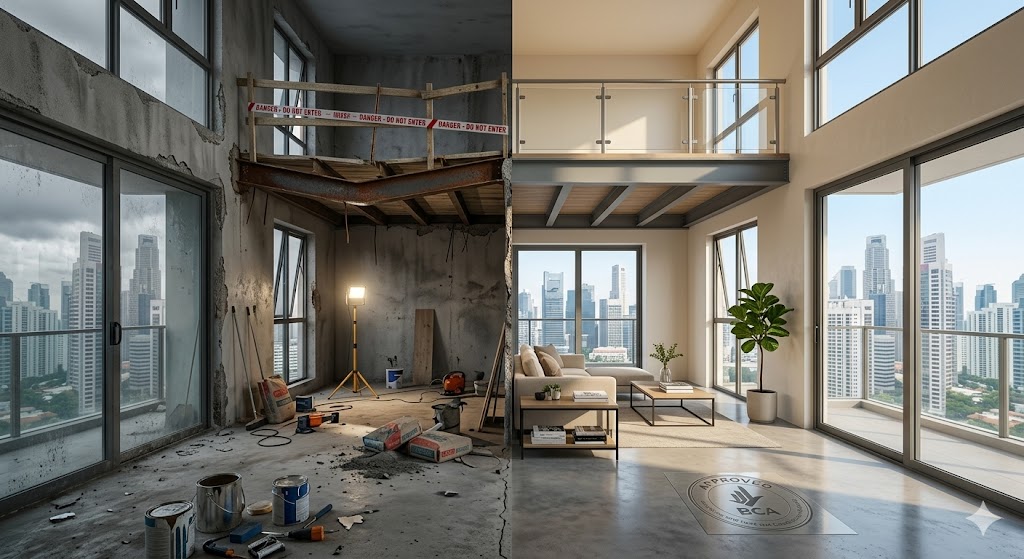
Regularisation 101: How to Fix Unauthorized Renovations Left by Previous Owners
SEO Metadata Configuration
Focus Keyphrase: Regularisation of unauthorized renovations Singapore.
SEO Title: Regularisation 101: How to Fix Unauthorized Renovations Left by Previous Owners.
Meta Description: Discover how to regularise unauthorized renovations in Singapore. Learn about BCA approvals, URA guidelines, MCST rules, and HDB compliance processes.
Tags: Unauthorized Renovations, BCA Approval, URA Guidelines, HDB Compliance, Property Regularisation, Singapore Real Estate, Structural Safety.
Introduction to Unauthorized Building Works
Unauthorized renovations present massive financial risks for property buyers. Consequently, regularisation becomes an essential regulatory necessity. Regularisation legalizes previously unapproved building modifications retroactively.1 Therefore, it protects buyers from severe statutory penalties.1
In Singapore, multiple government authorities govern property modifications. Primarily, the Building and Construction Authority (BCA) oversees structural safety.2 Similarly, the Urban Redevelopment Authority (URA) manages urban land use.2 Furthermore, the Housing and Development Board (HDB) regulates public housing.3
Buyers often unknowingly inherit illegal structures during resale transactions.1 Subsequently, they assume full legal and financial liability.1 Therefore, conducting thorough pre-purchase inspections is absolutely paramount.4
Transitioning a property requires strict statutory compliance validation.6 Consequently, unaddressed unauthorized structures trigger immediate enforcement actions.1 Furthermore, authorities regularly issue demolition orders for unsafe structures.7 Thus, understanding the regularisation framework protects property investments entirely.9
Digital Search Trends in Property Compliance
Digital search behavior reveals significant concern regarding property compliance. Consequently, understanding these trends helps address public knowledge gaps.10 Modern users frequently search for renovation compliance terminology online.10
Furthermore, intent signals highlight a strong demand for regularisation solutions.10 Therefore, analyzing search volumes provides valuable real estate market context.11 Transition words enhance the readability of these complex topics.12 Furthermore, they guide readers through intricate legal and engineering concepts.13
| Search Keyword | Monthly Volume Estimate | Intent Category |
| condo for sale singapore | 27,000 searches | Transactional 11 |
| HDB resale | 49,000 searches | Transactional 11 |
| property agent singapore | 6,600 searches | Service Search 11 |
| free home valuation | 300–8,000 searches | Informational 14 |
| sell house without a realtor | 500–15,000 searches | Informational 14 |
These high-volume keywords demonstrate active real estate engagement.11 Consequently, buyers heavily research property conditions before purchasing.14 Furthermore, this research highlights the critical importance of legal compliance.15
Therefore, properties with regularised works maintain higher market desirability.16 Subsequently, strong SEO strategies capture these highly motivated property investors.17
Housing and Development Board Renovation Controls
The HDB enforces highly rigorous public housing renovation guidelines. Consequently, unauthorized works face immediate and severe legal penalties.3 Property owners must exclusively engage HDB Registered Renovation Contractors.18
Furthermore, failing to engage registered contractors constitutes a criminal offence.18 Therefore, unauthorized renovations invite heavy fines and direct prosecution.19 The HDB aims to protect the safety of all residents.20
The Three-Year Bathroom Restriction Rule
A major HDB rule involves new bathroom floor tiles. The HDB strictly prohibits hacking new bathroom floors.21 Furthermore, this absolute restriction lasts for three entire years.21
The core purpose protects the underlying waterproofing membrane.21 Consequently, this membrane prevents water seepage between concrete floors.22 Water leaks cause severe damage to lower residential units.21
Violating this rule voids the waterproofing warranty immediately.22 Furthermore, hacking within three years places structural liability on owners.22 Therefore, owners must only overlay existing tiles using strong adhesives.20
Subsequently, the total thickness must never exceed 50 millimeters.3 The adhesive layer itself must remain under 13 millimeters.3 Furthermore, replacing bathroom vents requires a specific HDB permit.3 Glass louvers must feature safety devices and specific thicknesses.3
Structural Integrity and Wall Demolitions
HDB strongly regulates the demolition of internal apartment walls. Consequently, hacking structural load-bearing walls remains strictly prohibited everywhere.23 These load-bearing elements support the entire multi-story building structure.23
Therefore, unauthorized demolition threatens catastrophic building collapse globally.23 Furthermore, removing non-load bearing walls requires prior written approval.3 Demolitions must proceed from the top of the wall downwards.3
Additionally, specific guidelines dictate the erection of partition walls. For instance, hollow block walls must not exceed 63mm thickness.3 Furthermore, glass block walls have an 80mm maximum limit.3
Consequently, structural loading must never exceed 150kg per square meter.3 Therefore, exceeding these parameters results in unauthorized building works.3 Furthermore, discovering hidden steel bars demands immediate work cessation.3
Noise Regulations and Neighbor Disputes
HDB enforces strict noise control hours during extensive renovations. Consequently, noisy works happen only between 9 AM and 5 PM.24 Furthermore, they exclude weekends and all public holidays entirely.24
General quiet works may continue until 6 PM daily.25 Therefore, this tight schedule prevents severe neighbor disputes and complaints.26
Subsequently, unauthorized noisy works trigger immediate HDB enforcement actions.27 Neighbors frequently report inconsiderate contractors to the authorities directly.26
Furthermore, owners must display a renovation notice outside their flats.3 This notice must appear five days before any work commences.3 Consequently, managing neighbor relations ensures a smooth renovation timeline.28
Building and Construction Authority Compliance
The BCA regulates structural safety through the Building Control Act.2 Consequently, unapproved additions constitute major statutory building offences.29
Original buildings cannot always support concentrated new structural loads.29 Therefore, unregulated modifications pose severe collapse and public safety risks.29 Furthermore, comprehensive BCA structural plan approval remains strictly mandatory.29
Insignificant Building Works Exemptions
Certain minor works do not require BCA plan submissions. Consequently, these are termed “insignificant building works” legally.30
The First Schedule outlines these specific regulatory exemptions clearly.31 For example, minor partition walls might not require formal approval.32 Furthermore, small detached guard houses may also enjoy complete exemption.32
However, structural modifications always require official BCA clearance.8 Furthermore, unauthorized works failing this test require immediate regularisation.1 Therefore, owners must consult a Qualified Person to verify exemptions.30
Assuming a structure is exempt often leads to severe fines.8 Consequently, professional verification prevents costly future legal liabilities.30
Periodic Structural Inspections
Buildings require regular maintenance to remain structurally safe forever. Therefore, the Periodic Structural Inspection (PSI) regime ensures continuous safety.33 Residential buildings undergo PSI every ten years generally.33
Conversely, non-residential buildings face comprehensive inspections every five years.33 Furthermore, structural engineers visually inspect columns, beams, and slabs.34
Consequently, these inspections often uncover hidden unauthorized building works.34 Subsequently, the BCA issues enforcement notices demanding immediate regularisation.34
Therefore, failing to comply constitutes a severe criminal offence.34 Furthermore, insurers may decline coverage if PSIs remain overdue.34 Thus, maintaining structural health protects the entire property investment.33
Urban Redevelopment Authority Planning Controls
The URA regulates land use through the strict Planning Act.2 Consequently, it meticulously controls Gross Floor Area (GFA) parameters.29
Furthermore, unapproved structures often violate these critical planning guidelines.8 Therefore, regularisation requires careful URA compliance verification always.35 The URA ensures developments align with broader urban design plans.2
Mezzanine Floors and Gross Floor Area
Mezzanine floors add new covered space to existing buildings.29 Consequently, the URA categorizes mezzanines as chargeable GFA immediately.29 If a building maximizes its plot ratio, additions fail.29 Therefore, new mezzanines cannot be legally constructed in such scenarios.29 Furthermore, the minimum floor-to-ceiling height must exceed 4.2 meters.29
| Mezzanine Usage Type | Minimum Imposed Load | Additional Considerations |
| Light Storage | 5.0 kN/m² | Uniformly distributed load 29 |
| Heavy Storage | 7.5 – 15.0 kN/m² | Racking loads, concentrated loads 29 |
| Production Areas | 5.0 – 10.0 kN/m² | Equipment loads, vibration isolation 29 |
| Ancillary Office | 3.0 – 4.0 kN/m² | Partition loads, filing systems 29 |
Consequently, unregulated mezzanines pose a severe risk of collapse.29 Therefore, regularising them requires rigorous structural loading calculations.36 Furthermore, URA heavily penalizes unauthorized mezzanine construction nationwide.37 Landed property modifications exceeding 50% GFA constitute a complete rebuild.29
Civil Penalties for Unauthorized Works
The URA utilizes a tiered system for civil financial penalties. Consequently, financial punishments scale rapidly with the unauthorized area.2 Furthermore, deception triggers even higher financial penalty multipliers immediately.2 Therefore, hiding unauthorized works exacerbates the legal consequences significantly.2 Property owners face immense financial risks for non-compliance.2
| Unauthorized Area | Without Enforcement Record | With Enforcement Record |
| 0m² to ≤ 50m² | 1x Processing Fee | 2x Processing Fee 2 |
| 50m² to ≤ 150m² | 4x Processing Fee | 8x Processing Fee 2 |
| Greater than 150m² | 6x Processing Fee | 12x Processing Fee 2 |
Additionally, deceptive practices invite penalties up to $150,000.2 Alternatively, penalties may reach 25 times the initial processing fee.2 Consequently, immediate and transparent regularisation mitigates these extreme fines.1 Furthermore, voluntary declarations often result in more lenient regulatory treatment.2
Management Corporation Strata Title Regulations
Condominium renovations face Management Corporation Strata Title (MCST) rules.38 The Building Maintenance and Strata Management Act (BMSMA) governs this.39 Consequently, Section 37 strictly controls floor area expansions.39 Furthermore, changing common property requires a 90% resolution approval.39 Therefore, unauthorized condo renovations frequently trigger intense legal disputes.40
MCST Enforcement and Demolition Powers
The MCST possesses significant power to enforce internal by-laws.41 Consequently, owners must obtain written approval for any structural changes.42 Furthermore, external appearances must remain completely uniform across all units.42 Therefore, unauthorized balcony enclosures violate these strict aesthetic by-laws.40 The MCST acts to protect the collective interests of residents.38
Subsequently, the MCST can demand the removal of unauthorized works.43 If owners refuse, the MCST initiates civil litigation proceedings.44 Furthermore, courts frequently order the demolition of illegal strata structures.39 Therefore, strata living demands absolute and strict by-law compliance.41 Owners cannot unilaterally claim common property for personal usage.43
Fire Safety and Singapore Civil Defence Force Mandates
Fire safety remains an absolutely paramount concern for all buildings.45 The Singapore Civil Defence Force (SCDF) enforces critical fire safety.46 Consequently, unauthorized renovations often compromise essential life-saving infrastructure.47 Furthermore, balcony enclosures must never trap smoke during deadly emergencies.47 Therefore, SCDF approval remains mandatory for interaction balcony modifications.3
Additionally, access to dry riser compartments must remain unobstructed always.47 Furthermore, owners must not store items inside hose reel compartments.47 Consequently, open-flame devices are strictly prohibited on residential balconies.46 Therefore, regularisation must address all existing fire safety violations immediately.48 Unobstructed escape routes save lives during catastrophic building fire events.47
The Legal Implications of Inherited Renovations
Resale properties often sell strictly on an “as-is where-is” basis.49 Consequently, buyers permanently absorb the physical and legal risks.49 Furthermore, buyers must discover patent defects during normal property inspections.50 Therefore, inherited unauthorized works cause severe legal complications later.51 Understanding this legal framework protects buyers from massive financial losses.52
Patent Versus Latent Defects
Patent defects represent easily discoverable issues during initial property viewings.50 Conversely, latent defects remain completely hidden during normal vigilance.50 For example, an unauthorized internal structural modification constitutes a latent defect.53 Consequently, buyers struggle to hold previous owners legally accountable.49 Furthermore, the “as-is where-is” clause heavily protects the original seller.51 Therefore, recovering regularisation costs from previous owners proves exceedingly difficult.50
Breach of Warranties and Common Law
Sometimes, sellers falsely warrant that no unauthorized structures exist inside. Consequently, this misrepresentation constitutes a severe breach of legal contract.51 Furthermore, buyers can pursue damages under established common law rights.53 Therefore, courts may award compensation for the necessary rectification costs.54 However, pursuing civil litigation involves significant time and legal expense.50 Subsequently, thorough pre-purchase checks remain the best defensive strategy.6
Financial, Valuation, and Insurance Impacts
Unauthorized renovations severely impact a property’s overall financial viability. Consequently, unapproved works create significant hurdles during the resale process.55 Furthermore, they disrupt mortgage financing and retirement fund withdrawals.56 Therefore, achieving legal compliance protects the asset’s overall market value.57 Property investors must prioritize regularisation to safeguard their massive investments.16
Bank Loan and CPF Disruptions
Banks routinely require BCA-approved drawings before approving mortgage facilities.1 Consequently, unauthorized structures frequently derail housing loan disbursements entirely.56 Furthermore, law firms advise against completing purchases with illegal works.56 Therefore, this causes massive delays in the final property completion date.56 Lenders abhor the elevated credit risks associated with unapproved structures.58
Additionally, the Central Provident Fund (CPF) board sets strict policies. Consequently, CPF savings fund many residential property purchases locally.59 However, the CPF board requires properties to remain legally compliant always.60 Therefore, illegal works jeopardize the authorized use of CPF funds.61 Subsequently, buyers face sudden demands for extremely large cash payments.59
Property Valuation Dynamics
Property valuations rely heavily on legally approved gross floor areas. Consequently, illegal mezzanines do not increase official property valuations.16 Furthermore, valuers deeply discount properties burdened with unauthorized demolition works.16 Therefore, outdated or illegal renovations become massive financial liabilities quickly.16 A fully regularised property commands a significantly higher resale premium.16
Additionally, banks factor renovation risks into their strict credit assessments.62 Consequently, unauthorized works signal elevated credit risk to cautious lenders.62 Furthermore, fixing these legal issues requires significant upfront capital expenditure.57 Therefore, proactive regularisation restores the property to its maximum valuation.16 Buyers strongly prefer properties with clean, fully documented renovation histories.55
Home Insurance Claim Rejections
Home insurance policies contain strict and explicit legal exclusion clauses. Consequently, unauthorized renovations routinely void home insurance coverage completely.63 Insurers deny claims linked to unapproved internal structural modifications.64 Furthermore, personal liability coverage disappears if illegal structures cause injuries.65 Therefore, legal compliance ensures continuous and robust financial protection.65 Uninsured structural failures financially ruin unprepared and negligent property owners.66
The Roles of Professional Engineers and Qualified Persons
Regularisation requires highly specialized professional engineering and architectural expertise. Consequently, property owners cannot navigate this complex process alone safely.55 Furthermore, the regulatory framework mandates the engagement of Qualified Persons.67 Therefore, understanding these professional roles is crucial for legal compliance.67 The statutory framework relies entirely on these certified industry experts.55
Defining the Qualified Person
The Building Control Act formally defines the Qualified Person (QP).67 Consequently, a QP must be a registered Architect or Engineer.30 Furthermore, they must hold a valid practicing certificate locally.30 Therefore, the QP acts as the primary regulatory gatekeeper.67 Subsequently, only a QP can submit architectural plans to BCA.68
The Professional Engineer’s Liability
A Professional Engineer (PE) registers with the Professional Engineers Board.69 Consequently, the PE handles complex civil and structural engineering assessments.70 Furthermore, when a PE endorses works, they accept legal responsibility.70 Therefore, this endorsement is a binding certification with professional liability.70 This process ensures absolute accountability in Singapore’s built environment.70
Subsequently, PEs protect against the severe risk of structural collapse.71 Furthermore, they ensure load-bearing walls remain completely safe and stable.71 Consequently, a standard PE endorsement costs between $1,500 and $5,000.70 Therefore, this fee represents a necessary investment in legal compliance.71 Retrospective PE endorsement brings previously hidden works into legal compliance.48
The Comprehensive Regularisation Process
Regularisation is the post-construction approval process for unauthorized works.1 Consequently, it brings illegal structures into full regulatory compliance.1 Furthermore, it utilizes corrective design and necessary remedial construction works.1 Therefore, the process involves a rigorous, multi-step engineering assessment.35
Step 1: Initial Site Inspection
The process begins with a comprehensive onsite visual engineering inspection.35 Consequently, the PE examines all accessible structural elements physically.34 Furthermore, they document cracks, deflections, and signs of structural distress.34 Therefore, this inspection establishes the baseline condition of the property.35 Subsequently, the PE takes precise measurements of the unauthorized structures.35
Step 2: Feasibility Assessment
Next, the PE conducts a rigorous regulatory and legal feasibility assessment.35 Consequently, they evaluate compliance against current BCA and URA rules.35 Furthermore, they check available Gross Floor Area and plot ratios.72 Therefore, this vital step determines if the structure can remain.35 Subsequently, structures failing this assessment face mandatory and immediate demolition orders.7
Step 3: Preparation of As-Built Drawings
Following the assessment, professionals prepare highly accurate as-built drawings.35 Consequently, these technical drawings reflect the exact current physical state.35 Furthermore, they highlight the unauthorized modifications with precise engineering clarity.35 Therefore, these legal documents form the foundation of the official submission.35 Correct drawings prevent frustrating administrative delays during the approval process.73
Step 4: Structural Assessment and Endorsement
The PE then performs complex structural loading and weight calculations.35 Consequently, they verify the existing structure’s total load-bearing capacity.36 Furthermore, they design necessary strengthening works if structural weaknesses exist.48 Therefore, the PE officially endorses the drawings upon verifying safety.35 Subsequently, this crucial endorsement transfers legal liability directly to the PE.70
Step 5: Official BCA and URA Submission
Finally, the QP submits the complete package to the authorities.35 Consequently, the BCA reviews the structural plans for total compliance.68 Furthermore, processing typically takes between 7 and 14 working days.68 Therefore, the entire regularisation timeline spans 4 to 12 weeks.1 Straightforward cases may receive faster clearance from the relevant agencies.74
| Regularisation Phase | Expected Timeline | Associated Costs |
| Site Inspection | 1 – 2 Weeks | Included in PE Fee 1 |
| As-Built Drawings | 2 – 3 Weeks | Variable 35 |
| PE Endorsement | 1 – 3 Weeks | $2,500 – $20,000+ 1 |
| Authority Approval | 2 – 4 Weeks | Standard Processing Fees 68 |
Consequently, this structured process guarantees the restoration of legal compliance.1 Furthermore, it removes the threat of sudden regulatory enforcement actions.1 Therefore, proactive regularisation remains the optimal strategy for property owners.35 Delaying the process only compounds the eventual financial and legal penalties.8
Conducting Structural Assessments and Inspections
Sometimes, unauthorized works require highly advanced structural engineering investigation techniques.75 Consequently, visual inspections alone cannot determine hidden internal structural integrity.75 Furthermore, PEs must utilize Non-Destructive Testing (NDT) to gather data.36 Therefore, these tests evaluate concrete strength without causing further physical damage.36 Proper diagnosis is essential for planning effective and safe remedial works.75
Additionally, unauthorized structures often hide behind decorative false ceilings.3 Consequently, engineers must carefully open up these concealed architectural areas.34 Furthermore, they check for corroded reinforcement bars and spalling concrete.34 Therefore, thorough investigations prevent future catastrophic structural building failures effectively.75 Subsequently, the PE compiles these findings into a detailed engineering report.34
Demolition and Reinstatement Protocols
When regularisation fails completely, authorities mandate the demolition of unauthorized structures.7 Consequently, safe demolition requires meticulous planning and precise physical execution.76 Furthermore, owners must engage highly experienced and licensed demolition contractors.76 Therefore, DIY demolition attempts remain extremely dangerous and highly illegal.76 Unskilled workers can easily trigger a localized or total structural collapse.77
Safety Hazards During Demolition
Demolition presents significant safety hazards to workers and nearby neighbors.77 Consequently, severe risks include falling objects, electrical shocks, and structural instability.77 Furthermore, improper removal of bracing members causes sudden structural collapse.77 Therefore, a highly competent person must supervise the entire demolition process.77 Contractors must erect appropriate hoardings and overhead protection barriers securely.77
Temporary Works and PE Design
Dismantling illegal mezzanines often requires robust temporary structural supports.76 Consequently, a PE must specifically design and endorse these temporary works.76 Furthermore, these supports prevent surrounding structures from failing during active demolition.76 Therefore, obtaining required demolition permits ensures strict regulatory safety compliance.76 Subsequently, proper debris removal prevents environmental hazards and angry neighborhood complaints.76
Pre-Purchase Verification Strategies
Preventing regularisation nightmares begins with diligent and proactive pre-purchase verification.6 Consequently, buyers must cross-reference physical layouts with approved architectural plans.78 Furthermore, buyers can purchase these official plans directly from the BCA.79 Therefore, discrepancies immediately highlight the presence of unauthorized building works.30 Checking documentation prevents inheriting someone else’s expensive and illegal mistakes.80
Additionally, the URA and Singapore Land Authority offer detailed property information.81 Consequently, buyers can quickly check for existing caveats or enforcement notices.81 Furthermore, engaging an experienced real estate agent aids this vital verification.6 Therefore, thorough due diligence prevents inheriting costly and highly stressful liabilities.6 Subsequently, buyers can negotiate significant price reductions based on these findings.82
Landmark Case Studies in Property Regularisation
Analyzing historical legal cases provides crucial context for strict regulatory enforcement. Consequently, these precedents demonstrate the severe consequences of unauthorized works.83 Furthermore, they highlight the highly strict stance of Singapore’s regulatory authorities.84 Therefore, these cases serve as powerful and necessary warnings to property owners.85
The Little India Conservation Shophouse
In 2023, a massive unauthorized renovation occurred in Little India.84 Consequently, an owner destroyed a historic conserved shophouse facade illegally.84 Furthermore, the owner bypassed URA conservation permission to build co-living spaces.84 Therefore, the URA officially described this as an egregious legal breach.84 Heritage preservation laws exist to protect Singapore’s irreplaceable architectural history.84
Subsequently, the authorities issued landmark and extremely severe financial penalties.84 The owner faced a massive $250,000 fine for the blatant violations.84 Furthermore, the construction firm received a separate $150,000 fine.84 Consequently, this tragic case highlights the irreversible loss of heritage value.84 Therefore, conservation properties require absolute and flawless adherence to URA guidelines.85
The Frankel Estate Mezzanine Dispute
Another critical case involved a residential property located in Frankel Estate.39 Consequently, an owner built an unapproved 676-square-foot residential mezzanine floor.39 Furthermore, the MCST discovered this illegal structure during routine property inspections.39 Therefore, the MCST demanded immediate removal of the unauthorized building works.39 Strata laws exist specifically to manage these shared community disputes fairly.39
However, the owner ignored the MCST and stubbornly continued the construction.39 Consequently, the MCST initiated formal civil proceedings under the strict BMSMA.39 Furthermore, the court ordered the complete demolition of the illegal mezzanine.39 Therefore, this case underscores the immense legal power of MCST by-laws.39 Subsequently, ignoring strata management rules leads to guaranteed and costly legal defeat.39
The Alexcier Industrial Building Fine
Industrial properties also face strict scrutiny for unauthorized building works.8 Consequently, owners of The Alexcier constructed a massive illegal floor.8 Furthermore, this unauthorized mezzanine spanned over 5,000 square feet.8 Therefore, this addition severely altered the building’s critical structural loading parameters.8 Industrial loading failures can cause massive loss of life and property.8
Subsequently, the BCA discovered this massive violation during a routine inspection.8 The authorities immediately fined the property agency owner $50,000.8 Furthermore, workers had to dismantle the entire unauthorized structure very quickly.8 Consequently, this demonstrates that BCA actively prosecutes commercial property violations vigorously.8 Therefore, commercial regularisation remains just as critical as residential regularisation.8
The Sandy Island Latent Defect Ruling
The High Court ruling in the Sandy Island case provides clarity.54 Consequently, it addressed common law rights regarding property construction defects.53 Furthermore, a buyer sued a developer for significant building design flaws.54 Therefore, the developer argued that the defects liability clause applied exclusively.86 This argument attempted to limit the developer’s overall financial liability.86
However, the court upheld the buyer’s powerful common law damages right.86 Consequently, buyers can recover costs for rectifying latent property defects.53 Furthermore, failure to follow defects liability clauses does not extinguish rights.86 Therefore, this empowers buyers who discover hidden unauthorized works much later.53 Subsequently, sellers face prolonged legal exposure for their illegal modifications.54
Ardmore Park Common Property Dispute
A prominent legal dispute occurred at the luxurious Ardmore Park condominium.43 Consequently, an owner installed extensive timber decking over the flat roof.43 Furthermore, they installed an unauthorized air-conditioning vent on the common wall.43 Therefore, these actions directly violated the established MCST by-laws regarding common property.43 Common property belongs to all subsidiary proprietors within the strata development.43
Subsequently, the MCST demanded the complete removal of these unauthorized structures.43 The owner attempted to convert the common area to private usage.43 Furthermore, the Strata Titles Board ruled overwhelmingly in favor of the MCST.87 Consequently, the High Court affirmed this decision upon further legal appeal.87 Therefore, this firmly cements the MCST’s absolute authority over common property.87
The Summit Mezzanine Case
The Summit condominium case presents a highly unique and complex scenario.37 Consequently, an architect built an unauthorized mezzanine floor thirty years ago.37 Furthermore, the MCST only discovered the attic during a recent investigation.37 Therefore, the owner retroactively obtained URA permission and paid development charges.37 The owner paid over $422,000 to regularise the structure with the URA.37
However, the MCST sued to demand additional backdated sinking fund contributions.37 Consequently, the High Court surprisingly dismissed the MCST’s aggressive legal application.37 Furthermore, the court ruled the MCST had no legal recourse here.37 Therefore, extreme delays in enforcement can complicate MCST legal actions significantly.37 Subsequently, regularisation successfully protected this owner from a forced demolition.37
Proper Site and Record Management
During regularisation or demolition, engineers must maintain impeccable site records.88 Consequently, the BCA mandates strict documentation for all ongoing structural works.89 Furthermore, Qualified Persons must keep these records on site at all times.88 Therefore, this ensures continuous accountability throughout the entire construction or demolition phase.89 Missing documentation leads to immediate regulatory delays and possible financial fines.89
Essential Site Records
Engineers must maintain a three-month schedule of all upcoming structural works.89 Consequently, this schedule tracks excavation, installation, and fabrication of key elements.89 Furthermore, attendance records must log the presence of the site supervisor.89 Therefore, authorities can verify that proper supervision occurred during critical concreting.89 The site record book captures all instructions and comments from the supervisor.89
Additionally, the site must hold all approved structural plans and amendments.89 Consequently, these plans must be highly accessible for any sudden BCA inspections.89 Furthermore, engineers must document all repairs made to defective structural works.88 Therefore, fixing honeycombs or concrete cracks requires a detailed paper trail.88 Subsequently, meticulous record-keeping guarantees the integrity of the final regularised structure.88
Conclusion
Unauthorized renovations represent a severe and multifaceted risk in Singapore. Consequently, the regularisation process is not merely a simple administrative formality. Furthermore, it is a critical necessity for preserving property value and safety. Therefore, achieving compliance protects against structural collapse and very heavy statutory fines. High-density urban environments demand absolute adherence to strict BCA safety standards. Similarly, the URA must carefully control land use and population density.
Furthermore, HDB rules protect communal living environments from devastating internal damage. Condominium by-laws maintain uniformity and fairness across all strata title properties. Consequently, inheriting unapproved structures jeopardizes financing, home insurance, and legal standing. Therefore, engaging Qualified Persons and Professional Engineers remains the only safe solution. Subsequently, these professionals navigate the highly complex intersection of engineering and law. Ultimately, proactive regularisation transforms a dangerous legal liability back into a secure asset.
Works cited
- Regularisation of Unauthorised Building Structures Singapore – CVC Engineers, accessed May 11, 2026, https://www.cvcengineers.com/post/regularisation-unauthorised-building-structures-singapore
- Revised Civil Penalty Rates for Unauthorised Works in Singapore …, accessed May 11, 2026, https://www.adxarchitects.com/blog/revised-civil-penalty-rates-for-unauthorised-works-in-singapore-what-you-need-to-know/
- Renovation Guidelines for Building Works – Singapore – HDB, accessed May 11, 2026, https://www.hdb.gov.sg/managing-my-home/renovation-and-maintenance/renovation/renovation-guidelines/building-works
- Resale Home Buying Checklist – Singapore – DBS, accessed May 11, 2026, https://www.dbs.com.sg/personal/mp-home/resale-private-checklist.page
- HDB Resale Checklist for Buyers 2024 : What to Consider? – DoorVisual, accessed May 11, 2026, https://doorvisual.com/hdb-resale-checklist-for-buyers/
- What should I check before buying a resale condo in Singapore? – EdgeProp Buddy, accessed May 11, 2026, https://buddy.edgeprop.sg/discover/what-should-i-check-before-buying-a-resale-condo-in-singapore-16719448-944e-4a91-9836-d68641b78728
- Singapore A&A Works (2025): Essential Guide to Hiring a BCA-Certified Builder, accessed May 11, 2026, https://structures.com.sg/singapore-aa-works-2025-essential-guide-to-hiring-a-bca-certified-builder/
- BCA reviewing scope of alteration works that can be done without approval, accessed May 11, 2026, https://www.straitstimes.com/singapore/investigations-into-unauthorised-building-alterations-on-the-rise-bca-review-into-such-works-underway
- Design compliance in Singapore: The developer’s essential guide, accessed May 11, 2026, https://www.amanengineering.com.sg/design-compliance-singapore-developers-essential-guide/
- Keyword Discovery in 2026: A Modern Guide for Property Management SEO, accessed May 11, 2026, https://www.propertymanagerwebsites.com/blog/keyword-discovery-in-2026-a-modern-guide-for-property-management-seo
- SEO Singapore: Complete 2025/2026 Guide | Rank #1 on Google – Hashmeta, accessed May 11, 2026, https://hashmeta.com/ai-seo/seo-singapore-ultimate-guide/
- Transition words: why and how to use them – Yoast, accessed May 11, 2026, https://yoast.com/transition-words-why-and-how-to-use-them/
- SEO Content Writing: List of Transition Words for Better Results | by Jenna Brandon, accessed May 11, 2026, https://jennabrandon07.medium.com/seo-content-writing-list-of-transition-words-for-better-results-7f00f1b3f16e
- Real Estate Keyword Research: 60 High-Intent Property Keywords for 2026 – W3era, accessed May 11, 2026, https://www.w3era.com/blog/seo/real-estate-seo-keywords/
- Reliable SEO Agency Singapore 2026 | Sotavento Medios, accessed May 11, 2026, https://www.sotaventomedios.com/strategic-guide-to-selecting-reliable-seo-partners-in-singapore-in-2026/
- Can Renovations Affect Your Property Resale Value? Here’s Our List of Do’s and Don’ts, accessed May 11, 2026, https://www.propertyguru.com.sg/property-guides/qanvast-can-renovation-affect-property-resale-value-37428
- Professional SEO Services For Home Renovation Companies – Pearl Lemon, accessed May 11, 2026, https://pearllemon.com/seo-for-home-renovators/
- Guidelines for Renovation Works – HDB, accessed May 11, 2026, https://www.hdb.gov.sg/-/media/managing-my-home/renovation-and-maintenance/renovation/renovation-guidelines/design-build-and-sell-scheme-dbss-flats/parkland-hougang-reno-guidelines.pdf
- Housing and Development (Renovation Control) Rules CAP. 129, R 15] [2010 Ed. p. 1, accessed May 11, 2026, https://sso.agc.gov.sg/SL/HDA1959-R15?DocDate=20251125&ViewType=Pdf&_=20251128105216
- Important Information on Renovations – HDB, accessed May 11, 2026, https://www.hdb.gov.sg/managing-my-home/renovation-and-maintenance/renovation/important-information-on-renovations
- HDB 3-Year Renovation Restriction: How to Style Your BTO Bathroom Now, accessed May 11, 2026, https://www.herabathroom.com/blogs/bathroom-ideas-renovation-guides-in-singapore-hera/hdb-3-year-renovation-restriction-how-to-style-your-bto-bathroom-now
- Overlay vs Hacking: HDB Bathroom Renovation Guide 2026 – RCS Renovation Contractor Singapore, accessed May 11, 2026, https://renovationcontractorsingapore.com/blogs/news/overlay-vs-hacking-hdb-bathroom-renovation-singapore
- Breaking Walls, Breaking Rules: Illegal HDB Renovations That Could Cost You – PropNex, accessed May 11, 2026, https://www.propnex.com/picks-details/1096/breaking-walls-breaking-rules-illegal-hdb-renovations-that-could-cost-you
- HDB Renovation Noise Rules: Tips to Avoid Complaints and Maintain Peace, accessed May 11, 2026, https://www.prestige-affairs.com/blogs/how-to/avoiding-noise-complaints-during-hdb-renovations
- Fed Up with Renovation Noise? Here’s What Singapore Rules Say – YouTube, accessed May 11, 2026, https://www.youtube.com/watch?v=e-eUjgoogbg
- how to deal with upstairs neighbour??? : r/askSingapore – Reddit, accessed May 11, 2026, https://www.reddit.com/r/askSingapore/comments/1b05wpx/how_to_deal_with_upstairs_neighbour/
- 7 Ways to Avoid Noise Complaint During HDB Renovation – My Reno Diary, accessed May 11, 2026, https://mrd.com.sg/7-ways-to-avoid-noise-complaint-during-hdb-renovation/
- Renovations and neighbor complaints. : r/singapore – Reddit, accessed May 11, 2026, https://www.reddit.com/r/singapore/comments/ii0qwd/renovations_and_neighbor_complaints/
- Mezzanine Floor Approval Guide Singapore 2026, accessed May 11, 2026, https://structures.com.sg/mezzanine-floor-approval-guide-singapore-2026/
- Building works not requiring approval | Building and Construction Authority, accessed May 11, 2026, https://www1.bca.gov.sg/guidelines-and-requirements/building-works-not-requiring-approval/
- Building Control Regulations 2003 – Singapore Statutes Online, accessed May 11, 2026, https://sso.agc.gov.sg/SL/BCA1989-S666-2003?DocDate=20200817&ProvIds=pr3A-&ViewType=Advance&Any=road+traffic+act+bicycles&WiAl=1
- Building Control Regulations 2003 – Singapore Statutes Online, accessed May 11, 2026, https://sso.agc.gov.sg/SL/BCA1989-S666-2003?ProvIds=Sc4-
- Periodic Structural Inspection (PSI) – Building and Construction Authority, accessed May 11, 2026, https://www1.bca.gov.sg/safety-and-standards/periodic-building-inspections/periodic-structural-inspection/
- BCA Periodic Structural Inspection (PSI) Singapore Guide – CVC Engineers, accessed May 11, 2026, https://www.cvcengineers.com/post/bca-periodic-structural-inspection-singapore
- Regularisation of Unauthorised Building Works in Singapore: A Complete Guide, accessed May 11, 2026, https://www.cvcengineers.com/post/regularisation-of-unauthorised-building-works-in-singapore-a-complete-guide
- Real Estate Engineering Inspection – Aman Engineering Consultancy, accessed May 11, 2026, https://www.amanengineering.com.sg/real-estate-engineering-inspection/
- Court dismisses MCST’s case against architect who built unauthorised mezzanine floor in condo | The Straits Times, accessed May 11, 2026, https://www.straitstimes.com/singapore/courts-crime/court-dismisses-mcst-s-case-against-architect-who-built-unauthorised-mezzanine-floor-in-condominium
- MCST and Condominium Disputes in Singapore – GJC Law, accessed May 11, 2026, https://www.gjclaw.com.sg/articles/mcst-and-condominium-disputes-in-singapore/
- Legal Analysis: Unapproved Mezzanine Floor And It’s Legal Implications, accessed May 11, 2026, https://www.smtplaw.com/legal-analysis-unapproved-mezzanine-floor-and-its-legal-implications/
- Can You Win A Dispute With Condo MCST In Singapore? – Emerald Law LLC, accessed May 11, 2026, https://emeraldlaw.com.sg/can-you-win-a-dispute-with-condo-mcst-in-singapore/
- Condo Dispute Management – Singapore – IRB Law LLP, accessed May 11, 2026, https://irblaw.com.sg/learning-centre/condo-dispute-management/
- Condo Renovation Cost & Financing Guide in Singapore (2026) | MoneySmart, accessed May 11, 2026, https://www.moneysmart.sg/personal-loan/condo-renovation-cost-loan-guide-singapore-ms
- STB 40 of 2015 – Ardmore Park Condominium – Strata Titles Boards, accessed May 11, 2026, https://www.stratatb.gov.sg/files/Judgments/2016/stb-40-of-2015-ardmore-park-condominium.pdf
- Dispute With Your Condo’s Management or MCST: What to Do – SingaporeLegalAdvice.com, accessed May 11, 2026, https://singaporelegaladvice.com/law-articles/what-to-do-if-you-have-a-dispute-with-your-condominiums-management/
- CODE OF PRACTICE FOR FIRE PRECAUTIONS IN BUILDINGS 2023 – SCDF, accessed May 11, 2026, https://www.scdf.gov.sg/docs/default-source/fire-safety-docs/firecode-2023-111220241013.pdf?sfvrsn=b3dc3c15_3
- Complete Guide to Fire Pit Rules & Safety for Condo Balconies in Singapore – Loft Home, accessed May 11, 2026, https://lofthome.com/blogs/articles/complete-guide-to-fire-pit-rules-safety-for-condo-balconies-in-singapore
- Fire Safety Guidelines for Residential Estate – SCDF, accessed May 11, 2026, https://www.scdf.gov.sg/home/community-and-volunteers/fire-emergency-guides/fire-safety-guidelines-for–residential-estate
- Retrospective PE Endorsement for Unauthorized Works SG, accessed May 11, 2026, https://www.aectechnicalsg.com/retrospective-pe-endorsement-for-unauthorized-building-works-what-you-should-know/
- Buying Property on “As Is Where Is” Basis: What This Means – SingaporeLegalAdvice.com, accessed May 11, 2026, https://singaporelegaladvice.com/law-articles/as-is-where-is-clause/
- What Does It Mean to Purchase Property on an “As is Where is” Basis?, accessed May 11, 2026, https://pinnacle.sg/singapore-property-guides/what-does-it-mean-to-purchase-property-on-an-as-is-where-is-basis
- Ajit Chandrasekar Prabhu and another v Yap Beng Kooi and another [2015] SGHC 280 – :: eLitigation ::, accessed May 11, 2026, https://www.elitigation.sg/gd/s/2015_SGHC_280
- As Is, Where Is Property Purchases: Avoid Hidden Defects – IRB Law LLP, accessed May 11, 2026, https://irblaw.com.sg/learning-centre/purchasing-a-property-as-is-where-is-how-to-avoid-paying-for-property-defects/
- Defects liability clauses do not extinguish common law right to damages – new Supreme Court of Singapore Guidance, accessed May 11, 2026, https://cms.law/en/sgp/legal-updates/defects-liability-clauses-do-not-extinguish-common-law-right-to-damages-new-supreme-court-of-singapore-guidance
- Singapore High Court Clarifies the Legal Effect of a Defects Liability Clause – WongPartnership, accessed May 11, 2026, https://www.wongpartnership.com/upload/medias/KnowledgeInsight/document/6087/Casewatch-SingaporeHighCourtClarifiestheLegalEffectofaDefectsLiabilityClause.pdf
- HDB renovation permits: What you need for compliance – Aman Engineering Consultancy, accessed May 11, 2026, https://www.amanengineering.com.sg/hdb-renovation-permits-what-you-need-for-compliance/
- HDB completion delay due to unauthorised construction by seller? : r/askSingapore – Reddit, accessed May 11, 2026, https://www.reddit.com/r/askSingapore/comments/1gbwqhx/hdb_completion_delay_due_to_unauthorised/
- The Impact of Renovation SG Projects on Property Value, accessed May 11, 2026, https://hanyong.sg/the-impact-of-renovation-sg-projects-on-property-value/
- Navigating CRE risk in the Asia-Pacific – Moody’s, accessed May 11, 2026, https://www.moodys.com/web/en/us/creditview/blog/commercial-rea-estate-APAC.html
- Terms and Conditions Governing Mortgage Loans – OCBC, accessed May 11, 2026, https://www.ocbc.com/iwov-resources/sg/ocbc/personal/pdf/loans/tncs-governing-mortgage-loans.pdf
- Standard Terms and Conditions Governing Facilities Secured by Mortgage of Residential Property and/or Commercial Property, accessed May 11, 2026, https://pic.bankofchina.com/bocappd/singapore/202506/P020250620648287602065.pdf
- Central Provident Fund (Residential Properties Scheme) Regulations 1982 – Singapore Statutes Online, accessed May 11, 2026, https://sso.agc.gov.sg/SL/36-RG6
- Vulnerabilities and Potential Spillovers Stemming from Property Developer Financing – ASEAN+3 Macroeconomic Research Office (AMRO), accessed May 11, 2026, https://amro-asia.org/wp-content/uploads/2024/10/AFSR-2024-Chapter-2.pdf
- POLICY WORDINGS – ePROTECT Home – Etiqa, accessed May 11, 2026, https://www.etiqa.com.sg/wp-content/uploads/2024/01/ePROTECT-home-Policy-Wording.pdf
- HOMESURE INSURANCE POLICY – MSIG Singapore, accessed May 11, 2026, https://www.msig.com.sg/sites/msig_sg/files/2023-05/hsbc-homesure-policy.pdf
- Allianz Home Protect, accessed May 11, 2026, https://www.allianz.sg/individual-solutions/allianz-home-protect.html
- unihome-policy-wording.pdf – United Overseas Insurance, accessed May 11, 2026, https://www.uoi.com.sg/assets/web-resources/uoi/pdfs/insurance/unihome-policy-wording.pdf
- The Qualified Person (QP) in Singapore: Roles, Responsibilities and Liabilities, accessed May 11, 2026, https://structures.com.sg/the-qualified-person-qp-singapore-roles-responsibilities-liabilities/
- Structural Plan submission – Building and Construction Authority, accessed May 11, 2026, https://www1.bca.gov.sg/safety-and-standards/applications-and-licenses/structural-plan-submission/
- Guidelines on Registration – professional engineers board singapore, accessed May 11, 2026, https://www1.peb.gov.sg/files/Downloads/Guidelines/RegistrationasPE.pdf
- PE Endorsement: 5 Renovation Scenarios That Require It – singapore demolition hackers, accessed May 11, 2026, https://singaporehackers.com.sg/blog/when-you-need-pe-endorsement/
- PE endorsement for renovation works in residential and commercial properties such as hacking of non load bearing walls – Aman Engineering Consultancy, accessed May 11, 2026, https://www.amanengineering.com.sg/pe-endorsement-for-renovation-works-in-residential-and-commercial-properties-such-as-hacking-of-non-load-bearing-walls/
- Mezzanine Submission and Retention – Aman Engineering Consultancy, accessed May 11, 2026, https://www.amanengineering.com.sg/mezzanine-authority-approval/
- How Long BCA Approval Takes in Singapore – Aman Engineering Consultancy, accessed May 11, 2026, https://www.amanengineering.com.sg/how-long-bca-approval-takes-singapore/
- Other Processes that may be relevant to projects – CORENET X, accessed May 11, 2026, https://info.corenet.gov.sg/regulatory-process/about-the-new-submission-process/other-processes-that-may-be-relevant-to-projects
- GUIDELINES FOR STRUCTURAL ENGINEERS, accessed May 11, 2026, https://isomer-user-content.by.gov.sg/338/7fefc1c0-6299-41fa-bf17-17c3a9896f1a/psi-guidelines-for-structural-engineers-(sep-2024).pdf
- Break Down the Mezzanine Floor & Loft Dismantle Work in Singapore! – 9reno, accessed May 11, 2026, https://9reno.com/break-down-the-mezzanine-floor-loft-dismantle-work-in-singapore/
- Demolition – Singapore, accessed May 11, 2026, https://li.eversafe.com.sg/HTIM/4.%20Demolition-%20Technical%20Advisory.pdf
- Where To Download Floor Plan for Landed Properties? – HomeMatch, accessed May 11, 2026, https://www.homematch.sg/renovation-guides/where-to-download-floor-plan-for-landed-properties
- BCA Plan Purchase Application Form – Building and Construction Authority, accessed May 11, 2026, https://www.bca.gov.sg/pps
- How can I verify building plan approval documents? – VNCT Global, accessed May 11, 2026, https://vnctglobal.com/how-to-verify-building-plan-approval-successfully/
- INLIS – Singapore Land Authority, accessed May 11, 2026, https://app.sla.gov.sg/inlis/
- 6 Must-Know Checks for Your HDB Inspection Before Purchase – Lemon8, accessed May 11, 2026, https://www.lemon8-app.com/@buyhousesg/7386862117548229137?region=sg
- Singapore Finance Ltd. v. Lim Kah Ngam (S’pore) Pte. Ltd. & Others1 Introduction THE present case illustrates some of the – NUS Law, accessed May 11, 2026, https://law.nus.edu.sg/sjls/wp-content/uploads/sites/14/2024/07/1074-1985-27-mal-jul-190.pdf
- Owner, construction firm fined for unauthorised works on conserved shophouse in Little India – Singapore Law Watch, accessed May 11, 2026, https://www.singaporelawwatch.sg/Headlines/owner-construction-firm-fined-for-unauthorised-works-on-conserved-shophouse-in-little-india
- Illegal Renovation of Little India Shophouse Draws S$400K Fine, Heritage Lost, accessed May 11, 2026, https://thesiliconreview.com/2026/04/illegal-renovation-little-india-shophouse-fine-heritage-loss
- Case Digest: Singapore High Court upholds common law right to damages despite failure to follow defects liability provisions – Herbert Smith Freehills, accessed May 11, 2026, https://www.hsfkramer.com/notes/construction/2019-09/case-digest-singapore-high-court-upholds-common-law-right-to-damages-despite-failure-to-follow-defects-liability-provisions
- GROUNDS OF DECISION – :: eLitigation ::, accessed May 11, 2026, https://www.elitigation.sg/gd/gd/2018_SGCA_14/pdf
- Testing and Site Records – Building and Construction Authority (BCA) | PDF | Concrete | Civil Engineering – Scribd, accessed May 11, 2026, https://www.scribd.com/document/467079638/Testing-and-Site-Records-Building-and-Construction-Authority-BCA
Construction site records, accessed May 11, 2026, https://www1.bca.gov.sg/safety-and-standards/applications-and-licenses/permit-for-structural-works/construction-site-records/