





A civil engineering report for government projects is defined as a structured, evidence-based document that integrates technical specifications, financial assessments, environmental impacts, and regulatory compliance to support public decision-making. These reports are not optional summaries. They are the primary instrument through which agencies justify expenditure, satisfy audit requirements, and demonstrate accountability to the public. For government officials, civil engineers, and project managers, understanding how to produce a defensible civil engineering report on government projects determines whether a project secures funding, clears regulatory review, or survives post-completion audit scrutiny.
What critical elements must be included in a civil engineering report for government projects?
Effective government infrastructure reports are built on four parallel pillars: technical analysis, financial assessment, environmental evaluation, and regulatory compliance. Large infrastructure feasibility studies require these four pillars to develop simultaneously, not sequentially. Treating them as sequential checkpoints is the most common and costly structural error in public works engineering studies.
Technical analysis
The technical section documents design integrity, construction methodology, material specifications, and adherence to applicable codes and standards. It must address geotechnical conditions, load calculations, and construction sequencing. Civil engineering inputs for architectural design directly shape the technical section’s scope and depth, particularly for mixed-use or community infrastructure.

Financial assessment
The financial section covers cost estimates, funding sources, risk allocation, and long-term economic viability. Cost estimates for large projects typically represent 10–15% of the total detailed project cost during the pre-feasibility stage. The economic internal rate of return (EIRR) is a standard metric, but it frequently deviates from actual outcomes due to demand shifts, cost escalation, and schedule slippage.

Environmental and regulatory compliance
Environmental impact assessments document potential ecological disruption, mitigation plans, and required clearances. The regulatory section maps all required permits and inter-agency approvals. Large government projects commonly require 15–30 distinct regulatory clearances covering environmental, land acquisition, forest, and sector-specific approvals. These clearances dominate the critical path and directly affect both financial models and design decisions.
Key elements every report must address:
- Design integrity: Structural calculations, material standards, and code compliance references
- Cost transparency: Itemized estimates, contingency provisions, and funding source documentation
- Environmental clearances: Impact assessment findings, mitigation commitments, and agency sign-offs
- Regulatory approvals: Permit status, inter-agency coordination records, and compliance timelines
- Risk register: Identified technical, financial, and schedule risks with mitigation strategies
Pro Tip: Start regulatory engagement during the pre-feasibility stage, not after technical design is complete. Approval timelines for environmental and land-use clearances routinely extend 6–18 months and will reshape your financial model if discovered late.
How to align civil engineering reports with strategic government objectives
Government project evaluation does not end at technical compliance. Agencies and audit bodies increasingly require reports to demonstrate alignment with broader national or municipal infrastructure strategies. The UK’s Road Investment Strategy 3 (RIS3) ties £27 billion in planned funding to documented KPIs, outcome metrics, and strategic reporting commitments for the 2026–2031 cycle. That model illustrates a global shift: funding follows documented strategic alignment, not just engineering soundness.
Project narratives must connect engineering outputs to policy goals. A road widening project is not just a capacity improvement. It is a contributor to regional economic connectivity, freight efficiency, and public safety outcomes. Framing the report this way satisfies both technical reviewers and legislative audiences.
Aligning the project narrative in reports with long-term government strategies and policy objectives is key to securing value-for-money recognition and continued funding in audits. Reports that speak only to engineering specifications miss the accountability dimension that public agencies require.
Outcome-focused reporting also requires moving beyond EIRR as the sole financial metric. Non-economic considerations such as humanitarian needs, national security priorities, and social equity regularly override cost-benefit analysis in government financing decisions. Sustainability-oriented appraisal methods that capture multidimensional value are now expected in major public works engineering studies.
Practical steps for strategic alignment in government infrastructure reports:
- Map each project objective to a named policy document, infrastructure plan, or investment pipeline
- Define KPIs before the feasibility study begins, not after construction
- Include a dedicated section on public benefit outcomes beyond financial returns
- Document how the project contributes to sustainability targets and climate resilience goals
- Prepare an executive summary written for non-technical decision-makers, separate from the technical body
The ASCE 2025 Infrastructure Report Card has been cited over 40,000 times precisely because it connects engineering data to economic competitiveness and public safety. That reach demonstrates the policy influence a well-framed infrastructure report can achieve.
What tools and frameworks support efficient report preparation?
Structured frameworks reduce preparation time and improve report defensibility. The table below outlines the core components of a government project report framework and the tools that support each.
| Report Component | Framework or Tool | Purpose |
|---|---|---|
| Technical analysis | Feasibility study checklist, BIM software | Ensures design completeness and code compliance |
| Financial assessment | Cost estimation templates, risk registers | Documents funding sources and contingency provisions |
| Environmental review | EIA templates, agency clearance trackers | Tracks mitigation commitments and approval status |
| Regulatory compliance | Multi-agency approval matrices | Maps permit requirements and critical path dependencies |
| Stakeholder communication | Data visualization tools, executive summaries | Bridges technical and non-technical audiences |
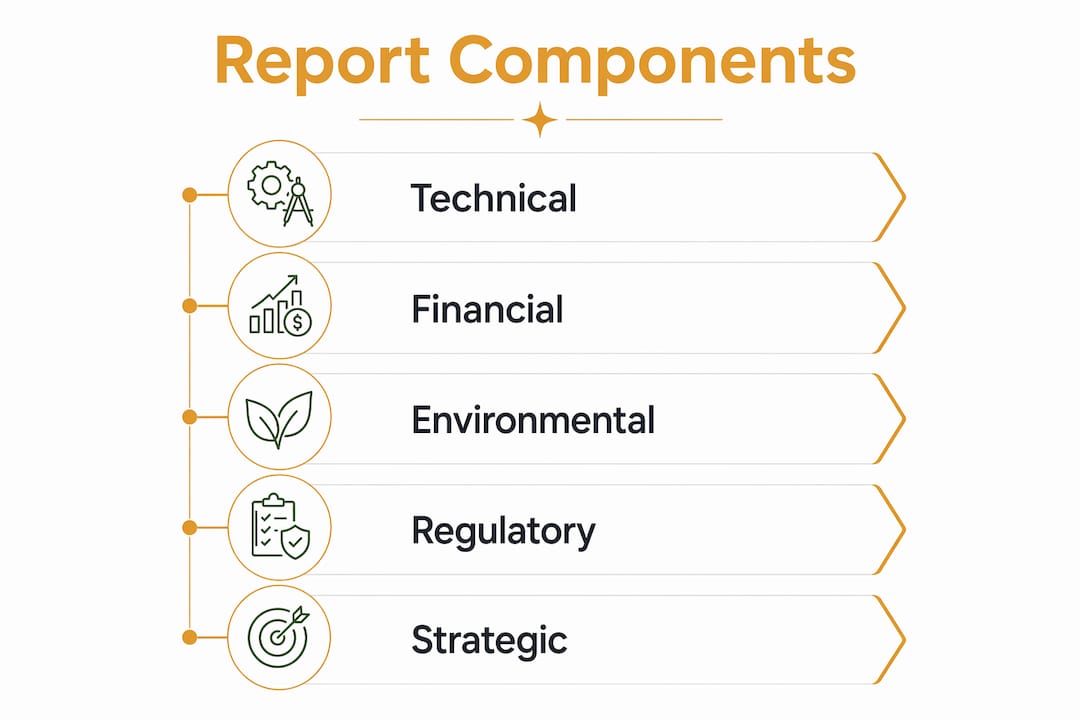
Integrated project management platforms that support multi-pillar coordination are the most effective tools for large civil engineering project analysis. They allow technical, financial, environmental, and regulatory workstreams to progress simultaneously, with shared timelines and dependency tracking. Integrated design and construction approaches apply this same logic at the project delivery level.
Data visualization tools serve a specific and undervalued function in government reports. Decision-makers who are not engineers rely on charts, maps, and infographics to evaluate project merit. A report that presents all findings in dense technical prose will not perform well in legislative review or public consultation.
Pro Tip: Build your regulatory clearance matrix in the first week of pre-feasibility. List every required approval, the responsible agency, the typical processing time, and the design inputs that approval depends on. This single document will prevent the most common cause of budget overruns: late-stage regulatory surprises.
What common challenges arise in civil engineering reporting for government projects?
Reporting failures in government projects follow predictable patterns. Identifying them early prevents audit findings, cost overruns, and project delays.
-
Sequential pillar development. Teams that complete technical design before starting environmental review or regulatory engagement create expensive retroactive corrections. Parallel pillar development is the standard for major infrastructure projects and avoids this entirely.
-
Missing quality verification tests. Audit findings from the Bhara Kahu Bypass project documented 23.31% contract cost overruns directly linked to the absence of the International Roughness Index (IRI) test. The IRI is a standard road quality metric. Omitting it from the final report created both a compliance failure and a financial liability.
-
Incomplete regulatory documentation. Reports that list approvals as “pending” without status dates, responsible officers, or contingency plans fail audit review. Every clearance must have a documented owner and a timeline.
-
Misaligned cost estimates. EIRR deviations occur when demand forecasts, construction costs, and schedule assumptions are not stress-tested. Sensitivity analysis on all three variables is a minimum requirement for defensible financial reporting.
-
Inaccessible technical content. Reports written exclusively for engineers fail in legislative and public accountability contexts. A structural design check may satisfy technical reviewers, but the report must also explain what that check means for public safety in plain language.
Audits of government infrastructure projects consistently cite delays, procurement violations, missing quality tests, and incomplete reporting as the primary red flags. The Bhara Kahu audit found direct contracting without condition fulfillment, delayed project opening, and omitted quality verification. Each finding was traceable to a documentation gap, not an engineering failure.
Multi-disciplinary coordination is the underlying challenge behind most of these issues. Civil engineering project management requires public agencies, engineering consultancies, and contractors to coordinate across multiple project phases with different funding sources and regulatory requirements. A clear reporting responsibility matrix, assigned at project inception, prevents the most common coordination failures.
Key Takeaways
A defensible civil engineering report for government projects requires parallel development of technical, financial, environmental, and regulatory pillars, aligned to strategic policy objectives and supported by complete quality verification documentation.
| Point | Details |
|---|---|
| Parallel pillar development | Develop technical, financial, environmental, and regulatory sections simultaneously to avoid costly retroactive changes. |
| Strategic alignment | Connect every project objective to a named policy document or infrastructure plan to satisfy audit and funding requirements. |
| Quality test documentation | Include all required quality verification tests, such as the IRI, to prevent audit findings and contract cost overruns. |
| Regulatory clearance mapping | Build a multi-agency approval matrix at pre-feasibility stage to protect the project schedule and financial model. |
| Accessible reporting | Write executive summaries for non-technical decision-makers to support legislative review and public accountability. |
Why strategic framing separates good reports from defensible ones
From my experience reviewing and contributing to public infrastructure documentation, the most consistent gap I see is not in the engineering. The engineering is usually sound. The gap is in how the report frames the project’s value to a non-technical audience.
Engineers are trained to document what was done and how. Government reports require something additional: a clear argument for why the project deserves public investment and how it connects to stated policy priorities. That argument does not write itself from technical specifications.
The shift I advocate for is treating the executive summary and strategic alignment section as primary deliverables, not afterthoughts. These sections reach the decision-makers who control funding and the auditors who determine compliance. If those sections are weak, the quality of the technical body is largely irrelevant to the project’s political and financial outcomes.
I have also seen teams underestimate regulatory timelines repeatedly. A 15-clearance approval process does not run in parallel with design by accident. It requires deliberate coordination from day one. The teams that build their regulatory matrix in week one of pre-feasibility consistently outperform those that treat approvals as a post-design task.
Sustainability appraisal is the next frontier in government project evaluation. Traditional EIRR calculations miss the social, environmental, and strategic dimensions that financing bodies increasingly require. Reports that include multidimensional value frameworks are better positioned for funding approval and audit resilience. That is not a prediction. It is already the standard in major multilateral and national infrastructure programs.
— Aman
Professional support for your government project documentation
Government project reports demand technical depth and regulatory precision at every stage. Stellar Structures (Com) provides civil and structural design checks that directly strengthen the technical sections of your project documentation, ensuring design integrity and code compliance are fully defensible under audit.

Com’s architectural design services and authority submission support cover the full range of regulatory clearances required for government and public works projects in Singapore, including BCA, URA, HDB, JTC, SCDF, PUB, LTA, NEA, and NParks. Whether you are preparing a feasibility study or navigating multi-agency approvals, Com’s team of experienced engineers and architects provides the technical foundation your report requires.
FAQ
What is a civil engineering report for government projects?
A civil engineering report for government projects is a structured document that integrates technical, financial, environmental, and regulatory analysis to support public decision-making, funding approval, and audit compliance.
How do you write a civil engineering feasibility study for a government project?
Develop all four feasibility pillars, including technical, financial, environmental, and regulatory sections, simultaneously during a structured pre-feasibility period. Cost estimates at this stage typically represent 10–15% of the total detailed project cost.
Why do government infrastructure reports require strategic alignment?
Funding bodies and audit agencies require reports to demonstrate that projects connect to named policy objectives and infrastructure strategies. Strategic alignment documentation is a condition for value-for-money recognition and continued funding.
What quality tests must be documented in a government road project report?
The International Roughness Index (IRI) is a standard quality verification test for road projects. Omitting it from the final report has been directly linked to contract cost overruns of 23.31% in government audit findings.
How many regulatory clearances does a large government infrastructure project require?
Large infrastructure projects typically require 15–30 distinct regulatory clearances covering environmental, land acquisition, forest, and sector-specific approvals. These clearances dominate the project critical path and must be tracked from the pre-feasibility stage.
Recommended
- Singapore Foundation Engineering Guide 2025: Geotechnical design, cost, and structural systems
- Essential ERSS Engineering for Excavation Support
- Steel vs Concrete PPVC Construction in 2026
- Civil and Structural Design Checks for Building Engineering – Stellar Structures