




Design-build coordination failures in Singapore consistently produce the same outcomes: budget overruns, on-site improvisations, and regulatory non-compliance. The most common design-build coordination pitfalls in Singapore include poor communication between design and construction teams, late builder involvement in design reviews, disconnected workflows across multiple contractors, and insufficient knowledge of local authority requirements from BCA, URA, HDB, and related agencies. Coordination failure is identified as the primary driver behind many projects being delivered late and over budget worldwide. Singapore’s dense regulatory environment amplifies every one of these risks.
The most prevalent coordination issues in Singapore design-build projects include:
- Poor communication and coordination causing rework, dimensional errors, and extended construction halts
- Late builder involvement in design reviews, leading to constructability conflicts and cost escalations
- On-site improvisations such as bulkheads and boxed pipework resulting from incomplete design coordination
- Disconnected workflows across multiple contractors without shared visibility or clear accountability
- Insufficient regulatory knowledge covering BCA, URA, HDB, SCDF, and other Singapore authority requirements
- Ineffective use of BIM and coordination technology for active project coordination rather than passive reporting
- Delayed design approvals and late changes disrupting project schedules
- Cultural and language barriers affecting collaboration in Singapore’s multicultural construction environment
- Unclear decision ownership and fragmented responsibilities across the project team
1. Poor communication and coordination cause rework and budget overruns
Poor communication and coordination is cited by 41% of global AECO teams as a leading cause of rework. Forensic case studies confirm that improper communication produces dimensional control problems, unforeseen rework, and extended construction halts. In Singapore’s compressed urban sites, where multiple trades operate in tight sequences, a single miscommunication can cascade into weeks of delay. The cost is not just financial; structural defects and life-safety system failures have been directly traced to communication breakdowns in documented cases.
2. Excluding builders from early design reviews creates constructability conflicts
When builders are not involved until after design finalization, costly design changes after construction begins become almost inevitable. Designers may specify materials or structural configurations that are technically compliant but physically difficult or prohibitively expensive to build. In Singapore, where BCA structural requirements and HDB renovation guidelines impose strict parameters, a designer focused on spatial flow can easily overlook a compliance nuance that a builder would catch immediately. The result is either an inflated variation order or a redesign that burns both time and budget.
3. On-site improvisations compromise aesthetics and structural integrity
When design and construction teams do not coordinate technical drawings before work begins, builders encounter problems the designer did not anticipate and make quick decisions to keep the project moving. These on-site improvisations typically manifest as clumsily boxed pipework, bulkheads appearing in unplanned locations, or services concealment that conflicts with ceiling heights. Beyond aesthetics, such improvisations can compromise structural integrity when load-bearing elements are modified without engineering review. Singapore’s strict post-construction inspection regime means these deviations are likely to surface during periodic building inspections, generating additional rectification costs.
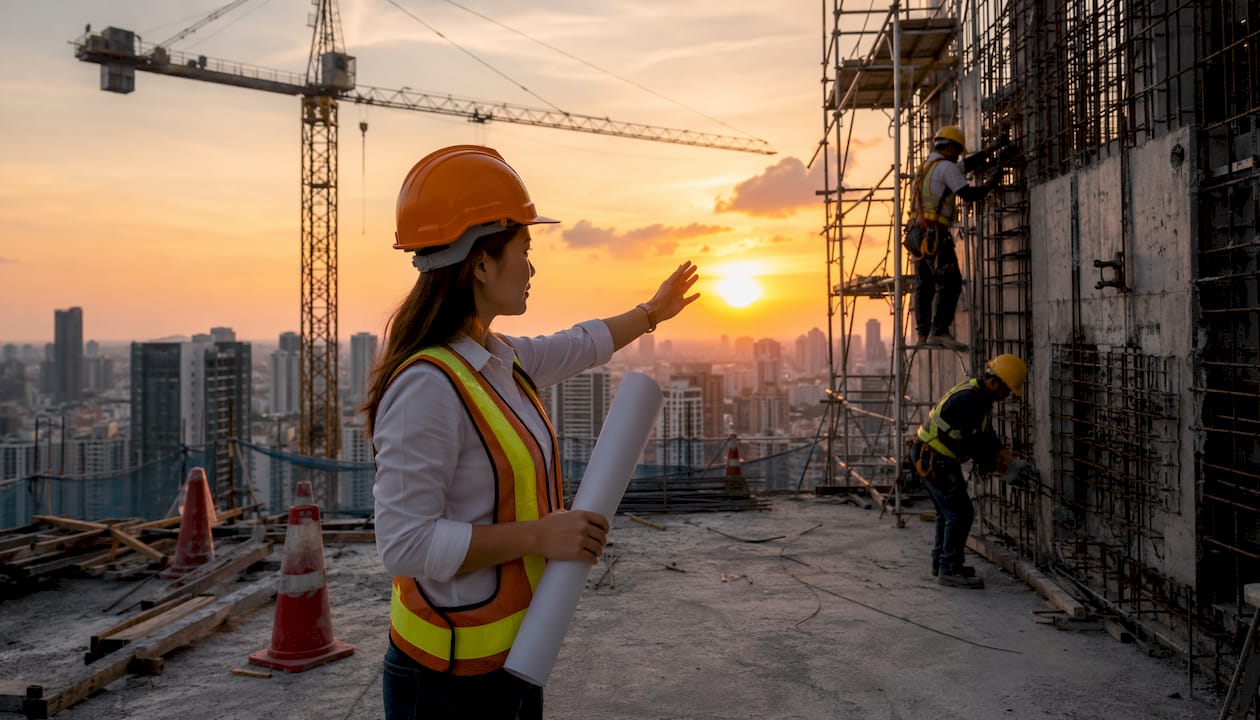
Pro Tip: Require builders to review and sign off on technical drawings before any authority submission. This single protocol eliminates the majority of on-site improvisation scenarios.
4. Disconnected workflows produce cascading coordination failures
Disconnected projects generate redundant meetings and failed anticipatory adjustments, worsening delays and costs across the supply chain. When each contractor operates within its own system with its own priorities, no participant has a complete picture of what is happening across the full project at any given moment. In Singapore’s design-build environment, where M&E, structural, architectural, and interior design scopes frequently overlap, the absence of a shared coordination platform means that a decision made by the mechanical contractor may not reach the structural team until physical conflict is already built in. Coordinating M&E and architectural drawings through an integrated workflow is one of the most direct ways to prevent this.
5. Insufficient knowledge of Singapore’s building codes and authority requirements
Singapore has some of the strictest building regulations in the world, and non-compliant designs caught during construction require demolition and attract fines. BCA structural requirements, URA planning parameters, HDB renovation guidelines, SCDF fire safety codes, PUB drainage requirements, and LTA road reserve conditions each impose distinct constraints that must be addressed in the design phase. Teams without deep familiarity with these overlapping frameworks routinely produce designs that pass internal review but fail at authority submission. The design check process for Singapore projects requires proactive engagement with each relevant authority, not a sequential submission approach.
6. Inadequate clash detection between design and construction phases
On average, 28% of design coordination issues remain unresolved near project completion, forcing on-site adjustments that affect cost and schedule. Design discrepancy, design error, clashes, and missing information are the most frequent causes, with mechanical rooms and condensed ceiling-to-floor spaces being the highest-risk zones. BIM-based clash detection addresses these issues when applied continuously and early, but many Singapore projects still run 60% of workflows on 2D drawings, limiting the practical impact of digital tools. Temporal and functional design issues, those related to constructability and sequencing, take the longest to resolve and cause the greatest schedule disruption when left until construction.
7. Delayed design changes and late authority approvals disrupt schedules
Late design changes are among the most disruptive project management pitfalls in Singapore’s construction sector. When design modifications occur after authority submissions have been lodged, teams must withdraw, revise, and resubmit, adding weeks or months to the approval timeline. Singapore’s authority approval processes for BCA, URA, and HDB operate on defined review cycles, and a late submission misses the queue entirely. The scope creep costs associated with uncontrolled design changes extend well beyond the direct redesign expense, affecting procurement lead times, trade sequencing, and contractor preliminaries.
8. Ineffective use of BIM and coordination technology
Most construction software focuses on post-event reporting rather than active coordination across independent companies. A dashboard showing project status to the main contractor does nothing to help the mechanical subcontractor align material deliveries with the structural program. Effective coordination requires connected workflows where actions taken by one party trigger the right response from another without manual follow-up, and clear accountability for who owns each decision and when it is needed. Until BIM implementation in Singapore moves from model-viewing to workflow-connected coordination, the technology investment will continue to underperform relative to its potential.
9. Cultural and language barriers affect team collaboration
Singapore’s construction workforce is genuinely multicultural, drawing from teams with different primary languages, professional conventions, and communication norms. Assumptions about shared understanding are common and frequently wrong. A technical instruction communicated in English may be interpreted differently by a subcontractor team whose working language is Mandarin, Tamil, or Bengali, particularly when the instruction involves regulatory compliance details or dimensional tolerances. Proactive cultural awareness training and bilingual documentation protocols are practical responses, not optional enhancements, for any project team operating across language groups in Singapore.
10. Unclear decision ownership and fragmented responsibilities
When no single party owns a decision, that decision either does not get made or gets made by whoever is on site at the moment, which is rarely the right person. Coordination failure is fundamentally a system failure, not an individual one, and it persists when accountability is fragmented across the project team. The design-build risk allocation structure in Singapore contracts must explicitly assign decision ownership for each coordination interface, including design-construction handoffs, authority submission responses, and on-site variation approvals. Without this clarity, disputes increase, productivity drops, and recovery becomes the project’s primary activity rather than delivery.
How to overcome design-build coordination pitfalls in Singapore
Addressing these pitfalls requires structural changes to how teams are organized and how workflows are connected, not just better communication intentions.
- Engage builders early: Require builder participation in design reviews from the schematic phase, with formal sign-off on technical drawings before authority submission.
- Implement integrated digital platforms: Move beyond document management to connected workflow systems where decisions by one trade automatically trigger responses from others.
- Define decision ownership explicitly: Assign named accountability for every coordination interface in the project contract and the project execution plan.
- Conduct regular joint site meetings: Weekly meetings involving both design and construction teams resolve emerging issues before they become built-in problems.
- Apply continuous clash detection: Run BIM-based clash detection at every design milestone, not only at the pre-construction stage, with particular attention to mechanical rooms and ceiling zones.
- Align submission timelines with authority review cycles: Map BCA, URA, HDB, and other authority approval timelines at project inception and build design freeze dates backward from submission deadlines.
- Address language and cultural barriers proactively: Provide bilingual technical documentation and structured cultural awareness protocols for multicultural project teams.
- Leverage owner-led coordination: Owners who provide the coordination platform used by their supply chain see measurably better delivery outcomes than those who leave coordination to contractors.
Pro Tip: Developers who build the same building type repeatedly and invest in programmatic delivery, with consistent supply chain relationships and scope standards, carry coordination improvements from project to project rather than rebuilding the system from scratch each time.
The expertise behind these insights
Stellar Structures is a Singapore-based multidisciplinary design and engineering firm with direct experience across civil, structural, geotechnical, M&E, and architectural design scopes. The firm manages authority submissions for BCA, URA, HDB, JTC, SCDF, PUB, LTA, NEA, and NParks, giving its team a practical working knowledge of the regulatory constraints that most frequently generate coordination failures in Singapore projects.
The insights in this article draw on global AECO coordination research, peer-reviewed forensic construction case studies, and Singapore-specific regulatory practice. Stellar Structures serves property owners, developers, contractors, architects, and government agencies across residential, commercial, industrial, and infrastructure project scales, with a consistent focus on compliance, constructability, and coordinated project delivery.
Key takeaways for improving design-build coordination in Singapore
Coordination failure, not contractor incompetence, is the primary driver of construction delays and budget overruns in Singapore design-build projects.
| Point | Details |
|---|---|
| Early builder involvement | Builders must review technical drawings before finalization to prevent constructability conflicts and regulatory non-compliance. |
| 28% unresolved design issues | On average, 28% of design coordination issues remain unresolved near project completion, forcing costly on-site adjustments. |
| Connected workflows over reporting | Effective coordination requires workflows that trigger responses across trades in real time, not dashboards that report past events. |
| Singapore regulatory complexity | BCA, URA, HDB, SCDF, and other authority requirements must be stress-tested against designs from the schematic phase onward. |
| Stellar Structures coordination expertise | Stellar Structures provides multidisciplinary design, engineering, and authority submission services to support compliant, coordinated project delivery in Singapore. |
Stellar Structures supports coordinated, compliant project delivery in Singapore
Coordination failures in Singapore design-build projects carry a predictable cost: variation orders, authority resubmissions, on-site demolitions, and schedule overruns that compound at every phase. Stellar Structures offers a direct alternative to the fragmented approach that produces these outcomes.
The firm’s multidisciplinary team covers civil, structural, geotechnical, M&E, and architectural design within a single coordinated practice, eliminating the inter-firm communication gaps that generate most coordination failures. Authority submissions across BCA, URA, HDB, JTC, SCDF, PUB, LTA, NEA, and NParks are handled in-house, with regulatory compliance stress-tested against designs from the earliest project phase. For developers, contractors, and architects who need structural design checks that align with Singapore’s authority requirements from day one, Stellar Structures provides the technical depth and regulatory experience to keep projects on schedule and within scope. Contact Stellar Structures to discuss your project’s coordination requirements.
Recommended
- Design and Build Contract Structure in Singapore: 2026 Guide
- Stages of New Build Construction in Singapore: 2026 Guide
- Design and build contracts: Singapore developer guide
- Integrated design and construction for efficient Singapore projects