




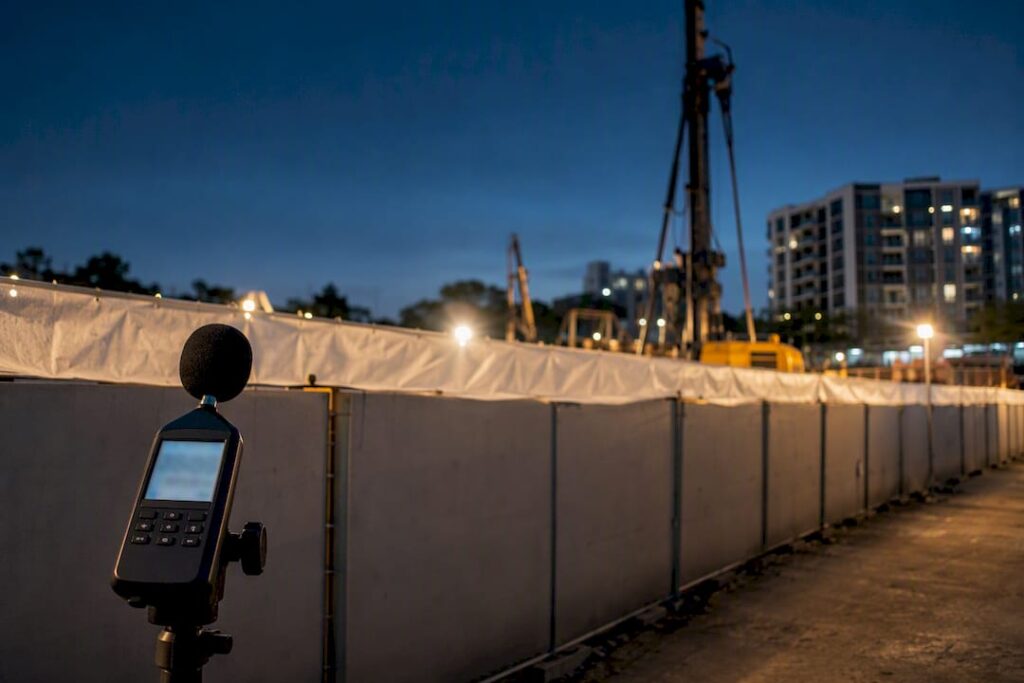
Yes, Singapore’s National Environment Agency (NEA) can issue written permits allowing construction work during prohibited hours, but that permit does not suspend the underlying noise limits. Contractors working within 150 meters of residential premises, hospitals, or schools still must meet the maximum permissible decibel levels set under the Environmental Protection and Management (Control of Noise at Construction Sites) Regulations (EPMA Regulations), and NEA typically expects a documented Noise Management Plan and Class 1 meter monitoring before granting any exception.
TL;DR:
- Permits issued during prohibited hours do not exempt sites from mandatory noise limits, which must still be met at all times.
- Construction sites within 150 meters of sensitive premises like homes or hospitals must implement continuous noise monitoring with Class 1 meters.
- Larger projects near sensitive areas require a detailed Noise Management Plan demonstrating mitigation measures and monitoring arrangements for permit approval.
- Noise reduction techniques such as acoustic barriers, equipment choice, and task sequencing significantly improve chances of permit approval and compliance.
- Non-compliance penalties can reach up to $40,000 daily fines, emphasizing the importance of thorough planning and real-time monitoring to avoid violations.
Table of Contents
- What Governs Construction Noise Permits in Singapore?
- How Loud Can a Construction Site Legally Be?
- When Does the 150m Rule Apply to Your Site?
- How Do You Apply for a Construction Noise Permit?
- What Mitigation Measures Actually Reduce Site Noise?
- What Happens If You Break the Rules?
- How Stellar Structures Helps With Noise Compliance
- Get Compliance Support Before You Break Ground
- Sources
What Governs Construction Noise Permits in Singapore?
The EPMA Regulations form the legal backbone of every construction noise permit decision in Singapore. They set quantitative noise ceilings, define prohibited working periods near sensitive premises, and give NEA’s Director-General discretion to authorize exceptions in writing when circumstances justify it.
That discretion is narrower than most contractors assume. A written permit issued during a prohibited period does not exempt the site from the standard noise limits under regulation 3. Work can proceed, but the decibel ceiling still applies in full.
The regulations place compliance duty primarily on the owner or occupier of the construction site, not on individual subcontractors. In practice, this means the main contractor or developer carries legal exposure for the whole site’s noise output, even when multiple trades are working simultaneously. Anyone managing a project timeline needs to build this responsibility into subcontractor agreements early, since a single noisy activity by one trade can trigger an enforcement action against the entire project.
How Loud Can a Construction Site Legally Be?
NEA’s Construction Noise Control guidance sets maximum permissible levels that tighten as the day goes on and as sites sit closer to noise-sensitive receptors. Limits are measured in equivalent continuous sound level (Leq), averaged over 5-minute, 1-hour, or 12-hour windows depending on the time band, and taken 1 meter from the façade of the affected building.
| Time period | Typical Leq limit (dBA) | Measurement window |
|---|---|---|
| 7 AM to 7 AM | Limits up to 90 dBA | Leq, 5 minutes |
| 7 PM to 10 PM | More stringent than daytime | Leq, 1 hour |
| 10:00 PM to 7:00 AM (within 150m of residential) | Limits as low as those permissible near residences | Leq, 12 hours |
The Third Schedule of the EPMA Regulations allows adjustments where background noise from other sources, such as traffic, would otherwise skew a reading. The practical effect for site planning is straightforward: whatever a crew can run at 90 dBA at noon becomes impossible after 7 PM, and virtually anything mechanical is off-limits after 10 PM near homes.
When Does the 150m Rule Apply to Your Site?
Any site within 150 meters of a noise-sensitive premises falls under stricter monitoring and scheduling rules. NEA defines sensitive receptors broadly, and the list matters because it decides whether continuous monitoring becomes mandatory.
- Residential buildings, including HDB blocks and private housing
- Hospitals and healthcare facilities
- Homes for the aged and similar care institutions
- Schools and other educational premises
Sites meeting the 150m threshold face prohibited working periods that go beyond the general daily limits. Work is generally barred from 10 PM Saturday through 7 AM Monday, and from the evening before a public holiday through the morning after. Saturday work itself is restricted to earlier hours than a typical weekday close.
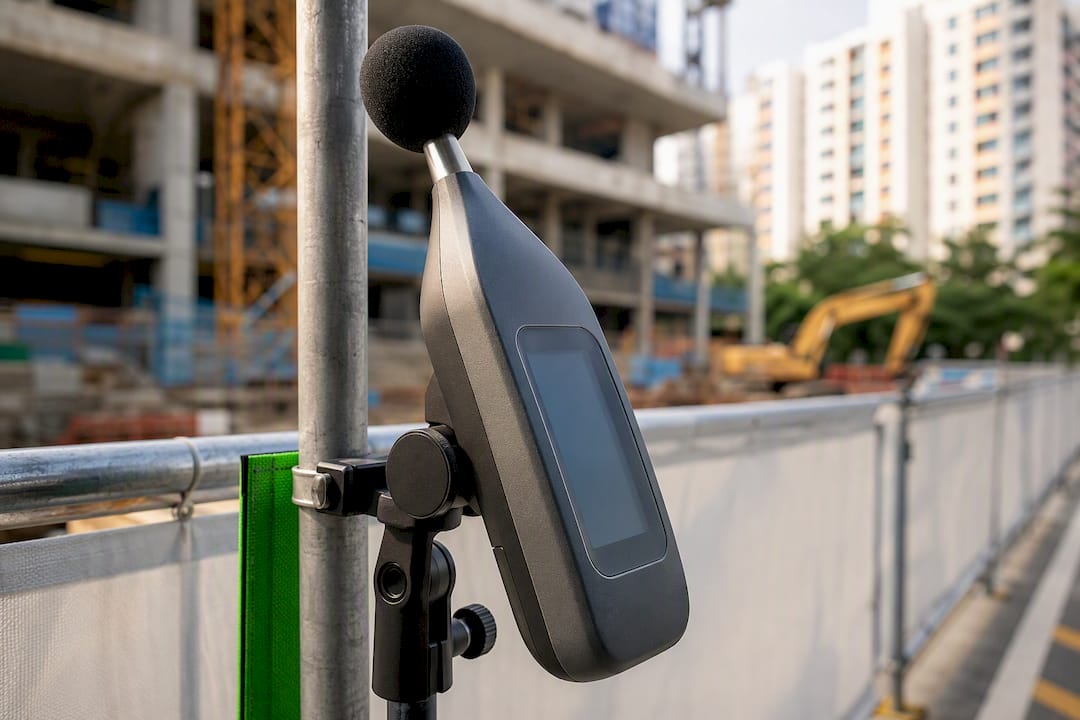
For these sites, NEA requires continuous noise monitoring using Class 1 meters, calibrated periodically and logging data around the clock. NEA can request access to these records at any time, and mobile phone apps are explicitly ruled out for compliance purposes since they lack the accuracy standard Class 1 instruments meet.
How Do You Apply for a Construction Noise Permit?
Larger projects near sensitive premises generally need to submit a Noise Management Plan (NMP) before work begins, not after a complaint arrives. The NMP is the document NEA reviews to decide whether a prohibited-period permit is even worth considering.
A workable NMP typically covers:
- A monitoring plan specifying meter locations, frequency, and calibration schedule
- Mitigation measures matched to the specific noisy activities planned on site
- A construction schedule showing when noisy work occurs relative to prohibited periods
- Equipment specifications, including noise ratings for major machinery
- Staffing arrangements for monitoring and rapid response to exceedances
Justifying a Director-General permit for after-hours or prohibited-period work means demonstrating genuine technical necessity, not convenience. Safety-critical activities, work that cannot be interrupted once started (like a continuous concrete pour), or public-interest infrastructure timelines carry more weight than a desire to finish ahead of schedule. The application should pair that justification with concrete mitigation commitments the site can actually deliver.
Submission responsibility usually sits with the owner or the qualified person coordinating authority approvals, and lead times should account for NEA review before the intended work date. Supporting documents, including recent noise logs, equipment spec sheets, and the NMP itself, should accompany the request.
Pro Tip: Submit your NMP and permit request well before your target start date. NEA review takes time, and a rushed application without solid monitoring history is far more likely to draw conditions you did not plan for.
What Mitigation Measures Actually Reduce Site Noise?
Reducing noise output is what makes a permit application credible in the first place. NEA reviewers respond better to a site that has already engineered noise down than one asking for a blanket exception.
Design and layout choices carry the most leverage before a single tool starts running. Temporary acoustic barriers around the noisiest work zones, orienting equipment away from the nearest façade, and sequencing so the loudest tasks happen furthest from receptors in time all reduce the baseline problem rather than just managing around it. Early-stage layout decisions like these often save far more mitigation cost than anything added later.
Equipment choices matter just as much. Electric or hybrid tools generally run quieter than diesel equivalents, and a scheduled muffler inspection program catches the gradual noise creep that untracked wear causes.
Operational discipline closes the loop:
- Sequence noisy tasks earlier in the permitted window, not later
- Notify nearby residents ahead of any planned after-hours activity
- Keep a real-time response plan ready so an exceedance gets addressed within minutes, not after NEA calls
- Review vibration control measures alongside noise mitigation where the same activities generate both
Pro Tip: A real-time monitoring dashboard that alerts your site manager the moment a reading crosses the limit is worth more than any after-the-fact excuse. NEA’s own guidance notes that continuous monitoring near sensitive receptors often triggers fast follow-up on breaches, so your response window is short.
What Happens If You Break the Rules?
Non-compliance under the EPMA Regulations carries fines up to $40,000, plus continuing daily fines for offenses that persist after notice. That structure means a single unresolved exceedance can compound quickly if it is not corrected fast.
Calibrated Class 1 meters and unbroken logs are your best defense if NEA questions a reading, especially when annotated with context like unusual weather or concurrent noise from a neighboring site. Records without that context are harder to defend even when the underlying work was compliant.
If an exceedance occurs, or NEA issues a notice, the sequence should be immediate: halt the offending activity, apply remediation, document what happened and why, and report to NEA rather than waiting for a follow-up inspection.
How Stellar Structures Helps With Noise Compliance
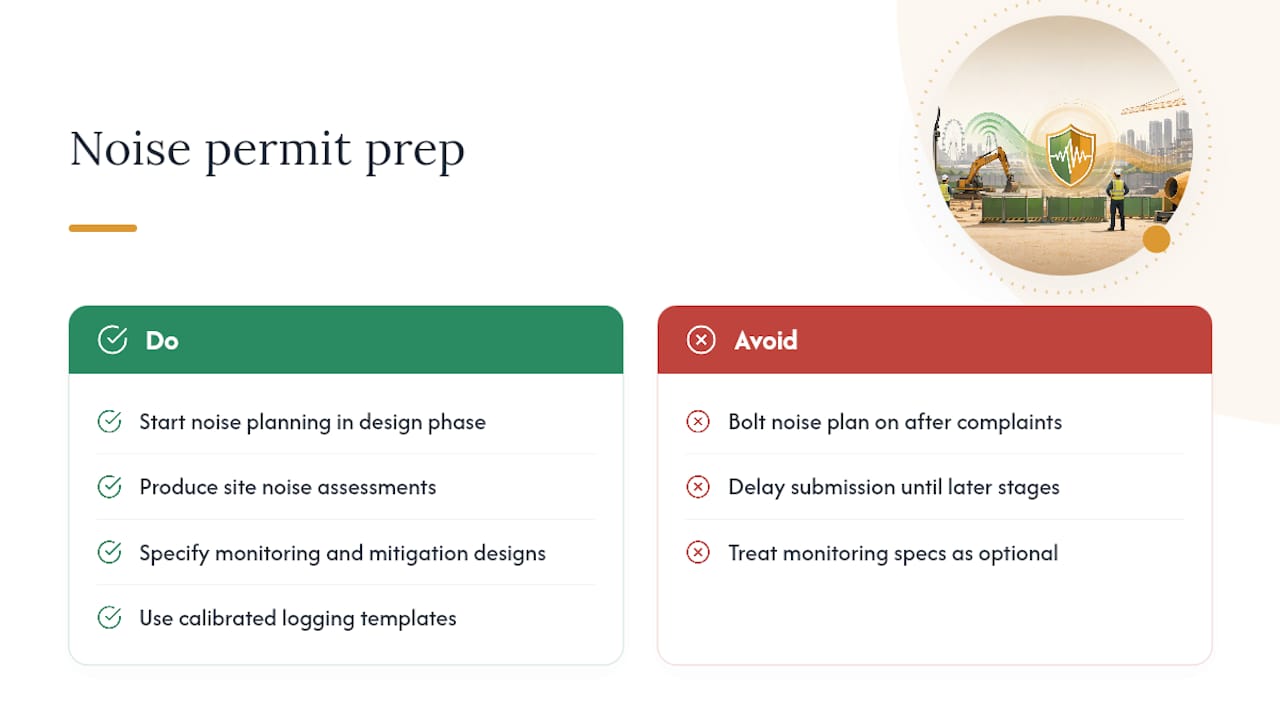
Getting a construction noise permit application right on the first pass usually depends on preparation that starts long before the site opens. Specialized consultants work with developers and contractors on the technical side of that preparation: site noise assessments, monitoring specifications, mitigation design sketches, and calibration and logging templates that hold up under NEA scrutiny.
Bringing noise planning into the design phase, rather than bolting it on after complaints start, tends to save both time and money. It also gives you a stronger case if an after-hours permit ever becomes necessary. The submission process should be coordinated alongside broader authority approval work, so the noise plan is not an afterthought bolted onto an unrelated application.
— Aman
Get Compliance Support Before You Break Ground
Most contractors discover the gaps in their noise compliance plan only after NEA flags a reading, which is exactly the moment you cannot afford surprises. Consultants provide an alternative to piecing together a compliance strategy from scattered guidance documents by building your Noise Management Plan, monitoring specification, and mitigation design as part of a coordinated process used for BCA, URA, and NEA authority submissions across projects.

That integration matters because a noise plan built in isolation from your structural and civil design often duplicates work or misses site constraints a geotechnical review would have caught. If your project sits within 150 meters of housing, a school, or a hospital, consider scoping your foundation and site design alongside your noise submission, so both move through NEA review together instead of in separate, disconnected rounds.
Sources
- Construction Noise Control — NEA
- Environmental Protection and Management (Control of Noise at Construction Sites) Regulations — Singapore Statutes Online
Recommended
- Engineer’s Checklist to Pass LTA for Street Works Permits in Singapore
- What Are The Requirements For Building Plan Submission In Singapore
- Temporary Works Design in Singapore: Mastering Safety
- Mezzanine Floor Approval Guide Singapore 2026