





If your project’s gross floor area reaches 5,000 square meters, CORENET X submission through portal.corenet.gov.sg is mandatory, and only a registered Qualified Person can file it. Projects at or above 30,000 sqm have faced mandatory portal submission since 1 October 2025. The immediate action for any project team approaching either threshold is straightforward: register the project on the portal and confirm every QP has working Corppass access before design work advances much further.
TL;DR:
- Projects exceeding 5,000 square meters must use IFC+SG models, with mandatory submission starting from that GFA threshold, requiring comprehensive model quality checks.
- The 30,000 square meter threshold makes portal submission mandatory for new projects from October 1, 2025, and all ongoing projects above this size should prepare accordingly.
- Core gateway reviews now involve multiple agencies evaluating the project collectively across design, piling, construction, and completion stages, changing documentation sequencing.
- Independent agency approvals, like demolition or environmental clearances, generally take between 5 and 21 working days and should be scheduled early in the process.
- Registering the project, confirming Qualified Person registration, and testing model readiness in the sandbox are crucial steps to avoid delays and rework during submission.
Table of Contents
- What Are the CORENET X Gateways and Direct Submission Process?
- What Are the BIM and IFC+SG Requirements for CORENET X?
- How Do You Register and Submit a Project on CORENET X?
- What Are Typical SLAs for Independent CORENET X Submissions?
- When Is CORENET X Mandatory, and What Should Ongoing Projects Do?
- What Should QPs Check Before Their First CORENET X Submission?
- A Practitioner’s View on Getting CORENET X Submissions Right the First Time
- Get Your Project Submission Ready with Stellar Structures
- Sources
What Are the CORENET X Gateways and Direct Submission Process?
CORENET X organizes regulatory review into a sequence of gateways, each triggering a Regulatory Approval for Building Works (RABW) cycle where multiple agencies review a project collectively rather than in separate, staggered submissions. That collective review is the structural difference from the old CORENET system, and it changes how project teams should sequence their documentation.
- Design Gateway (G1): Reviews planning parameters, massing, and cross-agency design intent. This is where BCA, URA, and other relevant agencies confirm the fundamentals before any construction detailing proceeds.
- Piling Gateway (G1.5): An optional stage for projects needing early foundation or piling clearance ahead of full construction approval, useful when site conditions demand an early start on substructure work.
- Construction Gateway (G2): Covers construction-level approvals, the point at which main works and sales launch typically become permissible.
- Completion Gateway (G3): Handles the as-built submission that supports Temporary Occupation Permit (TOP) and Certificate of Statutory Completion (CSC) issuance.
Smaller or lower-complexity projects may qualify for the Direct Submission Process (DSP), which bypasses some of the multi-gateway coordination when a project’s scope and risk profile don’t warrant it. Whether DSP applies depends on project type and scale, so confirm eligibility during pre-submission consultation rather than assuming it.
What Are the BIM and IFC+SG Requirements for CORENET X?
IFC+SG becomes mandatory once a project’s GFA hits 5,000 sqm, following a phased rollout that began with smaller voluntary trials. IFC+SG is Singapore’s local mapping of standard IFC attributes onto the specific data fields regulatory agencies need, and it’s what lets multiple agencies read one model instead of demanding separate formats. Supplementary 2D drawings and calculations remain acceptable alongside the model where the format genuinely can’t carry certain information.
Model quality determines how smoothly a submission clears automated checks:
- Geo-referencing accuracy, so the model aligns with site survey data.
- Correct discipline mapping across architectural, structural, and M&E components.
- Complete required attribute sets specific to IFC+SG templates.
- Clash detection run before submission, not discovered by the reviewing agency.
The URA Model Quality Checker and the IFC+SG Resource Kit exist specifically to catch these issues early.
Pro Tip: Run your model through the sandbox training environment at least once before a live gateway submission. It’s the only way to see how your attribute mapping performs against the actual validation logic agencies use, rather than guessing from the resource kit’s documentation alone.
How Do You Register and Submit a Project on CORENET X?
Getting a project into the system correctly the first time avoids a surprising share of downstream rework. The sequence matters:
- Register the project on portal.corenet.gov.sg and designate a project coordinator who owns communication across all appointed parties.
- Confirm QP registration and Corppass access. Every Qualified Person on the project, whether architect, surveyor, or professional engineer, needs Singpass-for-Business permissions configured correctly, and this is a common point of failure for teams new to the platform.
- Run a training environment simulation. Appointing project members and simulating a joint submission in the sandbox surfaces Corppass permission gaps and role mismatches before they block a live filing.
- Package joint submissions properly. When multiple agencies review at one gateway, their responses get consolidated into a single set of feedback rather than arriving as separate threads, which changes how amendment cycles need to be managed.
Amendment submissions follow their own workflow distinct from a fresh gateway filing, and treating them interchangeably is a frequent source of confusion for teams still learning the system.
What Are Typical SLAs for Independent CORENET X Submissions?
Independent submissions cover agency-specific approvals that sit outside the main gateway sequence, things like temporary works, demolition permits, or NParks and PUB clearances tied to specific site conditions. These aren’t optional paperwork; they’re often prerequisites that a gateway review will stall on if left too late.
- BCA structural ancillary submissions, such as demolition or cladding approvals, carry an expected response time of 15 working days.
- Other agencies’ response times vary, typically somewhere between 5 and 21 working days depending on scope and complexity.
- Sequence these early rather than after gateway submission. A submission workflow that waits on an independent clearance holds up the entire gateway review, not just the ancillary item.
Project teams that map out which independent submissions their project needs at the design stage, rather than discovering them mid-construction, consistently avoid the worst of these bottlenecks.
When Is CORENET X Mandatory, and What Should Ongoing Projects Do?
The rollout has moved in clear phases rather than a single cutover, and knowing where your project falls in that timeline matters for planning.
- December 18, 2023: Soft launch, limited to early adopters and pilot projects.
- June 1, 2024: Voluntary submission opened to the wider industry.
- 2025: IFC+SG became mandatory for new projects exceeding 5,000 sqm GFA, following the phased implementation timeline agencies had signaled well in advance.
- October 1, 2025: URA’s circular made portal submission mandatory for new projects at or above 30,000 sqm GFA.
- 1H 2026: Guidance points toward continued migration of remaining project categories, with further notices expected as full transition proceeds.
Ongoing projects already approved under the legacy system generally retain validity for existing approvals, but any new gateway submission, amendment, or completion filing should be checked against current mandatory thresholds before assuming the old process still applies. The CORENET X Code of Practice, agency circulars, and the support portal’s release notes remain the most reliable places to confirm current requirements, since CORENET X is being implemented iteratively and specific tooling can shift between releases.
What Should QPs Check Before Their First CORENET X Submission?
A short pre-submission routine catches most of the problems that otherwise surface as amendment requests weeks later.
- Raise open questions at pre-submission consultation. Unresolved cross-agency conflicts are far cheaper to fix before filing than after.
- Verify model readiness: confirm geo-referencing, run clash detection, and check that required attributes map cleanly to IFC+SG templates.
- Confirm administrative items: Corppass permissions, assigned project roles, and any supplementary calculations or 2D drawings the model doesn’t fully capture.
- Align the team on responsibilities. One designated project coordinator, clear ownership of each discipline’s submission package, and an agreed timeline prevent the common scramble in the final days before a gateway deadline.
Pro Tip: Embed IFC+SG attribute mapping during design development, not during a pre-submission scramble. Retrofitting a finished model to match template requirements takes far longer than building the mapping in from the start, and it’s where most avoidable clashes get flagged late.
A Practitioner’s View on Getting CORENET X Submissions Right the First Time
Working through CORENET X submissions with clients across residential, commercial, and industrial projects, the pattern is consistent: teams that treat the portal as just an upload point struggle, while teams that treat it as a coordination discipline don’t. Stellar Structures has supported clients including Stellar Structures’ own project teams through design checks and BIM model quality control specifically aimed at passing IFC+SG validation on the first attempt rather than the third.
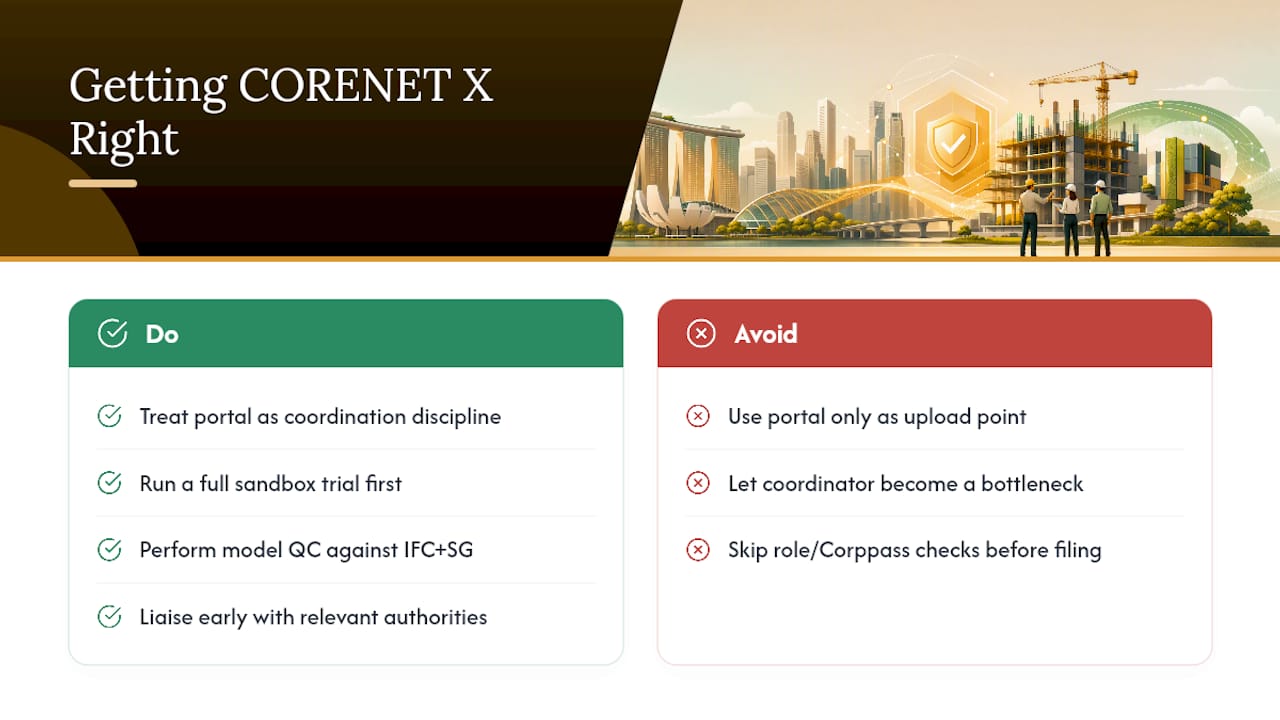
The services that matter most here are unglamorous: model QC against IFC+SG attribute sets, authority liaison across BCA, URA, SCDF, and other relevant agencies, and submission coordination that keeps a project coordinator from becoming a bottleneck. One practical improvement worth adopting broadly is running a full sandbox trial, including project member appointments, before any live gateway filing. It reliably catches Corppass and role configuration errors that would otherwise surface as a rejected submission days before a deadline.
For projects working with structural engineering support, outsourced calculation and modeling capacity can help teams that are stretched thin during peak submission periods keep pace without sacrificing model quality.
— Aman
Get Your Project Submission Ready with Stellar Structures
A design and engineering partner can help get your model and documentation genuinely ready for CORENET X, not just technically compliant on paper. That distinction shows up at the gateway review: a model with clean IFC+SG attribute mapping and a design check completed beforehand moves through Design and Construction Gateway review with far fewer amendment rounds than one assembled under deadline pressure.

The firm’s civil and structural design check service is built specifically for this stage, catching clashes, attribute gaps, and cross-discipline conflicts before they become a rejected submission. Whether you’re preparing a first-time filing above the 5,000 sqm BIM threshold or coordinating a joint submission across multiple agencies, getting a design check scheduled early gives your project coordinator room to fix issues instead of reacting to them. Reach out to a qualified provider to scope a design check for your next gateway submission.
Recommended
- Design Check Process for Singapore Projects: 2026 Guide
- Expert Guidance on CORENET eSubmission System for Efficient Plan Approval
- Checklist for Developers Contractors Choosing the Right QP S and Supervision Team for Your Next Build in Singapore
- What Are The Requirements For Building Plan Submission In Singapore