





The design check process for Singapore construction projects is defined as a coordinated, multi-agency regulatory review that validates architectural, structural, and engineering designs against statutory requirements before construction commences. Singapore’s Building and Construction Authority (BCA) mandates this process through the CORENET X digital platform, which enables concurrent submissions to seven regulatory agencies including the Urban Redevelopment Authority (URA), Singapore Civil Defence Force (SCDF), and National Parks Board (NParks). Projects that complete this process correctly reduce overall regulatory approval time by up to 20%, translating directly into faster project delivery and reduced holding costs for developers and contractors alike.
What the design check process in Singapore projects requires before you start
Before any submission reaches CORENET X, project teams must assemble a specific set of documentation and confirm that their project meets the platform’s mandatory thresholds. Understanding these prerequisites prevents abortive work and avoids rejection at the first submission gate.

Project eligibility and documentation requirements
CORENET X applies to most new building works above defined gross floor area thresholds, including commercial, industrial, and residential developments. The following documentation categories are required for a complete submission:
- Architectural plans: Floor plans, elevations, sections, and site plans compliant with URA and BCA requirements
- Structural drawings: Foundation, frame, and slab designs endorsed by a Qualified Person (QP) registered with BCA
- Mechanical and electrical (M&E) plans: ACMV, fire protection, and electrical layouts reviewed against SCDF and BCA fire safety codes
- Geotechnical reports: Required for projects involving deep excavation or complex soil conditions
- Authority certifications: Pre-application consultation records from URA, JTC, or HDB where applicable
BIM standards and interoperability
All submitted models must comply with IFC and IFC+SG standards to guarantee interoperability across disciplines and agencies. IFC (Industry Foundation Classes) is the vendor-neutral file format that allows architectural models from Autodesk Revit, Bentley Systems, or ArchiCAD to be read by structural and M&E engineers without data loss. The IFC+SG extension adds Singapore-specific property sets required by BCA for automated code checking.
The table below summarizes the primary submission components and the agencies that review them:
| Submission Component | Primary Reviewing Agency | Standard or Code Applied |
|---|---|---|
| Architectural plans | URA, BCA | URA Development Control, BCA Building Control Act |
| Structural drawings | BCA | SS EN 1992/1993/1994 Eurocodes |
| Fire safety plans | SCDF | Fire Code 2018 |
| Landscape and greenery | NParks | Landscape Replacement Policy |
| Drainage and sewerage | PUB | Code of Practice on Surface Water Drainage |
| Industrial layout | JTC | JTC Estate Guidelines |
Pro Tip: Engage a building plan submission specialist before finalizing your design program. Identifying agency-specific requirements at concept stage prevents costly redesigns during the formal review cycle.
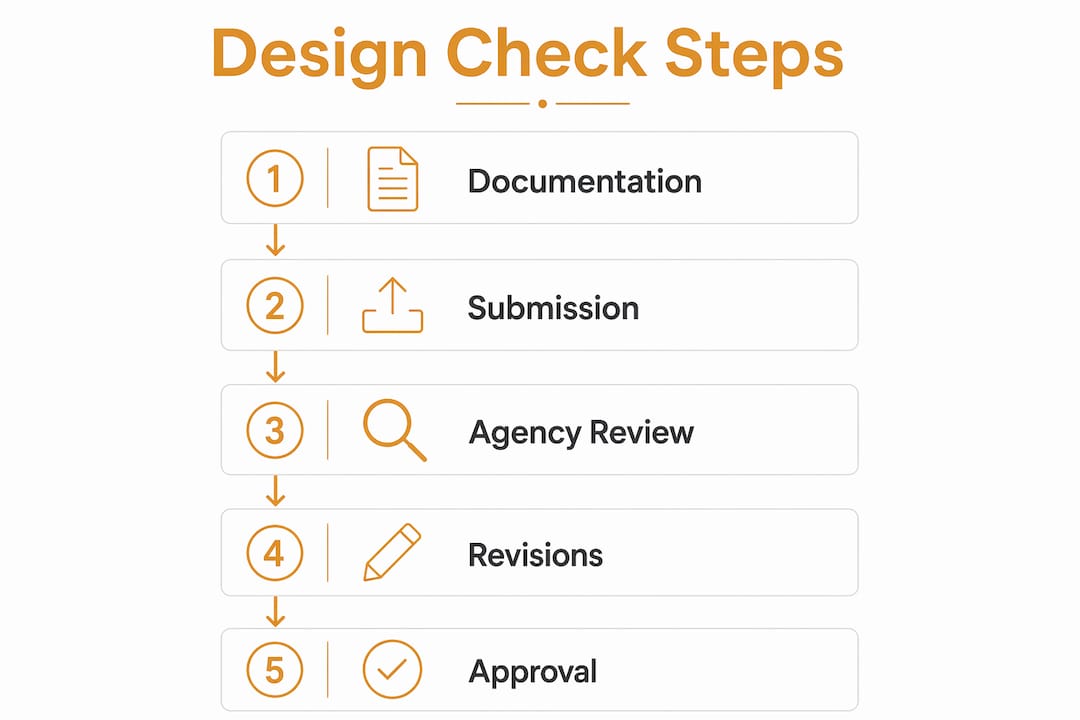
How does the CORENET X submission process work step by step?
The CORENET X workflow is structured around three sequential submission stages, each with defined deliverables and agency review cycles. Understanding the sequence prevents teams from submitting incomplete packages that trigger automatic rejection.
-
Stage 1: Provisional Permission (PP) submission. The project team submits the architectural concept model and site parameters to URA for planning permission. URA evaluates gross plot ratio, building height, setbacks, and use zoning. Approval at this stage confirms the development envelope before detailed engineering begins.
-
Stage 2: Building Plan (BP) submission. This is the core design check stage. The federated BIM model, integrating architectural, structural, and M&E disciplines, is uploaded to CORENET X. Seven agencies conduct simultaneous model review, issuing a consolidated response rather than sequential bilateral comments. BCA’s automated code-checking engine runs clash detection and compliance checks against the Singapore Building Regulations in real time.
-
Stage 3: Permit to Proceed (PTP) and TOP/CSC. After BP approval, the team submits construction-stage documentation for the Permit to Proceed. Temporary Occupation Permit (TOP) and Certificate of Statutory Completion (CSC) submissions close the regulatory cycle upon project completion.
Within Stage 2, the revision management workflow operates as follows. Each agency issues comments tagged to specific model elements within the CORENET X platform. The relevant QP responds directly within the platform, uploading revised model files with version-controlled change logs. This traceability is critical: federated BIM model submissions allow early detection of design clashes and buildability issues, reducing site risk and rework before construction begins.
Typical timelines for Stage 2 BP approval range from six to twelve weeks for standard commercial projects, depending on design complexity and the completeness of the initial submission. Projects with pre-application consultation records from URA or BCA consistently achieve approvals at the lower end of this range.
Pro Tip: Schedule a pre-submission coordination meeting with all QPs and the developer at least four weeks before the BP submission date. Resolving inter-discipline clashes in the federated model before submission eliminates the most common cause of agency comment cycles.
Common challenges during the design check process and how to resolve them
The most frequent source of delay in Singapore’s design check process is uncoordinated BIM updates. When one consultant revises a structural grid or ceiling height without notifying the architectural and M&E teams, the federated model develops internal conflicts that trigger agency comments and extend review cycles.
Uncoordinated BIM updates by different specialists introduce model discrepancies when revision controls and communication discipline are lacking. This requires strict data governance protocols, including a named BIM Coordinator responsible for issuing and approving all model revisions. The following practices address the most common coordination failures:
- Establish a revision control register: Every model update must be logged with a date, author, affected discipline, and reason for change. This register becomes the audit trail if agency queries arise.
- Use clash detection software before submission: Tools like Autodesk Navisworks or Solibri Model Checker identify hard clashes (physical intersections) and soft clashes (clearance violations) before the model reaches CORENET X.
- Assign submission ownership by discipline: Each QP owns their model file and is accountable for its compliance status. Shared ownership creates ambiguity and delays responses to agency comments.
- Hold structured coordination meetings: The Springleaf Residence project team held thrice-weekly coordination meetings to align consultants, contractors, and the developer on submission status and pending revisions.
- Leverage BCA’s official resources: BCA seminars and Code of Practice documentation provide authoritative guidance on submission standards and are updated when regulatory requirements change.
Pro Tip: Appoint a dedicated CORENET X submission manager separate from the lead QP. This person tracks agency comment status, coordinates responses across disciplines, and maintains the submission timeline. On projects with more than three QPs, this role prevents critical comments from being missed.
A secondary challenge involves teams new to CORENET X underestimating the learning curve. The platform’s CORENET eSubmission system requires familiarity with IFC export settings, property set configurations, and agency-specific model view definitions. Teams that invest in training before their first submission consistently outperform those who attempt to learn the platform during a live project cycle.
Traditional vs. CORENET X design review: what actually changes?
The shift from traditional fragmented submissions to CORENET X’s consolidated digital workflow represents a structural change in how Singapore project regulations are applied and enforced. The comparison below quantifies the operational differences.
| Dimension | Traditional process | CORENET X process |
|---|---|---|
| Agency submission method | Sequential bilateral submissions to each agency | Single federated model submission to all agencies simultaneously |
| Review coordination | Each agency reviews independently, no cross-agency alignment | Seven agencies review concurrently with consolidated response |
| Revision cycles | Multiple rounds per agency, often conflicting requirements | Unified comment register reduces conflicting directives |
| Clash detection | Identified during construction or late design stage | Detected at BP submission stage via automated BIM checking |
| Documentation format | 2D CAD drawings and PDF plans | IFC-compliant 3D BIM models with embedded data |
| Approval timeline | Typically 16 to 24 weeks for complex projects | Reduced by up to 20% through concurrent review |
| Abortive work risk | High due to late-stage conflict discovery | Significantly reduced through early integrated review |
Before CORENET X, fragmented submissions caused delays, inconsistencies, and abortive works. A structural engineer might receive BCA approval for a design element that SCDF subsequently required to be repositioned for fire egress compliance. The project team then faced a costly redesign cycle that neither agency had flagged in advance. CORENET X’s concurrent review model eliminates this specific failure mode by requiring all agencies to review the same model version at the same time.
The cost implications are direct. Abortive design work on a mid-sized commercial project in Singapore can represent 3 to 8 percent of total professional fees. Eliminating late-stage conflicts through integrated design and construction practices and CORENET X submissions recovers that cost and compresses the pre-construction program.
Key takeaways
The design check process for Singapore projects succeeds when teams combine IFC-compliant BIM submissions, disciplined revision control, and concurrent multi-agency coordination through CORENET X from the earliest project stage.
| Point | Details |
|---|---|
| Start with complete documentation | Assemble architectural, structural, M&E, and geotechnical files before any CORENET X submission to avoid rejection. |
| Use IFC+SG-compliant BIM models | All federated models must meet IFC and IFC+SG standards for automated code checking and agency interoperability. |
| Leverage concurrent agency review | CORENET X enables seven agencies to review simultaneously, cutting approval time by up to 20% versus sequential processes. |
| Enforce strict revision control | Appoint a BIM Coordinator and maintain a revision register to prevent model discrepancies across disciplines. |
| Invest in training before submission | Teams familiar with CORENET X export settings and agency model view definitions consistently achieve faster first-round approvals. |
Why early investment in the design check process pays off
Having worked with project teams across residential, commercial, and industrial developments in Singapore, I have observed a consistent pattern: the teams that treat the design check process as a back-end compliance task consistently face the most expensive delays. The teams that integrate CORENET X requirements into their design program from week one of concept design consistently deliver faster and with fewer surprises.
The most underestimated value of the CORENET X workflow is not the approval time reduction. It is the discipline it imposes on multi-disciplinary coordination. When every consultant knows their model will be reviewed simultaneously by BCA, URA, SCDF, NParks, PUB, LTA, and JTC, the standard of pre-submission coordination rises. That discipline produces better-coordinated construction drawings, fewer RFIs on site, and more predictable project outcomes.
The learning curve is real. Teams new to IFC+SG property sets and CORENET X model view definitions will struggle on their first submission. The answer is not to delay adoption but to invest in structured training and to engage consultants with demonstrated platform experience. The PE design check and authority approvals process rewards preparation. Projects that enter the platform with complete, coordinated models receive consolidated agency responses faster and with fewer revision cycles than projects that submit incrementally hoping to resolve issues during review.
My recommendation for any project team preparing a first CORENET X submission: allocate four to six weeks before the target BP submission date specifically for federated model coordination, clash resolution, and a dry-run IFC export review. That investment recovers itself within the first revision cycle.
— Aman
How Stellar Structures supports your design check and approval process
Stellar Structures provides civil and structural design checks and full authority submission services for residential, commercial, and industrial projects across Singapore. The firm’s team of registered engineers and architects manages BIM-compliant submissions to BCA, URA, SCDF, JTC, PUB, LTA, NEA, and NParks, covering every stage from Provisional Permission through to Certificate of Statutory Completion. For developers and contractors preparing their first CORENET X submission or managing a complex multi-agency approval cycle, Stellar Structures offers architectural and engineering design consultation to align your project with Singapore’s current regulatory standards from the outset. Contact the team to discuss your project requirements.
FAQ
What is the design check process for Singapore construction projects?
The design check process is a multi-agency regulatory review of architectural, structural, and engineering designs conducted through Singapore’s CORENET X platform before construction begins. BCA, URA, SCDF, and other agencies review a federated BIM model simultaneously and issue a consolidated response.
Which projects must use CORENET X for design submissions?
CORENET X is mandatory for most new building works above BCA’s defined gross floor area thresholds, including commercial, industrial, and residential developments. Projects below the threshold may still use the platform voluntarily to benefit from concurrent agency review.
How long does the building plan approval stage take under CORENET X?
Standard commercial projects typically receive Building Plan approval within six to twelve weeks, depending on design complexity and submission completeness. Concurrent multi-agency review under CORENET X reduces approval time by up to 20% compared to traditional sequential processes.
What BIM standards apply to CORENET X submissions in Singapore?
All BIM models submitted through CORENET X must comply with IFC and IFC+SG standards to support automated code checking and cross-discipline interoperability. The IFC+SG format includes Singapore-specific property sets required by BCA for regulatory review.
What is the most common cause of delays in the design check process?
Uncoordinated BIM updates across disciplines are the primary cause of delays, as revision control failures introduce model discrepancies that generate agency comments and extend review cycles. Appointing a dedicated BIM Coordinator and holding structured coordination meetings resolves this systematically.
Recommended
- Design and build contracts: Singapore developer guide
- Integrated design and construction for efficient Singapore projects
- Value Engineering in Singapore’s Civil & Structural Projects
- Temporary Works Design in Singapore: Mastering Safety