




How Much Does a BCA Periodic Structural Inspection Cost in 2026? A Breakdown of Pricing Factors
| SEO Element Configuration | Details |
| Focus Keyphrase | BCA Periodic Structural Inspection cost |
| Secondary Keywords | structural inspection cost Singapore, professional engineer fee, building safety regulations, BCA PSI regulations 2026, drone inspection cost Singapore, Stage 2 structural investigation |
| SEO Title | How Much Does a BCA Periodic Structural Inspection Cost in 2026? A Breakdown of Pricing Factors |
| Meta Description | Discover the exact BCA Periodic Structural Inspection cost in 2026. Explore pricing factors, professional engineer fees, NDT costs, and strict BCA regulations. |
Introduction to Singapore Building Safety Mandates
Building safety remains an absolute critical priority within Singapore. Extreme urban density demands rigorous structural maintenance protocols continuously. Therefore, the Building and Construction Authority (BCA) enforces strict oversight. The BCA Periodic Structural Inspection (PSI) regime ensures building integrity. Buildings naturally deteriorate over time due to harsh environmental exposure. Wear and tear compromise structural safety significantly.1 Overloading and poor maintenance drastically accelerate this physical deterioration.1
Consequently, the PSI regime mitigates these severe public safety risks. Early detection effectively prevents catastrophic structural failures and collapses.1 Property owners face significant financial obligations during this compliance process. Understanding the precise BCA Periodic Structural Inspection cost is vital. Professional engineer fees fluctuate wildly based on numerous variables. This report provides an exhaustive breakdown of these complex pricing factors. Furthermore, it details the strict regulatory compliance requirements for 2026.
The Statutory Framework: Section 28 Building Control Act
The legal basis for these mandatory checks is exceptionally strict. The Building Control Act (Chapter 29) governs this entire mandate.2 Specifically, Section 28 outlines the non-negotiable legal obligations of owners.3 Owners must proactively maintain absolute structural stability and safety.3 They absolutely cannot delegate this ultimate legal liability to tenants.3
This comprehensive legislation classifies numerous structures as regulated buildings. Permanent structures, earth retaining structures, and temporary huts are included.3 Roofed enclosures, massive docks, wharves, and jetties are also classified.3 Furthermore, civil defence shelters and permanently moored floating structures are regulated.3 Consequently, a vast array of assets requires periodic structural assessment.
Identifying the Legally Responsible Building Owner
Regulatory compliance directly burdens the officially registered property owner. Subdivided strata buildings possess highly unique and complex ownership structures. The Management Corporation Strata Title (MCST) acts as the owner.3 The MCST exclusively controls and maintains all common property elements.3
For unsubdivided buildings, every single registered proprietor is jointly liable.3 Massive public housing estates are governed by the Housing and Development Board.3 Owners must strictly adhere to the designated inspection timelines. Failure to identify the responsible party does not excuse non-compliance. Therefore, establishing legal ownership is the first crucial compliance step.
Inspection Triggers and Statutory Frequencies
Buildings are not immediately subject to these rigorous inspections. The mandatory regime begins from the building’s 13th year.4 Once eligible, the inspection frequency depends entirely on building usage. The BCA categorizes buildings into distinct operational risk profiles.
Non-Residential Building Requirements
Commercial and industrial properties endure heavy daily operational stress. Therefore, non-residential buildings require structural inspections once every five years.1 This stringent category includes massive commercial malls and industrial warehouses.3 It also encompasses institutional properties, schools, and public transport hubs. The frequent five-year cycle ensures rapid detection of load-induced fatigue.
Residential Building Requirements
Residential buildings experience different, generally lighter, daily stress patterns. Consequently, residential buildings require structural inspections once every ten years.1 This specific rule applies if 90% of the floor area is residential.5 Condominiums and large private apartment blocks fall under this category.
Permanent Statutory Exemptions
Specific structures are permanently exempted from this rigorous mandate. Detached, semi-detached, and terraced houses are explicitly excluded.1 This exemption applies only if they are used exclusively for residence.1 Temporary buildings are also explicitly excluded from the PSI regime.1 However, owners of landed properties must still ensure general safety independently.
The Role of the Professional Engineer (PE)
The most significant baseline expense is the Professional Engineer fee. The BCA dictates that a registered Civil Professional Engineer conducts the PSI.4 The engineer must possess a valid, current practicing certificate.4 Furthermore, they must register officially with the Professional Engineers Board.6
The appointed engineer takes massive personal civil and criminal liability.7 They essentially act as the building’s highly specialized structural doctor.6 They examine structural health, diagnose hidden issues, and prescribe solutions.6 Consequently, their professional fees directly reflect this immense legal risk. The BCA demands that engineers maintain complete professional independence strictly.3 They must hold absolutely no financial interests in the inspected property.3
Baseline Professional Engineer Fees: A Cost Breakdown
There is no standardized or fixed price for these statutory submissions.2 Costs are highly customized based on operational scale and complexity.2 However, prevailing market rates provide a highly reliable financial baseline.
Typical PE fees range broadly from S8,000.4 These fees strictly represent the foundational visual inspection endorsement costs. They explicitly exclude expensive access equipment or intrusive structural testing.
Estimated Structural Inspection Cost Singapore
The following table outlines the estimated baseline professional fees.
| Building Type and Geometrical Size | Estimated PE Fee Range (SGD) | Primary Structural Characteristics |
| Small Landed Property / Single Unit | S3,000 | Gross Floor Area strictly under 200 sqm. Simple structural frames. |
| Medium-Size Building / Strata Block | S5,000 | Mid-rise condominiums or medium commercial lots. Moderate complexity. |
| Large Commercial / Industrial Building | S8,000+ | High-rise commercial, massive industrial facilities, complex basement layouts. |
Source Data Integration:.4
Prices invariably fluctuate depending on severe project urgency factors.8 The quality of existing architectural documentation also heavily influences pricing.8 Engineers charge more if they must manually recreate missing structural plans. Furthermore, fees vary heavily based on specific building access conditions.4 Prior PSI history and previously flagged concerns also increase the quotation.4
Comparative Engineering Endorsement Costs
To understand PSI pricing, one must view broader engineering costs. PE endorsement fees vary wildly across different statutory submission types. This comparison highlights the relative market value of structural risk.
| Type of Specific PE Endorsement Service | Estimated Cost Range (SGD) |
| Simple hoarding or minor temporary structure | S1,200 7 |
| HDB non-load-bearing wall removal endorsement | S500 9 |
| Condo / private residential A&A endorsement | S900 9 |
| SCDF fire safety layout submission | S2,500 8 |
| Temporary works (e.g., ERSS, complex scaffolding) | S3,000+ 8 |
| Regularisation of unauthorised building structures | S20,000+ 7 |
| Deep foundation / ERSS structural submission | S15,000 7 |
This detailed comparison demonstrates that PSI fees sit in the mid-tier. They are substantially more complex than simple residential wall removals. However, they remain generally less expensive than massive foundation submissions.
Home Defect Inspection Cost Comparisons
Property buyers often confuse statutory PSI with basic home defect inspections. Home defect inspections evaluate superficial aesthetic finishes and minor functional issues. These basic checks are significantly cheaper than mandatory structural engineering assessments.
- HDB defect inspection: SGD 150 – 300.10
- BTO defect inspection: SGD 120 – 250.10
- Condo defect inspection: SGD 200 – 500.10
Basic home inspections do not require a registered Professional Engineer. Therefore, they carry absolutely no statutory weight with the BCA. They cannot satisfy the strict legal requirements of Section 28.
The Five-Step PSI Process and Associated Expenses
When the BCA serves an inspection notice, a rigid timeline begins. The comprehensive process involves five distinct chronological regulatory steps.2 Each step carries specific logistical challenges and significant financial implications.
Step 1: Quotation and Professional Appointment
Owners must quickly secure a quotation and appoint a PE.2 The BCA enforces a strict two-month deadline for this appointment.3 Missing this deadline triggers severe legal penalties and immediate financial fines.3 Owners must verify the PE is officially registered properly.1 Obtaining multiple quotations is a standard practice for cost management.
Step 2: Acquisition of As-Built Structural Plans
The PE absolutely requires the original building structural layout plans. They must legally purchase these as-built plans via the BCA PPS system.2 This administrative step generates an unavoidable initial operational cost.
However, smart owners can entirely bypass this specific financial expense. If the owner possesses the full BCA as-built digital drawings, costs drop.2 Providing these soft copies directly to the PE generates immediate savings.2
The PE utilizes these structural plans for critical risk identification. They identify special and critical structures requiring intensive visual inspection.5 They pinpoint structures lacking redundancies, such as cantilever balconies.5 Furthermore, they calculate the original allowable imposed concrete loads accurately.5 They also hunt for unapproved structural works deviating from the plans.5
Step 3: Formal Authority Notification
The PE officially completes the mandatory statutory appointment form.2 They submit this documentation directly to the BCA to notify them.2 This effectively formalizes the commencement of the strict statutory inspection timeline.
Step 4: Comprehensive Site Visit and Visual Survey
The PE subsequently conducts an exhaustive physical site visit.2 The owner must legally provide unrestricted site access for this assessment.1 The engineer personally executes a comprehensive visual survey of the premises.5 They are strictly prohibited from delegating this to junior assistants.5
During this phase, specific physical access costs rapidly accumulate. The engineer must inspect heavily concealed building structural members closely.3 Owners must arrange and pay for the removal of architectural claddings.5 For cladded columns, at least 30% must be completely exposed.5 The PE can legally demand further exposures if conditions warrant it.5
Step 5: Report Preparation and BCA Submission
Following the site visit, the PE compiles the official PSI report.2 The engineer submits this comprehensive document directly to the BCA.2 The detailed report format reflects the engineer’s ultimate professional diligence.11
The finalized report must contain highly specific structural data sets.
- General building information and distinct structural system classifications exactly.2
- Surveys evaluating the current physical loading on building structures.2
- Surveys identifying unauthorized works or illegal structural modifications clearly.2
- Surveys detailing signs of severe structural defects or concrete deterioration.2
- Surveys assessing heavy exposure to highly aggressive environmental conditions.2
- Surveys of protective safety barriers, retaining walls, and slope protection.2
- Recommended remedial actions for all detected structural defects specifically.2
- The official Structural Engineer’s Certification and final professional endorsement.2
Stage 1: The Visual Inspection Phase
The BCA PSI guidelines delineate the inspection into two distinct stages.5 The active stage dictates the depth, invasiveness, and final project cost. Stage 1 consists entirely of a comprehensive visual assessment methodology.5
The PE visually identifies localized structural defects, severe deformation, or deterioration.5 They analyze the current physical loading on the building structures critically.5 Additionally, they hunt for unauthorized structural modifications causing dangerous overloading.5 They examine walls, columns, beams, and deep foundations for damage.6
If no signs of structural deterioration exist, Stage 1 suffices.11 The engineer signs off, and the owner avoids further testing expenses.11 The total BCA Periodic Structural Inspection cost remains at the baseline.
However, localized concrete defects trigger immediate secondary regulatory actions. If defects are found, the PE recommends appropriate remedial concrete repairs.5 Alternatively, they may mandate a localized full structural investigation immediately.5 If elements risk total collapse, the PE must inform the owner urgently.5
Logistical Challenges: Navigating Residential Unit Quotas
Residential condominiums face extremely stringent access quotas during the PSI process. Inspecting only the common corridors and lobbies is legally insufficient entirely. The engineer must physically enter private residential apartments to assess structures.
The BCA enforces highly specific unit sampling criteria for residential blocks.
- For buildings 30 years old, the PE must access 20% of units.5
- For buildings > 30 years old, the PE must access 30% of units.5
Additionally, the selected units must be well-distributed across the entire block.5 All rooftop penthouse units must be physically accessed and completely inspected.5 At least one unit per storey must also be evaluated visually.5 If multiple connected towers exist, these rigid criteria apply to each.5
Coordinating access with private residents is logistically demanding and incredibly time-consuming. Residents frequently reschedule or completely deny initial entry to their homes. Property managers must expend immense administrative effort to secure this access. This massive coordination effort is invariably priced into the engineer’s overall fee. Therefore, massive residential developments incur a significantly higher structural inspection cost Singapore.
The False Ceiling Mandate: Exposing Hidden Structures
One of the largest hidden financial costs involves strict false ceiling regulations. Critical concrete structures often reside completely concealed above architectural false ceilings. The BCA strictly mandates the rigorous inspection of these hidden structural zones.5
The new regulations enforce rigid spatial intervals for ceiling access panels.
- Indoor Areas: Visual access is legally mandatory every 500 square meters.5
- Outdoor Areas: Visual access is legally mandatory every 250 square meters.5
The structural engineer must systematically evaluate the slab soffit for spalling.12 They must also hunt aggressively for hidden water leakage signs.12 Depending on line of sight, engineers may adjust these specific intervals.5
Financial Burden of Ceiling Access
The building owner bears the entire financial burden of this access. The client must physically open the delicate ceiling panels themselves.2 Furthermore, they must explicitly provide a worker to climb into the void.2
This worker must carefully capture photographic and video evidence for the PE.2 Hiring external contractors to safely dismantle false ceilings adds substantial expense. Furthermore, meticulously reinstating the fragile ceiling panels increases the total budget heavily.
Consequences of Discovered Degradation
If concrete degradation, like spalling, is detected, rules tighten considerably immediately.5 Spalled concrete indicates severe underlying structural distress and active rebar corrosion. In such cases, the PE must increase inspection coverage throughout the building.5
They must open panels at much smaller spatial intervals than previously mandated.5 They must meticulously establish the exact physical extent of the structural defects.5 This intensive localized investigation drives up manual labor costs significantly. Therefore, extensive false ceiling regulations heavily influence overall inspection pricing structures.
High-Level Access Equipment Costs
Visual inspections require engineers to examine elevated structural components very closely. Binoculars are completely insufficient for detailed assessments of high-rise structural distress. Consequently, heavy access equipment rental forms a major, unavoidable pricing factor.
Scissor Lifts for Indoor and Low-Level Access
For moderate building heights, scissor lifts provide highly stable, vertical elevated platforms. They are highly economical and incredibly adaptable for indoor industrial environments.13 Scissor lifts offer a large platform to accommodate personnel and heavy tools.13
Scissor lift rental in Singapore typically costs approximately S250, while monthly rentals drop to S$600.14 They are exceptionally perfect for tasks demanding great workspace or weight capacity.13 However, they strictly require smooth, hard surfaces like concrete or solid asphalt.15
Boom Lifts for Complex High-Rise Access
Many building facades present significant physical access challenges and immense architectural obstructions. Knuckle boom lifts offer vital maneuverability over and above these difficult obstacles.15 Straight telescopic boom lifts offer massive horizontal reach for distant exterior columns.15
Renting a heavy boom lift is an incredibly expensive logistical undertaking. Boom lift rentals can instantly add approximately S$2,500 to the total cost.16 Furthermore, operating these machines requires specialized licenses and dedicated safety supervisors.17 Deploying heavy machinery significantly increases the overall structural inspection cost Singapore.
Technological Innovations: Drone Inspection Cost Singapore
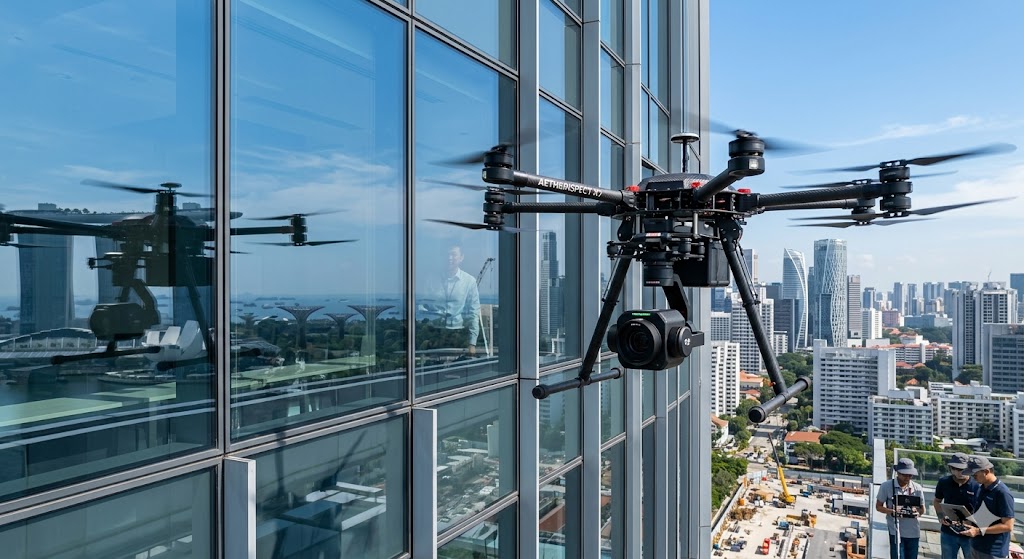
Traditional physical access methods utilizing heavy scaffolding or boom lifts are slow. Furthermore, these physical methods present significant, deadly safety hazards for inspection personnel. Consequently, remote access drone inspections are fundamentally revolutionizing the PSI methodology.18
Drones safely inspect difficult-to-access high-rise facades and highly confined building spaces.18 They rapidly eliminate the deadly risks associated with working at immense heights.19 Drones drastically accelerate the visual data capture phase of the entire inspection.
Advanced Drone Capabilities
Advanced industrial drones carry exceptionally high-resolution optical cameras onboard seamlessly. Furthermore, they deploy highly sophisticated infrared thermal scanners efficiently.18 Thermal scanning easily detects hidden water leakage and internal structural anomalies.18 It also effectively identifies invisible electrical faults and deteriorating building insulation.18
Regulatory Compliance and Cost Savings
Commercial drone operation in Singapore requires exceptionally strict regulatory compliance legally. Pilots must hold official operating permits from the Civil Aviation Authority Singapore.18 Furthermore, operators must possess Bizsafe 3 and WSQ Work-At-Height certifications.18
While professional drone deployment incurs a specialized service fee, it yields savings. Drone inspection is generally highly cost-effective compared to traditional physical methods.19 It completely eliminates the urgent need for extremely expensive daily boom lift rentals. It also circumvents the immense material costs of erecting physical exterior scaffolding entirely. Therefore, drones effectively optimize the overall BCA Periodic Structural Inspection cost.
Stage 2: Full Structural Investigation Approvals
When Stage 1 visual checks fail, Stage 2 becomes an absolute necessity. Stage 2 represents a massive financial escalation in both engineering complexity and cost. A Full Structural Investigation is highly intrusive and heavily analytical scientifically.5
BCA must officially grant explicit approval before this intensive investigation commences.5 The structural engineer submits a clearly defined scope of investigation for approval.5 This localized first investigation may eventually lead to a whole-building structural investigation.5
During Stage 2, the engineer probes deeply into the building’s material science. They utilize complex Non-Destructive Testing (NDT) to evaluate internal structural health accurately. Furthermore, they frequently perform exhaustive full structural calculations to verify load capacities.9
Stage 2 submissions involving full structural calculations cost significantly more money. These intensive engineering calculations add between S4,000 extra.9 This professional fee is added completely on top of the original baseline costs. Owners may legally engage a distinctly different structural engineer for Stage 2 operations.5 They must simply inform the BCA via a formal written notice promptly.5
The Financial Impact of Non-Destructive Testing (NDT)
When Stage 2 is triggered, NDT methodologies become financially critical for owners. NDT accurately allows engineers to diagnose internal concrete health without destroying it. Each specific testing methodology carries a highly distinct operational cost profile.
Rebound Hammer Testing Costs
The Rebound Hammer test is a fast, highly economical initial NDT method.20 It measures the physical elastic rebound of a mass from a concrete surface.20 This provides a rapid, quick estimate of surface hardness and compressive strength.20
Because the physical process is rapid, the cost per test point is low. Rebound hammer testing is incredibly cheap compared to complex core extractions.21 Therefore, test plans should include as many rebound hammer tests as financially possible.21 This maximizes data collection while aggressively minimizing the Stage 2 investigation budget.
Ultrasonic Pulse Velocity (UPV) Testing
UPV testing is far more sophisticated, scientifically complex, and considerably more expensive. It measures the exact velocity of ultrasonic pulses traveling through a concrete section.22 This highly accurate transit time helps identify dangerous hidden internal dis-homogeneities.22
It reliably locates dangerous micro-cracking, hidden voids, and severe internal delamination.22 UPV requires a highly specialized NDT technician to operate the complex analyzer.23 Reading complex UPV results on reinforced rebar requires immense professional expertise accurately.23
The Combined SONREB Method
Engineers frequently combine expensive UPV testing directly with the cheaper Rebound Hammer method.24 This highly effective combined diagnostic approach is known as the SONREB method.24
The dual approach mathematically cancels out individual testing errors effectively.24 For example, increased moisture increases UPV values but decreases rebound values predictably.24 Combining them vastly improves the ultimate accuracy of the estimated concrete strength.24 Engineers utilize complex spreadsheets to generate correlation curves from this combined data.24
Ground Penetrating Radar (GPR) Scanning Costs
Concrete scanning utilizing GPR technology is absolutely crucial for deep structural analysis. GPR reliably detects hidden steel reinforcements, post-tension cables, and buried electrical conduits.25 It accurately determines embedded rebar spacing and vital protective concrete cover depth.25
High-frequency GPR scanning provides immediate, real-time subsurface mapping for the investigating engineer.26 Deploying GPR requires specialized technical proficiency and incredibly expensive radar equipment.25 Therefore, GPR scanning significantly increases the specialized NDT cost Singapore parameters. However, this investment ensures highly accurate modeling of the building’s hidden structural skeleton.
Destructive Coring and Laboratory Analysis
Sometimes, non-destructive methods simply cannot provide sufficient forensic engineering certainty. In these rare, severe cases, physical concrete core extraction becomes absolutely mandatory.27
Engineers brutally extract a 100-mm diameter cylindrical core from the concrete structure.21 The extracted core undergoes brutal compressive, tensile, and flexural strength testing.27 Laboratories conduct deep chemical analyses of the hardened concrete matrix scientifically.27
They meticulously test for carbonation depth, chloride ion contamination, and aggressive water permeability.27 Coring is significantly more expensive than UPV or basic rebound hammer testing.21 Furthermore, it strictly requires subsequent structural patching to repair the extraction site.25 This destructive methodology represents the absolute highest tier of structural testing costs.
2026 Regulatory Evolutions: The Shophouse Pilot Project
The regulatory landscape governing Singapore’s structural inspections is constantly evolving and tightening. In May 2026, the BCA introduced a vital pilot project heavily impacting costs.
The Joint BCA-URA Collaboration
In May 2026, the BCA and the Urban Redevelopment Authority (URA) launched a collaboration.28 They officially initiated a 12-month joint pilot project targeting aging heritage shophouses.28 The pilot absolutely mandates a strict “usage declaration” during the Periodic Structural Inspection.28
The Grave Danger of Unauthorized Loading
Historic shophouses face immense structural vulnerabilities due to their extreme architectural age. Many shophouses possess incredibly narrow layouts and outdated, fragile structural timber rafters.29 Recently, numerous severe safety incidents have occurred within these delicate heritage properties.28
Rigorous investigations revealed these failures stem directly from the illegal use of internal spaces.28 Occupants frequently change light residential zones into heavy commercial or gym spaces.30 This unauthorized commercial use introduces massive, severe loading stresses onto fragile structures.28 The original historical structural framework simply cannot safely support these massive modern loads.
Financial Implications of the 2026 Pilot
The pilot project leverages the existing PSI regime for highly aggressive regulatory enforcement.28 The structural engineer must now systematically and strictly verify the building’s physical usage.28 They must carefully cross-reference observed activities against the URA’s approved Change of Use lodgments.30
If the engineer discovers an illegal commercial gym or office space, consequences follow. The owner is instantly forced to undertake incredibly expensive regularisation submissions.7 Regularisation of unauthorised structures costs between S20,000+ easily.7
Furthermore, if the original structure is compromised, massive structural strengthening is required.31 Consequently, heritage shophouse owners face dramatically higher financial risks during a 2026 PSI. This specific pilot drastically inflates the potential cost of structural inspection shophouse Singapore.
Connecting PSI with Periodic Facade Inspection (PFI)
Building owners must also navigate the parallel Periodic Facade Inspection (PFI) regime. Introduced in January 2022, PFI aims to detect deteriorating exterior facade materials early.3 This strictly protects innocent pedestrians from lethal falling building debris.3
PFI is legally mandatory for buildings exceeding 13 meters in total height.3 Furthermore, these buildings must be older than twenty years since their temporary occupation.3 Eligible buildings must undergo these highly specialized facade inspections once every seven years.3
The Extreme Cost of Facade Inspections
Facade inspections are incredibly expensive due to the massive physical access requirements. PFI costs vary widely depending on building height, architectural complexity, and geographical location.16
- Low-Rise Building (<5 Stories): Average cost is heavily estimated at S$10,000.16
- Mid-Rise Building (6–25 Stories): Average cost is heavily estimated at S$13,000.16
- Commercial/High-Rise (26–39 Stories): Average cost is heavily estimated at S$15,000.16
- Super High-Rise (>40 Stories): Average cost is heavily estimated at S$19,000.16
These massive costs include rigorous 100% visual inspections from distant vantage points.3 Furthermore, they mandate a 10% close-range, hands-on physical inspection of the facade.3 The inspector must physically check exterior elements for hollowness, severe corrosion, and looseness.3
Competent Persons and Facade Inspectors
PFI requires owners to appoint a legally defined “Competent Person” explicitly.3 This individual must be a registered Professional Engineer or a registered Architect.3 They may also appoint a certified Facade Inspector to assist them directly.3
If a building is simultaneously due for both PSI and PFI, coordination is vital. Smart owners align these inspections to share heavy equipment costs like boom lifts. This strategic alignment drastically optimizes the combined BCA Periodic Structural Inspection cost effectively.
Extreme Legal Consequences and Fines for Non-Compliance
Ignoring a BCA Periodic Structural Inspection notice is a disastrous, ruinous financial decision. The BCA enforces draconian, uncompromising penalties to guarantee absolute public safety compliance always. Non-compliance is officially classified as a severe criminal offense in modern Singapore.3
Devastating Financial Penalties for Building Owners
Registered building owners face immediate and truly devastating financial penalties for simple inaction.
- Maximum Initial Fine: The judicial courts can impose a massive S$20,000 fine.3
- Imprisonment: Owners may actively face imprisonment for a terrifying 12-month term.3
- Daily Accumulating Fines: The brutal punishment does not stop at the initial conviction. The court levies a crushing S$2,000 penalty for every single day the offense continues.3
Furthermore, unresolved structural issues can trigger severe, legally binding Remedial Orders rapidly. Ignoring a BCA Remedial Order carries a mind-boggling maximum fine of S2,500 per day.32 If the BCA issues a Stop Work Order, ignoring it incurs an unbelievable S$500,000 fine.32
Hidden Commercial Obstacles and Paralysis
Beyond the terrifying courtroom, non-compliance creates massive commercial and operational paralysis immediately.
- Insurance Voidance: Commercial insurers routinely decline coverage if a building’s PSI is legally overdue.4 They will fiercely and legally refuse to process any subsequent property damage claims.4
- Transaction Failures: Lucrative property transactions are instantly halted by outstanding BCA PSI notices. Buyers’ lawyers and retail banks diligently check the BCA PSI status thoroughly.4 Skipped inspections delay or permanently derail multi-million dollar property sales and corporate refinancing.4
Strict Tenant Fines and Occupier Obligations
Tenants absolutely cannot obstruct this vital engineering process to protect their daily business operations. The Building Control Act imposes incredibly strict access obligations on all building occupiers.3 Tenants are legally prohibited from blocking the owner or the appointed engineer completely.3
If a stubborn tenant refuses physical access for beyond eight days, penalties trigger instantly.3 The uncooperative tenant faces massive direct fines of up to S$1,000 daily.3 This continuous, painful daily fine ensures rapid compliance from obstructive retail or commercial tenants.
Severe Professional Penalties for Errant Engineers
The BCA also ruthlessly polices the structural engineering profession to maintain exceptionally high standards. The proper, diligent conduct of the PSI is essential for upholding public confidence fundamentally.33 The BCA issued highly specific 2026 circulars reminding engineers of their immense societal responsibilities.33
Structural engineers must actively allocate highly adequate time, personnel, and technological resources always.33 They are strictly ordered to price their inspection fees to reflect required professional rigour.33 Undercutting market fees and delivering substandard, rapid, negligent inspections is strictly, legally forbidden.
Engineers face similarly severe, career-ending penalties for any demonstrated professional negligence or laziness.3 An engineer failing their statutory duties faces a massive S$20,000 personal financial fine.3 Furthermore, fraudulent documentation, such as reusing old photographs, triggers immediate enforcement action.3 Delegating the inspection entirely to junior, unregistered staff is also strictly, legally forbidden.3
Actionable Strategies for Managing Inspection Costs
While the BCA Periodic Structural Inspection cost is mandatory, total expenses are highly manageable. Property owners can adopt highly proactive strategies to minimize their total financial exposure effectively.
Initially, owners must meticulously maintain a digital repository of as-built architectural structural plans. Providing these existing soft copies totally eliminates the engineer’s BCA PPS system purchase fees.2 This simple administrative step saves hundreds of dollars immediately before the inspection begins.
Furthermore, building owners should consolidate heavy access equipment requirements efficiently and strategically. If an expensive boom lift is required, schedule minor facade maintenance simultaneously. This highly intelligent dual-use strategy maximizes the return on the heavy S$2,500 daily rental investment.16
Additionally, trained property managers should act as the vigilant first line of defense.3 Routine daily maintenance dramatically reduces the likelihood of an expensive Stage 2 investigation. Patching minor concrete spalls early actively prevents highly aggressive internal rebar corrosion completely.32
This proactive maintenance halts ongoing corrosion and perfectly restores crucial structural cover.32 Consequently, it actively prevents the massive cost escalation associated with intrusive NDT coring. Applying chemical bonding agents ensures old and new materials adhere perfectly together.32
Finally, shophouse owners must aggressively audit their tenants’ usage declarations immediately in 2026. The May 2026 joint URA-BCA pilot project guarantees exceptionally strict regulatory scrutiny today.28 Ensuring tenants possess perfectly valid Change of Use lodgments prevents disastrous regularisation penalties later.30
Final Insights on Structural Integrity Investment
The BCA Periodic Structural Inspection is an absolutely uncompromising pillar of Singapore’s safety framework. The baseline professional engineer fee generally ranges reasonably from S8,000. However, this seemingly simple base figure masks the true economic complexity of the regime.
The final quoted cost is highly sensitive to building geometry, extreme age, and internal layout. Stringent regulations regarding false ceiling access massively drive up internal labor and tedious coordination costs. Meanwhile, accessing high-rise exterior facades necessitates incredibly expensive boom lifts or advanced UAV drone deployments.
If basic visual inspections uncover structural distress, costs multiply exponentially through Stage 2 investigations. Advanced non-destructive testing, such as GPR scanning and UPV analysis, demands highly specialized budgets. Furthermore, evolving regulatory shifts in 2026, particularly the shophouse usage declaration pilot, increase compliance burdens.
Ultimately, the cost of the structural inspection is negligible compared to the terrifying alternative. Non-compliance triggers catastrophic S$20,000 fines, prison terms, and continuous daily judicial court levies. Furthermore, outstanding notices completely paralyze property sales and instantly void commercial insurance policies.
Property owners must intelligently view the PSI not as a tax, but as a critical investment. Funding a deeply thorough structural inspection safeguards the valuable asset’s lifespan definitively. Most importantly, it completely protects the innocent public from the horrors of catastrophic structural disaster.
Works cited
- Periodic Structural Inspection (PSI) – Building and Construction Authority, accessed May 23, 2026, https://www1.bca.gov.sg/safety-and-standards/periodic-building-inspections/periodic-structural-inspection/
- BCA Periodic Structural Inspection (PSI), accessed May 23, 2026, https://structures.com.sg/bca-periodic-structural-inspection-psi/
- What is BCA Periodic Structural Inspection? A Beginner’s Guide, accessed May 23, 2026, https://structures.com.sg/bca-periodic-structural-inspection-a-beginners-guide/
- BCA Periodic Structural Inspection (PSI) Singapore Guide – CVC Engineers, accessed May 23, 2026, https://www.cvcengineers.com/post/bca-periodic-structural-inspection-singapore
- GUIDELINES FOR STRUCTURAL ENGINEERS, accessed May 23, 2026, https://isomer-user-content.by.gov.sg/338/7fefc1c0-6299-41fa-bf17-17c3a9896f1a/psi-guidelines-for-structural-engineers-(sep-2024).pdf
- Professional Engineer Singapore – Building Inspections Guide 2025 – Soteria, accessed May 23, 2026, https://www.soteria.sg/professional-engineer-singapore/
- PE Endorsement Singapore: When You Need One (2026 Guide) – CVC Engineers, accessed May 23, 2026, https://www.cvcengineers.com/post/pe-endorsement-in-singapore-when-you-need-one-what-it-costs-and-what-s-at-stake
- PE Endorsement Cost in Singapore | Pricing Guide 2025, accessed May 23, 2026, https://www.aectechnicalsg.com/how-much-does-pe-endorsement-cost-in-singapore/
- PE Endorsement Cost Singapore 2026 – CVC Engineers, accessed May 23, 2026, https://www.cvcengineers.com/post/pe-endorsement-cost-in-singapore-2026-transparent-pricing-for-civil-structural-submissions
- How Much Are Home Inspections in Singapore? A Complete Guide – A1 Inspection Singapore – BTO Defect Checking Condo Defect Inspection, accessed May 23, 2026, https://a1inspection.sg/how-much-are-home-inspections-in-singapore-a-complete-guide/
- BCA Guidelines for Periodic Structural Inspections | PDF – Scribd, accessed May 23, 2026, https://www.scribd.com/doc/207958067/Periodic-Structural-Inspection-of-Existing-Building
- Periodic Structural Inspection (PSI) for Industrial Buildings in Singapore: Regulations, Costs, and Smart Inspection Trends (2026 Edition), accessed May 23, 2026, https://structures.com.sg/periodic-structural-inspection-psi-for-industrial-buildings-in-singapore-regulations-costs-and-smart-inspection-trends-2026-edition/
- Scissor Lift Rental Singapore – A&G Equipment, accessed May 23, 2026, https://www.angequipment.com.sg/scissor-lift
- Scissors lift rental For Sale – Carousell Singapore, accessed May 23, 2026, https://www.carousell.sg/scissors-lift-rental/q/
- Ben’s Boom Lift Rental Singapore, accessed May 23, 2026, http://bensrental.sg/
- Facade Inspection Cost Calculator – GREENER AIR FACADE PTE LTD, accessed May 23, 2026, https://greenerair.sg/facade-inspection-cost-calculator/
- BATTERY OPERATED SCISSOR LIFT For Rent For Sale 98534404 – sgcctv, accessed May 23, 2026, https://sgcctv.com.sg/battery-operated-scissor-lift-for-rent/
- Drone Inspection – Lee Consultants, accessed May 23, 2026, https://www.leeconsultants.com.sg/services/drone-inspection/
- ABL’s Drone Inspection Services for Building Facade Singapore, accessed May 23, 2026, https://abl.com.sg/service/drone-inspection/
- The Ultimate Guide to Structural & Façade Inspections in Singapore: BCA Compliance, Certification, and Rectification for 2025, accessed May 23, 2026, https://structures.com.sg/structural-facade-inspections-singapore/
- Testing Plan for Estimating In Situ Concrete Strength | Practice Periodical on Structural Design and Construction | Vol 24, No 2 – ASCE Library, accessed May 23, 2026, https://ascelibrary.org/doi/10.1061/%28ASCE%29SC.1943-5576.0000410
- PULSONIC | Ultrasonic Pulse Analyzer – Controls, accessed May 23, 2026, https://controls-group.com/product/ultrasonic-pulse-analyzer/
- UPV Testing Services in Singapore – RVS Quality Certifications Pvt Ltd, accessed May 23, 2026, https://www.rvsglobe.com/singapore/upv-testing-services
- Concrete Compressive Strength Estimation with the SONREB Method, accessed May 23, 2026, https://www.screeningeagle.com/en/inspection/concrete-compressive-strength-estimation-with-the-sonreb-method
- CONCRETE SCANNING – ADVANCED RAPID GEOTECH SERVICES PTE LTD, accessed May 23, 2026, https://arges.com.sg/concrete-scanning.html
- How much does it cost for a ground penetrating radar? – Screening Eagle Technologies, accessed May 23, 2026, https://www.screeningeagle.com/en/academy/faq/how-much-does-ground-penetrating-radar-cost
- Materials testing and analysis | WSP Lab Testing, accessed May 23, 2026, https://www.wsp.com/en-nz/services/materials-testing-and-analysis
- Section 28 Building Control Act: Your Legal Obligations Summary – Stellar Structures, accessed May 23, 2026, https://structures.com.sg/section-28-building-control-act-your-legal-obligations-summary/
- Singapore Shophouse Renovation & URA Conservation Guide – Loren Ng Designs, accessed May 23, 2026, https://www.lorenngdesigns.com/blog/shophouse-styling—from-historic-charm-to-contemporary-comfort
- Revised Change of Use Lodgment Scheme for Shophouses, accessed May 23, 2026, https://www.ura.gov.sg/Corporate/Guidelines/Development-Control/DC-Connect/Revised-change-of-use-lodgment
- BCA Submission Service Singapore: 2026 Complete Guide – CVC Engineers, accessed May 23, 2026, https://www.cvcengineers.com/post/bca-submission-service-singapore-complete-guide
- BCA Periodic Structural Inspection PSI Cycle: Why BCA Requires 5 …, accessed May 23, 2026, https://structures.com.sg/bca-periodic-structural-inspection-psi-cycle-why-bca-requires-5-or-10-year-building-inspections/
Our ref : APPBCA-2026-02 02 Mar 2026 To: All Professional Engineers (Civil & Structural) and Industry Stakeholders REMINDER, accessed May 23, 2026, https://info.corenet.gov.sg/docs/default-source/bca-circulars/circular-on-reminder-on-proper-conduct-of-psi-and-expectations-of-structural-engineers_2march2026.pdf?sfvrsn=ad4bdb5e_1