





Planning permission in Singapore is defined as the formal written approval issued by the Urban Redevelopment Authority (URA) under the Planning Act before any development or material change of use on land or buildings may proceed. Without this approval, construction or conversion work is unauthorized and subject to enforcement action. The process involves digital platforms like GoBusiness Singapore and CORENET X, with fees starting at $500 for simple change-of-use applications and processing times ranging from 10 working days to 12 weeks depending on project complexity.
What is planning permission in singapore?
Planning permission is the URA’s mechanism for ensuring that all development aligns with Singapore’s Master Plan and long-term urban goals. It is not a building safety certificate. It is a land-use authorization that determines whether a proposed activity is permitted on a specific site. This distinction matters because developers who conflate planning permission with building plan approval routinely encounter scheduling failures and compliance gaps.
The Planning Act defines “development” broadly. It covers erecting new buildings, making additions or extensions, and carrying out any material change in the use of land or buildings. A retail unit converted to a restaurant, for example, requires planning approval even if no structural work is involved. The URA’s development control framework governs all such decisions.

Two types of written decisions exist under this framework. Provisional Permission (PP) is issued first, subject to conditions such as payment of the Land Betterment Charge and submission of additional documents. Written Permission (WP) is granted only after all PP conditions are fulfilled. Work cannot legally begin until WP is in hand.
Who needs planning permission for their project?
Any person or entity intending to carry out “development” as defined by the Planning Act requires planning approval from the URA. This applies to property owners, developers, tenants, and contractors alike.
Projects that require planning permission include:
- New buildings of any type, including residential, commercial, and industrial structures
- Extensions and additions that increase the Gross Floor Area (GFA) of an existing building
- Material change of use, such as converting an office to a food and beverage outlet, a warehouse to a showroom, or a shop to a medical clinic
- Subdivision of land into separate lots
- Erection of temporary structures beyond permitted thresholds
Minor internal renovations that do not alter GFA, structural elements, or the approved use of a space are generally exempt. Repainting walls, replacing flooring, or upgrading fixtures falls outside the definition of development. However, misunderstanding these exemptions is one of the most common causes of unnecessary applications and wasted fees.
Strata-titled properties carry an additional layer of requirement. Before the URA accepts a planning permission submission for a strata unit, the Management Corporation (MC) must provide a signed authorization letter. Skipping MC coordination is a documented cause of immediate application rejection. If you are purchasing or leasing a strata unit with the intention of changing its use, confirm MC consent before signing any agreement.
Pro Tip: Check the URA’s use-class definitions and exemption lists before submitting. Confirming that your works are genuinely exempt can save the $500 application fee and weeks of processing time.
How do you apply for planning permission in singapore?
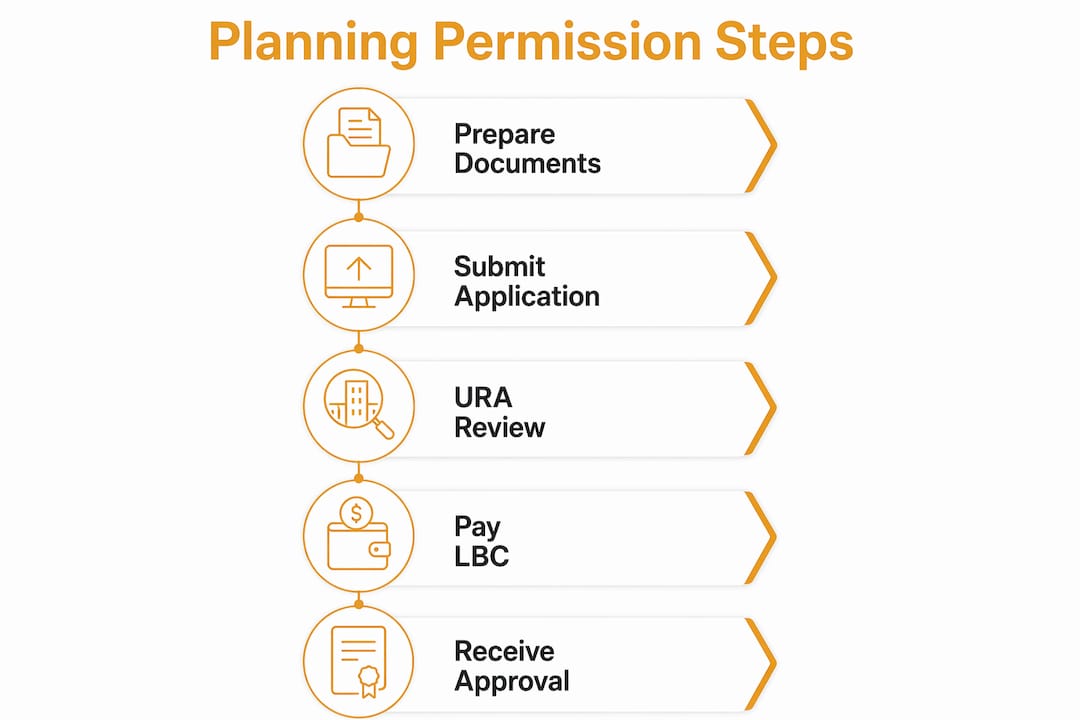
The application process follows a defined sequence, and understanding each stage reduces the risk of rejection or delay.
-
Determine the approval route. Simple change-of-use applications for commercial premises are submitted electronically via GoBusiness Singapore. Larger or structurally complex projects use the CORENET X platform, which became mandatory in 2024 for projects exceeding 30,000 m² GFA.
-
Prepare required documents. Typical submissions include a site plan, floor plans showing existing and proposed layouts, a description of the proposed use, and supporting technical reports where required. For strata properties, include the MC’s signed authorization letter.
-
Submit and pay the application fee. The standard processing fee for a simple change-of-use application is $500. Complex developments involving multiple agencies carry higher fees.
-
Receive Provisional Permission (PP). The URA issues PP with conditions attached. These conditions typically include payment of the Land Betterment Charge to the Singapore Land Authority (SLA) and submission of any required waivers.
-
Fulfill PP conditions. Address each condition within the stipulated timeframe. Incomplete or delayed responses extend the overall approval timeline significantly.
-
Receive Written Permission (WP). Once all conditions are met, the URA issues WP. Physical work may only commence after this stage.
-
Coordinate with other agencies. Projects reviewed through CORENET X involve concurrent input from BCA, NParks, LTA, SCDF, PUB, and NEA. The CORENET X platform enables these agencies to review submissions simultaneously rather than sequentially, reducing overall approval time by up to 20%.
Typical timelines vary by project type. Simple office renovations take 3–6 weeks. Complex food and beverage fitouts requiring multiple waivers take 6–12 weeks. Projects requiring full multi-agency review may extend further if documentation is incomplete.
Pro Tip: Engage a Qualified Person (QP), such as a registered architect or professional engineer, for any submission beyond a basic change of use. QPs understand agency-specific requirements and can pre-empt the most common causes of rejection.
How do costs and charges affect your application?
The financial obligations attached to planning permission extend well beyond the initial application fee. Understanding these costs before committing to a lease or purchase is critical.
Key cost components include:
- Application processing fee: $500 for a standard change-of-use submission via GoBusiness Singapore
- Land Betterment Charge (LBC): A levy collected by the Singapore Land Authority when planning permission increases the development potential or value of land. The LBC must be paid before the URA converts PP to WP.
- Professional fees: Costs for engaging architects, engineers, or planning consultants to prepare and submit the application
- Waiver application fees: Additional charges apply when requesting deviations from standard planning parameters
The LBC is the most significant and often the least anticipated cost. Its quantum depends on the type of development, the location of the land, and the extent of the uplift in use intensity. The SLA provides an LBC estimator tool that allows applicants to calculate an indicative charge before committing to a tenancy or acquisition. Failure to check this figure in advance has resulted in developers discovering six-figure liabilities after signing leases.
Non-payment of the LBC within the PP validity period results in the lapse of the Provisional Permission. The application must then be resubmitted, incurring additional fees and delays. Confirming current fee schedules directly with the URA and SLA websites before submission is the only reliable approach, as rates are subject to periodic revision.
Planning permission vs. building plan approval: key differences
Confusing planning permission with building plan approval is one of the most consequential mistakes in Singapore’s development process. These are separate approvals governed by different legislation and different agencies.
| Criteria | Planning Permission (URA) | Building Plan Approval (BCA) |
|---|---|---|
| Governing authority | Urban Redevelopment Authority | Building and Construction Authority |
| Legislation | Planning Act | Building Control Act |
| Focus | Land use and development intensity | Structural safety and technical compliance |
| Trigger | Any development or change of use | Any building works affecting structure or fire safety |
| Sequence | Must be obtained first | Follows planning permission |
| Output | Written Permission (WP) | Building Plan Approval |
Obtaining one does not guarantee the other. A project can receive URA planning permission but still fail BCA’s structural or fire safety review. Developers who schedule contractors based on planning approval alone, without accounting for building plan approval timelines, routinely face costly delays.
Common mistakes that compound this confusion include treating interior renovations as development-free when they affect structural elements, proceeding with work after PP without waiting for WP, and failing to verify whether a mezzanine floor addition increases GFA and therefore triggers both approvals. Reviewing building plan submission requirements before project planning begins prevents these errors.
Pro Tip: Always confirm with a QP whether your proposed works require both planning permission and building plan approval. Assuming only one is needed when both are required is a documented cause of enforcement action and project delays.
How to improve your chances of approval
Early preparation is the single most effective factor in reducing planning permission timelines. The following steps reflect current best practice for 2026 submissions.
- Consult the URA early. Pre-application consultations allow you to identify potential issues before formal submission. This is particularly valuable for projects involving non-standard uses or sites with planning restrictions.
- Use CORENET X for eligible projects. The platform’s concurrent multi-agency review capability reduces approval time by up to 20% compared to sequential submissions. Projects over 30,000 m² GFA must use it.
- Submit complete documentation on the first attempt. Incomplete applications are the leading cause of processing delays. Missing floor plans, absent MC authorization letters, or incorrect use classifications trigger requests for additional information that add weeks to the timeline.
- Identify and request waivers upfront. If your project requires deviations from standard parameters, submit waiver requests at the same time as the main application rather than waiting for PP conditions to flag them.
- Coordinate with the MC before submission for any strata-titled property. Obtain the signed authorization letter in advance and confirm the MC’s timeline for issuing it.
- Monitor application status actively. GoBusiness Singapore and CORENET X both provide real-time tracking. Responding promptly to agency queries prevents unnecessary hold periods.
For unauthorized works already carried out, the regularization process involves separate submissions and carries additional penalties. Addressing compliance proactively is always less costly than remediation after the fact.
Pro Tip: Monitor your application status at least twice per week during the review period. Agencies occasionally issue queries with short response windows, and a missed deadline can reset the review clock entirely.
Key takeaways
Planning permission in Singapore is a mandatory URA approval under the Planning Act that must be secured before any development or material change of use proceeds, with Written Permission granted only after all Provisional Permission conditions are fully met.
| Point | Details |
|---|---|
| Definition and authority | Planning permission is a URA-issued written approval required under the Planning Act before development begins. |
| PP before WP | Work cannot start until Written Permission is granted; Provisional Permission is only an interim conditional approval. |
| Separate from BCA approval | Planning permission and building plan approval are distinct; obtaining one does not satisfy the other. |
| LBC costs are significant | The Land Betterment Charge must be paid to SLA before WP is issued; use the SLA estimator before signing leases. |
| Digital platforms reduce delays | CORENET X enables concurrent agency review and reduces approval time by up to 20% for eligible projects. |
Why planning permission is more than a regulatory checkbox
From my experience working across residential, commercial, and industrial projects in Singapore, the most persistent problem I see is not ignorance of the planning permission requirement. Most developers know it exists. The problem is treating it as a single-step formality rather than a multi-stage regulatory process with real financial and scheduling consequences.
The LBC is the clearest example. I have seen tenants commit to leases on the assumption that a change-of-use application is a straightforward $500 exercise, only to discover a substantial LBC liability they had not budgeted for. The SLA estimator is publicly available and takes minutes to use. There is no excuse for skipping it.
The PP-to-WP distinction is equally misunderstood. Provisional Permission is not a green light. It is a conditional offer. Contractors who mobilize on the strength of PP alone are taking a compliance risk that can result in enforcement action and costly remediation. I would also push back on the assumption that digital platforms like CORENET X have eliminated coordination complexity. They have reduced it, but concurrent multi-agency review still requires thorough upfront preparation. Submitting an incomplete BIM model or missing agency-specific data into CORENET X does not accelerate review. It generates queries from seven agencies simultaneously.
The developers who move fastest through this process are the ones who engage qualified professionals early, check LBC exposure before signing anything, and treat each stage of the approval sequence as a distinct milestone with its own requirements.
— Aman
How stellar structures supports your planning approval process
Navigating URA submissions, multi-agency coordination, and LBC assessments requires technical depth that most property owners and developers do not have in-house. Stellar Structures provides civil and structural design checks that satisfy both URA and BCA requirements, reducing the risk of rejection at either stage. The firm’s authority submission team manages GoBusiness and CORENET X submissions across residential, commercial, and industrial projects, handling concurrent reviews with BCA, SCDF, LTA, PUB, NEA, and NParks. For commercial developments, the architectural design services are structured to align with URA planning parameters from the earliest design stage.
If you are planning a new build, extension, or change of use in Singapore, contact Stellar Structures for a consultation before committing to any lease or purchase agreement.
FAQ
What is planning permission in singapore?
Planning permission is a formal written approval issued by the Urban Redevelopment Authority under the Planning Act, required before any development or material change of use on land or buildings may proceed in Singapore.
How long does planning permission take in singapore?
Simple change-of-use applications processed via GoBusiness Singapore take approximately 10 working days. Complex projects involving multiple agencies take 6–12 weeks, depending on documentation completeness and waiver requirements.
What documents are needed for a planning permission application?
Typical documents include a site plan, existing and proposed floor plans, a description of the intended use, and for strata properties, a signed authorization letter from the Management Corporation. Complex projects submitted via CORENET X require IFC-compliant BIM models.
What is the difference between provisional permission and written permission?
Provisional Permission is a conditional approval issued by the URA with requirements such as LBC payment that must be fulfilled before work begins. Written Permission is the final approval granted once all PP conditions are satisfied, and it is the only authorization under which physical work may legally commence.
Does planning permission cover building safety compliance?
Planning permission covers land use and development intensity only, regulated by the URA under the Planning Act. Building safety compliance is governed separately by the Building and Construction Authority under the Building Control Act, and both approvals are required for most construction projects.
Recommended
- Mezzanine Floor Approval Guide Singapore 2026
- Design and build contracts: Singapore developer guide
- Singapore Marine Clay & Property Settlement: Guide for Homeowners (2025)
- Singapore A&A Works (2025): Essential Guide to Hiring a BCA-Certified Builder