




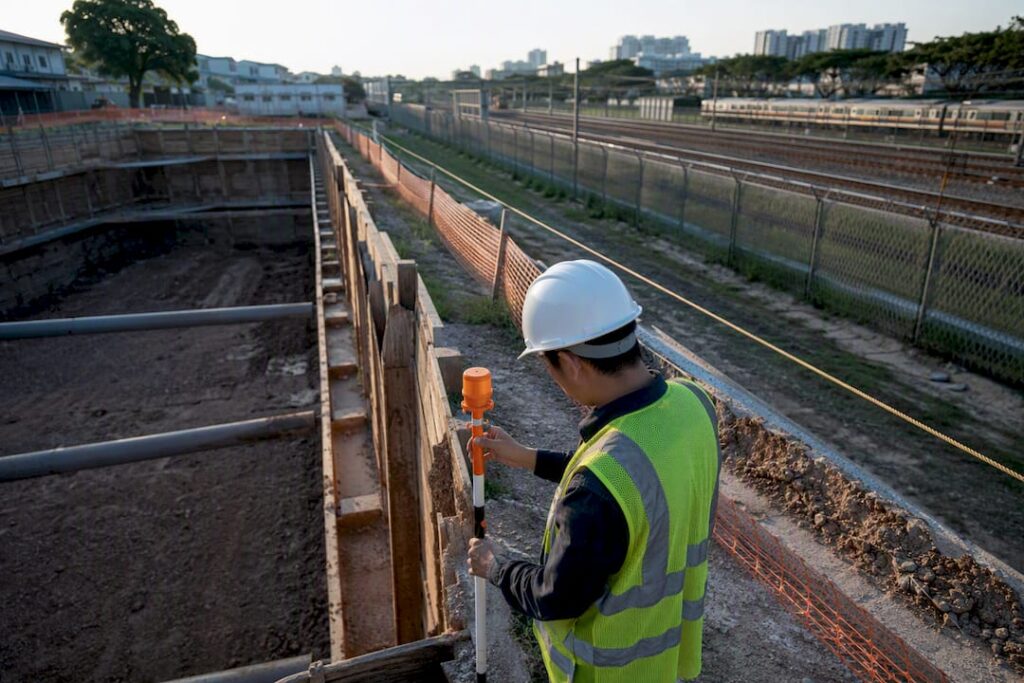
If your site lies within 40 meters of any part of a Rapid Transit System line, it sits inside a Railway Protection Zone (RPZ) and falls under the Land Transport Authority’s dual-permit regime. Before touching the ground, appoint a Qualified Person, verify your lot against the Railway Protection Plan, and secure development or restricted-activity approval before starting any works that could disturb the corridor. Skipping that sequence is the single most common cause of stop-work orders and redesign on affected projects.
TL;DR:
- Projects involving deep excavation, piling, or ground disturbance within 6 meters of the railway boundary require prior LTA approval, even if no building follows.
- Confirm lot boundaries against LTA’s cadastral maps and Railway Protection Plan, as errors can lead to costly delays or non-compliance.
- Submissions need separate permits for development approval and construction, with detailed engineering evaluations and live monitoring during works.
- Using low-vibration piling methods like auger or hydraulic press-in can facilitate faster approval processes within the first reserve.
- Early engagement with LTA, including pre-lodgement meetings and conservative monitoring thresholds, reduces delays and avoids stop-work orders.
Table of Contents
- What Are the Railway Protection Requirements for Building Near an MRT Line?
- Who Must Apply to LTA: Restricted Activities vs. Development Proposals
- What Documents Does LTA Require for a Railway Protection Submission?
- What Technical Limits Must a Design Meet Under the Railway Protection Code?
- Design Rules for Building Near the Railway: Setbacks, Piling, and Interfaces
- How Is Monitoring Conducted During Construction Near an RTS Structure?
- How Do You Check If Your Site Falls Within the Railway Protection Zone?
- Why Do LTA Railway Protection Submissions Get Delayed?
- Lessons From Authority Submissions Near MRT Protection Zones
- Why the Standard Advice on Railway Protection Falls Short
- Get Expert Support for Your LTA Railway Protection Submission
- Key LTA Documents to Reference for Your Submission
- Sources
- FAQ
What Are the Railway Protection Requirements for Building Near an MRT Line?
The RPZ is defined by law, not convention: it covers any land within 40 meters of a railway, measured from the nearest rail structure, tunnel, or viaduct, under the Rapid Transit Systems (Railway Protection, Restricted Activities) Regulations. That single figure decides whether your project needs LTA sign-off at all, which is why every feasibility study in Singapore should include an RPZ check before a design brief is finalized.
Within that 40-meter band, the Regulations and the accompanying Code of Practice for Railway Protection split the zone into tiers of control. The terminology matters because each tier carries different documentation and approval burdens:
- Railway corridor: the physical land occupied by the tracks, tunnels, viaducts, and associated RTS structures themselves.
- First reserve: generally the strip closest to the corridor, where restricted activities face the tightest controls and special permission requirements apply within 6 meters of the boundary
- Second and third reserves: the outer bands of the 40 meter zone, where activities are still regulated but with comparatively more design flexibility, provided movement and vibration limits are respected.
- Railway safety zone: the broader area shown on LTA’s mapping where the Authority assesses whether a proposed development could affect the structural or operational integrity of the RTS.
The first reserve deserves particular attention because it is where most enforcement action originates. Deep excavation, piling, or heavy plant operating inside this band without prior clearance can trigger a stop-work order regardless of whether the contractor believed the works were minor.
None of these terms should be estimated from a site plan or Google Maps. The only reliable source is LTA’s own mapping and the accompanying Railway Protection Plan FAQ, which shows cadastral lots against the current reserve lines. A registered land surveyor should confirm boundary distances against that plan before your architect commits to a massing study, because a few meters of error at concept stage can mean an entirely different consent pathway later.
Who Must Apply to LTA: Restricted Activities vs. Development Proposals
Not every job inside the RPZ needs the same paperwork, and misclassifying your works is one of the fastest ways to lose months on a program. The Regulations separate two distinct streams, and practitioners should treat them as genuinely separate regulatory tracks rather than interchangeable labels.
- Restricted activities are specific, listed operations that require prior written permission or a permit even when no formal development proposal is otherwise needed. Examples include piling, deep excavation, trenching close to the track, erecting temporary structures, blasting, tunneling, and heavy vibratory compaction. If your scope of works matches one of these listed activities and falls inside the RPZ, you need LTA clearance before mobilizing, independent of whether the works form part of a larger building project.
- Development or building proposal approval applies when the works constitute new construction, addition, or alteration to a building or structure within the RPZ, regardless of whether the specific construction methods are separately listed as restricted activities. This is a fuller submission, evaluated against the Code’s performance objectives for structural, operational, fire, and flood safety.
- Special permission within 6 meters of the railway boundary is a heightened category. Works this close to the corridor, even ordinary ones like fencing, minor excavation, or scaffold erection, typically require explicit special permission because the margin for error against track stability is minimal.
A common and costly mistake is assuming a job is a simple restricted-activity permission when it actually requires full development or building proposal approval plus a separate permit to commence engineering works. The two streams have different lead times, different document sets, and different LTA reviewers, so getting the classification wrong at the outset means resubmitting under the correct pathway later, often after months have already elapsed.
The consequences for skipping either pathway are not administrative slaps on the wrist. Under the Regulations, LTA can require immediate stoppage, remediation, or even enter the land to halt works it deems dangerous to the railway or to persons nearby. For a contractor mid-excavation, a stop-work order is not just a delay. It usually means demobilizing plant, securing an open excavation, and absorbing standing costs while a retroactive submission works its way through review, a materially worse position than simply sequencing the approval correctly from day one.
What Documents Does LTA Require for a Railway Protection Submission?
The submission pathway runs in two stages, and understanding what each stage actually approves prevents QPs from front loading documents that aren’t yet needed or, worse, omitting ones that are.
Stage one: development or building proposal approval. This is where LTA evaluates whether your proposed works, in principle, are compatible with railway safety objectives. It typically requires:
- A site plan and proposed development layout showing the works’ relationship to the RPZ boundaries and reserve lines.
- A preliminary engineering assessment addressing anticipated ground movement, loading, and vibration impact on nearby RTS structures.
- Certified survey plans from a registered surveyor confirming the exact setback distances from the railway.
- A method statement outlining construction sequencing, plant to be used, and temporary works philosophy.
Stage two: permit to commence engineering works. Once the development proposal is approved in principle, the QP must secure a separate permit before physically starting works that affect the protection zone. This second stage digs into execution detail:
- A full engineering evaluation report, often supported by finite-element or geotechnical modeling, demonstrating that predicted movement stays within the Code’s allowable limits.
- An instrumentation and monitoring proposal specifying instrument types, locations, monitoring frequency, and alert/action/suspension thresholds.
- Contingency and emergency response plans covering what happens if monitoring readings breach the agreed thresholds.
- A pre-condition survey report documenting the existing state of nearby RTS structures and surrounding buildings before works begin, which becomes the baseline for all subsequent monitoring comparisons.
- A construction schedule, where works fall within the railway corridor itself, coordinated with LTA’s own operational and maintenance windows.
- Endorsed LTA forms and checklists, including the RAIL-PERMIT application and the RAIL-S series (such as RAIL-S1 and RAIL-S4A/S4B), each of which must be signed and submitted through the LTA DBC submission channel.
The QP’s role does not end at submission. Once works commence, the QP is responsible for ongoing certification that construction proceeds in accordance with the approved method statement, for supervising instrumentation readings, and for notifying LTA promptly if thresholds are exceeded. This is a statutory obligation, not a courtesy, and LTA treats a QP’s certification as a direct professional representation that the site is being run as approved.
Pro Tip: Draft your instrumentation and monitoring proposal before finalizing your construction method statement, not after. LTA reviewers frequently ask for tighter monitoring where the proposed method carries higher ground-movement risk, and building that expectation into the method statement from the start avoids a full resubmission cycle.
For teams weighing which piling or excavation method to propose, the geotechnical modeling underpinning that engineering evaluation report often draws on tools like PLAXIS for assessing underground impact, particularly where ground conditions near the tunnel alignment are variable.
What Technical Limits Must a Design Meet Under the Railway Protection Code?
The Code of Practice organizes its technical requirements around five performance objectives, and every submission needs to show, item by item, how the design satisfies each one:
- Structural safety: the works must not compromise the load-bearing capacity or stability of RTS structures, whether at-grade, elevated, or underground.
- Operational safety: construction activity cannot interfere with train operations, signaling systems, or maintenance access.
- Fire safety: any interface with a station or tunnel structure must maintain the fire compartmentation and egress standards the RTS depends on.
- Flood protection: new works must not create a water ingress pathway into tunnels or underground stations, a requirement the Code treats as effectively non-negotiable given the consequences of flooding a live tunnel.
- Inspection and maintenance: the design must preserve LTA’s ability to access, inspect, and maintain its own structures after your project completes, including viaduct beams and expansion joints.
Two numbers anchor most engineering evaluation reports submitted under this Code. The first is the allowable movement and track distortion limit, referenced against tables in the Code that vary by structure type and proximity; the second is the construction vibration limit, set at 15 mm/sec peak particle velocity (PPV) at RTS structures. Any piling or excavation method proposed for use inside the first reserve needs a vibration prediction that demonstrably sits below that ceiling, backed by monitoring data from comparable ground conditions where possible.
Monitoring spacing is similarly prescriptive rather than left to engineering judgment. Where works fall within the predicted zone of influence of a tunnel, the Code requires monitoring points spaced no more than 3 meters apart, with a minimum of four points positioned around each tunnel ring to track ovalization and settlement in the round, not just along one axis. Station structures built from more massive elements typically use a wider spacing, but the underlying principle stays the same: instrumentation density scales with how sensitive the nearby structure is to movement.
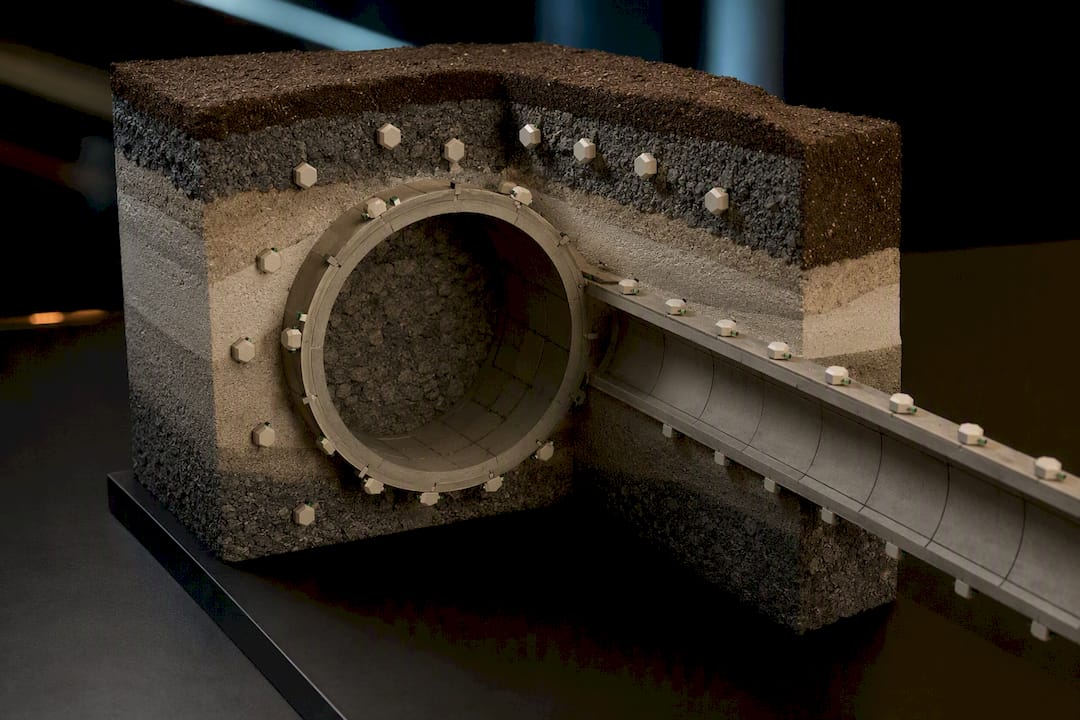
None of that monitoring data means anything without a credible baseline. A pre-condition survey, capturing crack patterns, existing settlement, and structural condition before works begin, is what lets the QP later distinguish between pre-existing conditions and movement actually caused by the new works. Skipping or rushing this survey is a recurring cause of disputes when a threshold is later breached and no one can agree on the starting point.
Flood protection deserves its own mention because it is frequently underestimated at design stage. Any basement, tunnel link, or underground structure built adjacent to an RTS tunnel or station must demonstrate watertightness that satisfies both LTA and PUB thresholds, since a water path from a new development into a live underground station is treated as one of the more severe failure modes the Code is written to prevent. Waterproofing detailing at construction joints and penetrations tends to receive close scrutiny during review for exactly this reason.
Design Rules for Building Near the Railway: Setbacks, Piling, and Interfaces
Above-ground structures near the RPZ generally need to observe a minimum clearance, commonly cited as 6 meters, from the railway boundary, or otherwise satisfy fire code separation requirements if that clearance can’t be achieved. This affects more than the building envelope. Facade openings, balconies, and even signage facing the corridor may need additional review if they reduce the effective separation distance or introduce fire spread risk toward RTS structures.
Inside the first reserve, piling and excavation face the tightest constraints, and the choice of construction method genuinely matters for approval speed. Low-vibration and low-disturbance techniques tend to move through review more smoothly than conventional impact piling:
- Auger piling, which displaces or removes soil with minimal impact energy transmitted to surrounding ground.
- Silent (hydraulic press-in) piling, which installs sheet piles or bored piles through static force rather than percussion.
- Oscillatory casing methods, useful in mixed ground where vibration control is critical near sensitive tunnel alignments.
- Reverse circulation drilling, which manages spoil removal with reduced ground disturbance compared to conventional rotary methods.
Where a building physically integrates with or sits adjacent to a station structure, the interface requirements go further than setback and vibration control. Fire barriers between the new development and station structures typically need to meet a 2-hour fire resistance rating where applicable, and the design must preserve dedicated space for LTA’s own maintenance access, including room for future viaduct beam replacement where the geometry demands it. These interface conditions are usually spelled out in the site-specific advisory LTA issues at development-proposal stage, and they commonly go beyond what the generic Code alone would suggest, which is why obtaining that lot-specific advisory early and pricing its extra design or monitoring conditions into your tender is worth the effort before committing to a construction budget.
Before any plant mobilizes, survey and demarcation of the RPZ boundary on site is a practical prerequisite, not paperwork. A certified surveyor should physically mark the reserve lines on the ground so that site supervisors, not just the drawings, know exactly where restricted-activity controls begin. For excavation-heavy projects near live lines, the practical realities of sequencing plant, shoring, and monitoring around a working railway are worth studying in more depth through examples of excavation works near MRT protection zones.
How Is Monitoring Conducted During Construction Near an RTS Structure?
LTA does not treat monitoring as a paperwork exercise completed once at submission. It expects a live instrumentation network running for the duration of works that could affect the RTS, with defined thresholds that trigger specific actions.
- Instrument selection typically includes settlement prisms on nearby structures, inclinometers to track subsurface lateral movement, load cells on temporary support systems, tunnel ring convergence gauges, and dedicated track monitoring points where works sit close to the running rails.
- Monitoring frequency and spacing follow the same principle used at design stage: tunnels within the predicted zone of influence are monitored at intervals of no more than 3 meters, while station structures built from massive elements are commonly monitored at spacing up to 5 meters in those heavier sections. Frequency typically increases as excavation or piling activity approaches the point closest to the structure being watched.
- Alert, action, and suspension levels are set against the allowable movement limits established in the engineering evaluation report. An alert-level reading prompts increased monitoring frequency and a review of the construction method; an action-level breach typically requires temporary works modification or slowed progress; a suspension-level breach means stopping the specific activity until the cause is understood and mitigated.
Reporting is where the QP’s statutory role becomes most visible. Monitoring data doesn’t just sit in a logbook. It feeds directly into work-suspension decisions, and the QP is expected to notify LTA when readings approach action or suspension thresholds, not just after a limit is actually breached. Reactive reporting, waiting until a threshold is crossed before flagging it, is a pattern LTA reviewers specifically watch for during audits of ongoing works.
Pro Tip: Set your internal action thresholds slightly more conservative than the Code’s stated limits, particularly during the first few weeks of excavation. Ground behavior near a working tunnel doesn’t always match the geotechnical model exactly, and a buffer gives your site team room to adjust the method before an actual Code limit is at risk of being breached.
How Do You Check If Your Site Falls Within the Railway Protection Zone?
Before committing to a design brief, request or download the current Railway Protection Plan and its explanatory notes from LTA’s resources. The plan overlays reserve lines directly onto cadastral lot boundaries, which is the only way to confirm with confidence whether a specific lot, not just a general area, falls within the RPZ.
Reading the plan correctly takes some care. Reserve lines are typically shown as distinct bands rather than a single boundary, and the mapping symbols distinguish between the railway corridor itself, the first reserve, and the outer reserve bands. If any part of the interpretation is ambiguous for your lot, particularly near tunnel alignments where the below-ground alignment doesn’t always track the surface corridor exactly, ask your registered land surveyor to confirm the setback distance against the plan rather than estimating it from the drawing alone.
Once a lot is confirmed to sit within an RPZ, a handful of early actions pay for themselves many times over later in the program:
- Brief your Qualified Person on the RPZ status before finalizing the architectural concept, not after.
- Factor the dual-permit timeline into your procurement schedule and tender documents from the outset.
- Consider a pre-lodgement meeting with LTA to flag unusual site conditions or construction methods before the formal submission is prepared.
- Build the cost of a pre-condition survey and instrumentation setup into early cost estimates rather than treating them as late additions.
Confirming lot status early consistently reduces rework, because verifying it before detailed design begins means the structural and geotechnical concept can be built around the real constraint from day one, rather than retrofitted around it after a submission gets flagged.
Why Do LTA Railway Protection Submissions Get Delayed?
Most delays trace back to a small, repeatable set of gaps, and almost all of them are avoidable with a disciplined pre-lodgement check.
- Missing certified survey plans. LTA needs surveyor-certified setback distances, not architect’s dimensioned drawings, and a submission lodged with the wrong document type is typically returned before substantive review even begins.
- Incomplete instrumentation or method statements. A method statement that names a piling technique without addressing predicted vibration against the 15 mm/sec PPV limit invites a query cycle rather than approval.
- Absent or generic contingency plans. A contingency plan that doesn’t specify who does what when a threshold is breached reads as boilerplate to reviewers who have seen the genuine article many times.
- Insufficient demonstration of compliance, particularly around movement and vibration limits, where the engineering evaluation asserts compliance without showing the calculation or modeling basis for that claim.
- Incomplete flood protection detailing, especially at construction joints and penetrations near underground RTS structures.
The practical mitigations are equally repeatable. Run every submission through an internal pre-lodgement validation checklist mapped directly against LTA’s own forms before it leaves your office. Consider a staged permit strategy, where lower-risk elements of a project apply for permission ahead of higher-risk excavation packages, so the program isn’t held hostage to the single hardest approval. Set your own monitoring thresholds a notch more conservative than the Code minimum, and where a design leans on an unconventional method or an alternative-solution approach, bring in third-party peer review before submission rather than after LTA raises the same question.
Pro Tip: Keep a running log of every LTA query received across past submissions, even from unrelated projects. Reviewers tend to focus on the same handful of technical gaps project after project, and a firm that tracks its own query history stops repeating the same avoidable mistake.
Lessons From Authority Submissions Near MRT Protection Zones
Working through LTA’s railway protection process repeatedly across different project types tends to surface the same sequencing pattern as the one that actually reduces review cycles: check the Railway Protection Plan before the design brief is locked, appoint the Qualified Person early enough that the preliminary engineering assessment shapes the concept rather than justifying it after the fact, complete a pre-lodgement conversation with LTA before formal submission, and only then move into phased permit applications matched to construction sequencing.
The projects that move through review with the fewest queries tend to share specific habits, not just good intentions. Certified survey plans are commissioned early, before the architectural concept is fixed, so setback constraints are known rather than assumed. Instrumentation proposals are written conservatively from the first draft, anticipating the kind of ground behavior LTA reviewers have seen go wrong elsewhere. Method statements are staged, addressing the highest-risk activity, typically piling or deep excavation closest to the corridor, in the greatest technical depth, rather than distributing equal detail across every work package regardless of actual risk. Contingency planning is treated as a genuine operational document, naming specific personnel and specific trigger actions, rather than a templated attachment.
None of this replaces the judgment of an experienced Professional Engineer working the submission, and site-specific advisories from LTA routinely introduce conditions beyond what the generic Code anticipates. Teams that treat the Code as a floor rather than a ceiling, and that price the extra design and monitoring effort into their proposals from the outset, are consistently the ones that avoid the costliest kind of delay: a stop-work order issued after mobilization.
Why the Standard Advice on Railway Protection Falls Short
Most guidance on this topic treats railway protection compliance as a documentation exercise, a checklist to complete once and file away. That framing misses the actual risk, which is timing, not paperwork. The regulatory content of a submission rarely changes much between projects of similar scope. What separates a smooth six-month approval from a stalled twelve-month one is almost always how early the Railway Protection Plan was checked and how early the Qualified Person was brought in relative to the architectural concept.
The industry also tends to underweight the site-specific advisory LTA issues at development-proposal stage. Firms price their tenders against the generic Code, then absorb unbudgeted redesign when LTA’s lot-specific conditions turn out to be stricter. That is not a failure of the Code. It is a failure to ask for the advisory before pricing the job.
If there’s one thing worth prioritizing above all else, it’s treating the 40 meter check as a go/no-go gate at feasibility stage, not a compliance step buried in the construction drawings phase. Everything downstream, permit sequencing, monitoring design, budget certainty, gets easier once that single question is answered early and correctly.
— Aman
Get Expert Support for Your LTA Railway Protection Submission
Railway protection submissions reward firms that have actually run the dual-permit process before, not just read about it. A specialist works through the full sequence for clients building near RTS lines: confirming Railway Protection Plan status, appointing or supporting the Qualified Person role, preparing certified survey plans, drafting engineering evaluation reports and instrumentation proposals, and assembling the endorsed LTA forms each stage requires (as applicable).
What that looks like in practice is a scoped engagement built around your project’s actual RPZ exposure, starting with an early lot check and preliminary engineering assessment, then moving into the detailed method statements, monitoring proposals, and contingency plans LTA expects before it issues a permit to commence engineering works. Clients typically get a clear document checklist up front, so nothing is discovered missing mid-review. If your site sits anywhere near an MRT line, the full range of authority submission services covers LTA alongside BCA, URA, and SCDF approvals your project may also need. Reach out through the authority submission services page to scope your railway protection submission before your design brief is finalized.
Key LTA Documents to Reference for Your Submission
Keep these on hand while preparing any RPZ submission, and always confirm you’re working from the current published version before finalizing your document set:
- Code of Practice for Railway Protection, for technical requirements, monitoring prescriptions, and allowable limits.
- The Handbook on Development & Building Works in Railway Protection Zone, for interpretive guidance and alternative-solution examples.
- The Railway Protection Plan FAQ, for confirming lot-specific RPZ status.
- The Rapid Transit Systems (Railway Protection, Restricted Activities) Regulations, for the statutory definitions and enforcement powers underlying every requirement above.
- LTA’s forms and checklists page, for the current RAIL-PERMIT and RAIL-S series forms.
Sources
- LTA | Requirements for Developments within Railway Protection and Road Structure Safety Zones
- Code of Practice for Railway Protection (LTA) — 2024 edition (PDF)
- Rapid Transit Systems (Railway Protection, Restricted Activities) Regulations — Singapore Statutes Online
- Railway Protection Plan FAQ (LTA PDF)
FAQ
What Is the Code of Practice for Railway Protection in Singapore?
It’s LTA’s technical document setting out submission procedures, performance objectives, and measurable limits, including the 15 mm/sec vibration threshold, that any development or restricted activity within the Railway Protection Zone must satisfy.
What Is Railway Protection?
Railway protection is the set of legal and technical controls that prevent nearby construction from compromising the structural, operational, fire, or flood safety of a Rapid Transit System, enforced through the Rapid Transit Systems (Railway Protection, Restricted Activities) Regulations.
What Is the Railway Protection Boundary for MRT Trains?
The Railway Protection Zone extends 40 meters from any part of the railway, with the area closest to the corridor, the first reserve, subject to the tightest controls and special permission required within 6 meters.
Which Part of Singapore Will the RTS Be Connected To?
The specific alignment and connecting station of any Rapid Transit System line is confirmed on LTA’s official project pages and the Railway Protection Plan, since alignments can extend or change as new lines are developed.
Do I Need a Qualified Person for a Railway Protection Submission?
Yes. LTA requires a Qualified Person to certify engineering evaluations, supervise monitoring, and prepare the documents behind both the development proposal approval and the permit to commence engineering works, and firms like Stellar Structures support clients through that role.
Recommended
- Engineer’s Checklist to Pass LTA for Street Works Permits in Singapore
- Temporary Traffic Diversions in Singapore: The Definitive LTA Compliance Guide
- Engineering Singapore’s MRT: Challenges Beneath The City
- What Commercial Landlords Need to Know About Excavation Works and Nearby MRT Protection Zones