





A Temporary Fire Permit lets you occupy premises before a full Fire Safety Certificate is issued, but only when fire safety works are essentially complete. Your Qualified Person submits the application through CORENET on your behalf, and the permit comes with conditions. Occupying without one, or breaching those conditions, is an offence under the Fire Safety Act.
TL;DR:
- A Temporary Fire Permit is only issued when fire safety works are almost complete, and occupancy without one is a legal offence.
- The application must be submitted by a registered architect or engineer through CORENET with complete documentation, including inspection certificates and product declarations.
- The permit typically lasts for a period set by SCDF based on project progress and must be accompanied by conditions such as maintaining access and completing minor works.
- Confusing a TFP with a Temporary Change of Use Permit can cause delays, as TCOUP applies for short-term event occupancy and goes through a different process.
- Proper coordination of inspections, sign-offs, and timely submission significantly improves the chances of a three-day approval cycle.
Table of Contents
- What Is a Temporary Fire Permit and How Does It Differ From an FSC?
- Who Applies for a TFP, and When Is It the Right Permit?
- Document Checklist for a TFP or FSC Application
- How to Submit a Temporary Fire Permit Application Through CORENET
- How Long Does a TFP Last, and What Conditions Come With It?
- TFP vs TCOUP: Avoiding the Confusion That Causes Delays
- What Practitioners See Go Wrong on TFP Applications
- How Stellar Structures Supports Your TFP or FSC Application
- Where to Verify TFP and FSC Requirements Directly
- Sources
- FAQ
What Is a Temporary Fire Permit and How Does It Differ From an FSC?
A Fire Safety Certificate (FSC) is the permanent clearance issued once every fire safety requirement for a building has been met in full. A Temporary Fire Permit (TFP) is the conditional, time-limited version of that clearance. The Singapore Civil Defence Force (SCDF) issues a TFP only when fire safety works have been satisfactorily completed and what remains outstanding is minor.
That distinction matters because SCDF will not issue a TFP for a building that is substantially incomplete on fire safety works. It exists to bridge the gap between “practically done” and “fully certified,” not to substitute for genuine construction progress.
The legal foundation sits in the Fire Safety Act 1993 and its subsidiary regulations, which give SCDF the authority to set permit conditions and penalize noncompliance. In practice, a TFP typically covers:
- Buildings awaiting final sign-off on minor fit-out items
- Premises where lift or accessway certification is pending final paperwork
- Projects where the bulk of fire protection systems have passed inspection
Who Applies for a TFP, and When Is It the Right Permit?
The application is not filed by the owner directly. A Qualified Person, either a registered architect or a professional engineer, submits the TFP application on the owner’s behalf. This differs from a Registered Inspector (RI), who conducts the technical fire safety inspections and issues the certificates the QP then bundles into the submission.
A TFP fits scenarios where:
- Fire safety works are largely finished, with only minor items like signage or documentation pending
- The owner needs to occupy the premises for business continuity before final FSC issuance
- Lift, accessway, or M&E certifications are in the final stages but not yet fully signed off
A TFP does not fit major structural alterations, incomplete fire protection systems, or events. If your need is short-term occupancy for an event or exhibition of up to 60 days, you want a Temporary Change of Use Permit (TCOUP), not a TFP. TCOUP applications run through GoBusiness rather than CORENET, and the two processes should not be confused.
Document Checklist for a TFP or FSC Application
SCDF’s own circular is blunt about this: incomplete documentation is the single biggest reason applications stall. Before your QP touches CORENET, gather the following:
- Completed TFP/FSC application form
- RI Inspection Certificates, Form 1 and Form 2, confirming the fire safety works inspection outcome
- Letter of appointment for the Registered Inspector
- The RI’s detailed inspection report
- FSC01: Certification for Fire Safety Works
- FSC02: Certification for Special Building Materials
- FSC03: Certification for Lift Installation and Operation
- FSC04: Certification for Fire Engine Access Road and Accessway
- Certificate of Conformity
- Declaration of Regulated Fire Safety Products
Each item has a different issuer. The RI signs off on Form 1/Form 2 and the general inspection report. Lift vendors provide the input behind FSC03. Contractors and material suppliers back the declarations tied to FSC02 and the Certificate of Conformity. Miss any one of these, and the SCDF circular makes clear the application simply sits, unprocessed, until it’s fixed.
Pro Tip: Build your document checklist the moment you appoint your RI, not the week before submission. Coordinating lift vendor sign-offs and RI certificates in parallel, rather than sequentially, is what separates a three-day approval from a three-week one.
How to Submit a Temporary Fire Permit Application Through CORENET
The mechanics are straightforward once your documentation is complete. Here’s the sequence your QP follows:
- Confirm completeness first. Verify every RI form, certification (FSC01 through FSC04), and the Certificate of Conformity are signed and dated before touching the portal. A submission missing even one form gets flagged, not fast-tracked.
- Submit via CORENET. The QP logs into the CORENET e-Submission system, completes the TFP/FSC application form, attaches all supporting documents, and files on the owner’s behalf.
- Monitor for SCDF’s response. SCDF states it will respond within 3 working days of a complete submission. If SCDF requests more information or rejects the application, the QP addresses the gap and resubmits rather than starting a fresh application.
That three-day window only applies to complete submissions. Incomplete ones don’t get a rejection notice in three days. They simply don’t move.
One practical note on communication: SCDF and other government agencies will never ask for bank details over the phone or through unofficial channels. Keep all correspondence about your application within CORENET or verified SCDF contact points to avoid impersonation scams that target property owners mid-application.
How Long Does a TFP Last, and What Conditions Come With It?
Validity varies by project size, complexity, and the nature of the outstanding work. There’s no single fixed duration; SCDF calibrates the permit period to how much is genuinely left to close out.
What stays consistent across almost every TFP are the conditions attached to it:
- A firm deadline to complete and certify the outstanding minor works
- A requirement to maintain fire engine access and clear accessways throughout the permit period
- Ongoing maintenance obligations for any declared regulated fire safety products
- A stipulation that the permit converts to, or is replaced by, a full FSC once remaining items close out
Breaching any of these conditions, or occupying a building without a valid TFP or FSC at all, is an offence under the Fire Safety Act. SCDF retains inspection and enforcement powers throughout the permit period, and a TFP is not a shield against those powers. It’s a conditional grant, not blanket cover.
TFP vs TCOUP: Avoiding the Confusion That Causes Delays
The two permits solve different problems, and mixing them up is one of the most common (and costly) mistakes property teams make. A TFP addresses a building’s ongoing path toward full fire safety certification. TCOUP addresses a temporary change in how a space is used, usually for an event lasting no more than 60 days, with its own set of fire safety conditions covering things like tentage layouts, exit passage widths, and extinguisher spacing. TCOUP applications go through GoBusiness and carry a non-refundable fee, separate entirely from the CORENET-based TFP/FSC process.
Beyond that core confusion, a handful of recurring pitfalls account for most rejected or delayed TFP applications:
- Incomplete or unsigned RI Inspection Certificates
- Missing lift or accessway certification (FSC03/FSC04) submitted late or omitted entirely
- Engaging a Registered Inspector too late in the construction timeline
- Assuming a TFP covers scope it doesn’t, such as major structural work still in progress
Pro Tip: If you’re unsure whether your situation calls for a TFP or a TCOUP, contact SCDF directly before submitting anything. A misfiled application wastes the three-day review window and pushes your actual timeline back further than if you’d asked first.
What Practitioners See Go Wrong on TFP Applications
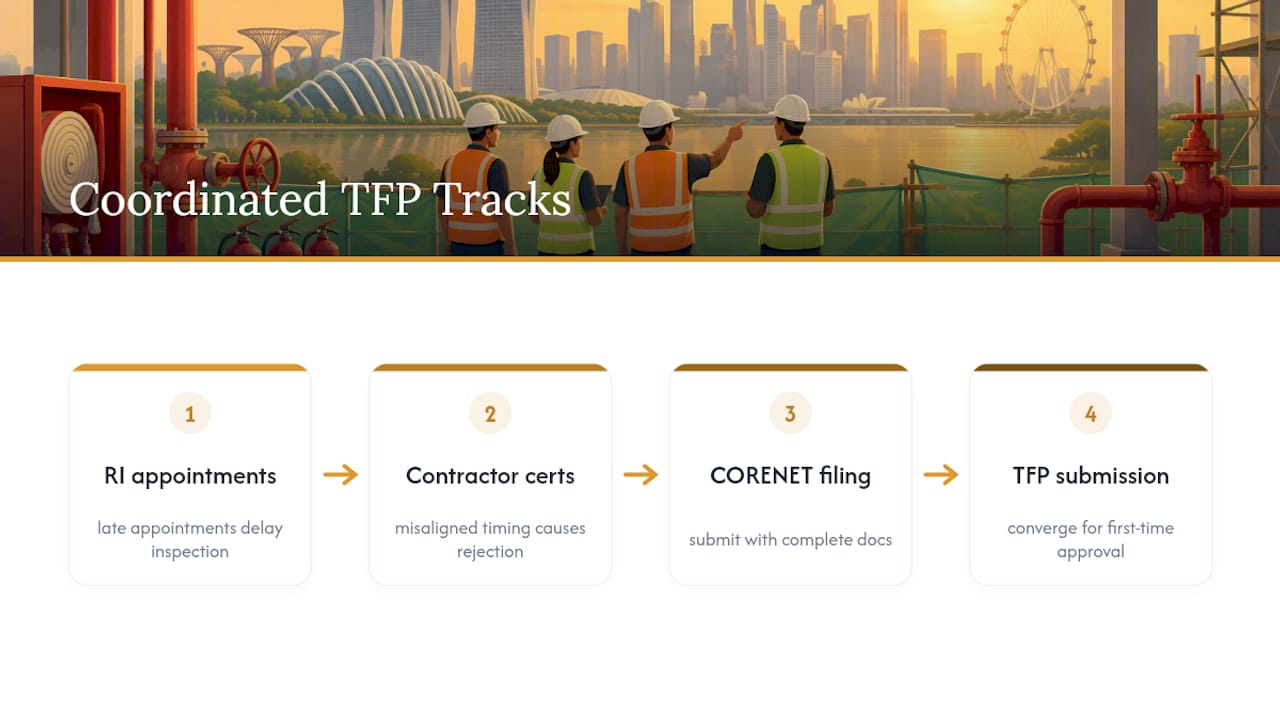
Most TFP delays we encounter trace back to the same handful of root causes: documentation gaps that surface only after submission, RIs appointed too late to complete inspections on schedule, and poor coordination between M&E contractors and lift vendors on certification timing. None of these are regulatory ambiguities. They’re project management failures that show up as regulatory rejections.
A multidisciplinary firm earns its keep here by running RI appointments, contractor certifications, and CORENET filing as one coordinated workflow instead of three separate tracks that only meet at the deadline. When those tracks are managed together from the start, the paperwork tends to arrive complete the first time, which is the single biggest lever for an on-time approval. Coordinating fire safety engineering alongside Registered Inspector services reflects how these workflows fit together in practice.
How Stellar Structures Supports Your TFP or FSC Application
If you’re weighing whether to coordinate a TFP application in house or bring in help, the practical difference usually comes down to how many moving parts you’re tracking at once, RI schedules, lift vendor sign-offs, CORENET deadlines, and how much margin you have for a rejected first attempt. A multidisciplinary firm may handle SCDF and FSSD submissions, coordinate Registered Inspectors, and facilitate M&E and lift certification steps that often affect filing timelines.
Experienced teams can work alongside your Qualified Person to prepare a complete document package before it reaches CORENET, reducing the back-and-forth that can extend occupancy timelines. This includes managing the FSC01 through FSC04 certifications, chasing lift vendor paperwork, and keeping the RI inspection report aligned with what SCDF expects to see. Keep in mind that statutory responsibility for the submission stays with the owner and QP regardless of who assists; our role is to make sure the package they sign off on is complete the first time. If you’re preparing a submission now, you can request a submission review through our authority approvals services and get a clear read on what’s missing before you file.
Where to Verify TFP and FSC Requirements Directly
For the most current rules, go straight to the source rather than relying on secondhand summaries. SCDF’s Fire Safety Certificate and Temporary Fire Permit page covers prerequisites and processing times. The TFP/FSC circular lists every required form in detail. For events, check GoBusiness directly rather than assuming TCOUP and TFP rules overlap.
FAQ
How much does it cost to apply for a Temporary Change of Use Permit?
TCOUP applications through GoBusiness carry a non-refundable fee, commonly cited around $60, separate from any TFP or FSC costs. Check GoBusiness directly for the current fee schedule before applying, since amounts can change.
How do I apply for a Temporary Change of Use Permit?
You apply through GoBusiness, not CORENET, since TCOUP covers temporary event use rather than ongoing building occupancy. The application requires details on event duration (typically capped at 60 days) and compliance with SCDF’s specific fire safety conditions for the venue type.
How much does a fire safety certificate cost in Singapore?
SCDF does not publish a flat FSC fee since costs depend on project scope, the RI’s inspection fees, and any outstanding works needing remediation. Stellar Structures can provide a quotation for coordinating your FSC or TFP submission once your project scope is reviewed through our authority submission services.
Where can I get a fire certificate?
Fire Safety Certificates and Temporary Fire Permits are both issued by SCDF after your Qualified Person submits the application through CORENET with all required RI certifications attached. There is no separate physical office visit required since the process is fully electronic.
Can I occupy my building while waiting for FSC approval?
Only with a valid Temporary Fire Permit in hand. Occupying premises without either an FSC or an active TFP is an offence under the Fire Safety Act, regardless of how close the fire safety works are to completion.
Recommended
- Singapore Fire Safety Certificate Requirements For Building Owners
- What Drives Fire Safety Compliance In Singapore Building Projects
- Shophouse Renovation Fire Safety Guide: 2025 Singapore Fire Fighting Compliance
- Ensuring Fire Safety Compliance For Commercial Premises Through SCDF Regulations And Guidelines