




SEO Metadata Profile
SEO Element | Optimized Content |
Strong SEO Title | The Difference Between a Mezzanine and an Equipment Platform |
Focus Keyphrase | Difference between a mezzanine and an equipment platform |
Meta Description | Discover the difference between a mezzanine and an equipment platform. Learn how this impacts your building permit submission, taxes, and safety. |
Primary Tags | Industrial Mezzanine, Equipment Platform, Building Permit Submission |
Secondary Tags | IBC 505, OSHA Safety, Section 179 Depreciation, High Intent SEO |
Introduction to Elevated Industrial Structures
The difference between a mezzanine and an equipment platform is critical. Facility managers frequently confuse these two distinct elevated structures.1 However, precise language dictates your entire building permit submission process.1 Consequently, using incorrect terminology triggers costly administrative delays.2 Furthermore, incorrect structural classification drastically impacts your corporate property taxes.4 Additionally, classification dictates strict adherence to specific workplace safety regulations.6 Therefore, understanding this vital distinction is absolutely paramount for success.
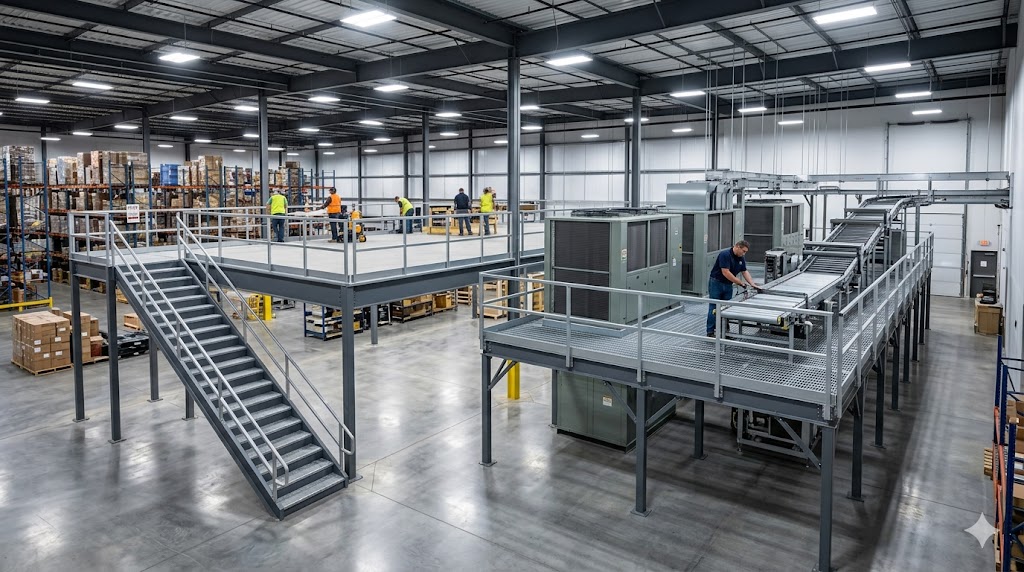
A mezzanine operates as a permanent intermediate level, and while the words mezzanine and equipment platform are sometimes used interchangeably, a mezzanine is integrated into the building’s physical structure, unlike an equipment platform, which is treated differently for code and tax purposes.2 Conversely, an equipment platform acts as a freestanding equipment piece that is often chosen for servicing machinery rather than storing equipment, a distinction that matters in industrial and commercial settings and often makes the approval path more cost effective.2 Ultimately, this singular difference dictates immense regulatory and financial compliance.6 Therefore, this exhaustive report explores every technical facet of these structures. Subsequently, it details how classification heavily affects your building permit submission.
International Building Code Definitions
Building codes strictly govern the design of these elevated structures. Specifically, the International Building Code regulates their safe construction.7 Therefore, total compliance with the IBC is absolutely mandatory everywhere.
Mezzanine Classification Rules
The IBC defines a mezzanine explicitly in Section 505.2.2 Specifically, a mezzanine is an occupied, permanent intermediate level within a room intended for long-term personnel use.9 Furthermore, it is officially considered a permanent building story portion that becomes part of the floor area, physical structure, and building’s physical structure, so it is not easily movable after installation.2 Consequently, it directly impacts the facility’s building’s structure continuously.
Moreover, mezzanines face incredibly strict architectural size limitations universally. Generally, a mezzanine can cover up to 1/3 of the floor space below, counts toward square footage, and serves as a permanent expansion of additional floor space rather than an elevated storage area used only for storage space.8 However, specific code exceptions exist for fully sprinkler-equipped buildings.11 Specifically, Type I and II buildings permit larger internal mezzanines.11 In these specific scenarios, the limit increases to one-half of the overall floor space.11 Mezzanines must still meet strict building code requirements, including a typical minimum of 7 feet above and below. Therefore, existing fire protection systems directly influence permitted mezzanine footprints and may contribute to a higher assessed value.
Equipment Platform Classification Rules for Mechanical Systems
Conversely, equipment platforms strictly follow IBC Section 505.3 guidelines.2 An equipment platform is an unoccupied, uniquely elevated structure designed to provide access to equipment for servicing machinery and mechanical systems.1 Specifically, it exists exclusively to support industrial machinery or systems.2 Additionally, the code does not consider it a floor portion.2
Furthermore, equipment platforms never contribute to the building’s overall building area.10 They also do not increase the official number of stories.2 As a result, structural size limitations are vastly more forgiving. Specifically, this elevated platform is used in industrial settings to provide access for maintenance of industrial equipment rather than occupied use, and it can cover two-thirds of the floor.10 Therefore, platforms offer vastly superior spatial optimization for heavy machinery.1
Regulatory Feature | Industrial Mezzanine | Equipment Platform |
|---|---|---|
IBC Governing Section | IBC Section 505.2 10 | IBC Section 505.3 / 505.5 10 |
Structural Permanence | Permanent physical building structure 10 | Freestanding piece of equipment 1 |
Maximum Size Limitation | Up to 1/3 of floor space below 10 | Up to 2/3 of floor space below 10 |
Building Story Contribution | Considered a portion of the story 2 | Does not contribute to story count 10 |
The Ohio Board of Building Standards Analysis
State agencies frequently clarify these complex building code distinctions. Specifically, the Ohio Board of Building Standards issued a memo.10 This critical document clarified building service equipment platform definitions.13 Previously, some departments incorrectly applied mezzanine rules to these platforms.13 Therefore, the state board intervened to eliminate costly regulatory confusion.13
An equipment platform must strictly remain an unoccupied space.13 Furthermore, it exclusively supports building service equipment like HVAC units.13 Personnel only access these specific areas occasionally for routine maintenance.13 Thus, they are never considered occupiable or habitable workspaces.13 Even spaces used exclusively for storage fail habitable workspace definitions.13 Therefore, limited activity distinguishes equipment platforms from standard occupied mezzanines.13
Fire Area Calculations and Safety
Fire safety regulations represent a major architectural design divergence. Consequently, the difference between a mezzanine and an equipment platform matters.
Mezzanine Fire Area Implications
Mezzanines are explicitly included in a building’s fire area calculation because they count as part of the building’s floor area and overall square footage.10 Therefore, adding a permanent mezzanine increases the total fire loading.9 Consequently, this structural addition frequently triggers complex automatic sprinkler requirements.2 Furthermore, municipal building inspectors heavily scrutinize these specific fire calculations.14 Ultimately, increased fire areas elevate overall construction and compliance costs.10
Equipment Platform Fire Exemption
In stark contrast, equipment platforms escape fire area calculations entirely.10 This provides a massive, incredibly lucrative regulatory construction advantage.14 Because they remain unoccupied, they do not increase life-safety risks.9 Therefore, installing an equipment platform cleverly bypasses strict fire mandates.4 Consequently, facility managers vastly prefer platforms for machinery storage solutions.4
NFPA 13 Automatic Sprinkler Systems
However, automatic sprinkler requirements heavily depend on installed floor materials. Specifically, National Fire Protection Association rules regulate sprinkler water density.17
Solid mezzanine decks physically shield fires from overhead ceiling sprinklers.19 Therefore, sprinklers are absolutely required underneath all solid mezzanine floors.19 Conversely, grated industrial platforms might initially seem exempt from sprinklers. However, grated metal floors severely obstruct ceiling sprinkler water distribution.19 Furthermore, spilled materials on grated floors further block water flow.19
Consequently, NFPA 13 mandates sprinkler protection beneath grated platforms universally.19 FM Global conducted extensive, highly controlled fire testing regarding this.19 Indeed, stored paper ignited violently beneath a standard grated catwalk.19 Consequently, overhead ceiling sprinklers failed to control the blaze effectively.19 Therefore, slatted floors must be treated cautiously during fire designs.20
Means of Egress and Evacuation Standards
Life-safety egress constitutes another highly regulated, complex construction domain. The difference between a mezzanine and an equipment platform dictates egress.
Strict Mezzanine Egress Mandates
Mezzanines must possess a dedicated, highly safe means of egress.10 Specifically, mezzanines require permanent, fully code-compliant structural stairways always.2 Furthermore, if occupant loads exceed 49 people, two exits apply.2 Moreover, IBC regulations strictly prohibit ships ladders for mezzanine egress.2 Likewise, permanent vertical ladders cannot legally serve as mezzanine exits.2 Therefore, significant warehouse floor space is consumed by mandatory stairwells.
Relaxed Platform Access Provisions
Conversely, equipment platforms cannot legally serve as building egress components.10 Because they are unoccupied, life-safety evacuation rules are vastly relaxed.2 Therefore, platforms freely permit diverse, highly efficient space-saving access solutions that provide access with easy access and safe access for workers. Specifically, workers may legally access platforms utilizing alternating tread devices, which provide efficient access to equipment and mechanical systems for maintenance tasks.2 Furthermore, permanent vertical ladders are perfectly acceptable for platform access.4 Elevated walkways may also be used in industrial work platforms to provide safe and efficient access. Consequently, equipment platforms preserve incredibly valuable warehouse floor space efficiently.
Egress Compliance Feature | Mezzanine Code Requirement | Equipment Platform Code Allowance |
|---|---|---|
Means of Egress Status | Mandatory building egress component 10 | Cannot be part of egress 10 |
Stairway Requirements | Required, strictly dimensioned stairs 2 | Optional, vastly less strict 4 |
Ships Ladders Usage | Strictly prohibited for egress 2 | Perfectly allowed for access 2 |
Vertical Ladders Usage | Strictly prohibited for egress 2 | Perfectly allowed for access 2 |
Occupancy Classifications Under the Building Code
Understanding various occupancy classifications is crucial for all facility managers. The IBC assigns unique classifications based on the building’s usage.21
For instance, Group A designates buildings utilized for public assembly.22 Group B covers standard business and professional office space environments.22 Furthermore, Group E designates properties used strictly for educational purposes.22 Group F applies broadly to factory and industrial manufacturing facilities.22 Additionally, Group H covers incredibly dangerous, high-hazard material storage sites.22
Moreover, Group I designates institutional facilities like hospitals or prisons.22 Group M covers mercantile retail stores displaying goods for sale.22 Group R designates residential living structures like apartments or hotels.22 Finally, Group S specifically covers massive industrial warehouse storage facilities.22
Crucially, an internal mezzanine inherits the classification of its room.21 However, equipment platforms avoid this classification because they hold machinery.13 Therefore, classification dictates every single building permit submission detail perfectly.
OSHA Fall Protection and Workplace Safety
Regardless of classification, severe fall protection protocols remain absolutely critical. The Occupational Safety and Health Administration enforces extremely strict standards.7
OSHA Walking-Working Surfaces Directives
Specifically, OSHA standard 1910.28 heavily governs all walking-working surfaces.24 OSHA also requires walking-working surfaces and platforms to support at least four times their maximum intended load as part of basic safety measures. Therefore, any unprotected edge four feet high creates fall hazards and requires immediate protection.6 Consequently, employers must physically install robust guardrail systems on edges.24 Failure to comply triggers massive, incredibly punitive financial safety fines.24
Detailed Guardrail Criteria
Furthermore, OSHA standard 1910.29 outlines exact, unyielding guardrail physical specifications.24 The top edge of any guardrail must measure 42 inches.24 Additionally, a small variance of three inches is legally permitted.24 Moreover, this top rail must physically withstand 200 pounds of force.24 Specifically, it must resist force applied downward or outward directionally.24 Common safety features on elevated work platforms also include anti-slip surfaces to reduce fall hazards in industrial settings.24
Mid-rails are also strictly mandated for optimal worker fall safety. Furthermore, these mid-rails must structurally withstand 150 pounds of force.25 Therefore, utilizing an experienced safety vendor ensures total OSHA compliance.25
Falling Object Protection Mandates
Additionally, workers beneath the platform require continuous overhead impact protection.6 Consequently, OSHA absolutely requires toe boards to intercept dangerous falling objects.24 Specifically, these toeboards must feature a 3.5-inch minimum vertical height.6 Furthermore, the installed toeboard must withstand 50 pounds of force.24 Therefore, highly compliant toeboards remain universally vital for warehouse safety.
Americans with Disabilities Act Accessibility
Accessibility regulations differentiate these two elevated structures quite significantly indeed. The difference between a mezzanine and an equipment platform determines ADA.4
ADA Rules for Standard Mezzanines
Mezzanines are legally considered occupied workspaces for standard human employees. Therefore, broad ADA accessibility guidelines generally apply to them universally.4 Specifically, mezzanines exceeding 300 square feet typically require wheelchair access.4 Consequently, building owners must install ADA-compliant ramps or elevators to meet handicap accessibility requirements for occupied mezzanines.4 This can add additional construction costs and increase spatial requirements.
ADA Exemptions for Equipment Platforms
Conversely, equipment platforms are beautifully exempt from these strict requirements.4 The IBC explicitly prohibits utilizing wheelchair lifts for platform egress.4 Specifically, IBC Section 505.5 fiercely forbids elevators as platform components.4 Furthermore, spaces used exclusively for equipment service are entirely exempt.26 Therefore, equipment platforms brilliantly avoid massive elevator installation capital expenses.
California Title 24 Building Regulations
California enforces uniquely strict accessibility rules under Title 24 codes. Specifically, Section 11B-410 dictates precise landing sizes for platform lifts.28 Elevators require a sixty by sixty inch physical landing space.28 Furthermore, signs must explicitly forbid using lifts for freight transport.28 Consequently, navigating California building codes requires exceptionally meticulous architectural planning.
Structural Load and Engineering Calculations
Structural calculations form the bedrock of your building permit submission. Therefore, incredibly meticulous structural engineering is universally and legally required.29
Defining Dead Loads and Live Loads
Engineers meticulously calculate two primary and distinct structural load types. First, dead load includes the self-weight of the steel framing.29 Additionally, any fixed, permanently attached machinery contributes to dead loads.30 Second, live load encompasses highly variable weights like human traffic.29
Standard live loads vary drastically based on intended structure usage. Specifically, light-duty commercial storage requires 125 pounds per square foot.29 Medium-duty industrial platforms require 150 PSF for palletized inventory items.31 Furthermore, heavy-duty robotic machinery platforms require 200 PSF or greater.31 Depending on the supported industrial equipment and layout, industrial work platforms may be freestanding platforms or rack supported platforms. Therefore, precisely accurate load assumptions permanently prevent dangerous floor deflection.31
Seismic Design and Nonbuilding Structures
Earthquake engineering represents an incredibly highly complex municipal permit requirement. Consequently, ASCE 7 dictates minimum design loads for all structures.33
ASCE 7 Classification Guidelines
Mezzanines and platforms interact dynamically with the primary building’s frame. Specifically, ASCE 7 Chapter 15 thoroughly addresses specialized nonbuilding structures.33 An equipment platform is universally categorized as a nonbuilding structure.36
Therefore, a critical weight threshold mathematically dictates the seismic model. If the platform weighs under 25 percent, calculations are simpler.33 However, exceeding this 25 percent threshold dramatically alters the response.33 Consequently, heavy equipment platforms require advanced structural seismic separation strategies.36
Seismic Code Element | Description | Governing Standard |
Nonbuilding Structure | Structures carrying equipment, not human occupancy. | ASCE 7 Chapter 15 33 |
Low Weight Threshold | Platform weight is under 25% of total. | ASCE 7 Section 15.3 33 |
High Weight Threshold | Platform weight is over 25% of total. | ASCE 7 Section 15.3 33 |
Seismic Separation | Detaching columns from primary building frame. | ASCE 7 Guidelines 36 |
Material Selection: Structural versus Cold-Formed Steel
Material choices fundamentally impact structural strength and total project budgets. Generally, commercial builders utilize either structural steel or cold-formed steel.37
Structural Steel Characteristics
Manufacturers uniquely shape structural steel via an intense hot-rolling process.37 Consequently, this incredible heat creates incredibly dense, highly rigid beams.38 Therefore, hot-rolled steel supports massive load-bearing industrial applications effortlessly.39 Specifically, heavy-duty platforms supporting giant equipment demand thick structural steel.39 However, structural steel remains heavy, expensive, and requires crane installation.38
Cold-Formed Steel Advantages
Conversely, factories brilliantly create cold-formed steel entirely at room temperature.37 Specifically, thin steel sheets are systematically bent using progressive rollers.37 As a result, CFS provides an absolutely excellent strength-to-weight ratio.37 Furthermore, CFS is substantially cheaper to mass-produce and physically transport.40 Additionally, small crews can assemble CFS platforms without heavy cranes.38 Therefore, cold-formed steel heavily dominates light-to-medium duty storage mezzanine installations.39
The Building Permit Submission Process
The difference between a mezzanine and an equipment platform dictates permits. Consequently, your structural classification directly impacts your commercial project timelines.
Stringency of Municipal Approval
A permanent mezzanine faces an incredibly stringent building permit submission.1 Specifically, because it impacts the fire area, reviewers scrutinize intensely.10 Conversely, equipment platforms can be easier to permit than mezzanines because they face fewer building code requirements, often support a smoother building approval process, and typically move through building permit approval with less friction under local building codes.5 Because platforms remain unoccupied, regulators legally require fewer code verifications.2 Therefore, classifying a structure as an equipment platform is often more cost effective, can avoid additional construction, and may reduce overall construction costs compared with a permanent mezzanine.2
Average Permit Approval Timelines
Building permit timelines unfortunately fluctuate wildly based on municipal efficiency. However, a typical equipment platform permit roughly averages three weeks.42 Conversely, complex permanent mezzanine permits can take several grueling months.42 In highly congested jurisdictions, commercial permits may average 293 days.43 Therefore, hiring a dedicated permit expediter is highly recommended today.
Required Documentation Checklists
A successful building permit submission requires absolutely flawless architectural paperwork. Missing documents literally guarantee incredibly frustrating, highly expensive construction delays. Therefore, dutifully prepare the following essential items for your submission. For a mezzanine in an existing building, approval commonly needs updated building plans showing impacts to the building’s structure and compliance with local building codes.
Required Document | Description of Requirement | Source |
|---|---|---|
Application Forms | Standard municipal administrative building permit forms. | 3 |
PE-Stamped Drawings | Structural drawings sealed by a Professional Engineer. | 3 |
Load Calculations | Explicit mathematical documentation of dead and live loads. | 29 |
Site and Floor Plans | Blueprints showing exact layout and egress routes clearly. | 45 |
Fire Suppression Plans | Detailed plans for automatic sprinkler system integration. | 16 |
Common Reasons for Permit Rejection
Permit rejections ruthlessly destroy perfectly planned, highly expensive construction schedules. Therefore, thoroughly understanding common pitfalls ensures a smooth building permit submission.
Incomplete Architectural Plans
The primary reason for permit rejection remains strictly incomplete plans.3 If reviewers cannot verify code compliance, they reject submissions immediately.3 Therefore, over-communicating through highly detailed CAD drawings is absolutely essential.3 Furthermore, hiring a competent structural engineer mitigates this risk completely.3
Egress Dimension Failures
Building inspectors constantly catch highly dangerous egress dimension architectural failures. For example, failing to maintain seven feet of overhead clearance.32 Additionally, improperly sized stairs trigger immediate Requests for Information continually.32 Therefore, early pre-design consultations with local code officials are vital.3
Tax Depreciation and Financial Strategy
The financial implications of your structure’s legal classification are staggering. Indeed, the difference between a mezzanine and an equipment platform dictates taxes.
31-Year vs. 7-Year Depreciation
The IRS treats permanent building structures and capital equipment differently. Because a mezzanine is a building addition, it depreciates slowly.5 Specifically, commercial mezzanines depreciate over a massive thirty-one year period.10 A permanent mezzanine can also contribute to a higher assessed value because it becomes part of the building’s floor area.
In stark contrast, an equipment platform classifies as capital equipment.2 Therefore, it legally qualifies for a rapid seven-year depreciation schedule.5 Consequently, classifying your structure as an equipment platform yields advantages.2 Massive, immediate tax advantages dramatically improve overall corporate cash flow.
Section 179 and Bonus Depreciation
Furthermore, equipment platforms frequently qualify for Section 179 tax deductions.47 Section 179 allows businesses to instantly write off equipment purchases.49 For the 2025 tax year, the deduction limit reached $2,500,000.49 Therefore, eligible businesses can drastically lower their immediate tax burden.48
Additionally, current Bonus Depreciation rules massively amplify these financial savings.49 Recent legislation permanently restored 100% bonus depreciation for qualified property.48 Therefore, companies can legally deduct the entire platform cost immediately.48 Conversely, a permanent mezzanine rarely qualifies for these aggressive methods.49 Ultimately, your building permit submission terminology dictates this tax liability.2
Warehouse Automation and Robotics Integration
Modern industrial warehouses increasingly rely on incredibly advanced robotics systems. Consequently, elevated storage platforms must support these highly dynamic machines.
Automated Guided Vehicles (AGVs)
Automated Guided Vehicles historically follow heavily fixed physical floor paths.53 Specifically, they utilize magnetic tape or embedded wires for navigation.54 Therefore, platforms designed for AGVs require highly predictable, static pathways. Furthermore, AGVs are exceptionally heavy and handle massive physical payloads.54 Consequently, structural steel platforms are mandatory to handle AGV loads.
Autonomous Mobile Robots (AMRs)
Conversely, Autonomous Mobile Robots brilliantly navigate freely without fixed infrastructure.53 Specifically, AMRs utilize sophisticated LiDAR and cameras to avoid obstacles.55 Therefore, AMRs require exceptionally smooth, perfectly level platform decking floors.
Furthermore, AMRs frequently operate in high-density AutoStore cube storage systems.57 These incredible grid systems rest entirely on specialized steel equipment platforms.57 Mezzanines can also support conveyor systems when the goal is to expand storage space and move goods efficiently. Therefore, structural engineers must perfectly calculate the unique dynamic vibrations.3 Moving AMRs generate immense kinetic energy across the platform decking.
Robotics Technology | Navigation Method | Platform Decking Requirements |
|---|---|---|
Automated Guided Vehicles (AGV) | Fixed paths, magnetic tape, wires 54 | Heavy-duty structural steel support 54 |
Autonomous Mobile Robots (AMR) | Free navigation, LiDAR, cameras 55 | Smooth, level decking, vibration control 56 |
AutoStore Cube Systems | Automated high-density robotic grid 57 | Extreme precision and dynamic load capacity 57 |
High Intent SEO Strategies for Contractors
For construction contractors, mastering modern SEO is absolutely highly critical. Furthermore, a highly targeted SEO strategy drives incredibly lucrative leads.59
Targeting High Intent Keywords
Targeting broad keywords generates traffic, but high-intent keywords generate revenue.61 High-intent keywords fiercely indicate a user is ready to purchase.62 Therefore, ambitious construction companies must focus heavily on transactional queries.62
For example, never merely target a broad phrase like warehouse mezzanine. Instead, boldly target industrial mezzanine builders near me for leads.59 Furthermore, phrases containing words like cost or quote signal readiness.61 Consequently, these lower-volume keywords surprisingly yield vastly higher conversion rates.61 Ultimately, high-intent targeting smartly bypasses fierce competition on broad terms.64
Leveraging Long-Tail Keywords
Long-tail keywords are highly specific phrases containing three or more words.64 Specifically, they incredibly account for over 90% of search queries.64 For instance, difference between a mezzanine and an equipment platform works.64
Because they are extremely specific, they attract highly motivated users.66 Furthermore, long-tail keywords perform exceptionally well with AI search engines.64 Therefore, aggressively optimizing for long-tail phrases builds deep topical authority.67
The Importance of SEO Transition Words
Moreover, clever transition words drastically improve content readability and rankings.68 Smooth linguistic transitions heavily reduce reader friction and bounce rates.69 Specifically, Google search algorithms generously reward logically flowing, structured text.
Therefore, effectively utilizing transition words is an absolutely essential tactic. Cause and effect words like consequently and therefore establish authority.68 Furthermore, emphasis words like indeed and specifically guide reader attention.68 Consequently, high transition word density remains a premium content hallmark.69
SEO Tactic | Strategy Description | Keyword Example |
Broad Term Keyword | High volume, low intent, highly competitive. | “Warehouse storage” 66 |
High Intent Keyword | Low volume, user is ready to buy. | “Mezzanine installation cost” 61 |
Long-Tail Keyword | Highly specific, extremely low competition phrase. | “Difference between a mezzanine and an equipment platform” 64 |
Transition Words | Improves flow, readability, and algorithm ranking. | Therefore, consequently, furthermore, specifically, indeed 68 |
Deep Dive: SEO Bucket Brigades
The bucket brigade technique keeps readers heavily engaged through transitions.69 Originally used by copywriters, it translates perfectly to modern SEO.69 Specifically, it utilizes conversational transition phrases to maintain reader momentum.69 Therefore, phrases like “Here is why” force the reader forward.69
Consequently, search engines observe increased dwell time on your website. Furthermore, increased dwell time directly boosts your organic search rankings. Therefore, integrating bucket brigades alongside standard transition words is brilliant.
Deep Dive: Section 179 Rules
Section 179 rules offer unbelievably powerful financial incentives for businesses.49 Specifically, it allows deducting massive equipment costs in one year.49 Therefore, choosing an equipment platform over a mezzanine is lucrative.47
However, careful tax planning remains absolutely essential for legal compliance. Specifically, the total deduction cannot exceed the taxpayer’s total income.49 Furthermore, deductions begin to phase out after four million dollars.49 Therefore, large corporations must calculate these precise thresholds very carefully.49
Conclusion
The difference between a mezzanine and an equipment platform is profound. Indeed, this crucial distinction dictates structural engineering, safety, and taxes. Therefore, precise classification is absolutely essential for a building permit submission.
Mezzanines act as permanent building expansions, creating dedicated areas such as storage space or offices, and they are not easily moved once installed, demanding stringent fire safety. Consequently, their permit approvals are rigorous and their depreciation lengthy. Conversely, equipment platforms are unoccupied structures intended to provide access to equipment for maintenance tasks on machinery with fewer regulatory hurdles. As freestanding structures, they bypass strict egress rules and fire calculations. Furthermore, they miraculously qualify for aggressive, highly lucrative tax deductions.
Ultimately, choosing correct terminology completely prevents municipal rejections and delays. By understanding IBC, OSHA, and IRS codes, managers optimize operations. Furthermore, integrating proper SEO strategies ensures construction firms capture audiences. Therefore, meticulous planning and exact language form the absolute blueprint.
Works cited
- Equipment Platform vs Mezzanine – Steele Solutions, accessed May 17, 2026, https://www.steelesolutions.com/equipment-platform-vs-mezzanine/
- Equipment Platform vs Mezzanine: What is the Difference? – Lapeyre Stair, accessed May 17, 2026, https://www.lapeyrestair.com/blog/equipment-platform-vs-mezzanine/
- Mezzanine Permits: Step-by-Step Guide, accessed May 17, 2026, https://structures.com.sg/mezzanine-permits-step-by-step-guide/
- Equipment Platform vs Mezzanine – What’s right for your space? – Shelving + Rack Systems, accessed May 17, 2026, https://www.srs-i.com/blog/equipment-platforms-vs-mezzanines/
- Work Platforms vs. Mezzanines: Key Differences, Benefits & Best Uses, accessed May 17, 2026, https://alliedmodular.com/what-is-the-difference-between-a-work-platform-and-a-mezzanine/
- Work Platforms and Mezzanines: What Are the Distinctions? – Damotech, accessed May 17, 2026, https://www.damotech.com/blog/work-platforms-and-mezzanines-what-are-the-distinctions
- Mezzanine Floor Code Requirements: OSHA, IBC, And More, accessed May 17, 2026, https://mezzaninedistributors.com/resources/mezzanine-floor-code-requirements/
- IBC Code Requirements for Mezzanine Design in Car Condos and Man Cave Structures, accessed May 17, 2026, https://www.ciindustrial.com/post/ibc-code-requirements-for-mezzanine-design-in-car-condos-and-man-cave-structures
- section 505 Mezzanines and Equipment Platforms – ICC, accessed May 17, 2026, http://media.iccsafe.org/news/eNews/2014v11n14/2012_ibc_handbook_130-31.pdf
- Mezzanines vs Equipment Platforms – The differences – Upside Innovations, accessed May 17, 2026, https://upsideinnovations.com/blog/mezzanines-vs-equipment-platforms/
- Mezzanines and fire sprinkler allowances, accessed May 17, 2026, https://nfsa.org/2021/03/30/mezzanines-and-fire-sprinkler-allowances/
- 2024 IBC Building Areas, Fire Areas and Mixed Occupancies, accessed May 17, 2026, https://bsd.dli.mt.gov/_docs/Training/2024-IBC-Full-day-Bldg-Areas-Fire-Areas-and-Mixed-Occupancies.pdf
- Building Service Equipment Platforms Versus Mezzanines – Ohio.gov, accessed May 17, 2026, https://dam.assets.ohio.gov/image/upload/com.ohio.gov/documents/351.pdf
- Industrial Mezzanines vs Equipment Platforms | FCPMezzanine, accessed May 17, 2026, https://fcpmezzanine.com/industrial-mezzanines-vs-equipment-platforms/
- The Benefits of Equipment Platforms | #1 Mfg – FCP Mezzanines, accessed May 17, 2026, https://fcpmezzanine.com/the-benefits-of-equipment-platforms/
- Mezzanine Construction Permits and Fire Code Implications – Quality Material Handling Inc., accessed May 17, 2026, https://www.qmhinc.com/mezzanine-construction-permits-and-fire-code-implications/
- NFPA 13 1969 – MSHA.gov, accessed May 17, 2026, https://arlweb.msha.gov/readroom/coal%20handbook/NFPA%2013%201969.pdf
- NFPA 13 and Permissible Sprinkler Omissions, accessed May 17, 2026, https://www.nfpa.org/news-blogs-and-articles/nfpa-journal/2011/11/01/nfpa-13-and-permissible-sprinkler-omissions
- Mezzanines Fire Protection%%page%% – Risk Logic Inc. Loss Prevention, accessed May 17, 2026, https://risklogic.com/fire-protection-under-mezzanines
- How Tall is Storage Above & Below Mezzanine? – MeyerFire, accessed May 17, 2026, https://www.meyerfire.com/daily/how-tall-is-storage-above-below-mezzanine
- IBC Occupancy Classifications: All 10 Groups Explained – Young Architect Academy, accessed May 17, 2026, https://academy2.youngarchitect.com/occupancy-classifications/
- Occupancy Classifications in the International Building Code, accessed May 17, 2026, https://nfsa.org/2024/01/08/occupancy-classifications-in-the-ibc/
- Mezzanine Building Codes, Permits & Safety Requirements – Speedrack West, accessed May 17, 2026, https://www.speedrackwest.com/resources/learn-mezzanine-systems/mezzanine-building-codes-permits-safety
- Safety Standards for Mezzanines & Raised Platforms | Rite-Hite, accessed May 17, 2026, https://www.ritehite.com/en/am/news/2017/blog/safety-standards-for-mezzanines-and-raised-platforms
- OSHA Safety Standards for Mezzanines & Platforms – Cisco-Eagle, accessed May 17, 2026, https://www.cisco-eagle.com/blog/2017/11/09/what-osha-has-to-say-about-guard-rails-on-mezzanines-and-platforms/
- ADA Accessibility Standards – Access-Board.gov, accessed May 17, 2026, https://www.access-board.gov/ada/
- ADA Standards for Accessible Design Title III Regulation 28 CFR Part 36 (1991) – ADA.gov, accessed May 17, 2026, https://www.ada.gov/law-and-regs/design-standards/1991-design-standards/
- 2022 California Access Compliance Advisory Reference Manual – DGS (ca.gov), accessed May 17, 2026, https://www.dgs.ca.gov/-/media/Divisions/DSA/Publications/access/2022_CAC_Advisory_Manual.pdf
- Warehouse Mezzanine Permit Requirements | Hammerhead, accessed May 17, 2026, https://www.hammerheadllc.com/articles/mezzanine-permit-requirements
- What You Need to Know About Platform Loading – Steele Solutions, accessed May 17, 2026, https://www.steelesolutions.com/what-you-need-to-know-about-platform-loading/
- Mezzanine Floor Problems and How to Fix Them – Speedrack West, accessed May 17, 2026, https://www.speedrackwest.com/resources/learn-mezzanine-systems/common-mezzanine-floor-problems
- Mezzanine Floor Regulations: Your Complete Guide to Building …, accessed May 17, 2026, https://safetysourcellc.com/blog/mezzanine-floor-regulations/
- Seismic Design of Nonbuilding Structures and Nonstructural Components, accessed May 17, 2026, https://www.structuremag.org/article/seismic-design-of-nonbuilding-structures-and-nonstructural-components/
- Chapter 13 – Seismic Design Requirements for Nonstructural Components – ASCE AMPLIFY, accessed May 17, 2026, https://amplify.asce.org/content/standard/9780784415788/part/provisions/standard-chapter/s13
- Chapter 15 – Seismic Design Requirements for Nonbuilding Structures – ASCE AMPLIFY, accessed May 17, 2026, https://amplify.asce.org/content/standard/9780784415788/part/provisions/standard-chapter/s15
- When does a mezzanine need to be considered a story for seismic design purposes? [Updated Oct. 20, 2015], accessed May 17, 2026, https://www.skghoshassociates.com/blog/when-does-a-mezzanine-need-to-be-considered-a-story-for-seismic-design-purposes-updated-oct-20-2015/
- Cold Formed Steel vs Structural Steel: A Detailed Comparison – Deepblue Smarthouse, accessed May 17, 2026, https://www.deepbluehome.com/post/cold-formed-steel-vs-structural-steel-a-detailed-comparison
- Metal Building Guide: PEMB vs. Cold-Formed Steel, accessed May 17, 2026, https://armstrongsteel.com/blog/metal-building-guide-pemb-vs-cold-formed-steel
- Cold-Formed vs. Rigid-Frame Metal Buildings: Choosing the Right System for Your Project, accessed May 17, 2026, https://www.cecobuildings.com/blog/cold-formed-vs-rigid-frame-metal-buildings-choosing-the-right-system-for-your-project/
- Cold-Formed Steel VS Structural Steel – TotalJoist, accessed May 17, 2026, https://www.totaljoist.com/news/cold-formed-steel-vs-structural-steel/
- Understanding Roll Formed Steel vs Structural Steel – Got Rack, accessed May 17, 2026, https://got-rack.com/understanding-roll-formed-steel-vs-structural-steel/
- How Long Does It Take to Get a Building Permit? | Timeline & Tips, accessed May 17, 2026, https://ecseco.com/blog/how-long-does-it-take-to-get-a-building-permit/
- Building Permit Timelines Explained: How Long Does It Really Take? – Hover Architecture, accessed May 17, 2026, https://hoverarchitecture.com/building-permit-timelines-explained-how-long-does-it-really-take/
- Mezzanine Installation: A Guide to Height, Safety, and Code Compliance, accessed May 17, 2026, https://precisionwarehousedesign.com/blog/mezzanine-installation-guide/
- Commercial Building Permit Application Checklist Project Address – Polk County, accessed May 17, 2026, https://www.polkcountyiowa.gov/media/4rwpsqu0/2022-commercial-building-permit-application-checklist-3-10-21.pdf
- PLAN SUBMISSION APPLICATION GUIDE BUILDING CONSTRUCTION, accessed May 17, 2026, https://dhbc.ky.gov/Documents/KHBC_PlanGuide.pdf
- Understanding Section 179 Tax Deductions In 2026: Your Ultimate Guide, accessed May 17, 2026, https://bodeequipment.com/understanding-section-179-tax-deductions-in-2026-your-ultimate-guide/
- Equipment Tax Deductions | How Bonus Depreciation Works, accessed May 17, 2026, https://taxsavingspodcast.com/equipment-tax-deductions-bonus-depreciation/
- An Introduction to Section 179 and Bonus Depreciation – Ambrook, accessed May 17, 2026, https://ambrook.com/education/taxes/section-179-and-bonus-depreciation
- Maximizing your deductions: Section 179 and Bonus Depreciation – U.S. Bank, accessed May 17, 2026, https://www.usbank.com/corporate-and-commercial-banking/insights/credit-finance/equipment/maximize-deductions-section-179.html
- Bonus depreciation – Overview and FAQs | Thomson Reuters, accessed May 17, 2026, https://tax.thomsonreuters.com/en/glossary/bonus-depreciation
- Mezzanine or Storage Platform? The Differences Are Critical – Cisco-Eagle, accessed May 17, 2026, https://www.cisco-eagle.com/blog/2013/08/04/when-is-a-mezzanine-not-a-mezzanine/
- Automated Guided Vehicles (AGVs) and Autonomous Mobile Robots (AMRs), accessed May 17, 2026, https://www.automate-uk.com/our-associations/bara/expert-advice/robots-explained/autonomous-mobile-robots-guides-vehicles/
- AGV vs. AMR: Which is Right for Your Material Handling Needs? – Atomix Robotics, accessed May 17, 2026, https://www.atomixrobot.com/blog/agv-vs-amr-which-is-right-for-your-material-handling-needs/
- What are the Differences Between AGVs, AS/RS, and AMRs? – Cyngn Inc., accessed May 17, 2026, https://www.cyngn.com/blog/differences-between-agv-asrs-and-amr
- AMRs in Warehouse Operations: What Is an AMR Robot and How It Works, accessed May 17, 2026, https://www.ycmetalstorage.com/news/industry-news/amrs-in-warehouse-operations-what-is-an-amr-robot-and.html
- Using mezzanine solutions to optimise space and empower automation, accessed May 17, 2026, https://www.mezzanine.co.uk/storage/downloads/1749056136_9161-whitepaper-mezzanineapplications-2025-en-web.pdf
- Common Mistakes to Avoid When Installing a Mezzanine Floor, accessed May 17, 2026, https://factorymezzaninefloors.com.au/blog/common-mistakes-installing-mezzanine-floor
- Construction Company Keywords That Attract More Clients | ITVibes: Full-Service Digital Marketing Agency in Houston, accessed May 17, 2026, https://www.itvibes.com/blog/search-engine-optimization/construction-company-keywords/
- Unlock Top Rankings: The Ultimate 8-Step SEO Guide for Equipment Rentals – EZO, accessed May 17, 2026, https://ezo.io/ezrentout/blog/seo-guide-for-equipment-rentals/
- High-Intent SEO Keywords for 2026: Why “Buy” and “Hire” Beat High-Volume Terms, accessed May 17, 2026, https://almcorp.com/blog/high-intent-seo-keywords-2026-buy-hire-vs-high-volume/
- High-Intent Keywords: How to Target Them for Increased Conversion Rates – The HOTH, accessed May 17, 2026, https://www.thehoth.com/blog/high-intent-keywords/
- What are High Intent Keywords & How to Use Them in SEO – SEOptimer, accessed May 17, 2026, https://www.seoptimer.com/blog/high-intent-keywords/
- Long-Tail Keywords: The Ultimate 2026 Guide – Yotpo, accessed May 17, 2026, https://www.yotpo.com/blog/long-tail-keywords-guide/
- Long-Tail Keywords: A Comprehensive Guide – BrightEdge, accessed May 17, 2026, https://www.brightedge.com/blog/long-tail-keywords-comprehensive-guide
- How to Rank for Long-Tail Industrial Keywords (M10 Hex Bolts, etc.) – SCUBE Marketing, accessed May 17, 2026, https://www.scubemarketing.com/blog/long-tail-industrial-keywords-guide
- Balancing High and Low Volume Keywords for SEO Growth – Monterey Premier, accessed May 17, 2026, https://montereypremier.com/balancing-high-and-low-volume-keywords/
- SEO Transition Words: What are They & How to Use Them – SEOptimer, accessed May 17, 2026, https://www.seoptimer.com/blog/seo-transition-words/
- SEO Content Writing: List of Transition Words for Better Results | by Jenna Brandon, accessed May 17, 2026, https://jennabrandon07.medium.com/seo-content-writing-list-of-transition-words-for-better-results-7f00f1b3f16e
- What, Why & How To Use Transition Words in Content & SEO – Rocket Agency, accessed May 17, 2026, https://rocketagency.com.au/resources/free-guides/transition-words-for-seo
- Examples of transition words in your language – Yoast, accessed May 17, 2026, https://yoast.com/help/transition-words-in-your-language/
SEO: List of Transition Words for Yoast – Complete – WPJunction, accessed May 17, 2026, https://wpjunction.net/seo-transition-words-yoast/