





Most property owners assume that construction projects always involve two separate parties: one that designs the building and another that builds it. That assumption holds in traditional project delivery, but it does not hold in design-build. Understanding what is a design build contractor role means recognizing that a single entity takes on both functions under one contract, eliminating the gap between the drawing board and the job site. This guide breaks down the full scope of design build contractor responsibilities, the legal implications, how collaboration works in practice, and how to determine whether this delivery method fits your project.
Table of Contents
- Key Takeaways
- What a design build contractor role actually involves
- Liability and contract implications
- How design-build contractors manage collaboration
- Comparing design-build to other delivery methods
- My perspective on what owners consistently get wrong
- How Stellar Structures supports your design-build project
- FAQ
Key Takeaways
| Point | Details |
|---|---|
| Single-entity responsibility | A design-build contractor manages both design and construction, giving owners one point of accountability. |
| Unified liability exposure | The contractor bears design-related liability even when design work is subcontracted to licensed professionals. |
| Early cost and schedule integration | Constructability reviews and cost estimating happen during design, not after, improving budget predictability. |
| Contract clarity is non-negotiable | Clear risk-sharing clauses for unforeseen site conditions protect both owners and contractors from costly disputes. |
| Owner engagement still matters | Design-build simplifies the process, but informed owner participation in contract negotiation remains critical. |
What a design build contractor role actually involves
The core of the design-build model is straightforward: one entity contracts with the owner to deliver both the design and the construction of a project. Under a traditional design-bid-build approach, the owner hires an architect separately, receives a completed set of drawings, then bids the construction to a contractor. The owner sits between those two parties and absorbs any conflicts that arise between design intent and construction execution. Design-build eliminates that gap.
Design-build firms contract once with owners, consolidating all project delivery responsibilities into a single agreement. The design build contractor duties that flow from this arrangement are broad and continuous. They include:
- Pre-construction planning: Defining project scope, assessing site conditions, and establishing performance requirements with the owner before any design work begins.
- Cost estimating and budgeting: Developing and updating cost models throughout the design phase, not just at the end when design is complete.
- Design coordination: Managing architects, engineers, and specialty consultants, whether they are in-house staff or external subcontractors.
- Constructability reviews: Evaluating design documents to identify details that would be difficult or expensive to build, and resolving those issues before construction begins.
- Subcontractor procurement and management: Selecting and overseeing trade contractors for structural, mechanical, electrical, and other systems.
- Construction supervision: Directing on-site work to meet quality, safety, schedule, and budget requirements.
- Closeout and commissioning: Coordinating systems testing, regulatory inspections, and handover documentation.
Pro Tip: When reviewing a design-build proposal, ask specifically how cost estimating is integrated during design phases. Firms that run parallel cost and design processes consistently deliver more accurate final budgets than those that estimate only at milestones.
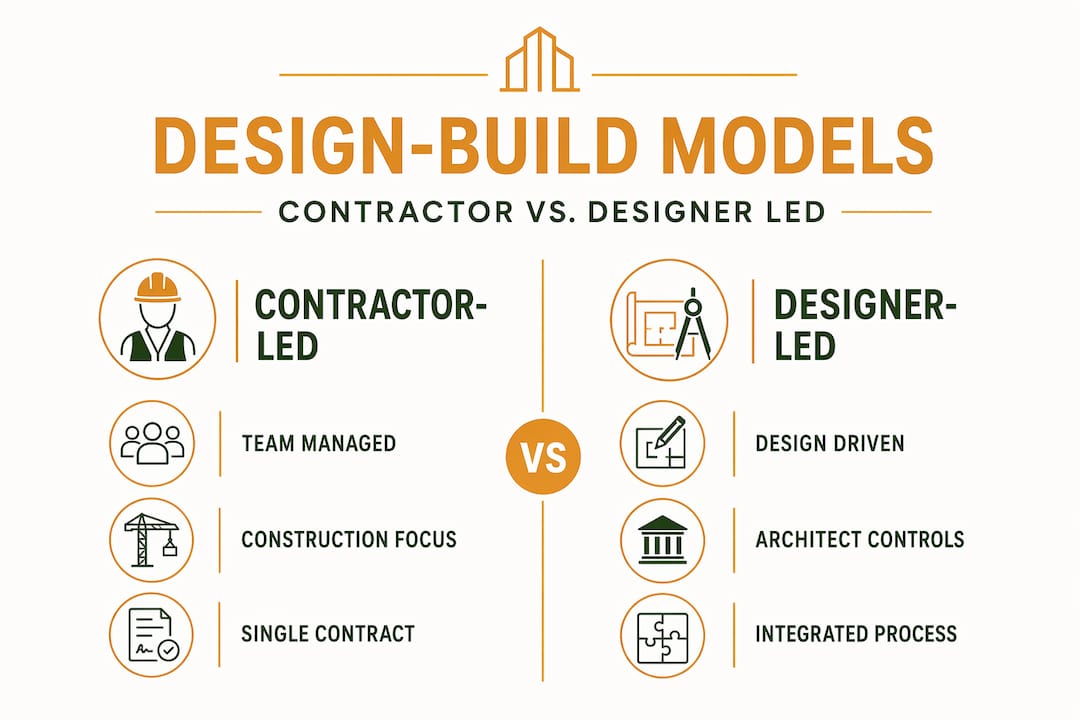
Two distinct internal structures exist for design-build firms. In a contractor-led model, a construction company employs or subcontracts design professionals. In an architect-led model, a design firm subcontracts construction. Either way, the owner contracts with one entity and holds that entity responsible for the complete project outcome.
| Delivery Method | Design Responsibility | Construction Responsibility | Owner Contracts With |
|---|---|---|---|
| Design-Bid-Build | Owner’s architect | Separate general contractor | Two parties |
| Design-Build | Design-build contractor | Design-build contractor | One party |
| Construction Management | Owner’s architect + CM advisor | Multiple prime contractors | Multiple parties |
Liability and contract implications
Understanding what does a design build contractor do in legal terms requires a clear look at liability. Under traditional delivery, the owner’s architect holds professional responsibility for the design, and the contractor is liable only for executing the construction in accordance with those drawings. When something goes wrong at the boundary between design and construction, disputes over who bears responsibility are common and costly.
Design-build consolidates liability for both design and construction with the single contracting entity. This gives the owner a direct avenue for redress when problems arise, without needing to litigate between two separate parties. It also significantly increases the risk exposure carried by the design-build contractor.
A particularly important nuance: design-build contractors bear design liability even when they subcontract design work to licensed architects and engineers. The contractor cannot simply pass that liability downstream and disclaim responsibility to the owner. This creates a layered risk structure that every design-build firm must manage carefully.
Risk allocation for unforeseen site conditions is among the most contested issues in design-build contracts. These clauses require careful drafting because risk-sharing provisions can default to owner responsibility, contractor responsibility, or a shared model, and the default varies significantly between contract templates.
Key contract elements that every property owner should review before signing a design-build agreement include:
- Scope definition: Precisely what design scope is included and what triggers additional fees.
- Design liability clause: Who bears responsibility if a design error causes a construction defect or building failure.
- Unforeseen conditions clause: How costs and delays caused by unexpected subsurface or site conditions are allocated.
- Guaranteed maximum price terms: Whether the contract is firm-fixed-price or GMP, and what the contingency provisions are.
- Change order process: How design changes requested after contract execution are priced and approved.
Design-build contracts in Singapore and internationally frequently use guaranteed maximum price structures, where the design-builder provides architectural, engineering, and construction services with a defined cost ceiling. This model ties budget discipline directly to design decision-making, which is one of the functional advantages of the integrated approach.
Pro Tip: Do not accept a design-build contract that lacks an explicit differing site conditions clause. Without one, discovering unexpected soil conditions, buried utilities, or contamination on site could result in the full cost burden falling on you as the owner.
How design-build contractors manage collaboration
The practical functions of design build contractors go beyond managing a single team. The complexity lies in coordinating designers and builders who have fundamentally different professional priorities, timelines, and communication styles, and doing so within a unified project framework.
Here is how effective design-build coordination typically unfolds across a project lifecycle:
- Owner alignment workshop: The design-build contractor facilitates early sessions with the owner to establish performance requirements, budget constraints, aesthetic priorities, and schedule expectations before design begins.
- Integrated design team formation: Architects and engineers are brought into the team at the outset, either as employees or subcontractors, with construction professionals participating in design meetings from day one.
- Progressive design reviews with cost reconciliation: As design documents advance from schematic to design development to construction drawings, the contractor continuously reconciles design decisions against the project budget. This prevents the common failure mode where a fully designed project comes in significantly over budget.
- Constructability assessments: Construction superintendents and trade contractors review design documents for buildability, flagging details that would be technically difficult, code-noncompliant, or disproportionately expensive before those details are finalized.
- Authority submission coordination: The contractor manages regulatory submissions and approvals, coordinating between the design team and relevant authorities to prevent schedule delays.
- Construction phase integration: Design professionals remain actively engaged during construction to respond to field questions, approve material substitutions, and resolve discrepancies between drawings and actual site conditions.
Integrated design-build teams improve transparency and collaborative culture across the project, which directly reduces the volume of costly disputes and change orders that plague traditionally delivered projects.
One structural tension worth noting: architects in design-build projects operate under contractor control rather than as independent advisors to the owner. This changes the professional dynamic. The architect’s commercial priorities align with the contractor’s interests, which may differ from pure owner advocacy. Owners who understand this dynamic use their own design reviewer or independent technical advisor to verify that design quality standards are being met.
| Coordination Activity | Who Leads | When It Happens |
|---|---|---|
| Budget-design reconciliation | Design-build contractor | Throughout design phases |
| Constructability review | Construction team | Design development stage |
| Authority submissions | Contractor with design team | Pre-construction and during construction |
| Field design queries | Architect of record | During construction |
| Systems commissioning | Contractor with MEP engineers | Near project completion |
Early collaboration between cost estimators and design professionals is one of the defining characteristics that separates high-performing design-build teams from those that deliver poor outcomes despite the structural advantages of the delivery model.

Comparing design-build to other delivery methods
Knowing the role of design build contractor becomes sharper when you understand what it is not. The benefits of design build contracting are specific and contextual, not universal.
In a design-bid-build project, the owner engages an architect who designs the project to completion, then the owner bids that design to general contractors. The winning contractor builds exactly what the architect designed. This model gives the owner full design control and an independent advocate in the architect. It works well when design quality is the primary priority and the owner has the expertise to manage two separate parties.
Construction management at-risk (CMAR) sits between these two models. The owner retains a designer separately but brings in a construction manager early in the design process for cost and constructability input. The CM then takes on the construction risk. It offers some of the collaborative benefits of design-build while preserving a more independent design process.
Design-build is most effective in specific conditions:
- Projects with clearly defined performance outcomes rather than highly detailed aesthetic specifications.
- Projects where budget certainty and schedule compression are priorities over maximum design control.
- Owners who prefer single-point accountability and are willing to define requirements clearly upfront.
- Complex projects where early contractor input on constructability can prevent expensive redesigns.
Design-build simplifies project delivery for owners but requires informed engagement. The owner who delegates all decisions to the design-build contractor and reviews nothing is not protected by the single-contract structure. They are exposed to it, because every decision the contractor makes, whether on design quality, material selection, or value engineering, directly affects the delivered product.
The design-build contractor overview is therefore this: a delivery model with genuine efficiency advantages, significant liability consolidation, and real risks for uninformed owners. Choosing it wisely means understanding the contract, maintaining active engagement, and selecting a contractor with both design and construction credentials.
My perspective on what owners consistently get wrong
I’ve worked across enough design-build projects to recognize a pattern that owners repeat regardless of project scale. They select a design-build contractor based on the lowest price proposal, then discover mid-project that the design quality embedded in that proposal was minimal. The design-build model does not automatically produce integrated, high-quality outcomes. It produces whatever the contract incentivizes.
What I’ve found actually works is this: treat the pre-contract period as your most important investment. The questions you ask before signing, the contract terms you negotiate, and the performance requirements you define determine your outcomes far more than any on-site supervision you conduct afterward. Specifically, I’ve seen owners benefit enormously from having independent design checks completed at the schematic and design development stages, before construction locks in decisions that are expensive to reverse.
I’ve also observed that the best design-build teams genuinely integrate their architects from day one rather than treating design as a necessary step before “real work” begins. When collaborative engineering services are properly embedded in the design-build workflow, the design and construction teams solve problems together rather than handing off blame. That distinction separates good projects from difficult ones.
— Aman
How Stellar Structures supports your design-build project
Stellar Structures provides the specialized engineering and technical oversight that design-build projects in Singapore require. Whether you are a property owner assessing a contractor’s design package or a developer managing a complex integrated project, Stellar Structures delivers civil and structural design checks that verify constructability and code compliance at every stage. The firm’s authority submission expertise covers BCA, URA, HDB, JTC, SCDF, and other Singapore regulatory bodies, removing one of the most schedule-sensitive responsibilities from your project timeline. For projects requiring architectural design coordination, Stellar Structures aligns design intent with engineering requirements to support effective design-build execution. Contact Stellar Structures to discuss how its technical services can support your upcoming project.
FAQ
What does a design-build contractor do?
A design-build contractor manages both the design and construction of a project under a single contract, coordinating architects, engineers, and trade contractors to deliver a complete built outcome to the owner.
Who is liable for design errors in a design-build project?
The design-build contractor bears liability for design errors even when design work is performed by a subcontracted architect or engineer, giving the owner a single point of accountability.
How does design-build differ from design-bid-build?
In design-bid-build, the owner contracts separately with an architect and a contractor. In design-build, one entity handles both under a single agreement, consolidating responsibility and typically compressing the project schedule.
When should a property owner choose design-build?
Design-build works best when the owner prioritizes budget certainty, schedule efficiency, and single-point accountability over maximum independent design control, provided that performance requirements are clearly defined in the contract.
How do you hire a design build contractor effectively?
Evaluate candidates on both design credentials and construction track record, review sample contracts for liability and risk allocation terms, and define your performance requirements in detail before proposals are submitted.
Recommended
- Design and build contracts: Singapore developer guide
- Building Authority Submission Consultant Guide – Stellar Structures
- Interior designer for rebuilds: key benefits and pitfalls
- Architectural Design for Commercial Buildings – Stellar Structures