





Design coordination in BIM is defined as the structured integration of architectural, structural, and MEP discipline models into a single federated digital environment to identify spatial conflicts, assign resolution ownership, and validate constructability before work begins on site. The industry term for this practice is BIM coordination, and it encompasses far more than automated clash detection. Tools like Autodesk Navisworks, Revit, and BIMcollab are central to the process, but the BIM Coordinator role is what transforms software output into resolved design decisions. Understanding what is design coordination BIM means recognizing it as a human-led, communication-intensive workflow that determines whether a project reaches construction with integrity or with costly surprises embedded in the drawings.
What is design coordination in BIM and how does it work?
BIM design coordination integrates architectural, structural, and MEP models into a federated environment for clash prevention and validation throughout a project’s lifecycle. The federated model is not a merged file. It is a linked assembly of discipline-specific models that can be reviewed collectively while each discipline retains authorship and control over its own data.
The BIM Coordinator sits at the center of this process, facilitating multidisciplinary review sessions, tracking unresolved issues, and confirming that model updates reflect agreed decisions. Without this role, clash reports accumulate without resolution, and the federated model drifts further from construction reality with each design iteration. The process applies equally to residential towers, commercial developments, and infrastructure projects, though the complexity scales with the number of disciplines and the density of building systems involved.

BIM coordination also supports authority submissions and regulatory compliance. In Singapore, where BCA mandates BIM submission for projects above certain gross floor area thresholds, a well-coordinated federated model is a prerequisite for approval, not an optional quality measure. The benefits of BIM adoption in Singapore’s construction sector are well documented, and design coordination is the operational mechanism that delivers those benefits at the project level.
What are the main stages of the BIM design coordination process?
The design coordination process follows five core stages, each with defined inputs, outputs, and responsible parties. Skipping or compressing any stage introduces risk that compounds downstream.
-
Define the Employer Information Requirements (EIR) and BIM Execution Plan (BEP). The EIR establishes what information the client requires and at what Level of Development (LOD). The BEP translates those requirements into discipline-specific modeling responsibilities, file naming conventions, coordinate systems, and meeting schedules. This stage sets the rules that all subsequent coordination depends on.
-
Prepare discipline models. Each discipline team, whether architectural, structural, civil, or MEP, builds its model to the agreed LOD and naming standards. Model preparation includes verifying that all elements are correctly categorized, that shared parameters are populated, and that the model is free of internal errors before federation.
-
Federate the models. The BIM Coordinator assembles the discipline models into a single federated environment using tools such as Navisworks or Revizto. Absolute coordinate alignment across all discipline models is verified at this stage. Misaligned survey points generate thousands of false-positive clashes and waste significant review time.
-
Conduct multidisciplinary clash detection and resolution meetings. Weekly coordination meetings are the industry standard for keeping models aligned and controlling project complexity. The BIM Coordinator runs clash reports, presents conflicts by priority, assigns resolution ownership to the responsible discipline, and sets deadlines. BIMcollab tracks each issue through statuses from open to in-progress to resolved.
-
Validate for fabrication and construction. Once clashes are resolved and the federated model reaches a coordinated status, it undergoes final validation. This confirms that the model accurately represents buildable geometry, that clearances for maintenance access are preserved, and that the design satisfies structural and regulatory requirements before construction documentation is issued.
Pro Tip: Establish the coordinate system and survey point protocol in the BEP before any discipline begins modeling. Correcting misaligned models mid-coordination wastes more time than any other single error in the process.
How does design coordination differ from clash detection?
Clash detection and design coordination are not interchangeable terms, though they are frequently treated as synonymous. The distinction matters because conflating them leads teams to believe that running a Navisworks clash report constitutes coordination. It does not.
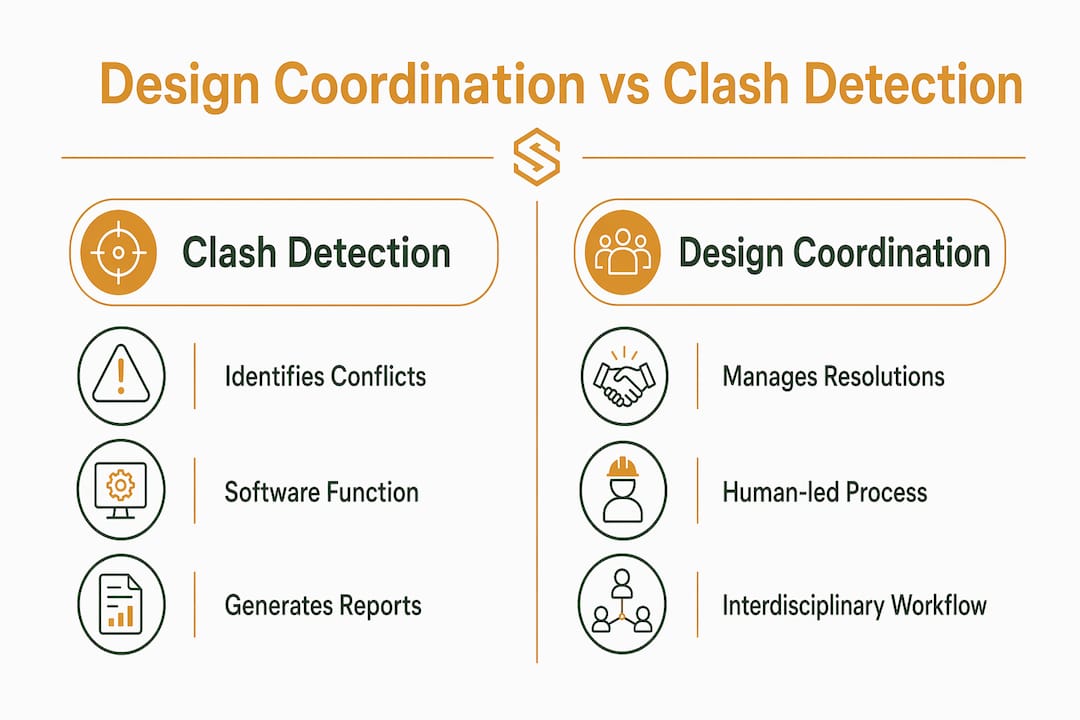
Clash detection is a software function that identifies spatial conflicts between model elements. It produces a report. Design coordination is the broader human-led process that reviews that report, prioritizes conflicts by severity, assigns responsibility, tracks resolution, and verifies that corrections are incorporated into updated models. Automated clash reports are only a tool. True coordination involves stakeholder review, responsibility assignment, and repeated verification cycles.
The table below clarifies the functional boundary between the two:
| Attribute | Clash detection | Design coordination |
|---|---|---|
| Primary function | Identifies spatial conflicts in federated models | Manages the full resolution lifecycle of those conflicts |
| Execution | Software-automated (Navisworks, Revizto) | Human-led by BIM Coordinator with discipline teams |
| Output | Clash report with conflict locations | Resolved, validated, construction-ready federated model |
| Scope | Geometric and spatial analysis only | Includes standards compliance, communication, and model governance |
| Frequency | Run on demand | Structured weekly cycle with tracked ownership |
Professional teams apply a clash prioritization hierarchy to manage resolution efficiently. Structural and safety conflicts are addressed first. MEP routing conflicts come next. Architectural finish conflicts are resolved last. This sequencing prevents gridlock when dozens of clashes compete for attention simultaneously.
Pro Tip: Not every clash requires a design change. Some conflicts are acceptable tolerances or modeling artifacts. The BIM Coordinator’s judgment in filtering meaningful clashes from noise is as valuable as the software itself.
The structural design check stages that engineering teams follow during coordination reinforce this distinction. Structural verification is a disciplined review process, not a software output.
What role do critical zones play in design coordination?
Critical zones are defined as areas within a building where multiple building systems converge at high density, creating coordination challenges that automated clash detection alone cannot resolve. Plant rooms, service corridors, ceiling voids above operating theaters, and transfer floors in high-rise structures are the most common examples.
Focused coordination on critical zones is three to four times more effective in preventing construction bottlenecks than general clash detection across the entire model. This finding reflects a practical reality: a single unresolved conflict in a plant room can halt mechanical installation for weeks, while an equivalent conflict in an open office ceiling has minimal schedule impact.
Critical zones require manual spatial review for several reasons:
- Limited geometry. Structural members, drainage gradients, and duct sizes all compete for the same vertical clearance. Automated tools flag the conflict but cannot determine which system should be rerouted.
- Maintenance access requirements. Coordinated geometry must preserve code-mandated clearances for equipment servicing. Clash detection software does not evaluate access envelopes unless specifically modeled.
- Multi-system convergence. Chilled water, condenser water, electrical trays, fire suppression, and fresh air ducts may all intersect within a 600mm ceiling void. Resolving one conflict without modeling the full system interaction creates new conflicts.
- Structural constraints. Penetrations through transfer beams or post-tensioned slabs require structural engineer sign-off before MEP routing is finalized. Coordination in these zones is not complete until structural approval is documented.
The best practice for critical zone coordination is to isolate these areas early in the BEP, assign dedicated review sessions to them, and require LOD 350 or higher modeling before clash detection is run. Civil engineering inputs that affect foundation and slab geometry must be incorporated before MEP routing in these zones is finalized.
Practical application of design coordination in AEC projects
In practice, BIM design collaboration operates through a structured weekly cycle that connects design decisions to model updates to construction documentation. The BIM Coordinator schedules and chairs coordination meetings, but the discipline leads, structural engineers, M&E consultants, and architects, are accountable for resolving issues within agreed timeframes.
A typical project coordination setup includes the following elements:
- Federated model hosted on a Common Data Environment (CDE) such as Autodesk Construction Cloud or BIM 360, giving all disciplines access to the current model state.
- Weekly clash detection runs conducted by the BIM Coordinator before each meeting, with reports filtered by zone and priority.
- Issue tracking in BIMcollab with each clash assigned an owner, a resolution deadline, and a verification status.
- Model update deadlines set 48 hours before each meeting so that the federated model reflects the latest discipline inputs when the team reviews it.
Clear documentation of clash resolutions and updated federated models serve as authoritative sources during construction and fabrication. This documentation reduces repeated issue reviews and gives site teams a reliable reference when field conditions require interpretation.
The collaborative engineering services that architects and engineers provide within this framework are most effective when coordination begins during design development rather than at the construction documentation stage. Starting early mitigates the exponential cost of late-stage design changes. A routing conflict resolved at LOD 200 takes hours to fix. The same conflict discovered during shop drawing review takes days and may require structural remediation.
Pro Tip: Assign a single BIM Coordinator with authority to reject model submissions that do not meet the BEP standards. Coordination quality degrades rapidly when non-compliant models are federated and reviewed without consequence.
Disciplined BIM coordination reduces construction errors and project delays by ensuring that every trade enters the construction phase with a verified, conflict-free model. The result is fewer requests for information, fewer change orders, and greater confidence in project delivery timelines.
Key takeaways
Design coordination in BIM is a human-led, structured process that integrates discipline models, resolves spatial conflicts through iterative review cycles, and validates constructability before construction begins.
| Point | Details |
|---|---|
| BIM coordination is process-driven | It encompasses model federation, clash resolution, and validation, not just automated clash detection. |
| Five stages define the workflow | EIR/BEP setup, model preparation, federation, clash resolution meetings, and construction validation form the complete cycle. |
| Critical zones require manual review | Plant rooms and service corridors demand LOD 350 modeling and dedicated coordination sessions beyond standard clash runs. |
| Prioritization prevents gridlock | Structural and safety clashes must be resolved before MEP routing and architectural finish conflicts. |
| Early coordination reduces cost | Starting coordination at design development phase avoids exponentially more expensive late-stage design changes. |
Why BIM coordination is still misunderstood in practice
The most persistent misconception I encounter is that a project is “coordinated” once the clash count drops to zero in Navisworks. That number is a metric, not a guarantee. Clashes can be suppressed, grouped, or simply ignored without resolution, and the report still shows zero. What actually determines coordination quality is whether each conflict was reviewed by the right people, resolved with a documented decision, and verified in the updated model before the next cycle.
The second issue is timing. Teams that begin coordination during construction documentation are managing a crisis, not a process. By that stage, structural drawings are issued, MEP equipment is specified, and rerouting a duct may require a slab penetration that triggers a BCA submission amendment. Starting at design development, when LOD 200 models are sufficient to identify major routing conflicts, gives teams the flexibility to resolve issues without cascading consequences.
The third observation is about ownership. Coordination meetings without assigned issue owners produce lists of problems, not solutions. Every clash that leaves a meeting without a named responsible party and a deadline will appear in the next meeting unchanged. The BIM Coordinator’s most critical function is not running software. It is enforcing accountability within the multidisciplinary team.
— Aman
How Stellar Structures supports BIM design coordination
Stellar Structures integrates BIM coordination workflows into its architectural and engineering services for commercial, industrial, and residential projects across Singapore. The firm’s project teams apply structured coordination protocols from design development through authority submission, ensuring that federated models meet BCA, URA, and JTC requirements before construction documentation is issued.

For developers and contractors seeking architectural design for commercial buildings with integrated BIM coordination support, Stellar Structures provides discipline-coordinated models, clash resolution management, and authority submission services under one engagement. The firm also offers civil and structural design checks that align with coordinated BIM workflows, reducing the risk of structural conflicts reaching the construction phase unresolved. Contact Stellar Structures to discuss how coordinated BIM delivery can be applied to your next project.
FAQ
What is BIM coordination in construction?
BIM coordination is the process of integrating architectural, structural, and MEP discipline models into a federated environment to identify and resolve spatial conflicts before construction. It involves structured review meetings, issue tracking, and model validation cycles led by a BIM Coordinator.
How does design coordination differ from clash detection?
Clash detection is a software function that identifies geometric conflicts between model elements. Design coordination is the broader human-led process that prioritizes, assigns, resolves, and verifies those conflicts through iterative review cycles.
What tools are used in BIM design coordination?
Autodesk Navisworks and Revizto are the primary tools for federated model review and clash detection. BIMcollab is widely used for issue tracking and resolution status management across discipline teams.
When should BIM coordination begin on a project?
BIM coordination should begin during the design development phase, when LOD 200 models are available. Starting at this stage allows major routing and spatial conflicts to be resolved before structural drawings are issued and equipment is specified.
What are critical zones in BIM coordination?
Critical zones are high-density areas such as plant rooms, service corridors, and ceiling voids where multiple building systems converge. These zones require manual spatial review, LOD 350 modeling, and dedicated coordination sessions because automated clash detection cannot account for maintenance access and multi-system interaction.
Recommended
- Types of collaborative engineering services architects provide
- What Is a Design Build Contractor Role: A Clear Guide
- Architectural Design for Commercial Buildings – Stellar Structures
- What Is an As-Built Drawing? A Professional Guide