





Many property owners in Singapore assume that skipping an architect saves money. In practice, the opposite is often true. Understanding why hire architect new build is the right approach requires looking beyond the upfront fee. Without professional architectural involvement, projects frequently encounter permit rejections from the Urban Redevelopment Authority (URA) or Building and Construction Authority (BCA), mid-project redesigns that inflate budgets, and contractor disputes caused by incomplete documentation. This guide explains what architects actually do in Singapore’s regulatory environment, and why engaging one early is among the most financially sound decisions you can make for a new build.
Table of Contents
- Understanding architects’ role in Singapore new builds
- Why hiring an architect early saves time and money
- Navigating Singapore’s complex approvals with an architect
- The financial and practical benefits of hiring an architect for your new build
- How architects support project success during construction and bidding
- Why hiring an architect is more than just design: an essential strategic investment
- Explore Stellar Structures’ architectural and engineering services for your Singapore build
- Frequently asked questions
Key Takeaways
| Point | Details |
|---|---|
| Early architect engagement | Hiring an architect before construction starts sets clear scope, prevents redesigns, and saves money. |
| Regulatory expertise | Architects ensure new builds comply with Singapore’s complex planning and building codes for smooth approvals. |
| Cost and quality benefits | Professional design optimizes materials, bidding, and resale value, offsetting architect fees. |
| Construction support | Architects help during bidding and building to avoid delays and costly changes. |
| Strategic partner role | Architects translate real constraints into feasible, compliant, and beautiful building solutions. |
Understanding architects’ role in Singapore new builds
Before examining the financial case, it helps to understand the full scope of what an architect does on a Singapore new build project. The role extends well beyond producing design drawings. Architects operate at the intersection of creative design, technical compliance, regulatory submission, and construction coordination, and each function contributes directly to project outcomes.
Architects are trained and licensed to design within local zoning requirements, fire codes, accessibility standards, and structural compliance frameworks. In Singapore, this means understanding the specific requirements of URA’s Master Plan zoning, BCA’s building regulations, and the technical standards prescribed by authorities such as the Singapore Civil Defence Force (SCDF) for fire safety and the National Environment Agency (NEA) for environmental compliance.
Key functions architects perform in a Singapore new build include:
- Design integration: Translating your project brief into a buildable plan that satisfies both functional requirements and regulatory constraints
- Authority submissions: Preparing permit-ready drawings and documentation for URA planning approval, BCA plan submissions, and related authority clearances
- Engineer coordination: Working alongside structural and civil engineers to ensure that architectural layouts are structurally feasible, which is why civil and structural design checks form a critical part of the design process
- Regulatory interpretation: Translating dense technical codes into practical design decisions so you avoid violations before they occur
- Contractor interface: Producing clear, enforceable contract documents that define the scope of construction work
This breadth of involvement means that an architect’s value on a new build is not simply aesthetic. They function as the primary technical and regulatory coordinator for your project.
Why hiring an architect early saves time and money
Timing matters as much as the decision itself. Many property owners engage architects only after they have already committed to a site layout, a contractor arrangement, or a preliminary design from another source. That sequence creates compounding problems.
Hiring an architect at the beginning defines design scope and budget from the outset. When the architect is involved from day one, they can assess regulatory constraints, identify potential submission risks, and calibrate the design to what is actually permissible under Singapore’s planning and building codes. Hiring late, by contrast, often forces redesigns of work that has already been started, adding both time and cost.
Here is a practical sequence for engaging an architect on a Singapore new build:
- Pre-design consultation: Discuss site constraints, budget, program requirements, and authority considerations before any design work begins
- Schematic design phase: Develop preliminary layouts that reflect both your brief and regulatory parameters, identifying any deviations from zoning requirements early
- Authority submission preparation: Finalize drawings and documentation for URA and BCA submissions in alignment with your authority submissions guide timeline
- Tender documentation: Produce detailed drawings and specifications that allow contractors to price the work accurately and competitively
- Construction administration: Maintain design integrity throughout the build by reviewing contractor work and responding to site queries
Pro Tip: Before signing any land purchase agreement, ask an architect new build professional to review the site’s development parameters. Zoning restrictions and gross plot ratio (GPR) limits in Singapore can significantly affect what you can build, and discovering these constraints after purchase is a costly outcome.
Navigating Singapore’s complex approvals with an architect
Singapore’s regulatory approval framework for new builds involves multiple agencies with distinct requirements, and coordinating submissions across these agencies is one of the most technically demanding aspects of any project.
The two primary approval pathways for most new build projects are URA and BCA, and they serve different but related purposes. Getting the sequence of BCA and URA submissions right before design is finalized avoids expensive errors that arise from misaligned documentation.
| Approval authority | Primary focus | Key submission elements |
|---|---|---|
| URA | Land use and planning permission | Site plan, floor area calculations, development parameters |
| BCA | Building safety and technical compliance | Structural plans, fire safety, accessibility, M&E systems |
| SCDF | Fire safety provisions | Fire compartmentalization, escape routes, suppression systems |
| PUB | Drainage and water supply | Drainage plans, water demand calculations |
Beyond URA and BCA, projects may also require clearance from authorities such as NParks for tree conservation, LTA for road access, and NEA for environmental controls. Architects identify which approvals apply to your specific project and coordinate the submission timeline accordingly.
The practical risks of navigating this process without an architect include:
- Submission sequencing errors: Submitting BCA plans before URA planning permission is granted, which invalidates the process and causes significant delays
- Inconsistent documentation: Discrepancies between architectural and structural drawings that trigger correction notices from BCA
- Missed authority requirements: Failing to include required consultant endorsements or prescribed documentation, resulting in rejection at the formal submission stage
Pro Tip: Instruct your architect to produce a regulatory compliance matrix for your project at the schematic design stage. This document maps each authority requirement against the corresponding design element, giving you a clear reference for tracking compliance throughout the project.
The financial and practical benefits of hiring an architect for your new build
A common concern among property owners is whether architect fees represent justifiable expenditure. The answer requires examining the full cost picture, not just the fee itself.

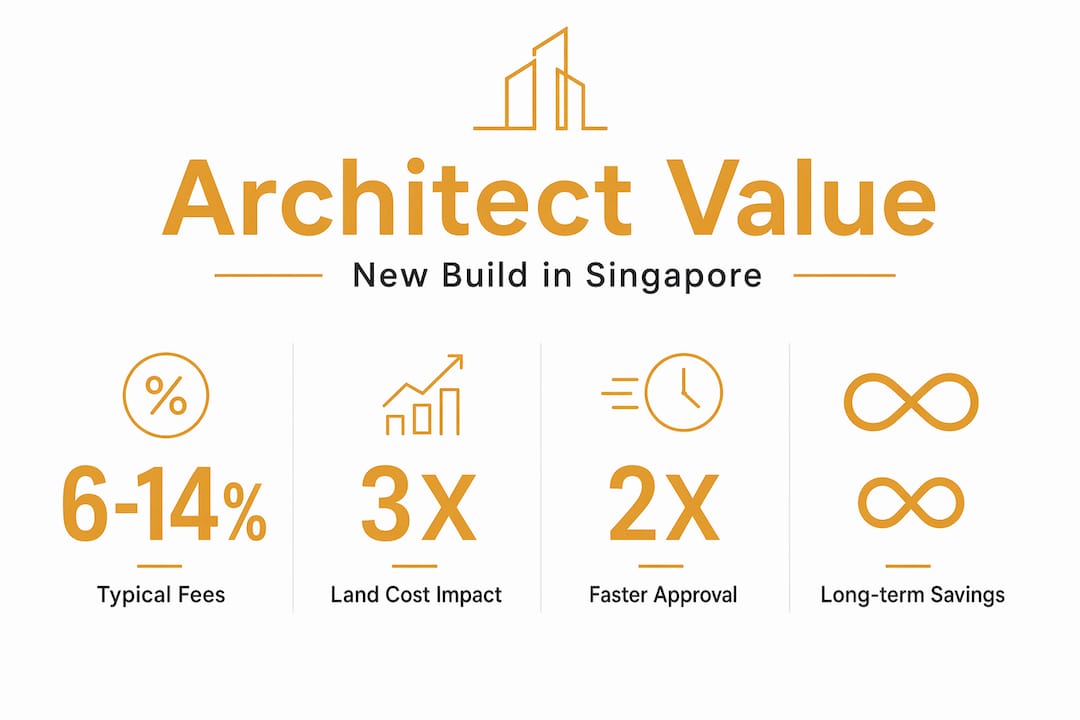
Architect fees typically range from 6% to 14% of total construction cost, but the financial return from avoiding redesigns, code violations, and contractor disputes frequently exceeds that fee. This is particularly relevant in Singapore, where construction costs for landed residential projects are substantial and where regulatory non-compliance can trigger mandatory demolition and reconstruction of non-conforming elements.
The financial and practical benefits of engaging an architect for your new build include:
- Avoiding redesign costs: Non-compliant or poorly coordinated designs require expensive corrections. An architect catches these before they become contractual obligations.
- Material and system optimization: Architects with knowledge of Singapore’s architectural design benefits can specify materials and structural systems that meet performance requirements at lower cost, reducing waste and over-specification
- Competitive bidding: Detailed, unambiguous architectural drawings allow multiple contractors to price the same scope accurately. Vague documentation produces inflated contingency allowances and disputes about scope inclusions.
- Property value enhancement: Architect-designed homes in Singapore consistently achieve stronger resale and rental valuations due to superior spatial planning, quality of construction documentation, and regulatory compliance
“An architect’s involvement is not an optional premium service — it is a risk management mechanism that prevents the far greater costs of correction, non-compliance, and project delays.”
The importance of professional architects in Singapore’s context is amplified by land cost. Because land values are among the highest in the region, the proportional cost of construction errors is extremely high. A mid-project redesign that costs S$80,000 in additional construction work on a landed property is not an abstract figure — it is a real financial consequence of under-investment in professional design.
How architects support project success during construction and bidding
Design approval is not the endpoint of an architect’s contribution. The construction and bidding phases carry their own risks, and architects play a defined role in managing those risks.
Architect involvement during bidding prevents costly rework by clarifying scope, responding to contractor queries (formally called Requests for Information, or RFIs), reviewing bid pricing for scope accuracy, and supporting construction verification against the approved design. Here is how that process works in practice:
- Pre-tender documentation: The architect issues a complete set of drawings, specifications, and schedules to all bidding contractors, ensuring a consistent basis for pricing
- Addenda and query management: During the tender period, the architect responds to contractor questions in writing, with responses issued to all bidders simultaneously to maintain fairness
- Bid review: The architect evaluates contractor submissions for scope completeness, not just price, identifying bids that have excluded significant elements or introduced non-compliant substitutions
- Construction phase review: The architect conducts periodic site inspections to verify that work conforms to the approved drawings and specifications, and issues formal instructions where deviations are identified
- Completion certification: For BCA purposes, the architect’s completion certificate is a required document for the Certificate of Statutory Completion (CSC), which is mandatory before a building can be lawfully occupied
Pro Tip: Require your architect to maintain a formal RFI and site instruction register throughout construction. This creates a documented record of all design decisions made during the build, which is invaluable if contractor disputes arise later.
Additionally, integrating civil and structural design checks during construction review prevents non-conforming structural elements from being concealed during finishing works, which is a risk that is very difficult and expensive to rectify after completion.
Why hiring an architect is more than just design: an essential strategic investment
There is a tendency among some property owners to view architectural services as a design commodity, something that produces drawings which can then be handed to any contractor. That framing underestimates what a qualified architect actually brings to a Singapore new build.
An architect’s value includes translating real constraints into feasible, compliant, and buildable solutions. This is a capability that no AI image generation tool or generic drafting service can replicate, because it requires contextual knowledge of Singapore’s specific regulatory landscape, practical construction sequencing, and the legal accountability that comes with professional registration.
Consider what this means for your project. When an architect prepares a BCA submission, they are placing their registered professional license behind the accuracy and compliance of those drawings. That accountability does not exist when a non-registered party produces construction documents. The consequence of non-compliant submissions in Singapore is not simply a correction notice — it can involve stop-work orders, demolition requirements, and personal liability.
The property owners who achieve the most successful outcomes in Singapore new build projects are typically those who treat architect engagement as a proactive compliance and risk management strategy, not as a downstream creative service. They involve architects before any physical or contractual commitments are made, they maintain architect oversight throughout construction, and they treat the architect’s documentation as a binding project record rather than a reference sketch.
Singapore’s regulatory environment for new construction is not forgiving of improvisation. Engaging a qualified architect who understands the integrated demands of URA, BCA, SCDF, and other authority requirements is the single most effective measure you can take to protect your investment.
Explore Stellar Structures’ architectural and engineering services for your Singapore build
Now that you understand why architects are vital to new build success in Singapore, the next step is engaging a team that integrates architecture, engineering, and authority submission expertise under one coordinated framework.

Stellar Structures offers architectural and interior design solutions alongside full structural, civil, and geotechnical engineering services, allowing your project team to operate with a single point of coordination rather than fragmented consultants. Their team manages authority submissions across BCA, URA, HDB, JTC, SCDF, PUB, LTA, NEA, and NParks, and their civil engineering consultancy services support projects from initial feasibility through to construction completion. Use their authority submission guide as a starting reference, and contact Stellar Structures to discuss how their integrated approach can support your new build project from the earliest planning stage.
Frequently asked questions
Is it mandatory to hire an architect for new builds in Singapore?
While not always legally mandatory for every project type, hiring an architect is strongly recommended because architects are trained and licensed to design within Singapore’s zoning codes, fire safety standards, and accessibility requirements, making regulatory approval significantly more reliable.
Can I hire an architect after starting construction?
Engaging an architect after construction has begun is possible but inadvisable, as hiring late typically forces redesigns of completed work, increasing both costs and project duration beyond what early engagement would have required.
How do architects help with regulatory approvals in Singapore?
Architects prepare and coordinate submissions for URA, BCA, and related authorities, and getting the submission sequence right before design is finalized prevents expensive errors and ensures approvable documentation from the outset.
What are the cost benefits of hiring an architect?
Architect fees of 6% to 14% of construction cost are typically offset by savings from prevented redesigns, avoided code violations, optimized material specifications, and stronger property resale values at project completion.
Can architects assist during the construction phase?
Yes. Architect involvement during bidding and construction includes clarifying scope documents, responding to contractor RFIs, reviewing bid submissions, conducting site inspections, and issuing the completion certification required for Singapore’s Certificate of Statutory Completion.
Recommended
- Hiring a Structural Engineer for Renovation in Singapore
- Singapore A&A Works (2025): Essential Guide to Hiring a BCA-Certified Builder
- Integrated design and construction for efficient Singapore projects
- BIM Adoption in Singapore Construction: Engineering Benefits & Trends – Stellar Structures