




Introduction
Geotechnical engineering is the critical discipline that determines whether industrial land reclamation projects in Singapore succeed or fail. Every reclaimed industrial site-whether destined for petrochemical storage, port operations, or wide span warehouse construction-sits atop layers of soft marine clay, loose hydraulic fill, and variable bedrock. Without rigorous soil investigation, ground improvement, and foundation design, these facilities face excessive settlement, structural distortion, and regulatory rejection.
This article focuses exclusively on industrial reclamation challenges: the heavy load demands of manufacturing plants, chemical storage facilities, logistics hubs, and port terminals. Residential and commercial reclamation projects fall outside its scope. The content addresses developers, contractors, statutory boards, and industrial facility owners who are planning or evaluating reclamation projects in Singapore, particularly those requiring structural steel truss design Singapore specifications and column-free interior spaces for large-scale operations, while also recognizing where environmental engineering matters when reclamation interfaces with compliance and mitigation.
Geotechnical engineers provide critical soil analysis, foundation recommendations, and ground improvement strategies, with geotechnical work covering investigation, ground improvement, foundation design, and monitoring that make safe industrial development on reclaimed land possible. They assess seabed conditions before reclamation, design foundations matched to verified soil properties, and monitor ground movements throughout construction-ensuring that every facility built on reclaimed land meets both performance requirements and Singapore’s regulatory standards, while managing environmental impacts.
By reading this article, you will gain:
-
Clear understanding of site investigation requirements for industrial reclamation
-
Knowledge of foundation design considerations for heavy industrial loads and wide-span structures
-
Familiarity with ground improvement techniques suited to Singapore’s marine clay conditions
-
Insight into regulatory compliance pathways through JTC, BCA, and other authorities
-
Strategies for cost optimization and risk reduction through early geotechnical involvement
Understanding Singapore’s Industrial Land Reclamation Context
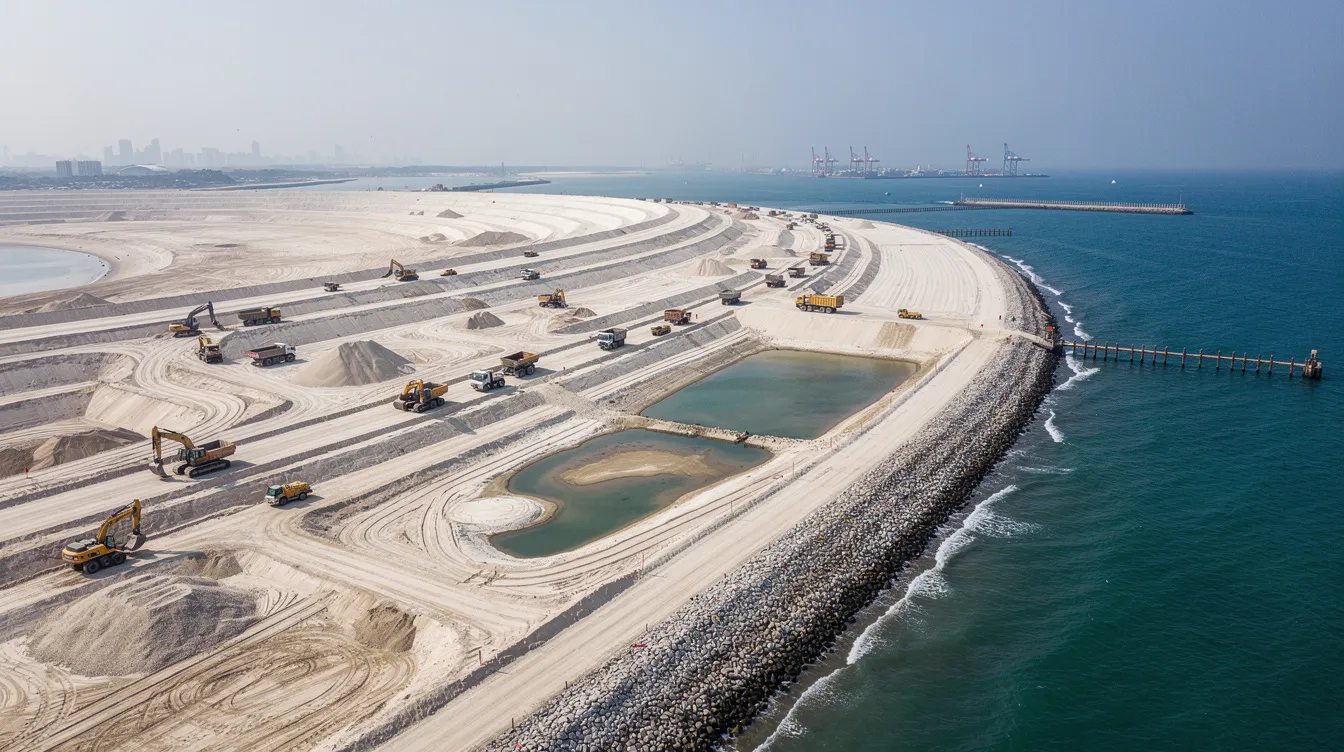
Land reclamation-the process of creating new land from sea, riverbeds, or wetlands through filling and ground treatment-has been Singapore’s primary strategy for expanding its industrial footprint. With limited natural terrain, reclamation supplies the flat, expansive sites needed for port consolidation, petrochemical clusters, and major infrastructure projects that drive the nation’s economy.
Industrial facilities demand far more from reclaimed land than typical developments. Storage tanks impose concentrated static loads, container cranes generate dynamic lateral forces, and chemical plants require foundations with extremely tight differential settlement tolerances. Geotechnical engineering is crucial for industrial land reclamation in Singapore because it bridges the gap between the weak, compressible soils beneath these sites and the exacting performance standards that heavy industry demands.
Singapore’s Geological Challenges for Industrial Development
Singapore’s coastal and reclaimed zones are underlain by the Kallang Formation, which includes Singapore Marine Clay-a soft, highly compressible deposit with very high water content and low undrained shear strength, often less than 20–30 kPa in the upper layers. This marine clay can extend to depths of 30–40 metres in coastal reclamation zones, with deep soil layers in these marine clay deposits creating enormous consolidation challenges for any structure placed above them.
Beneath the marine clay, engineers encounter variable substrata: Old Alluvium (OA) sands that are abrasive and wear pile installation tools, residual soils, Bukit Timah Granite, and the Jurong Formation-each with different stiffness, bearing capacity, and mechanical properties, consistent with local ground-condition expertise developed through the National University of Singapore. These geological variations mean that a single reclamation site can present radically different foundation conditions across its footprint.
For heavy industrial facilities, this geology creates a fundamental engineering problem. Chemical storage bunkers require piles penetrating entirely through marine clay to reach Old Alluvium or bedrock, because undrained shear strengths below 25–50 kPa in marine clay make shallow foundation solutions impractical. Soft marine clay in Singapore has low shear strength and high compressibility, which means settlement control is vital to avoid damage to massive structures such as tank farms, crane rail systems, and wide-span warehouses supported by structural steel truss design.
Regulatory Framework for Industrial Reclamation
Industrial reclamation projects in Singapore operate within a multi-authority regulatory environment. JTC Corporation leads the planning and execution of industrial land development, setting technical standards for heavy floor loading, slope stability, and estate infrastructure. The Building and Construction Authority (BCA) oversees building plan submissions and requires that a Professional Engineer in Geotechnical discipline must endorse certain projects-specialist and accredited checkers must verify geotechnical parameters including soil strength, deformation characteristics, pile shaft friction, and negative skin friction.
URA provides development control guidelines for earthworks, retaining walls, and boundary walls in Business 2 (B2) industrial zones. PUB and NEA exercise environmental regulatory oversight, requiring Environmental Impact Assessments (EIA) and Environmental Monitoring & Management Plans (EMMP) for reclamation projects so environmental impacts are assessed, monitored, and managed. Geotechnical reports must be current and site-specific for BCA approvals-a requirement underscored by the 2013 Resource Piling case, which established liability for relying on third-party data. Outdated soil data can lead to liability for developers, making thorough geotechnical site investigation a legal necessity, not merely good practice.
The geotechnical design framework is governed by SS EN 1997-1:2010 (2018)-the nationally adopted Eurocode 7 with Singapore’s National Annex-which establishes limit state design rules for fill, ground improvement, spread and pile foundations, and retaining structures. Prior to 2015, CP 4 (Code of Practice for Foundations) was the governing standard; many local practices from CP4 have been incorporated into non-contradictory complementary information supporting the current Eurocode framework, but current submissions should be planned under the present Eurocode-based approach rather than legacy practice.
Industrial vs. Other Reclamation Types
Industrial reclamation demands are fundamentally stricter than residential or commercial projects. Port terminal container yards must support massive bearing capacity requirements and resist large lateral loads from crane movements. Chemical plants require bunded containment areas where differential settlement must be controlled to fractions of design tolerances to maintain chemical leakage containment sealing. Manufacturing facilities housing precision equipment need vibration isolation and precisely level floor slabs.
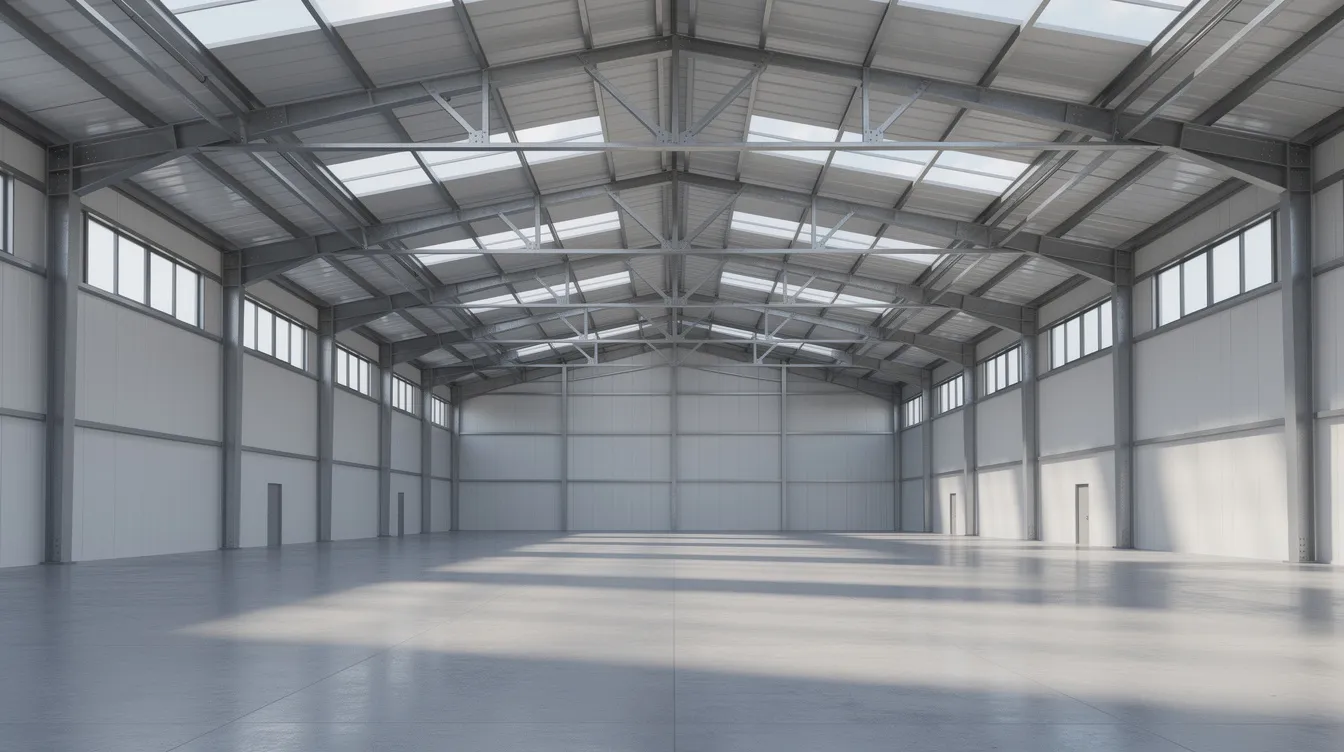
These requirements cascade into every geotechnical decision: the quality and mechanical properties of fill materials matter more, ground improvement must achieve higher target strengths, and foundation systems must be designed for both ultimate and serviceability limit states with narrower margins. For wide span warehouse construction on reclaimed land, structural steel truss design Singapore standards require foundations that limit settlement variation across the entire building footprint-otherwise, long truss lines distort and structural connections fail. Understanding these heightened demands establishes why the specific engineering applications discussed next are so critical.
Geotechnical Engineering Applications in Industrial Reclamation
With the regulatory and geological context established, the practical applications of geotechnical engineering in industrial reclamation projects become clearer. These applications span from initial subsurface characterization through foundation construction to long-term performance monitoring-each phase building on the data and decisions of the previous one.
Site Investigation and Soil Characterization
Geotechnical engineers conduct soil and site investigations as the first and most consequential step in any reclamation project. Land reclamation involves site investigation before dredging, and the scope of these investigations for industrial sites goes well beyond standard practice. Site investigation methods include boreholes and in-situ tests such as Cone Penetration Tests (CPT), Standard Penetration Tests (SPT), vane shear tests, self-boring pressuremeter tests, and dilatometer tests. The Changi East reclamation project, for example, employed CPT, dilatometer, field vane shear, and pressuremeter testing to map compressible marine clay and its lateral variations across the site.
Laboratory analysis complements field testing: water content determination, Atterberg limits (liquid and plastic limits), unconfined compression tests, triaxial tests, permeability measurements, and consolidation tests derive the coefficients of consolidation (Cv) and compressibility parameters needed for settlement predictions. Groundwater assessment establishes phreatic water tables and identifies possible artesian pressures that affect slope stability and retaining wall design. For industrial sites, contamination screening is essential-older seabeds and dredged fill materials may contain pollutants requiring chemical testing before development can proceed.
Bearing capacity evaluation defines allowable bearing pressures and determines foundation type selection. They assess key site conditions for foundation design decisions, including differential settlement predictions under equipment loads, crane loads, and dynamic effects. Geotechnical engineers produce factual and interpretive geotechnical reports that form the basis for all subsequent design decisions. Geotechnical site investigations must be current and site-specific-contractors must verify actual ground conditions in Singapore rather than relying on historical data or neighboring site records.
Foundation Design for Industrial Facilities
Pile foundations are almost always required over soft marine clay for heavy industrial applications. Two primary types dominate: bored piles, which produce less vibration and noise but are slower and more expensive; and driven piles, which are faster and more economical but may induce vibrations and heave affecting nearby structures. They recommend appropriate foundation systems based on soil conditions, selecting pile type based on the soil profile, proximity to sensitive structures, and applied loads.
Mat or raft foundations are viable only when the overlying soils have been significantly improved or when marine clay layers are thin. For heavier loads or deeper marine clay-common in Singapore’s reclaimed industrial zones-raft foundations must be combined with piles in pile-raft configurations that share loads between surface contact and deep bearing elements.
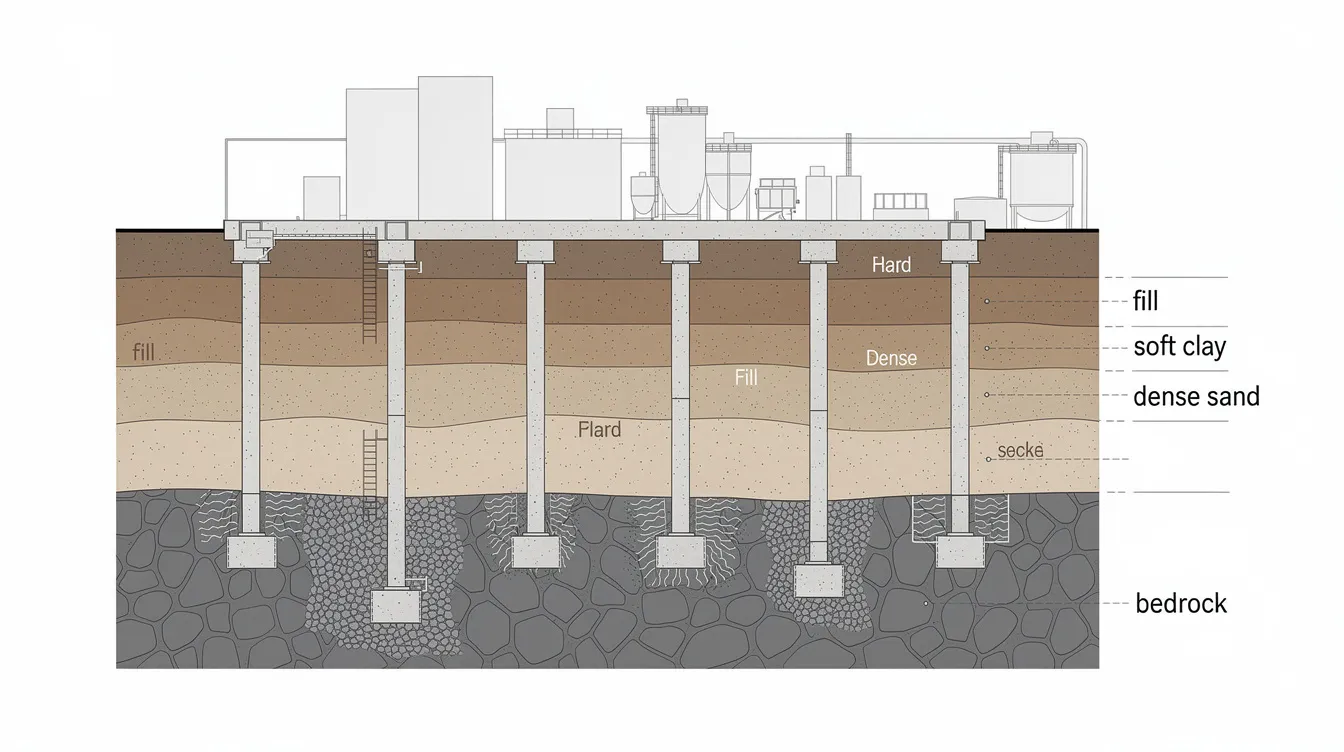
Specialized foundations serve specific industrial functions. Crane rail systems require precise alignment and must resist increased lateral loads; chemical storage tanks may need ring beam foundations or pile ring arrangements to prevent tilting; tank bund foundations need continuous settlement control to maintain containment integrity. For wide span warehouse construction, the challenge is particularly acute: structural steel truss design Singapore projects require column-free interior spaces where truss reactions concentrate enormous vertical and horizontal forces at widely spaced column bases. Geotechnical engineers must evaluate soil modulus and allowable differential settlement to prevent distortions along extended truss lines-foundation settlement variation across a wide-span building footprint can crack cladding, jam doors, and compromise structural steel connections.
Ground Improvement Strategies
Ground improvement helps reclaimed land support heavy industrial loads by transforming weak, compressible soils into stable bearing platforms. Ground improvement techniques are used to stabilize soft marine clay through various ground improvement techniques, each suited to different conditions and performance requirements.
Surcharge preloading with prefabricated vertical drains enhances soil strength by placing fill over the reclamation area while PVDs accelerate pore water dissipation through the marine clay. Prefabricated Vertical Drains (PVDs) help accelerate soil consolidation-at Changi East, over 170 million metres of PVDs were installed to consolidate marine clay up to 50 metres thick. Deep cement mixing is a method for soil stabilization that creates stiff soil-cement columns providing lateral stiffness and higher bearing capacity, particularly at edge zones, heavy load areas, and shore protection bunds. Deep mixing and soil stabilization methods increase soil strength for heavy loads in areas where PVD-and-preloading alone cannot achieve required performance.
Ground improvement techniques include dynamic compaction and vibro-replacement for densifying sand fill and loose granular layers. Vibro-flotation densifies soil to improve load-bearing capacity in hydraulic fill zones. Jet grouting improves soil properties by injecting cement grout into targeted zones requiring localized strengthening. Vacuum preloading-a newer method employed at Changi East-reduces reliance on surcharge fill where costs or environmental constraints limit fill placement, accelerating consolidation without requiring large surcharge heights.
These soil improvement methods must be selected based on the specific industrial loads, settlement tolerances, timeline constraints, and cost parameters of each project. The next section details how these methods are implemented systematically.
Implementation Process and Technical Methods
Industrial land reclamation projects in Singapore follow a systematic, phased approach that integrates geotechnical assessment with regulatory coordination, construction execution, and long-term monitoring. Geotechnical engineers assess site conditions throughout the project lifecycle, from initial seabed evaluation through post-construction performance verification.
Phased Implementation Approach
A well-managed industrial reclamation project proceeds through five distinct stages, each with specific geotechnical deliverables:
-
Pre-reclamation geotechnical assessment and planning: Geotechnical engineers assess seabed conditions before reclamation through macro-scale soil investigations, defining reclamation extent, identifying borrow areas, and selecting fill materials (sand, dredged materials, or stabilized waste). Testing establishes underlying marine clay compressibility and groundwater conditions. Reclamation, ground treatment, and compliance measures should be planned together before fill placement begins. Regulatory pathways through JTC, BCA, URA, and PUB are initiated, including EIA and EMMP submissions where required, and Environmental Engineering inputs are often coordinated where monitoring and mitigation of environmental impacts are required. Engaging geotechnical specialists early improves design efficiency and reduces downstream risk.
-
Fill placement and compaction monitoring: Dredging uses equipment like clamshell and cutter suction dredges to source and place fill materials. Filling materials can include sand, cement, or construction waste, spread over geotextile mats in controlled lifts. Geotechnical engineers monitor ground behavior during construction with various instruments-settlement plates, density gauges, and compaction testing verify fill quality and placement. Instrumentation helps manage liquefaction risks during earthquakes in areas of loose fill.
-
Ground treatment and improvement works: PVD installation, surcharge fill or vacuum preloading, stone columns, deep cement mixing, or dynamic compaction are executed based on the ground improvement design. Pilot or trial improvement zones calibrate performance predictions against actual soil response, with treatment selection depending on deep soil behavior in thick marine clay profiles. Surcharging improves settlement of reclaimed land, while vibroflotation densifies soil in land reclamation projects and dynamic compaction is used to improve soil strength in granular fill zones.
-
Foundation construction and load testing: Once ground has achieved target improvement, foundation construction begins-piling, raft casting, or pile-raft hybrid systems. Static and dynamic load testing verifies that piles achieve design bearing values and that negative skin friction from settling soils is within acceptable limits. Geotechnical engineers design retaining structures to ensure shoreline stability where earth-retaining systems protect reclaimed edges.
-
Post-construction settlement monitoring: Long-term monitoring using settlement plates, piezometers, and inclinometers tracks residual settlement, pore water pressure dissipation, and lateral ground movements. Monitoring is especially critical in heavy load zones supporting tanks, cranes, and wide-span warehouse structures. Geotechnical engineers monitor construction for ground safety and continue assessment through the operational life of the facility.
Projects with early geotechnical input perform better on cost and schedule. Early geotechnical involvement reduces project risk significantly by identifying problematic ground conditions before they become expensive construction surprises.
Technology and Methods Comparison
Designers compare ground improvement methods based on application suitability, timeline to completion, relative cost, and capacity for heavy industrial loads. The following table summarizes the primary options:
|
Method |
Application |
Timeline |
Relative Cost |
Suitability for Heavy Industrial Loads |
|---|---|---|---|---|
|
PVD + Surcharge Preloading |
Large areas over thick soft clay; bulk fill zones |
Months to years depending on clay thickness |
Moderate (fill + PVD installation + instrumentation) |
Good for general loading; may need supplemental piles for concentrated heavy loads |
|
Vacuum Preloading + PVD |
Areas where fill material costs are high or environmental restrictions apply |
Faster than surcharge alone; weeks for vacuum application |
Higher equipment/membrane cost but saves on fill transport |
Strong for industrial zones needing reduced consolidation time |
|
Deep Cement Mixing (DCM) |
Edge zones, heavy equipment pads, bunds, road/rail foundations |
Rapid; usable stiffness within weeks of curing |
High (material, equipment, quality control) |
Very high; provides immediate strength and minimal settlement |
|
Stone Columns / Vibro Replacement |
Loose fills, transition zones, moderate load areas |
Weeks to complete; consolidation faster via lateral drainage |
Moderate to high depending on coverage area |
Good for moderate loads; insufficient alone for tank/crane foundations |
|
Jet Grouting |
Localized strengthening, underpinning, seepage control |
Days to weeks per zone |
High (specialized equipment and materials) |
Excellent for targeted heavy load support and soil sealing |
For wide span warehouse construction, the choice of ground improvement method directly affects structural steel truss design Singapore parameters. Where truss reactions concentrate at column bases spaced 30–50 metres apart, differential settlement between supports must be minimized. DCM beneath column positions combined with PVD treatment across the general footprint often provides the most cost-effective solution, achieving the uniform bearing surface that long-span steel trusses demand.
Selecting the right combination requires site-specific evaluation-a reality that leads directly to the common challenges encountered in such projects.
Common Challenges and Solutions
Industrial land reclamation projects in Singapore consistently encounter several categories of geotechnical challenge. Understanding these and their proven solutions helps developers and professional engineers plan more effectively and achieve cost savings through proactive risk management.
Soft Marine Clay Settlement Issues
Marine clay undergoes primary and secondary consolidation over periods spanning years to decades, with total settlement magnitudes potentially reaching several metres. For industrial facilities, this threatens structural integrity, crane rail alignment, piping connections, and containment sealing.
The proven solution combines PVD installation with staged surcharge loading, calibrated through pilot test zones and monitored using piezometers and settlement plates. Vacuum consolidation accelerates the process where surcharge height or fill transport is constrained. For zones supporting equipment with tight tolerances-crane foundations, tank ring beams, structural steel truss columns-DCM or stone columns provide localized stiffness enhancement. Designing foundations to accommodate calculated residual settlement through flexible connections and adjustable bearing elements adds a critical safety margin. Settlement control is vital to avoid damage to massive structures, and the combination of ground treatment with robust monitoring and instrumentation provides the necessary control.
High Groundwater and Dewatering Challenges
Reclaimed areas are saturated, with high water tables creating uplift pressures, risk of basal heave during deep excavation, seepage into foundation pits, and potential for contaminant migration. PUB requirements add environmental monitoring obligations.
Effective solutions include wellpoint or deep well dewatering systems coordinated with sheet pile walls or cutoff walls to control seepage. Drainage design must manage surface water runoff while maintaining water-tightness in chemical bunds. Environmental monitoring ensures that dewatering operations do not spread contaminants through altered groundwater flow paths. For facilities requiring deep excavation on reclaimed land, ERSS engineering provides the earth retaining and stabilization systems needed to maintain excavation stability.
Heavy Load Foundation Requirements
Managing concentrated loads from storage tanks, heavy manufacturing equipment, and container cranes-including dynamic and moving loads-while accounting for negative skin friction from settling soils, presents one of the most complex geotechnical engineering challenges in reclamation projects.
The solution requires end-bearing piles designed to penetrate through marine clay to competent strata, verified through both static and dynamic load testing. Pile-raft hybrid systems share loads where appropriate, and rigid inclusions provide supplementary support. Design must comply with Eurocode 7 requirements for characteristic values derived from site-specific testing, addressing both ultimate and serviceability limit states. For structural steel truss design Singapore projects requiring wide-span, column-free interiors, foundation design must ensure that settlement at truss support points remains uniform-typically within 10–15 mm differential across the building footprint-to prevent distortion of steel connections and roof geometry. Geotechnical engineers assess seabed conditions before reclamation and continue monitoring through construction to verify that foundation performance matches design predictions.
Conclusion and Next Steps
Successful industrial land reclamation in Singapore demands integrated geotechnical expertise from the earliest project stages through long-term facility operation. From characterizing Singapore’s challenging marine clay and variable bedrock, through selecting and implementing appropriate soil improvement methods, to designing foundations that safely support heavy industrial loads and wide-span structures, geotechnical engineering provides the technical foundation upon which every other discipline builds. Investments in land reclamation projects are significant in Singapore, and geotechnical engineering contributes to the resilience of coastal infrastructure that supports the nation’s industrial economy.
To move forward effectively on an industrial reclamation project:
-
Conduct a preliminary geotechnical assessment with current, site-specific investigations-never rely on neighboring site data or historical records
-
Engage a PE (Geo) consultant early in the planning phase to coordinate geotechnical work with design, submissions, and construction sequencing while evaluating ground conditions, recommending ground improvement strategies, and optimizing foundation design for cost and schedule
-
Plan regulatory submissions to JTC, BCA, URA, and environmental authorities in parallel with geotechnical design, ensuring that geotechnical reports and authority submission requirements are aligned from the outset
Related topics worth exploring include structural vs. geotechnical engineering integration for complex industrial facilities, MEP coordination on reclaimed sites with high water tables, and ongoing facility maintenance considerations where residual settlement affects operational infrastructure.
Additional Resources
-
SS EN 1997-1:2010 (2018) – Singapore’s nationally adopted Eurocode 7 with National Annex, governing all geotechnical design for reclamation and foundation works
-
JTC Corporation technical guidelines – Standards for industrial estate infrastructure, floor loading, and slope stability on JTC-managed industrial land
-
BCA Building Control Regulations – Requirements for geotechnical building works submissions, accredited checker review, and PE (Geo) endorsement
-
Stellar Structures’ geotechnical and civil engineering services – Professional engineering consultancy providing site investigation, foundation design, ground improvement advisory, and authority submission support for industrial projects in Singapore
-
URA Development Control Handbooks – Guidelines for earthworks, retaining walls, and boundary walls in B2 industrial zones
-
National University research note – Use local academic references only where substantiated, such as offshore or reclamation geotechnics material authored by a Research Fellow
-
Australia case-study note – Useful as a broader infrastructure benchmark when comparing large-scale marine ground engineering approaches
-
China case-study note – Relevant for understanding how major dam and coastal infrastructure projects inform geotechnical risk thinking at scale
-
Malaysia regulatory note – Can provide regional context on reclamation, restoration, and offshore land-use obligations where cross-border comparison is helpful