




Introduction
Data centre operators in Singapore storing diesel for standby generators, fire pumps, or day tanks above SCDF exemption limits must hold a valid P&FM storage licence before commissioning. This article is a structured, step-by-step companion to a video checklist produced by Stellar Structures, designed to walk data centre project teams through every stage of an SCDF Petroleum and Flammable Materials licence submission. Watch it before your concept design is locked in, and again before your GoBusiness submission, to cut out the errors that cause resubmissions and failed inspections.
The scope here is mission-critical data centres in Singapore: new builds, retrofits, and capacity expansions for colocation, hyperscale, and enterprise facilities. Labs, warehouses, and non-Singapore jurisdictions are outside this guide. The target readers are data centre operators, facility managers, colocation providers, hyperscale owners, and the project team members (qualified person, professional engineer, EHS leads) who carry the P&FM licensing workload.
The short answer: most Tier III and Tier IV data centres need an SCDF P&FM storage licence because their aggregated diesel storage for generators and fire pumps exceeds the Class III petroleum exemption threshold of 1,500 litres. Watching the checklist video before submission reduces revisions, inspection failures, and delays that hold up generator energisation.
SCDF P&FM (Petroleum and Flammable Material) Authority Submission Process in Singapore; Data Centre Edition by Stellar Structures
After reading this article and watching the video, you will:
-
Know exactly what to prepare before starting an SCDF P&FM licence application for a data centre.
-
Understand how diesel generator and day-tank design choices affect approval outcomes.
-
Avoid the common mistakes that trigger SCDF queries, resubmissions, or commissioning delays.
-
Use a practical, printable checklist aligned with the video to coordinate your project team.
-
Recognise where Singapore’s fire safety regulations diverge from global standards such as NFPA.
Understanding SCDF P&FM Requirements for Data Centres
Under the Fire Safety Act (Chapter 109A), the Singapore Civil Defence Force regulates the storage of petroleum and flammable materials on any premises. A P&FM storage licence is required whenever on-site stored quantities exceed the legal exemption limits set out in the Fire Safety (Petroleum and Flammable Materials) Regulations. For data centres, this regulation centres on diesel fuel (classified as Class III petroleum, with a flash point between 60 °C and 93 °C) held in bulk tanks, day tanks, and fire-pump fuel tanks.
Even facilities marketed as “IT buildings” fall under SCDF licensing control the moment their total diesel storage crosses the 1,500-litre exemption threshold. Because uptime-critical facilities typically store tens or hundreds of thousands of litres of diesel to support N+1 or N+2 generator configurations, the licence requirement is effectively a strict legal mandate for most production data centres. Understanding these obligations at the outset makes the rest of the video checklist actionable rather than abstract.
Key P&FM Elements Inside a Typical Singapore Data Centre
Several fuel and flammable material systems inside a data centre fall under P&FM control:
Underground or above-ground diesel bulk tanks for standby power generation are the primary regulated asset. Capacities in Singapore data centres typically range from 30 m³ to 200 m³, depending on the facility’s power density and autonomy requirements. Elevated day tanks, which serve multiple generator sets on upper mechanical floors, add to the aggregate total. So do diesel tanks dedicated to fire pumps and sprinkler pumps, even if their individual capacity seems small; SCDF counts the actual storage across all vessels on the licensed premises.
Beyond diesel, any LPG, fuel oils, or specialised cooling or energy-storage media classified as petroleum flammable materials also fall under these requirements. Gas suppression cylinders containing substances listed in SCDF’s Fourth Schedule of scheduled chemicals require a licence regardless of quantity. SCDF’s Fourth Schedule lists 378 groups; any storage of a scheduled chemical triggers licensing even if the stored volume is a few litres.
Whether these installations trigger licensing depends on total capacity, petroleum class, and whether any scheduled chemicals are present. Stellar Structures typically engages at concept and detailed design stages to right-size and position these systems for smoother SCDF approval, since relocating a tank after structural design is frozen can add weeks to a programme.
How SCDF Classifies Petroleum and Flammable Materials Relevant to Data Centres
SCDF sorts petroleum products into four classes based on flash point:
-
Class 0 petroleum: liquefied petroleum gas (LPG). Class 0 petroleum has the lowest flashpoint and highest volatility, and LPG storage is strictly regulated under SCDF controls, requiring stricter licensing due to that volatility.
-
Class I petroleum: flash point below 23 °C (e.g. petrol). Storage limits for Class I petroleum cap at 400 litres for factory use.
-
Class II petroleum: flash point between 23 °C and 60 °C. Class II petroleum storage limit is 1,000 litres for factory use.
-
Class III petroleum: flash point above 60 °C up to 93 °C. Diesel sits here. Class III petroleum storage limit is 1,500 litres for both factory and non-factory business premises.
Data centres deal primarily with Class III petroleum products. Some facilities also hold small volumes of solvents or cleaning agents for maintenance; if these fall into Class I or Class II, they count toward aggregate limits and can push total flammable materials into a licensing band.
The distinction between petroleum classes and scheduled chemicals matters. Petroleum class determines exemption quantities, but not all licensed chemicals are exempt based on their storage amount; some require licensing regardless of quantity. Most data centres handle petroleum products exclusively, but operators who also store chemical-based suppression agents or battery electrolytes must check whether those substances appear in the Fourth Schedule. The SCDF requires a chemical register for all stored materials, and maintaining it is part of ongoing compliance.
When a Data Centre Actually Needs an SCDF P&FM Licence
A P&FM storage licence is required if on-site storage exceeds legal exemption limits. For a data centre running multiple generators with a combined diesel tank farm of 100,000 litres or more, the answer is unambiguous. But the edge cases require attention.
Consider a hyperscale facility with a main generator plant holding 100 m³ of diesel (approximately 100,000 litres), plus multiple day tanks of 5,000 litres each. That facility needs a full P&FM storage licence, a quantitative risk assessment, detailed drawing approvals, bunds, and a site inspection.
Now consider a small edge data centre inside a commercial building, served by a single backup generator with a day tank under 1,000 litres and no scheduled chemicals. That operator might sit under the Class III exemption for non-factory business use (1,500 litres). But if a fire-pump fuel tank adds another 800 litres, the aggregated total crosses the threshold. Data centre operators must assess exemption thresholds for diesel storage by adding up every vessel on the premises, not just the main generator tank.
Separate licences may also apply for import licensing procedures and transport. A transport licence is needed for each vehicle carrying dangerous goods, and operators must account for fire and explosion risks during transit. This article and video focus on the P&FM storage licence for on-site installations.
One regulatory development to track: the Civil Defence Shelter and Fire Safety (Miscellaneous Amendments) Bill introduces a class licensing regime for lower-risk P&FM storage, which may include buildings that store diesel solely for emergency generators. That could alter whether a full individual licence is needed for certain facilities.
Once you know your planned design crosses these thresholds, watching the checklist video becomes essential preparation.
Overview of the “Watch Before You Start” Video Checklist
This section outlines how the video is structured and how data centre teams should watch and use it. The video is segmented into four chapters with on-screen timestamps, mirroring the main steps of an SCDF P&FM submission for data centres. The article sections below follow the same sequence, so teams can read, watch, and tick off checklist items in parallel.
Video Segment 1: Pre-Design Compliance Framing
The first segment covers whether the planned data centre requires a P&FM licence based on projected diesel and fuel system design. It walks through how to compute total storage quantities across bulk tanks, day tanks, fire-pump fuel, and any ancillary flammable materials, then compare those against SCDF’s exemption thresholds.
This segment stresses alignment among the data centre operator, qualified person (architect or PE), M&E engineer, and fire safety consultant on the full P&FM scope before layouts are frozen. It references the current fire code, fire safety regulations under the Fire Safety (P&FM) Regulations, and recent SCDF circulars, including the implementation of SS 532:2024, which became mandatory for all building plan submissions from 1 December 2024.
Visually, the segment shows a block diagram of a data centre fuel system with regulated components (bulk tank, day tank, fuel piping run, suppression gas cylinders) clearly highlighted.
Video Segment 2: Design & Documentation Planning
This segment walks through the design decisions that affect P&FM approval: tank locations (above-ground versus underground versus elevated), bund sizing, ventilation strategy, and fire-rated compartmentation. It also covers which drawings and reports must be planned early, including layout plans, sections showing diesel piping routes, tank detail drawings, and whether a quantitative risk assessment is needed.
A key focus is coordination between structural, architectural, and M&E disciplines so that fuel systems do not clash with cable risers, bus ducts, or white-space layouts. The screen shows sample annotated drawings (generic) to illustrate the level of detail SCDF expects in submissions.
Video Segment 3: Submission Workflow on GoBusiness and SCDF Touchpoints
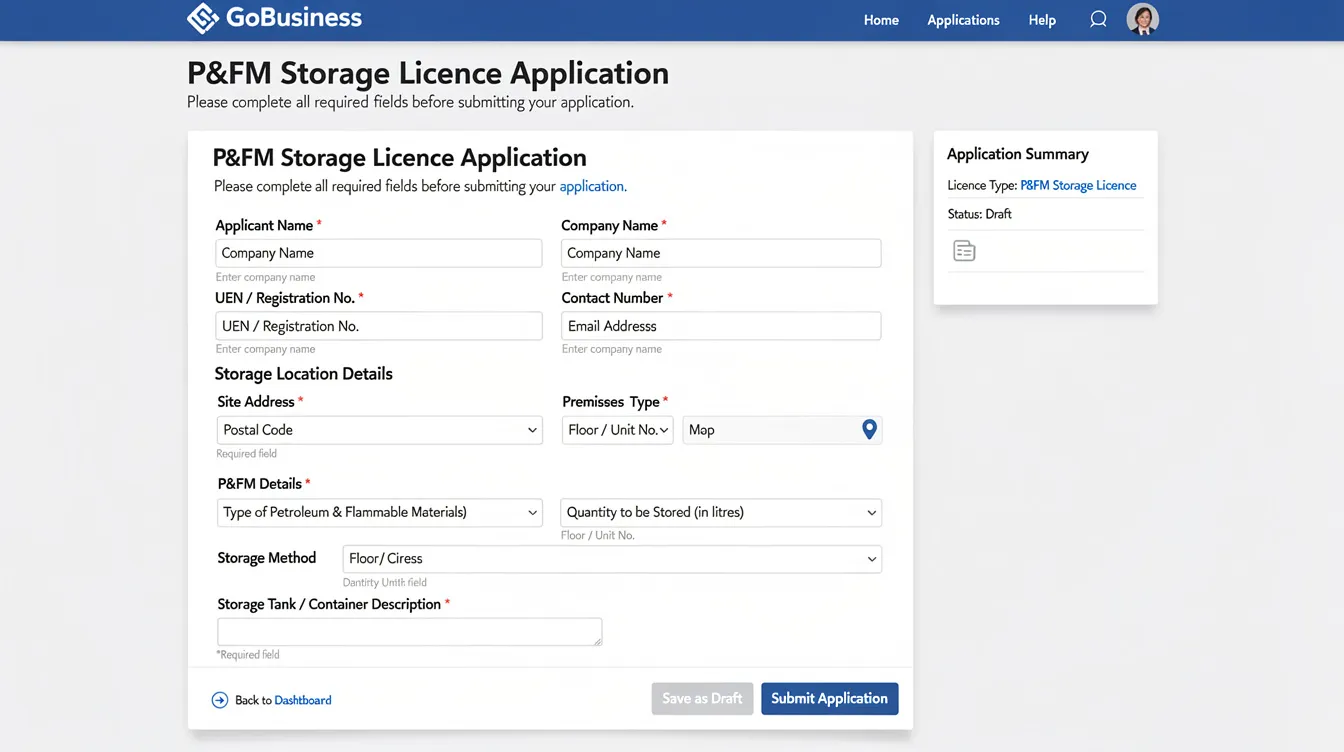
This segment provides a step-by-step walkthrough of the GoBusiness portal path for a P&FM storage licence application: UEN, Corppass login, licence type selection (“P&FM Storage”), and document upload. Applications are submitted through the GoBusiness portal, and operators engaging third-party filers must provide letters of authorisation as part of the submission.
The video places the P&FM licence within the overall fire safety approval timeline: conceptual fire safety plan approval, fire safety works clearance, Fire Safety Certificate issuance, then P&FM licence submission. A fire safety certificate is required before final submission. For high-capacity fuel systems, SCDF’s major hazards department and licensing department may both be involved, along with the Hazmat Department for scheduling the site inspection.
Video Segment 4: Pre-Inspection Readiness and On-Site Pitfalls
The final segment covers what must be physically completed on site before scheduling the SCDF inspection: tanks installed, hydrostatic and leak tests done, bunds built and tested, signage and emergency response equipment in place, venting and access clearances confirmed.
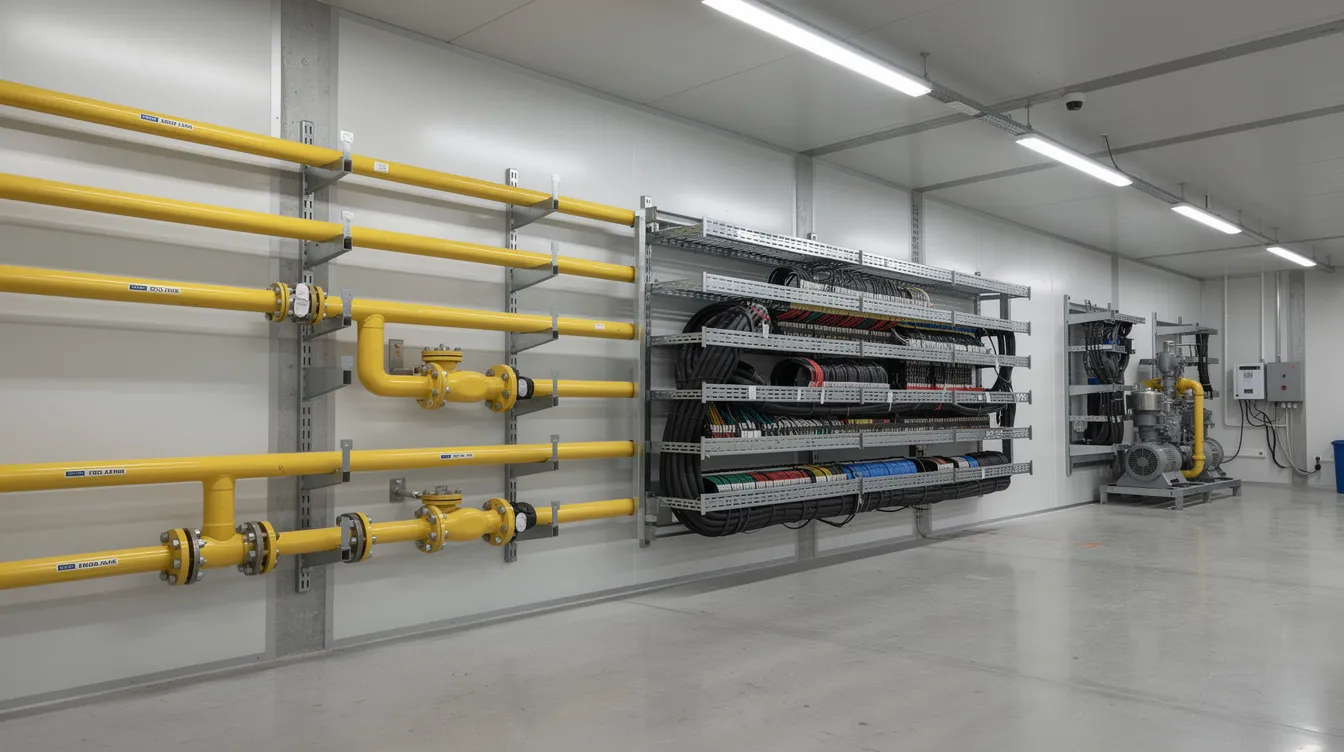
It flags typical on-site issues in data centres: cable trays blocking access to fuel tanks, inadequate ventilation in generator rooms, missing spill control measures, fuel piping running through protected cable risers without fire-rated penetrations, and incorrect labelling. Stellar Structures uses this checklist for a pre-inspection walk-through aimed at reducing SCDF non-conformities before the inspector arrives.
Visuals include photos and diagrams of correct versus incorrect tank installations in both plant room and rooftop generator yard contexts.
Step-by-Step SCDF P&FM Submission Process for Data Centre Operators
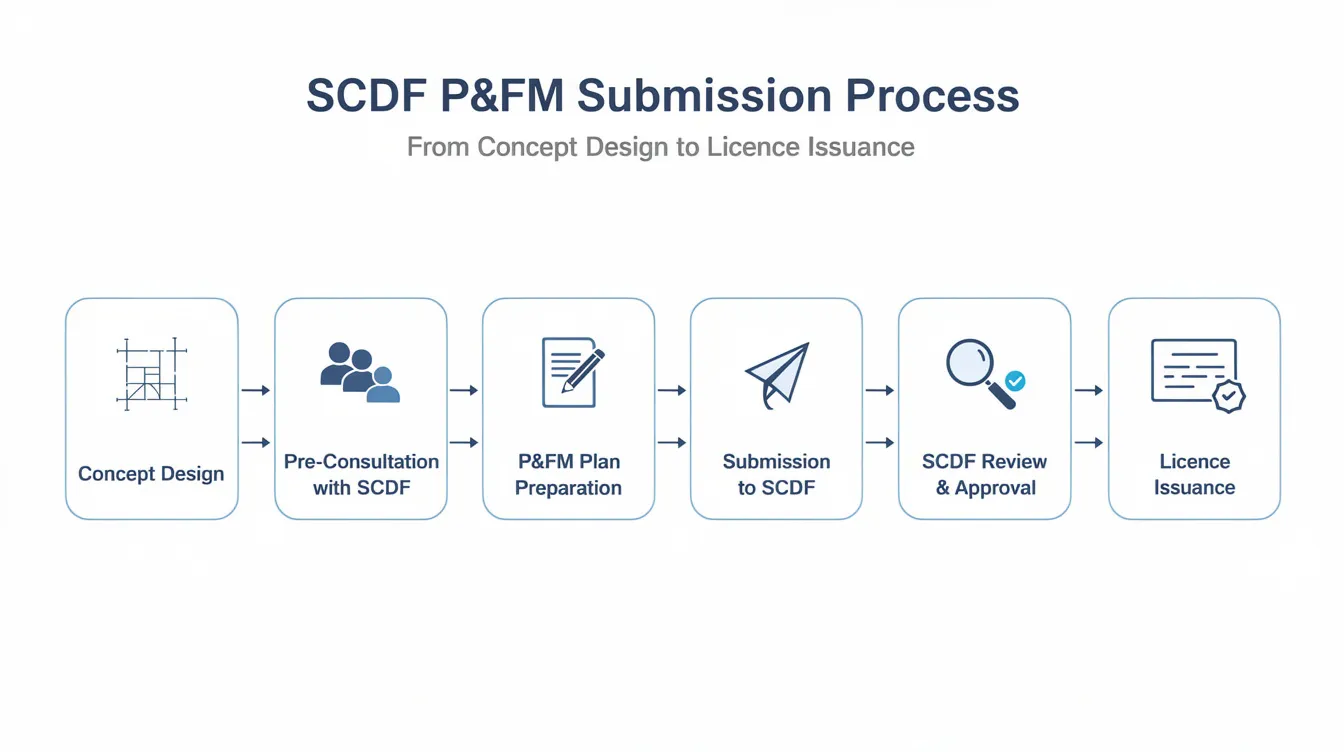
The numbered process below maps directly to the video’s timeline. Data centre teams can follow alongside the clip, pausing at each step to verify their own project status.
Procedural Checklist: From Concept to Licence Approval
-
Confirm projected total diesel and other P&FM storage quantities for full build-out. Include N+1 and N+2 generator configurations, future expansion phases, fire-pump fuel, and any ancillary flammable materials. Establish which petroleum class(es) apply, compare total storage against SCDF exemption thresholds and relevant quantity limits, and confirm whether any scheduled chemical storage is involved.
-
Engage qualified persons with data centre and P&FM experience. A qualified person must prepare and submit fire safety plans. The team should include a structural PE, M&E PE or professional engineer, and a fire safety engineer. Operators must engage a qualified person for approved fire safety plans and storage layouts.
-
Freeze preliminary tank locations, capacities, and routing at concept design. Ensure structural slab loading accommodates tanks and tanker access. Confirm separation distances from external walls, openings, and neighbouring buildings. Address blast and thermal separations at this stage; relocating tanks after structural design is locked adds cost and programme time.
-
Determine need for a quantitative risk assessment. A quantitative risk assessment may be required for large quantities of stored diesel, proximity to sensitive receptors, or other high-risk scenarios where aggregate flammable quantities exceed SCDF thresholds. The QRA focuses on diesel spill and pool-fire scenarios and their impact on adjacent occupied areas.
-
Prepare and coordinate P&FM-relevant drawings and technical documents. Required documents include site layout plans, floor plans, sections showing diesel piping rise and vent terminations, tank specifications with material and corrosion protection details, bund capacity calculations, safety data sheets for fuels, and test certificates. Operators must ensure that all relevant documents are up to date and consistent before application.
-
Submit building plans for fire safety works clearance. Plans must comply with Fire Code 2023 and SS 532:2024 (for submissions after 1 December 2024). Address SCDF design queries before starting major construction. Inconsistencies in fire safety plans and storage arrangements can lead to application delays or rejections.
-
Construct and install tanks, piping, vents, emergency shut-offs, and bunds in strict accordance with approved plans and SS 532. Secondary containment must hold at least 110% of the largest tank’s capacity to prevent spills. SCDF requires professional endorsements for certain storage tanks and systems, particularly those over 250 litres.
-
Conduct inspections and tests. Hydrostatic tests, leak tests, functional checks of fuel transfer and emergency shutdown systems. Compile reports dated close to commissioning.
-
Engage a registered inspector to certify that on-site installation matches approved drawings and fire safety requirements. Registered inspectors remain responsible for confirming that physical conditions match the approved building plans.
-
Submit the P&FM storage licence application via GoBusiness with all supporting documents, then host the SCDF site inspection. Operators must prepare a comprehensive emergency response plan as part of the licence application. SCDF typically responds within about 19 working days after submission and site inspection if the application is complete and the inspection passes.
-
Rectify any non-conformities raised. Submit evidence of rectification (photos, retest reports). Upon SCDF’s satisfaction and successful payment of the applicable fees, the P&FM storage licence is issued, valid for up to three years depending on risk category. Fees scale with the quantity of materials stored: for example, storing up to 500 litres costs S$184 per year, while storing between 50,001 and 250,000 litres costs S$862 per year.
Each step in the article references the corresponding timestamp in the video where it is demonstrated.
Coordinating Between Stakeholders During the Process
Coordination checkpoints that should run in parallel with the procedural steps:
-
Internal alignment between data centre operations, project development, and EHS teams on design intent and risk appetite. The operator’s emergency response plan and safety protocols must reflect the actual storage configuration.
-
Regular design coordination meetings involving the qualified person, structural engineer, M&E consultant, and fire safety consultant to close P&FM design issues before they become site conflicts. These meetings should address fire risks, ventilation, and fuel piping routing through high-density technical floors.
-
Engagement with landlords and adjacent facility owners. If the data centre sits on a JTC site, JTC submission requirements for diesel storage may impose additional boundary conditions. Adjacent operators sharing infrastructure or access roads need to be consulted on tanker movements and separation distances.
-
National Environment Agency coordination. Where hazardous substances overlap with NEA permit requirements, operators must ensure parallel submissions do not conflict. Multiple regulatory bodies may have jurisdiction over the same chemical storage.
Comparing New-Build vs Live-Site Upgrade Submissions
Greenfield data centres integrate P&FM licensing with overall building plan approvals. The fuel system design is part of the initial fire safety works submission, and the P&FM storage licence follows after construction and inspection. Drawings, QRA, and test reports are produced as part of a single coordinated programme.
Brownfield or live-site retrofits face additional layers. Adding three new generator sets with a day tank on a rooftop mechanical floor of an operating facility requires phased cut-over plans, temporary fuel connections under temporary P&FM arrangements, and hot-work controls with method statements and risk assessments. Documentation focus shifts: beyond the standard drawing package, SCDF expects method statements for tie-ins to existing fuel systems and evidence that safety measures maintain operational integrity during construction. Mixed storage scenarios may arise where existing fuel quantities plus new additions push the facility into a different fee or licensing band.
If you are retrofitting, watch Video Segments 2 and 4 with particular care, since design clashes with existing cable trays and ventilation are the most common cause of rework in live-site P&FM projects.
Technical and Documentation Requirements for Data Centre P&FM Licensing
Incomplete or mismatched documents are the top cause of SCDF queries for data centre P&FM submissions. A drawing that shows a 50,000-litre tank while the licence application form states 40,000 litres will generate a query that costs at least two weeks. This section provides the documentation mini-checklists that correspond to the video’s second segment.
Drawings and Engineering Details SCDF Expects to See
SCDF expects the following drawing types, tailored here to data centre submissions:
-
Overall site layout showing bulk tank and day tank locations, tanker truck access routes, and separation distances to site boundaries and occupied buildings. Any point in the building plan must be within 60 m travel distance of a fire engine access road.
-
Generator plant room and fuel tank room floor plans with indications of fire-rated enclosures, doors, escape paths, and ventilation openings.
-
Sections and elevations showing diesel piping rise, vent terminations (location relative to air intakes and openings), and interfaces with structural slabs and cable risers.
-
Construction details of bunds, including materials, floor gradients, leak detection pits, and capacity calculations. Bund capacity must be at least 110% of the largest tank.
-
Tank particulars: material, wall thickness, double-wall construction where required, corrosion protection (coatings or cathodic protection), and standards used (SS 532, NFPA equivalents, BS, or UL).
Screenshots from the video visually match this checklist, reinforcing each requirement with annotated drawing examples.
Supporting Reports, Calculations, and Certificates
Key documents to compile:
-
Tank and pipe pressure-test or leak-test certificates dated close to commissioning.
-
Bund capacity calculations (110% of largest tank or as per SS 532 / SCDF requirements).
-
QRA report (if applicable), focusing on diesel spill and pool-fire scenarios and impact on adjacent buildings and potential hazards to occupied areas.
-
Safety data sheets for fuels and any other flammable materials stored on site.
-
Certificates of compliance for fuel pumps, vents, and valves; manufacturer product data; welding and fabrication drawings.
-
Fire performance test reports for fuel pumps or vent stacks under fire exposure, where applicable.
Stellar Structures often coordinates these deliverables for clients into a consolidated submission pack, reducing the chance of gaps that trigger SCDF queries.
Digital Submission Hygiene on GoBusiness
A mini-checklist for avoiding portal-related delays:
-
Use consistent project naming, address, and UEN across the fire safety certificate application, building plan approvals, and P&FM licence submissions. Mismatches between these records generate queries.
-
Ensure file naming and drawing numbers in uploaded PDFs match the title blocks inside the drawings and the indices referenced in registered inspector reports.
-
Upload clear, legible scans with all regulated components properly labelled: tank class, capacity, vent discharge point, bund outline, fuel piping, fuel pumps, gas cylinders.
-
Organise files by category (drawings, risk assessments, test reports, SDSs). Avoid scanned low-quality images that are unreadable when SCDF officers zoom in.
The video includes a brief “good versus bad” comparison of document organisation on the GoBusiness portal.
Common Data Centre-Specific Challenges and How the Checklist Helps
Data centres operate under constraints that make P&FM compliance harder than for a typical industrial premises: tight urban sites, high power density per square metre, and 24/7 uptime requirements that rule out simple shutdowns. The video checklist is structured around the four most frequent pain points.
Challenge 1: Squeezed Space for Diesel Storage on Urban Sites
Urban data centres in Singapore often have limited setbacks, no space for above-ground bulk tanks, and neighbours close to the property boundary. Underground tanks require structural slab reinforcement, driveway load analysis for tanker access, and corrosion protection measures that add cost and coordination time.
Early use of the checklist prompts teams to evaluate trade-offs between underground, podium-level, and vertical-stacked tank configurations before committing to a layout that cannot meet separation distances. Reviewing this at concept design, per Video Segment 1, prevents late-stage redesigns that ripple into structural design changes.
Challenge 2: Routing Fuel Piping Through High-Density Technical Floors
Technical floors in data centres are dense with bus ducts, chiller pipes, structured cabling, and HVAC ductwork. Introducing diesel fuel piping into that environment creates clashes: fire-rated penetrations through cable risers, slope and venting requirements for fuel mains, and spatial conflicts with existing services.
The checklist enforces 3D coordination reviews with clash detection focused on P&FM runs. It also flags that fuel piping must not pass through protected cable risers unless fire-rated seals are installed, a requirement that is missed in roughly one in three retrofit submissions Stellar Structures reviews.
Challenge 3: Maintaining Uptime During Retrofits and Capacity Upgrades
Adding generators or tanks to a live data centre means working around energised systems. Temporary fuel connections, hot-work controls, isolation zones, and phased shutdowns all need method statements. If temporary fuel storage exceeds exemption thresholds, a temporary FM storage licence arrangement may be required.
Operators can use the checklist to plan staged works acceptable to SCDF: identify which generators remain online, which fuel lines are isolated, what temporary safety measures are in place, and how the phased programme aligns with inspection scheduling. Video Segment 4 covers this scenario in detail.
Challenge 4: Misalignment Between Global Standards and Local SCDF Rules
Global data centre operators often design to NFPA or corporate fire safety standards. Singapore’s fire code and flammable material storage requirements under SS 532:2024 differ in specific ways. For instance, SS 532:2024 no longer requires vapour barriers in some cases previously mandated under SS 532:2016, and non-metallic containers may now be permitted under certain conditions. Flash point classification boundaries and exemption quantities also differ from NFPA definitions.
The checklist and video flag areas where overseas reference designs commonly clash with SCDF expectations, prompting early design adjustments. Understanding these gaps before submission prevents costly redesigns after SCDF issues queries on non-compliant tank specifications or separation distances.
Conclusion and Actionable Next Steps
Data centre P&FM licensing follows a predictable process: quantify storage, engage the right professionals, design to SS 532 and fire code requirements, submit clean documentation through GoBusiness, pass the site inspection. Non-compliance can lead to fines up to $200,000, and daily fines can reach $25,000 for ongoing violations. Serious breaches may lead to prosecution and legal charges; one company paid $21,000 for failing to fix compliance issues. Unauthorized fire safety work can result in hefty penalties. The video checklist compresses the learning curve by showing each step with real examples, so your first submission is as complete as possible.
Do this next:
-
Share the video and checklist internally with your data centre design and operations leads.
-
Run through the checklist against your current or planned diesel system design and identify gaps in storage quantities, drawings, and test documentation.
-
Schedule a pre-submission review with a qualified person and, if desired, Stellar Structures for a design and documentation audit.
-
Align your P&FM submission timeline with overall project milestones (structural completion, M&E installation, FSC application) to avoid critical-path delays.
Related topics worth exploring next include fire safety certificate requirements for data centres, SS 532 versus SS 641 distinctions for different flammable liquid categories, and JTC and NEA interfaces for industrial sites where multiple regulatory bodies review the same premises.
Additional Resources and Visual Aids
-
Downloadable one-page printable version of the P&FM data centre checklist (PDF).
-
SCDF’s official P&FM licensing page and GoBusiness guide for storage licences.
-
High-level diagram of a compliant data centre diesel system annotated with P&FM-regulated components.
-
Contact Stellar Structures for a P&FM readiness review or design optimisation workshop.
FAQ: SCDF P&FM Licence Submission for Data Centre Operators
These FAQs address the most common questions data centre owners and operators ask before starting their first P&FM submission.
Do all data centres in Singapore need an SCDF P&FM storage licence?
Most Tier III and Tier IV facilities and colocation data centres do, because their diesel reserves for standby generators and fire pumps exceed the Class III exemption threshold of 1,500 litres. A small edge deployment or in-building server room with a single day tank under that limit and no scheduled chemicals may fall under exemption. Operators should always verify projected stored quantities against current SCDF exemption thresholds before assuming no licence is needed. Mixed storage limits apply when multiple petroleum classes or solid/liquid/gas combinations are present: for example, the aggregate limit for mixed solids drops to 20 kg, and liquid exemption falls to 40 litres.
At what project stage should data centre teams watch the checklist video?
The ideal time is during early concept or schematic design, before tank locations and generator layouts are locked. Watch it again just before GoBusiness submission as a final cross-check of required documents, drawing completeness, and digital submission hygiene.
How long does it typically take to obtain a P&FM storage licence for a data centre?
The SCDF P&FM storage license application typically takes about 19 working days from submission and site inspection, assuming complete documentation and a clean inspection outcome. Design queries, missing test certificates, or rectification works after inspection can extend the timeline by weeks or months, and the licence is issued only after SCDF completes its review and receives successful payment. Following the checklist keeps the first submission as complete as possible and reduces the chance of back-and-forth with SCDF’s licensing department.
What happens if SCDF finds non-compliance during inspection?
SCDF may issue directions for rectification, require additional tests, or in serious cases issue enforcement notices. Non compliance delays licence approval and generator energisation. Regular inspections after licence issuance also apply; the licence is valid for up to three years, and SCDF can revoke it if conditions on the licensed premises deteriorate. Using the checklist for a pre-inspection walk-through catches obvious issues (blocked vents, missing signage, bund defects, inadequate workplace safety measures) before the formal visit.
How can Stellar Structures support data centre operators with P&FM submissions?
Stellar Structures reviews and optimises fuel system designs for SCDF and fire code compliance, focusing on fire safety standards specific to mission-critical facilities. The firm prepares or coordinates drawings, reports, and test documentation required for P&FM licensing. It conducts pre-inspection audits and accompanies operators during SCDF visits where appropriate. For projects involving complex or high-capacity fuel systems, Stellar Structures provides integrated engineering and authority-submission consultancy across BCA, URA, SCDF, JTC, and related agencies.
If your project involves data centre diesel systems, conduct evacuation fire drills planning, or multi-agency submissions where SCDF interfaces with the national environment agency, reach out for a scoping discussion.