




Risk Management Facilitator RMF for Commercial Construction Sites Cost Guide in Singapore (2025)
Introduction
Appointing a risk management facilitator (RMF) on commercial construction sites in Singapore typically costs between S$5,000 and S$12,000 per month, or S$50,000 to S$360,000 as a project lump sum, depending on scale and complexity. These figures represent 2025 market benchmarks for offices, retail developments, mixed-use towers, and business parks – the core commercial segment where risk management facilitation has become a defined cost line item rather than an afterthought.
This guide focuses specifically on what developers, main contractors, facility owners, and project managers should expect to spend when engaging an RMF for commercial building projects in Singapore. Industrial, residential, and pure infrastructure costs may differ and fall outside this scope. Whether you are preparing a tender, reviewing a consultant’s proposal, or justifying RMF investment to stakeholders in your company, understanding these cost dynamics is essential for both regulatory compliance and project success.
The cost of hiring a risk management facilitator depends on project complexity and duration, but the spend is ultimately an investment in predictable delivery. Under the Workplace Safety and Health Act, risk assessments must be conducted for all workplace safety risks, and employers must maintain risk assessment records for at least three years. Failure to comply can lead to severe legal repercussions for contractors, and those records must be produced to the Commissioner upon request, including fines, demerit points, and stop-work orders that dwarf any RMF fee.
Here is what you will learn from this guide:
- Typical RMF fee structures and indicative cost ranges for small, medium, and large commercial projects
- The key factors that drive RMF costs higher or lower on your specific project
- How to build an accurate RMF budget line item at tender stage
- Cost comparison between engagement models and where real cost savings lie
- How Stellar Structures approaches RMF pricing for commercial construction clients
Understanding the Risk Management Facilitator (RMF) Role in Commercial Construction
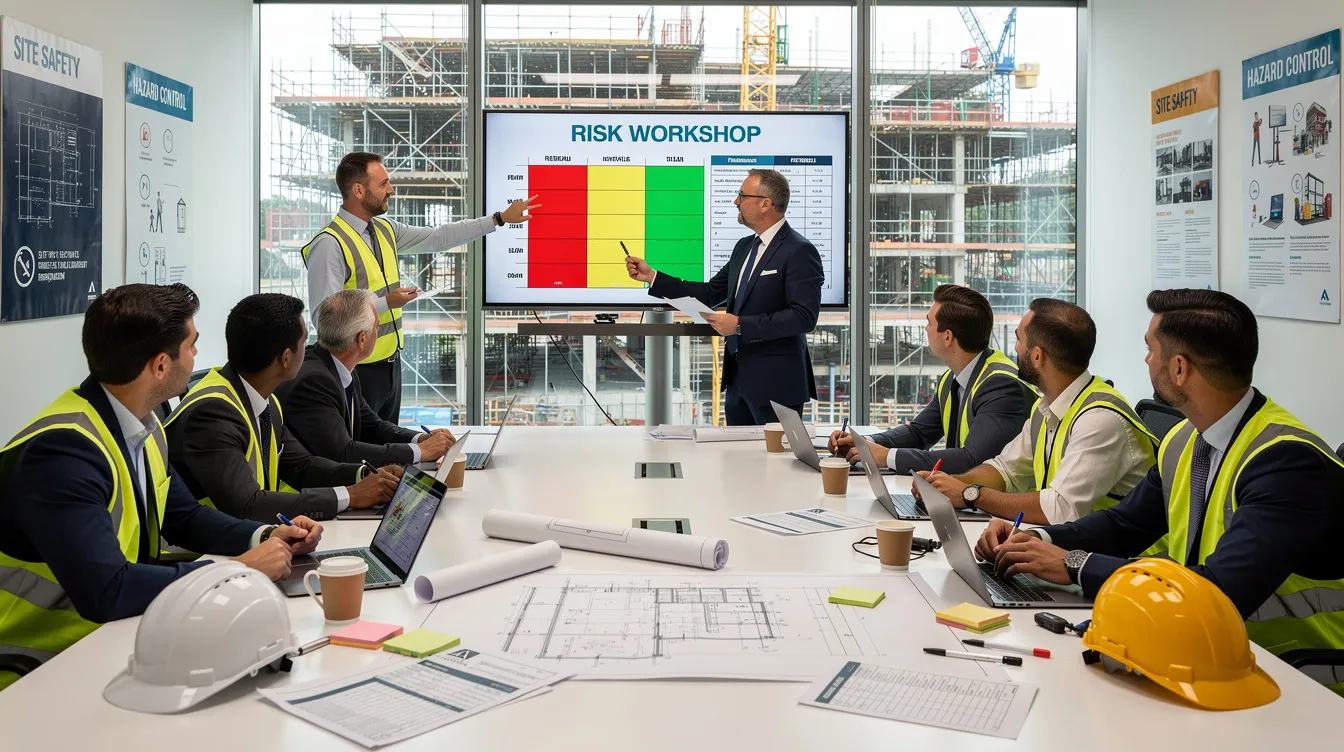
A risk management facilitator in Singapore’s commercial construction industry is not a generic safety consultant. The RMF is the professional who structures the risk process for decision-making on controls – leading multidisciplinary teams through systematic hazard identification, risk assessments, and the implementation of control measures across every project phase. The difference between an RMF and a standard Workplace Safety and Health Officer (WSHO) is significant: while a WSHO manages day-to-day site safety operations, the RMF facilitates the structured assessment and design-for-safety (DfS) process that shapes how risks are identified, evaluated, and eliminated before they reach the site.
This distinction matters for cost planning. The RMF role demands a combination of engineering knowledge, facilitation skills, and deep familiarity with regulatory requirements – a skill set that commands higher fees than standard safety supervision. As public sector tendering criteria place greater weight on safety submissions and DfS documentation, and as private developers increasingly adopt similar standards, the RMF has moved from “nice-to-have” to a core professional appointment on most sizeable commercial projects.
Core Responsibilities of an RMF on Commercial Sites
A risk management facilitator on a commercial construction site typically handles the following:
- Facilitating risk assessment workshops with designers, engineers, contractors, and safety officers at each project stage – from concept design through commissioning and handover
- Leading hazard identification sessions to systematically catalogue risks associated with construction methods, sequences, and site conditions
- Maintaining a live risk register and DfS register, updating them whenever design changes or method revisions occur
- Advising on method statements and permit-to-work (PTW) systems for high-risk works such as deep excavation, crane lifts in dense urban zones, façade installation at height, and complex M&E heavy lifts
- Coordinating with Qualified Persons (structural, civil, architectural), safety supervisors, major subcontractors, and regulatory authorities
- Ensuring documentation meets statutory and contractual standards – including records for WSH risk management regulations, DfS submissions, and audit trails
For commercial buildings specifically, site-specific tasks frequently include managing risks around tower crane operations over public footpaths, façade access systems on high-rise towers, work within or adjacent to operational malls and offices, deep basement construction near MRT structures or critical utilities, and mechanical ventilation requirements in confined spaces.
These responsibilities translate directly into time commitment – and therefore cost. The number of workshops, site inspections, coordination meetings, and documentation cycles determines how many hours an RMF must dedicate to your project. Larger construction projects require more facilitation time than smaller projects, and high-risk projects require more frequent site inspections and additional risk workshops.
Legal and Contractual Drivers of RMF Engagement
Regulatory frameworks, like the WSH (Risk Management) Regulations, dictate risk management responsibilities for all workplace activities. The Workplace Safety and Health Act mandates risk assessment, and in the bizSAFE context the Risk Management Champion may attend the WSQ course “Develop a Risk Management Implementation Plan,” while RMFs must maintain risk assessment records for at least three years. These statutory requirements influence risk management facilitation across the entire Singapore construction industry.
The RMF ensures compliance with the Workplace Safety and Health Act, and the bizSAFE program operationalizes risk management in Singapore by requiring a Risk Management Champion for compliance. A Risk Management Facilitator is also legally required for PUB projects, including sewer works, where RMFs must ensure compliance with PUB’s Codes of Practice. For example, works that obstruct a drainage reserve can trigger PUB code-compliance requirements that the facilitator must address early in planning.
Beyond statutory obligations, contractual and commercial arrangements can influence facilitator fees in construction. Public and large private developers increasingly write RMF and DfS facilitation requirements into pre-qualification and tender documents. Typical contract clauses now specify evidence of risk workshops, DfS review records, and a named risk management champion. For projects with contract sums of S$10 million or more, Design for Safety Regulations apply, mandating design risk elimination and reduction with documented review meetings.
This means RMF is no longer an optional overhead – it is a defined line item in project preliminaries that directly affects tender competitiveness. Understanding this is the first step toward budgeting accurately.
How RMF Services Are Priced for Commercial Construction Projects
Knowing what an RMF does establishes the basis for understanding how those activities are typically priced. In Singapore’s commercial construction market, RMF fees are structured in several ways, often combined depending on the project stage and the client’s preferred engagement model.
Common Fee Structures
There are four primary pricing models in practice for RMF services:
- Hourly or daily rates – Used for ad-hoc workshops, incident risk reviews, or short consulting assignments. In 2025, expect daily rates of several thousand dollars for experienced facilitators, with facilitators with specialized certifications commanding higher fees in the construction industry. This model suits projects needing occasional expert input rather than continuous presence.
- Monthly retainer – Common for projects requiring ongoing RMF presence. The retainer covers a defined number of site visits, workshops, and coordination meetings per month. This provides budget certainty and ensures regular monitoring of identified hazards and control measures.
- Lump-sum per project – A fixed fee covering the entire RMF scope for a defined project lifecycle (e.g., one DfS study, a set number of workshops, specified submissions over a 24-month programme). This is popular with contractors who want cost certainty at tender stage.
- Hybrid models – A base retainer plus variable charges for additional workshops, night work sessions, or scope extensions triggered by design changes. This balances predictability with flexibility and is increasingly common on medium-to-large commercial projects.
The amount of documentation required by a facilitator affects their overall fees. Projects demanding ISO 45001–aligned records, detailed audit trails, or corporate global EHS documentation standards will cost more than minimal-compliance engagements.
Indicative Cost Ranges for Different Project Scales
Site size and value influence the need for risk management facilitation in construction. Here are realistic 2025 planning benchmarks for three common commercial project types in Singapore:
Small projects (contract value below S$10 million) – A neighbourhood retail mall addition-and-alteration (A&A) or a low-rise commercial office fit-out with limited high-risk works. RMF involvement is typically part-time and workshop-based, with an external consultant engaged for specific design reviews and method statement assessments. Indicative total RMF fee: S$50,000–S$100,000 over the project lifecycle, or roughly S$5,000–S$7,000 per month during peak construction phases.
Medium projects (S$10 million–S$80 million) – An 8–10 storey business park development with moderate complexity, standard basement, and typical façade systems. The RMF is engaged on a part-time retainer with periodic workshops and site walks. Indicative range: S$6,000–S$8,000 per month during active phases, or S$120,000–S$200,000 as a lump-sum fee for the full project scope.
Large projects (above S$80 million) – A 30-storey CBD office tower with three basement levels, complex façade, multiple tower cranes, and significant public interface. This demands a senior RMF embedded full-time or on a comprehensive long-term retainer covering the entire programme. Indicative range: S$9,000–S$12,000 per month, with total RMF fees over a 30-month project reaching S$250,000–S$360,000.
These are planning benchmarks, not quotations. Actual fees depend on detailed scope definition, risk profile, and the specific deliverables agreed between parties.
Breakdown of What You’re Paying For
When evaluating an RMF fee proposal, understanding the main cost components helps you assess whether a quotation represents best value:
- Planning and document review time – Reading drawings, specifications, method statements, and soil investigation reports before workshops
- Facilitation hours – Leading risk assessment workshops, DfS review sessions, and hazard identification meetings with project teams
- Site inspections – Verification walks to confirm controls are implemented and to identify new hazards as construction progresses
- Reporting and risk register updates – Producing workshop minutes, updating risk registers, preparing safety submissions and compliance documentation
- Coordination with QP, WSHO, and subcontractors – Aligning risk controls with design intent and site procedures
- Administrative and compliance documentation – Maintaining the records that employers must keep for at least three years under statutory requirements
Non-obvious cost items that clients often forget to budget for include additional workshops triggered by design changes, temporary works risk reviews, constructability review inputs, and risk assessments for mock-ups or prototyping. A practical budgeting example is a project team that trims these line items early, then has to add them back later when design changes or site conditions expose gaps. A “cheap” RMF engagement that skips these activities may produce cost savings on paper but increases residual risk – and some companies simply cannot afford to make that trade-off if they want real risk reduction rather than false savings.
Key Factors That Influence RMF Costs on Commercial Projects
Two commercial projects with identical contract sums can have dramatically different RMF costs. The difference comes down to risk profile, management complexity, and the specific demands each project places on facilitation resources. Understanding these factors helps you justify and compare quotations from different vendors.
Project Size, Duration, and Complexity
The built-up area, number of storeys, and presence of basements directly determine how many risk scenarios must be reviewed. A single-storey retail shell-and-core presents far fewer hazards than a multi-tower mixed-use development with three basement levels, complex structural transfers, and integrated podium.
Duration matters equally. Projects lasting more than 24 months require more cycles of risk review as construction activities, manpower configurations, and subcontractor interfaces change over time. Each new phase – from piling to superstructure to façade to fit-out – brings different risks requiring fresh assessment.
Special construction methods act as complexity multipliers: top-down basement construction, heavy structural steel erection, complex cantilever structures, and projects requiring geotechnical engineering input for challenging soil conditions all increase the number and depth of risk workshops needed.
Commercial projects in dense urban locations – CBD, Orchard Road, regional centres – tend to demand more coordination with adjacent landowners, transport authorities, and the public, adding to the RMF’s time commitment and therefore cost.
Risk Profile, Risk Assessments, and High-Risk Activities
Projects involving high-risk activities require higher-level risk assessments. Common high-risk works in commercial construction that drive RMF effort include:
- Deep excavation near MRT structures or critical utilities, where soil stability and adjacent structure monitoring are paramount
- Heavy tower crane operations and tandem lifts in congested sites, requiring detailed lift planning and PTW integration
- Façade and curtain wall installation at height and over public footpaths, demanding fall protection and exclusion zone planning
- Work over live roads or within operational malls and offices, where public interface creates additional hazard layers
- Confined spaces in basement construction and service tunnels, which pose significant hazards requiring specific risk controls, hazardous atmospheres assessment, and appropriate technology to verify gas detection and related safety measures
Each additional high-risk activity category means more detailed risk assessment workshops, more site verification visits, more PTW system integration, and more documentation – all of which influence the fee level.
Stakeholder and Interface Complexity
The number of stakeholders involved in a project directly affects the facilitation workload. A straightforward new-build on a greenfield business park site involves primarily the developer, main contractor, and design team. By contrast, an A&A project within an operating shopping mall involves the asset owner, multiple existing tenants, the operations and maintenance team, adjacent landowners, and potentially several authorities – each with different risk tolerances and coordination requirements.
Extensive interfacing scenarios – night work in live buildings, phased handovers to tenants, concurrent fit-out works – increase the RMF’s time commitment for coordination meetings, additional risk workshops, and documentation preparation. These are real cost drivers that should be mapped early in project planning.
Regulatory Compliance, Certification, and Documentation Requirements
Added cost arises when clients seek specific certifications or documentation standards beyond minimum statutory compliance. The bizSAFE program requires a Risk Management Champion for compliance, and many commercial developers pursue bizSAFE Star certification, which demands thorough, auditable RA documentation. Alignment with ISO 45001 management system documentation, or compliance with a multinational client’s global EHS standards, significantly increases the facilitation workload.
Government-linked entities and public sector clients often demand the highest documentation standards, with detailed audit trails for every risk workshop, control decision, and register update. This level of rigour is achievable but requires the RMF to allocate proportionally more time to preparation, reporting, and records management.
Cost Comparison: RMF Engagement Models for Commercial Sites
Clients can choose between several engagement models for RMF services, each with distinct cost profiles and risk trade-offs. Understanding these options helps you select the approach that delivers the best value for your project’s specific needs and budget.
Typical Engagement Options and Their Cost–Benefit Profiles
| Criterion | Basic Compliance-Only RMF | Integrated RMF with Design & Construction Support | In-House RMF with External Review |
|---|---|---|---|
| Typical Cost Level | $ (Lowest) | $$$ (Highest) | $$ (Mid-range) |
| Fee Structure | Lump sum for minimum workshops and documentation | Monthly retainer or lump sum covering full lifecycle, all phases, comprehensive workshops | In-house salary (S$8,000–S$12,000/month) plus periodic external review fees |
| Scope Included | Minimum RA documentation, basic register, limited site visits | Full DfS facilitation, ongoing risk register, method statement review, site walks, PTW input, coordination | Daily operations handled internally; external specialist validates and audits |
| Legal Defensibility | Low – may not withstand regulatory scrutiny after an incident | High – comprehensive, well-documented, independently facilitated | Medium – depends on internal competence and external review depth |
| Accident Reduction Potential | Limited – risks may remain inadequately controlled | High – continuous improvement cycle, early hazard mitigation | Moderate – depends on in-house skills and independence |
| Best Suited For | Very small, low-risk projects with minimal public interface | Large or complex commercial projects, CBD towers, projects with significant high-risk works | Established contractors with WSQ-trained teams on medium-complexity projects |
For small commercial projects with low complexity, a basic compliance approach may serve adequately, provided the facilitator is genuinely competent and the risk profile is straightforward. For medium and large projects – particularly those in high-risk urban environments – an integrated RMF model almost always delivers better value over the project lifecycle.
In-house WSQ-trained RM Champions are suitable for daily site operations in construction, but external specialist consultancies provide dedicated Risk Management Facilitators for high-risk construction where independent facilitation, specialist technical knowledge, and regulatory credibility are paramount. The choice between models should be driven by risk profile, not solely by upfront cost.
Direct Costs vs Indirect Savings
RMF fees must be weighed against the indirect costs they help avoid:
- MOM fines and demerit points – A serious WSH offence can result in fines of tens of thousands of dollars, demerit points affecting future tender eligibility, and reputational damage that takes years to recover from
- Stop-work orders – A one-week crane incident delay on a CBD office tower can cost S$200,000–S$500,000 in programme delay, idle manpower, equipment rental, and liquidated damages – several times an entire project’s RMF fee
- Reputation and business impact – A major accident on a commercial project can damage relationships with blue-chip tenants, institutional investors, and government agencies, affecting the company’s ability to win future work
Consider this scenario: a 30-storey commercial tower with a total RMF investment of S$300,000 over 30 months. A single serious lifting incident causing a two-week stoppage could easily cost S$400,000–S$800,000 in direct and indirect losses – before accounting for potential legal liability, increased insurance premiums, and MOM enforcement action. The RMF fee is not overhead; it is risk reduction investment that pays for itself many times over when it prevents even one significant incident.
Budgeting RMF Costs in a Commercial Construction Tender
Accurate RMF budgeting at tender stage prevents costly surprises during construction. Too many contractors allow a token sum for risk management facilitation, only to discover that the actual scope demands substantially more resources. Here is how to build a realistic cost line item.
Step-by-Step: How to Build an RMF Cost Line Item
- Estimate project duration and phases – Map the programme from design through pre-construction, construction, commissioning, and handover. Identify which phases require RMF involvement (typically all, with varying intensity).
- Identify high-risk packages – Catalogue elements such as basement excavation, superstructure, façade installation, M&E heavy lifts, temporary works, and any work in confined spaces or over live environments.
- Estimate the number of risk workshops and reviews per phase – Design stage may need 3–5 DfS workshops; pre-construction requires method statement risk reviews for each major trade; construction demands periodic risk register updates and PTW reviews.
- Assign realistic hours per workshop – Include preparation time (reviewing drawings and specifications), facilitation time, and follow-up documentation. A single substantial workshop typically requires 8–16 hours of total RMF effort including preparation and reporting.
- Apply a suitable rate or package price – Use the indicative ranges from this guide to derive a budget allowance, then validate against market quotations from at least two providers.
This process directly connects to the fee structures discussed earlier. For lump-sum pricing, aggregate the total estimated workshops and site visits across all phases. For retainer models, estimate the average monthly effort and apply the appropriate monthly rate range.
Coordinating RMF Costs with Other Professional Fees
RMF scope overlaps and interfaces with several other professional appointments:
- Qualified Person (Structural / Civil / Architectural) – The QP(S) addresses structural design safety, while the RMF facilitates broader risk assessment across all trades. Clear demarcation prevents duplication.
- Design for Safety Professional – On projects where a DfS Professional is separately appointed, the RMF and DfS roles must be coordinated. In practice, many firms (including Stellar Structures) combine both functions for efficiency.
- WSHO and safety supervisor teams – The principal contractor’s safety team manages daily compliance; the RMF provides the structured risk assessment framework they operate within.
To avoid duplication or gaps – both of which waste money – include a clear “RMF scope matrix” in the contract that specifies who does what, who attends which meetings, and who is responsible for which documentation. This achieves clarity on cost allocation and prevents disputes during construction.
Cost Control Tactics Without Compromising Workplace Safety
Keeping RMF spend efficient without undermining safety outcomes requires smart planning:
- Combine related activities into fewer, well-structured workshops – Rather than scheduling separate sessions for each trade, batch related risk assessments into comprehensive workshops that cover multiple work packages
- Use digital collaboration tools – Digital risk management platforms standardize hazard tracking across construction teams, and online risk registers with software for real-time updates reduce the need for physical meetings during design-stage reviews
- Front-load risk reviews during design – Early engineering consultation gives the RMF more leverage to eliminate hazards cost-effectively through design changes, reducing rework and ad-hoc site visits later
- Avoid false economies – Asking internal production staff with conflicts of interest to “self-facilitate” risk assessments saves money upfront but undermines independence, produces weaker risk controls, and creates legal vulnerability. This approach is wrong for any project with meaningful risk exposure.

Common Cost-Related Challenges and How to Address Them
Stellar Structures regularly encounters recurring problems when clients plan or manage RMF budgets on commercial projects. These challenges are preventable with the right approach.
Underestimating RMF Scope at Tender Stage
A common situation: the contractor allows a token sum for RMF in the tender, perhaps S$30,000 for a medium-complexity project that actually requires S$150,000 of facilitation effort. When the project begins, the actual need for multiple workshops, regular site walks, PTW integration, and detailed documentation becomes apparent.
The consequences include variation order disputes, pressure on the RMF to “do less,” and diluted risk reviews that leave the project exposed. Facilitator qualifications significantly affect their rates in construction projects, and an inadequately budgeted engagement often results in engaging someone less experienced – increasing rather than reducing risk.
Solution: Use the factors and step-by-step budgeting process outlined in this guide as a checklist. Better yet, consult an experienced RMF firm during bid preparation for a quick scope review – the cost of a preliminary consultation is negligible compared to the risk of a materially wrong budget allowance.
Late Appointment of the RMF
Appointing an RMF only at construction commencement – rather than during design or pre-construction – is a frequent and costly mistake. The Hierarchy of Control mandates eliminating risks at the source, which is most effectively achieved during design. A late-appointed RMF must retrofit risk assessments onto designs that are already frozen, produce risk registers from scratch under time pressure, and schedule catch-up workshops that disrupt the construction programme.
The cost implications are significant: redesign of methods, rework of risk registers, additional workshops to cover ground that should have been addressed months earlier, and residual risks that could have been designed out entirely.
Solution: Build RMF costs into the early design budget. Integrate the facilitator into value-engineering and buildability reviews from concept stage. The earlier the RMF is engaged, the greater the ability to influence design decisions that reduce both risk and downstream cost.
Misalignment Between Client Expectations and RMF Contract
This challenge arises when the written RMF scope is minimal – perhaps specifying four workshops and monthly site visits – but the client expects extensive on-site presence, weekly coordination meetings, detailed method statement reviews for every trade, and audit-ready documentation for each risk workshop.
The result is billing disputes, scope creep without compensation, and an eroded professional relationship that undermines the collaborative environment essential for effective risk management.
Solution: At award stage, jointly define clear deliverables – the specific number of workshops, site visits, reports, and documentation formats – and link the fee directly to these in a transparent schedule. Any additional services beyond the agreed scope should have pre-agreed unit rates so that both parties understand the cost implications of scope changes.
Stellar Structures’ Approach to RMF Services and Pricing
Stellar Structures is a multidisciplinary engineering and architectural consultancy with established experience in RMF facilitation for commercial construction projects across Singapore. Our approach to pricing reflects our broader philosophy: technical depth produces better safety outcomes and, ultimately, better value for clients.
Integrated Engineering + RMF Model
By combining structural, civil, architectural, and façade engineering expertise with RMF facilitation, Stellar Structures delivers workshops that are technically grounded from the outset. Our facilitators understand not just the risk management process but the engineering reality behind each identified hazard – whether it involves temporary works stability, façade connection details, or basement excavation sequences in challenging soil conditions.
This integration reduces the total project risk management cost in practice. Workshops reach technically sound control measures faster because the facilitator can engage directly with designers and engineers on feasibility, rather than producing generic recommendations that require additional review cycles. On recent commercial projects – including a CBD office tower with deep basements and a retail podium with complex phased handovers – this approach reduced total workshop count by approximately 20–30% compared to traditional standalone RMF engagements, while producing more robust risk controls.
Transparent, Project-Specific Pricing
Stellar Structures’ pricing philosophy centres on transparency and project-specific scope definition:
- Clear breakdown of activities and time assumptions – Every proposal itemises the number of workshops, site visits, coordination meetings, and documentation deliverables, with the hours allocated to each
- Fixed-fee packages by project phase – Clients can opt for lump-sum pricing for each phase (design, pre-construction, construction, commissioning) to achieve budget certainty
- Defined unit rates for additional services – Extra workshops, night-work assessments, or scope extensions triggered by design changes are priced at pre-agreed rates, so there are no hidden extras
We commit to agreeing upfront assumptions on project duration, workshop count, and documentation standards. If the project evolves – as commercial projects inevitably do – the cost implications are transparent and predictable.
How to Obtain a Tailored RMF Cost Proposal
To prepare a firm RMF fee proposal, Stellar Structures typically needs the following information:
- Basic project description – Gross floor area, building height, number of basements, site location, and surrounding context
- Contract value band and indicative programme – Duration, key milestones, and phasing strategy
- Known high-risk elements – Deep excavation, façade systems, complex M&E installations, work in confined spaces, public interface requirements
- Client EHS and certification requirements – bizSAFE level, ISO 45001 alignment, corporate EHS standards, or specific developer procedures
The most efficient path to an accurate proposal: send your drawings, draft method statements, or tender documents for review. This allows Stellar Structures to prepare a structured RMF fee schedule that reflects your project’s actual risk profile and deliverable requirements – not a generic estimate.
Conclusion and Next Steps
RMF costs for commercial construction projects in Singapore range from approximately S$50,000 for small, low-risk engagements to over S$350,000 for large, complex developments with full lifecycle involvement. The primary factors driving this range are project size and duration, risk profile and high-risk activity count, stakeholder complexity, and documentation requirements. Facilitator qualifications significantly affect rates, with experienced professionals on major infrastructure and commercial projects commanding monthly rates of S$9,000–S$12,000.
Early, adequate budgeting for RMF services is not just financially prudent – it is a critical enabler of workplace safety, regulatory compliance, and project delivery performance. Under-allowance at tender stage leads to scope disputes, diluted risk reviews, and exposure to incidents that cost multiples of the RMF fee saved.
Immediate next steps you can take:
- Audit your current tenders and project budgets for RMF under-allowance using the benchmarks and factors in this guide
- Map the high-risk work packages on your upcoming commercial projects to estimate the facilitation effort required
- Review existing RMF contracts for scope clarity – ensure deliverables, workshop counts, and documentation standards are explicitly defined
- Request a preliminary RMF scope discussion with Stellar Structures or your preferred consultancy during the design or bid preparation phase
- Explore related topics that affect total risk management cost, including design-for-safety reviews, temporary works design, and BIM-enhanced safety planning
Frequently Asked Questions on RMF Costs for Commercial Construction
These are cost-specific questions that Stellar Structures frequently receives from commercial clients and contractors in Singapore.
Is an RMF always legally required for commercial construction projects in Singapore?
Risk management facilitation in Singapore is governed by the Workplace Safety and Health Regulations, which mandate that risk assessments be conducted for all work activities and that employers maintain records for at least three years. While the regulations do not always prescribe a specific titled “RMF” role, they require that a competent person lead the risk assessment process. For most sizeable commercial projects, this effectively necessitates a dedicated RMF – particularly where DfS Regulations apply (projects with contract sums of S$10 million or more). A Risk Management Facilitator is mandatory for PUB sewer works and PUB projects. Regulators evaluate the competence and independence of whoever leads risk assessments, and competent risk-assessment records may also need to be produced to the Commissioner upon request; non-compliance can lead to severe legal repercussions including fines and enforcement actions.
Can a contractor’s existing WSHO or engineer act as RMF to save cost?
In-house WSQ-trained RM Champions are suitable for daily site operations in construction, and on smaller projects with straightforward risk profiles, an experienced internal professional may adequately facilitate risk assessments. However, there are significant limitations: internal staff may lack the independence needed for objective risk evaluation, their facilitation skills may be insufficient for complex multi-stakeholder workshops, and their primary production responsibilities may create conflicts of interest. For medium and large commercial projects, or any project with significant high-risk works, a company should engage an external RMF – such as from Stellar Structures – to strengthen quality and legal defensibility.
At what project size does it make sense to appoint a dedicated external RMF?
As a general guide, any commercial project with a contract value above S$10 million, more than two basement levels, tower crane operations, significant façade works, or work within or adjacent to live environments should engage a dedicated external RMF. Below S$10 million, the decision depends on complexity: a straightforward low-rise office fit-out may need only periodic workshop facilitation (S$50,000–S$100,000 total), while a retail A&A within an operating mall at the same value could justify a more comprehensive engagement due to stakeholder and public interface complexity.
How early should RMF costs be locked in?
RMF costs should ideally be established at concept or schematic design stage – no later than main contract tender preparation. Early engagement gives the RMF maximum leverage to influence design decisions that eliminate hazards at source, which is both the most effective risk reduction strategy and the most cost-efficient. Projects that defer RMF appointment to construction commencement typically spend 20–40% more on facilitation due to catch-up workshops, method statement rework, and residual risks that could have been designed out.
Do RMF fees change significantly between 2024 and 2026?
Market trends point to gradual upward pressure on RMF fees. Construction manpower costs continue to rise, regulatory requirements are tightening with enhanced public sector safety criteria, and the supply of qualified RMF professionals with combined design and safety facilitation experience remains scarce relative to demand. Treat the figures in this guide as 2025 benchmarks and seek updated quotations for projects commencing in 2026 or later. The underlying cost drivers – project complexity, risk profile, documentation standards – will remain the primary determinants regardless of market timing.