




How to Read Your BCA Inspection Notice: Ultimate Compliance Guide
Understanding Singapore Building Safety Fundamentals
Singapore features a highly dense and iconic urban skyline.1 Therefore, maintaining absolute structural integrity is extremely critical.1 Buildings require constant maintenance to remain structurally safe.2 Over time, structures deteriorate due to continuous weathering.2 Furthermore, simple wear and tear degrades building components.2 Consequently, the Building and Construction Authority enforces strict rules.1
The regulatory framework demands mandatory periodic building inspections.2 These inspections ensure buildings remain completely safe for occupants.2 Moreover, they eliminate severe safety risks to the public.2 Early detection of minor defects prevents catastrophic structural issues.2 Therefore, when defects are identified, prompt repairs are mandatory.2 This proactive approach protects the long-term health of buildings.2
The Historical Catalyst for Regulatory Reform
Current building safety regulations stem from a historical tragedy.3 On March 15, 1986, a catastrophic event occurred.4 The Lian Yak Building collapsed entirely in Singapore.4 This structure was commonly known as Hotel New World.4 The six-story building fell in under sixty seconds.5 Consequently, fifty people were trapped beneath heavy concrete rubble.5
Ignoring the Early Warning Signs
The building showed severe warning signs before collapsing.6 For example, a nightclub mirror spontaneously cracked one day.6 Furthermore, a structural pillar exposed its internal masonry bricks.6 Additionally, plywood panelling bulged noticeably to the right side.6 The owner was explicitly informed of these dangerous instances.6 However, workers simply used timber planks as temporary props.6
The Aftermath and Commission Findings
Rescue operations involved massive national defence and emergency resources.4 Ultimately, thirty-three individuals lost their lives very tragically.5 Therefore, the government launched a full Commission of Inquiry.5 Investigators discovered no external impacts triggered the sudden collapse.5 Instead, poor structural design caused the tragic failure.5 Moreover, completely inadequate maintenance contributed to the disaster.5
Consequently, the inquiry yielded critical recommendations for the government.8 They suggested legislation enforcing mandatory maintenance checks every five years.8 This directly birthed the Building Control Act of 1989.3 This law fundamentally shifted the philosophy of building safety.3 The government transferred direct accountability to property owners entirely.3 Owners must now proactively maintain their private structural assets.3
Deciphering the Building Control Act Section 28
The legal bedrock for mandatory inspections is strictly defined.1 Part V of the Building Control Act governs these processes.1 Specifically, Section 28 empowers the Commissioner of Building Control.1 The statute defines exactly who is legally responsible.9 Therefore, the legally defined “owner” must ensure strict compliance.9
Defining the Responsible Property Owner
Different property types have different legally defined accountable owners.9
| Property Classification Type | Legally Defined Owner Entity |
| Strata-Titled Property (Condominiums) | Management Corporation Strata Title (MCST) 9 |
| Limited Common Property Sectors | Subsidiary Management Corporation 9 |
| Public Housing Estates (HDB Blocks) | Housing and Development Board (HDB) 9 |
| Non-Strata Commercial Buildings | Registered Proprietor in the Land-Register 9 |
| Private Landed Properties | Registered Proprietor in the Land-Register 9 |
For undivided buildings comprising multiple individual flats, rules vary.11 Owners of subsisting leases must jointly appoint one engineer.11 Therefore, inspections cannot commence until this joint appointment occurs.11 This prevents fragmented structural assessments of a single shared asset.11
The Broad Scope of Regulated Buildings
The Act defines the term “building” very broadly.12 It includes traditional permanent structures and temporary roofed enclosures.12 Furthermore, it encompasses earth retaining and structural stabilising walls.12 Additionally, it includes civil infrastructure like docks and wharves.12 Jetties, bridges, underpasses, and road tunnels are also included.12
Moreover, floating structures are categorized as regulated buildings.12 These structures must be supported primarily by water displacement.12 They must not be intended for active maritime navigation.12 They must be permanently moored to a fixed location.12 Consequently, all these structures require mandatory regular safety inspections.13
Decoding Your BCA Inspection Notice Letter
Receiving a BCA Inspection Notice initiates a strict legal timeline.1 The BCA issues this notice twelve months before deadlines.10 This official letter acts as a mandatory statutory demand.9 Therefore, owners must read this document with extreme care.1
Identifying the Required Inspection Type
The letter clearly states the required mandatory inspection type.1 It will specify either a structural or facade inspection.1 Furthermore, the notice references the exact building address involved.9 It outlines the specific period for completing the compliance.9
Key Elements Within the Official Letter
The BCA notice contains several critical instructions for owners.14 Firstly, the date of issuance starts the compliance clock.14 Secondly, owners must appoint qualified professionals very promptly.15 For structural inspections, this usually means within two months.1
Thirdly, the letter includes specific regulatory legal reference numbers.14 Fourthly, the notice may include historical warnings or annexes.14 It might highlight previous defects requiring special engineering attention.14 For example, a spiral staircase might require structural plan approval.14
Filing for Inspection Deadline Extensions
Sometimes owners cannot meet the deadlines stated within notices.11 Therefore, structural engineers can apply for formal time extensions.11 This written request must reach the BCA very promptly.11 Specifically, it must arrive five days before the deadline.11 However, extensions require valid, documented justifications from the engineer.11
Step-by-Step Guide: Periodic Structural Inspection (PSI)
The Periodic Structural Inspection focuses on the load-bearing skeleton.1 It prevents collapses and ensures overall building stability.3 Structural defects occur due to overloading and poor maintenance.2 Therefore, routine checks are essential for all aging buildings.2
Eligibility Criteria and Frequency Requirements
The BCA categorizes buildings to determine their inspection frequency.2 Frequencies depend primarily on the building’s designated daily usage.2
| Building Usage Classification | Mandatory Inspection Frequency |
| Residential Buildings (90%+ residential use) | Once every 10 years 2 |
| Non-Residential Buildings (Commercial/Industrial) | Once every 5 years 2 |
Buildings become subject to the PSI regime eventually.10 This occurs from their thirteenth year of age onwards.10 However, some properties are explicitly excluded from these requirements.13 Detached and semi-detached houses used solely for residence are exempt.13 Terraced and linked residential houses are also completely excluded.13 Furthermore, temporary buildings are exempt from the PSI regime.2
Step 1: Appointing a Structural Engineer (SE)
Upon receiving the notice, owners must appoint a professional.2 This individual must be a registered Professional Engineer (PE).10 Furthermore, they must specialize in civil or structural disciplines.11 They must possess a valid, current practicing official certificate.11
The appointed engineer must maintain strict professional independence completely.1 Therefore, they cannot have financial interests in the building.1 This guarantees an objective, completely unbiased assessment of conditions.1 The owner formally notifies the BCA of this appointment.1 They use standard Form D2 for this notification process.1
Step 2: Site Access and Document Preparation
Building owners are responsible for providing necessary site access.2 The engineer must access locked rooms and utility rooftops.1 Furthermore, they must access individual residential condominium units.11
For newer buildings, 20% of residential units require access.11 However, this rises to 30% for buildings exceeding thirty years.11 The engineer must review the latest approved structural plans.17 These plans identify critical structures completely lacking structural redundancies.17
If owners lack these plans, the engineer purchases copies.3 These archival copies are bought directly from the BCA.3 Past inspection reports are also reviewed to track defects.3 This helps track the historical progression of existing cracks.3
Step 3: Stage 1 Comprehensive Visual Inspection
The engineer conducts a systematic visual inspection of structures.1 This process assesses all accessible major load-bearing structural elements.10 Columns, beams, structural slabs, walls, and foundations are checked.10 The engineer looks for specific signs of severe distress.10
These include dangerous cracks, severe deflections, and concrete spalling.10 Reinforcement corrosion and long-term moisture damage are highly concerning.10 The engineer also checks for unauthorized structural building modifications.10 Unapproved tenant works can cause excessive structural floor loading.11
Specific attention is given to hidden structural column elements.17 At least 30% of cladded columns must be physically exposed.17 This prevents aesthetic finishes from hiding dangerous internal deterioration.17 The engineer must personally carry out this visual survey.17 Delegating this task to unregistered assistants is strictly prohibited.11
Step 4: Assessing Visual Inspection Results
Following the physical assessment, the engineer categorizes all findings.1 If no significant structural defects exist, the process concludes.1 The engineer signs and submits Form D3 immediately.1 This certifies the building has only minor, non-structural defects.2
However, if serious structural defects are strongly suspected, things change.1 A much deeper structural investigation is then legally required.1 The engineer submits Form D4 to recommend further testing.1 This triggers the escalation to a Stage 2 investigation.1 Owners may retain the same engineer or appoint others.11
Step 5: Stage 2 Full Structural Investigation
A Stage 2 investigation is highly intensive and forensic.1 The exact scope must be clearly defined and approved.11 It often involves invasive concrete core sampling and testing.1 Engineers may recalculate the building’s overall original structural adequacy.1 Load tests might be conducted on specific floor sections.1
After the investigation, the engineer submits subsequent certification forms.1 Form D5 is used if suspected defects prove structurally insignificant.1 Conversely, Form D6 confirms that significant structural defects exist.1 This necessitates immediate safety precautions and major structural strengthening.1
Step 6: Implementing Required Rectification Works
When defects are identified, owners must repair them promptly.2 Quick action prevents further damage and saves long-term money.18 The engineer provides a recommended remedial action repair plan.11 This might include restricting building usage or relocating machinery.11
The owner then hires a contractor to execute repairs.1 The structural engineer may need to supervise these rectifications.1 Certain major repairs require separate BCA Structural Plan approval.14 Once repairs are completed satisfactorily, Form D7 is submitted.1 This finalizes the compliance process until the next cycle.1
Step-by-Step Guide: Periodic Façade Inspection (PFI)
The PFI regime was introduced recently to address exteriors.19 Falling facade elements pose severe safety risks to pedestrians.20 The PFI facilitates the early detection of facade deterioration.19 BCA expects thousands of buildings to be inspected annually.20
Eligibility Criteria and Frequency Requirements
The BCA outlines strict eligibility criteria for facade inspections.21
| Specific Criteria | PFI Legal Requirement Threshold |
| Building Age | More than 20 years old 21 |
| Building Height | Exceeding 13 metres from the ground 21 |
| Inspection Frequency | Every 7 years 21 |
The 20-year age is calculated from the TOP date.21 Alternatively, the CSC issuance date is used for calculations.21 The 13-metre height excludes roof installations like television antennas.21 Detached houses and temporary buildings are completely exempt.19 Terraced and linked residential houses are also explicitly excluded.21
Step 1: Appointing Competent Persons
Owners must appoint an independent Competent Person (CP) promptly.1 The CP can be a registered Professional Engineer initially.20 Alternatively, a licensed Architect can act as the CP.20 The CP assesses the facade and assumes overall responsibility.20
The CP is usually assisted by a Façade Inspector.20 This Façade Inspector (FI) must be properly registered.20 The FI is often an accredited resident technical officer.20 Both professionals must complete a Certificate in Façade Inspection.20 This guarantees they understand the complex mechanics of claddings.20 The CP appointment is formalized via the PFI_F1 form.22
Step 2: Preparation and Access Planning
The CP begins by reviewing approved architectural shop drawings.21 They study past repair histories to plan the methodology.21 Safe access planning is highly critical for facade inspections.21
The CP formulates safe methods to access elevated envelopes.21 Standard access equipment includes heavy gondolas and boom lifts.15 Motorized elevated work platforms are also utilized very frequently.21 Specialized methods utilize expert rope access technicians for safety.21 All methods must comply strictly with workplace safety regulations.21 Tenants must be notified beforehand regarding outdoor access disruptions.15
Step 3: Full Visual Façade Inspection
The visual phase requires a 100% systematic exterior observation.1 This strictly covers all elevations of the building’s facade.1 The CP assesses areas from the ground or rooftops.1
High-resolution cameras and optical binoculars are utilized extensively.1 Inspectors look for obvious anomalies or misaligned exterior panels.21 Excessive corrosion on metal claddings is a major concern.21 The team takes overview photographs and close-up defect images.21 This creates a comprehensive visual record of the facade.21
Step 4: Close-Range Hands-On Inspection
Visual observation alone cannot detect all dangerous structural debonding.21 A mandatory physical contact inspection is therefore legally required.21 The inspection team must physically access a minimum area.21 This equates to at least 10% of the surface area.1 This 10% rule applies strictly to each building elevation.1
Inspectors perform tactile testing using specialized tapping rods.1 Rubber mallets are used to sound out individual tiles.1 A hollow sound indicates materials have detached internally.1 This debonding creates an immediate public safety falling risk.1 Borescopes are also used to inspect concealed anchorage connections.21
Step 5: Assessment and Full Investigation
The CP classifies the overall condition into three statuses.21
| Condition Status | Required Follow-up Action |
| Safe | No immediate action is needed currently. |
| Require Repair | Maintenance is needed to prevent future issues. |
| Unsafe | Immediate protective measures and rapid rectification required. |
If widespread deterioration is found, full facade investigations occur.21 This involves localized removal of facade elements for testing.15 Laboratory analysis of construction materials might be deemed necessary.21 The CP provides recommendations for comprehensive building remedial measures.15
Step 6: PFI Report Submission and Rectification
The CP submits the final PFI report to BCA.15 The BCA reviews the detailed report very meticulously.15 The authority may seek clarifications or demand site inspections.15 Once accepted, the owner must promptly execute recommended repairs.15
Upon completing the repairs, the CP issues final certification.15 This certification confirms the building facade is completely safe.15 Notably, facade inspections can synchronize with other maintenance works.20 Aligning PFI with planned redecoration projects yields cost savings.20
Dealing With Statutory Reportable Matters
Building owners must remain vigilant even between inspection cycles.22 The BCA mandates strict reporting for sudden structural failures.22
Fallen Exterior Features Protocols
The Building Control Regulations mandate rapid safety incident reporting.22 If an exterior feature falls, BCA must be notified.22 Owners must call the Safety Incident Hotline immediately.22 This must happen within 6 hours of discovering it.22
Text messages or media files via WhatsApp are unacceptable.22 A formal incident report must follow via a form.22 This electronic form must be submitted within 24 hours.22 Prompt reporting allows emergency teams to secure the area.22
Selecting Certified Contractors via the CRS
Owners cannot hire just any contractor for structural rectifications.24 Contractors must be registered with the BCA appropriately.25 The Contractors Registry System (CRS) categorizes capabilities via Workheads.24 The Trade Head (TR) categories are particularly important here.25
Specific Trade Head Categories
Different structural defects require specifically certified trade head contractors.25
| Trade Head (TR) | Specific Description of Works |
| TR01 | Formwork, strutting, support systems, table-form, and falsework. 25 |
| TR02 | Steel reinforcement cutting, bending, fabrication, and site placement. 25 |
| TR03 | Concreting to all structures including civil engineering works. 25 |
| TR04 | Installation of drywall partitions. 25 |
| TR05 | Erection of pre-cast concrete structural components. 25 |
| TR06 | Ceiling works including plasterboard and metal suspended ceilings. 25 |
| TR07 | Wall and floor works with tile, marble, stone. 25 |
| TR08 | Timber, vinyl and laminate flooring works. 25 |
| TR09 | Plastering and skimming wall finishes. 25 |
| TR10 | Metalwork, ironmongery, grating, grills, and architectural metalworks. 25 |
Financial and Personnel Requirements for Contractors
The BCA ensures these registered contractors are highly reliable.25 For example, TR01 contractors face strict financial metric requirements.25 They must maintain a minimum paid-up capital of $10,000.25
Furthermore, they must employ suitably qualified technical personnel.25 They require one personnel with a recognized building-related degree.25 Alternatively, a recognized diploma is acceptable for this role.25 They must also have two completed projects properly endorsed.25 This rigorous system protects building owners from incompetent repairwork.25
Integrating Smart Inspection Technologies
The Construction Industry Transformation Map aims to modernize workflows.3 Inspections are shifting rapidly from manual to digital analyses.3 These innovations enhance safety while minimizing human reporting subjectivity.3
Digital Twins and BIM Integration
Engineers increasingly utilize LiDAR laser scanning during site visits.3 This captures the precise real-time geometry of the structure.3 The point cloud data maps onto a Building Information Model.3
Software algorithms automatically compare reality against the digital blueprint.3 This instantly flags minor structural deformations, like deflecting beams.3 It establishes an incredibly accurate digital record of degradation.3 This technology removes vast amounts of human calculation error.3
AI-Driven Defect Recognition
Artificial intelligence tools are revolutionizing visual inspection data processing.3 AI algorithms analyze high-resolution photographs taken by field engineers.3 The software automatically measures the precise width of cracks.3
Furthermore, the AI classifies the specific defect type accurately.3 It distinguishes between benign flexural cracks and dangerous shear cracks.3 The system logs these locations directly onto digital plans.3 This drastically reduces report drafting time and standardizes tracking.3
IoT and Continuous Monitoring Systems
Periodic inspections capture a static snapshot of building health.3 However, the industry is moving toward continuous, condition-based monitoring.3 Wireless Internet of Things sensors are installed on structures.3
Accelerometers, strain gauges, and tiltmeters transmit live data constantly.3 If a column tilts beyond safe thresholds, alerts trigger.3 Predictive maintenance algorithms notify facility managers before catastrophic failure.3 This is particularly vital for highly critical industrial assets.3
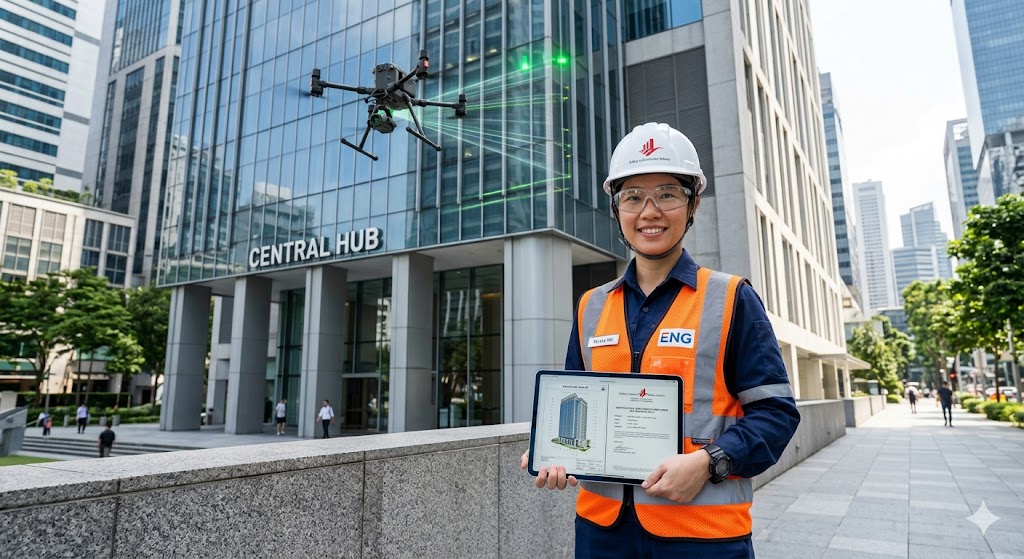
Drone Integration in Façade Inspections
Unmanned Aircraft Systems have completely transformed modern facade inspections.3 Drone usage bypasses the need for extensive, expensive scaffolding.21 High-resolution drones capture detailed elements of the highest superstructures.21
Drones are frequently equipped with advanced thermal imaging cameras.21 Thermal imaging detects hidden structural issues like water infiltration.21 Delaminating facade tiles register distinctly as unusual heat spots.3 Drone pilots must obtain strict Civil Aviation Authority permits.23 This methodology is significantly safer than utilizing hanging gondolas.3
The Standardized 6-Step Drone Inspection Process
Professional firms follow a strict methodology when deploying drones.23
- Quotation and Appointment: Obtain quotes and appoint a CP.23
- Drawing Acquisition: The CP purchases as-built structural plans.23
- Clearance: CP submits forms while pilots obtain CAAS clearance.23
- Execution: The drone inspection progresses on permitted dates.23
- Targeting: The CP uses drone data to find the 10% area.23
- Physical Contact: The close-up inspection completes the physical process.23
Financial Costs of Statutory Compliance
Regulatory compliance introduces necessary but substantial operational property expenses.26 Budgeting accurately prevents unexpected financial strain on management funds.1
Periodic Structural Inspection (PSI) Costs
PSI fees depend heavily on building size and complexity.10 The presence of prior defects also influences final pricing.10
| Building Type / Overall Size | Estimated PSI Fee Range (SGD) |
| Small Landed / Single Unit (<200 sqm GFA) | $1,500 – $3,000 10 |
| Medium-Size Building / Strata Residential Block | $3,000 – $5,000 10 |
| Large Commercial / Industrial Factory Building | $5,000 – $8,000+ 10 |
These typical fees generally cover the initial visual inspection.18 They also cover basic testing and final report preparation.18 If the engineer discovers severe issues, specialized testing costs extra.18 Management corporations fund routine inspections via general management funds.1 However, major structural repairs are financed through dedicated sinking funds.1
Professional Engineer Endorsement Fees
Engineers charge distinct fees for official endorsements of works.27 These are separate from the baseline periodic inspection fees.27
| Specific Type of PE Endorsement | Estimated Cost Range (SGD) |
| Structural works (simple repairs) | $800 – $1,800 27 |
| Structural works (complex strengthening) | $2,000 – $5,000+ 27 |
| SCDF fire safety layout | $1,200 – $2,500 27 |
| M&E systems endorsement | $1,000 – $2,000 27 |
| Temporary works (ERSS, site scaffolding) | $1,000 – $3,000+ 27 |
| Drainage/sewerage plan endorsement (PUB) | $1,000 – $2,500 27 |
Periodic Façade Inspection (PFI) Costs
Facade inspections are inherently more expensive than standard checks.21 They require specialized height access equipment and multidisciplinary teams.21
| Building Height / Structural Type | Average Estimated PFI Cost (SGD) |
| Low-Rise Building (<5 Stories) | $10,000 26 |
| Mid-Rise Building (6–25 Stories) | $13,000 26 |
| Commercial/High-Rise (26–39 Stories) | $15,000 26 |
| Super High-Rise (>40 Stories) | $19,000 26 |
These costs fluctuate heavily based on the required reporting.26 Synchronizing facade checks with structural checks offers minimal savings.15 Both inspections remain completely distinct in scope and execution.15 Therefore, two totally different comprehensive reports must be submitted.15
Enforcement Actions and Severe Penalties
The legal framework utilizes heavy penalties to ensure compliance.9 Building safety is absolutely never treated as a suggestion.9 Negligence severely endangers public lives and surrounding urban infrastructure.3
Failing to Appoint Professionals
Receiving a notice triggers strict legal obligations immediately.9 Failing to comply with an inspection notice is criminal.9 If an owner ignores the letter, enforcement actions escalate.10
Any owner who fails to comply faces massive consequences.9 A conviction carries a maximum fine not exceeding $20,000.1 The BCA may also issue immediate stop-work enforcement orders.18
Failing to Execute Repairs
Ignoring repair recommendations after the inspection is strictly penalized.9 Owners must execute all necessary safety measures specified.9 Failure to implement these structural remedies carries steeper threats.9
Offenders face a heavy fine not exceeding $20,000.9 Furthermore, they face imprisonment for up to 12 months.9 The courts may impose both the fine and imprisonment.9
Continuing Defiance and Façade Penalties
The law punishes stubborn non-compliance with accumulating daily penalties.9 For continuing contraventions, owners face an additional daily fine.9 This specific fine is $500 for each day of defiance.9 If defiance continues post-conviction, the daily fine reaches $2,000.9
Penalties relating specifically to facade inspections are even higher.9 Failing to properly execute the facade inspection yields massive fines.9 Offenders face a fine not exceeding $50,000 upon conviction.9 This reflects the immediate public danger of falling building components.20
Environmental Sustainability and Energy Reporting
Building safety now intersects with broader environmental sustainability goals.28 The Building Control Act mandates energy consumption tracking.28 This applies strictly to major properties categorized as Type 1.28
Mandatory Energy Usage Reports
Owners of Type 1 buildings must submit periodic energy reports.28 These reports detail total electricity consumption by various users.28 They also strictly track chilled water supplied to cooling systems.28
The Commissioner sets the format and timeline for submissions.28 Failing to submit this energy report constitutes a legal offence.28 Owners face a fine not exceeding $10,000 for non-compliance.28 This demonstrates a major regulatory shift toward holistic performance auditing.28
Managing Workplace Safety During Inspections
Safety protocols during the inspection process are heavily regulated.30 Competent Persons must ensure occupant safety during physical testing.21 Rectification contractors must abide by stringent site safety rules.30
Appendix A: Safety, Health and Environment (SHE)
Construction and repair works fall under Appendix A regulations.30 Contractors must implement a robust SHE Management System.30 They must submit a comprehensive Monthly SHE Report consistently.30 Furthermore, a dedicated Workplace Safety and Health Coordinator is mandatory.30
Contractors must conduct regular Tool Box Meetings for workers.30 They must implement a strict Permit to Work system.30 The use of Mobile Elevated Working Platforms requires strict oversight.30 Rope access technicians must adhere to rigorous fall-protection guidelines.21
Contractors must provide adequate illumination for all nighttime work.30 They must also maintain comprehensive first aid provisions onsite.30 Work inside confined spaces requires specialized safety emergency preparedness.30 Every physical intervention must align with broader workplace safety policies.30
Professional Standard Expectations for Structural Engineers
The BCA enforces rigorous standards to uphold public confidence.16 Engineers must allocate adequate personnel for thorough building inspections.16 They must dedicate sufficient time and resources to the task.16
Inspection fees must reflect the requisite professional engineering expertise.16 They must also reflect the extreme rigour required by law.16 Errant engineers failing to comply face severe enforcement actions.16 The BCA continually reminds the industry to maintain absolute professionalism.16 The entire ecosystem relies on the uncompromised integrity of engineers.16
Engineers are strictly bound by the Professional Engineers Act 1991.11 They cannot delegate their critical visual survey duties away.11 The law relies heavily on their personal professional engineering judgement.11 This ensures that visual inspections are not merely administrative checkboxes.11
Conclusion
Understanding your BCA Inspection Notice is a critical legal responsibility. It represents the frontline defense against catastrophic urban structural failures. The framework introduced after the 1986 Hotel New World collapse saves lives. It transformed building maintenance from an afterthought into proactive science.
The integration of strict statutory timelines ensures buildings cannot decay quietly. The introduction of the Periodic Façade Inspection addresses aging skyscrapers realistically. Property owners must respect these notices as urgent legal imperatives. Prompt appointment of qualified professionals minimizes long-term financial liabilities effectively.
Embracing smart technologies like AI and drones will streamline future compliance. These tools offer unprecedented accuracy in detecting invisible structural flaws. Ultimately, absolute statutory compliance guarantees the resilience of the built environment. It protects property values while prioritizing the physical safety of occupants. Ignorance of these procedures is never an acceptable legal defense. Property owners must budget for, plan, and execute these checks diligently.
Works cited
- Structural & Façade Inspections in Singapore – Stellar Structures, accessed May 20, 2026, https://structures.com.sg/structural-facade-inspections-singapore/
- Periodic Structural Inspection (PSI) – Building and Construction Authority, accessed May 20, 2026, https://www1.bca.gov.sg/safety-and-standards/periodic-building-inspections/periodic-structural-inspection/
- Periodic Structural Inspection (PSI) for Industrial Buildings in Singapore: Regulations, Costs, and Smart Inspection Trends (2026 Edition), accessed May 20, 2026, https://structures.com.sg/periodic-structural-inspection-psi-for-industrial-buildings-in-singapore-regulations-costs-and-smart-inspection-trends-2026-edition/
- Collapse of Hotel New World (Lian Yak Building) – Singapore – NLB, accessed May 20, 2026, https://www.nlb.gov.sg/main/article-detail?cmsuuid=c283d7e4-5a3b-418f-812f-720b1ecc53e6
- Failures – Hotel New World Collapse – Penn State Engineering, accessed May 20, 2026, https://www.engr.psu.edu/ae/thesis/failures/MKP/failures/failures.wikispaces.com/Hotel_New_World_Collapse.html
- Collapse of Hotel New World – Wikipedia, accessed May 20, 2026, https://en.wikipedia.org/wiki/Collapse_of_Hotel_New_World
- Geotechnical Failures in Singapore Regulations | PDF | Deep Foundation – Scribd, accessed May 20, 2026, https://www.scribd.com/document/369876934/The-Impact-of-Building-Failures-on-the-Building-Control-Sys
- HOTEL NEW WORLD – Singapore – National Heritage Board, accessed May 20, 2026, https://www.nhb.gov.sg/~/media/nhb/files/resources/publications/ebooks/nhb_ebook_hotel_new_world.pdf
- Building Control Act 1989 – Singapore Statutes Online, accessed May 20, 2026, https://sso.agc.gov.sg/Act/BCA1989?ProvIds=pr26-,pr27-,pr28-,pr29-
- BCA Periodic Structural Inspection (PSI) Singapore Guide | CVC, accessed May 20, 2026, https://www.cvcengineers.com/post/bca-periodic-structural-inspection-singapore
- GUIDELINES FOR STRUCTURAL ENGINEERS, accessed May 20, 2026, https://isomer-user-content.by.gov.sg/338/7fefc1c0-6299-41fa-bf17-17c3a9896f1a/psi-guidelines-for-structural-engineers-(sep-2024).pdf
- Building Control Act 1989 – Singapore Statutes Online, accessed May 20, 2026, https://sso.agc.gov.sg/act/bca1989
- About BCA Periodic Structural Inspection (PSI) | Requirements …, accessed May 20, 2026, https://bca-psi.sg/about-psi
- BCA Structural Inspection Remedial Notice | PDF | Quality | Singapore – Scribd, accessed May 20, 2026, https://www.scribd.com/document/850082853/SM-2024-10-2143-ISS-STATUS-AAPSI820
- Periodic Façade Inspection (PFI) Frequently Asked Questions (FAQ) – Lee Consultants, accessed May 20, 2026, https://www.leeconsultants.com.sg/periodic-facade-inspection-pfi-frequently-asked-questions-faq/
- Our ref : APPBCA-2026-02 02 Mar 2026 To: All Professional Engineers (Civil & Structural) and Industry Stakeholders REMINDER, accessed May 20, 2026, https://info.corenet.gov.sg/docs/default-source/bca-circulars/circular-on-reminder-on-proper-conduct-of-psi-and-expectations-of-structural-engineers_2march2026.pdf?sfvrsn=ad4bdb5e_1
- JOINT BCA / IES / ACES CIRCULAR 2022, accessed May 20, 2026, https://isomer-user-content.by.gov.sg/338/cf895f61-8322-4a3f-8fc0-75becce20dcd/enhancements-to-psi-guidelines-for-structural-engineers_1sep2022.pdf
- Professional Engineer Singapore – Building Inspections Guide 2025 – Soteria, accessed May 20, 2026, https://www.soteria.sg/professional-engineer-singapore/
- BCA Façade Inspection Guidelines | PDF | Corrosion | Unmanned Aerial Vehicle – Scribd, accessed May 20, 2026, https://www.scribd.com/document/695988368/Pfi-Guidelines-for-Competent-Person
- Guidelines for Building Façade Inspection in Singapore | High X Cess Solutions, accessed May 20, 2026, https://highxcess.asia/guidelines-for-building-facade-inspection-singapore/
- BCA Facade Inspection Guidelines: Guide for Building Owners – Environ Construction, accessed May 20, 2026, https://environ-construction.com/bca-facade-inspection-guidelines/
- Periodic Facade Inspection (PFI) – Building and Construction Authority, accessed May 20, 2026, https://www1.bca.gov.sg/safety-and-standards/periodic-building-inspections/periodic-facade-inspection/
- BCA Periodic Façade Inspection (PFI) – AEC Technical Advisory Singapore Engineering Consultancy, accessed May 20, 2026, https://www.aectechnicalsg.com/bca-periodic-facade-inspection-pfi/
- 1 CONTRACTORS REGISTRATION SYSTEM (“CRS”) Application and Registration Guidelines Objectives and purpose of CRS 1. The CRS i, accessed May 20, 2026, https://isomer-user-content.by.gov.sg/338/33c93cd3-c998-4dff-8dc9-5fd6947170cf/registration_guidelines.pdf
- SPECIFIC REGISTRATION REQUIREMENTS FOR TRADE HEAD (TR), accessed May 20, 2026, https://file.go.gov.sg/bca-crs-srr-tr.pdf
- Facade Inspection Cost Calculator – GREENER AIR FACADE PTE LTD, accessed May 20, 2026, https://greenerair.sg/facade-inspection-cost-calculator/
- PE Endorsement Cost in Singapore | Pricing Guide 2025, accessed May 20, 2026, https://www.aectechnicalsg.com/how-much-does-pe-endorsement-cost-in-singapore/
- Building Control Act 1989 – Singapore Statutes Online, accessed May 20, 2026, https://sso.agc.gov.sg/Act/BCA1989?ProvIds=P13B-
- Building Control Act 1989 – Singapore Statutes Online – Attorney-General’s Chambers, accessed May 20, 2026, https://sso.agc.gov.sg/Act/BCA1989?ProvIds=pr22FF-&ViewType=Advance&Phrase=energy&WiAl=1
GENERAL SPECIFICATION APPENDIX A SAFETY, HEALTH AND ENVIRONMENT (March 2023 Edition), accessed May 20, 2026, https://file.go.gov.sg/gsappa2023.pdf