




Introduction
Reinstatement works and Addition & Alteration (A&A) works serve fundamentally different purposes under a JTC lease – yet outgoing tenants routinely confuse the two, triggering avoidable disputes, cost overruns, and failed inspections. Reinstatement works are the contractual obligation to strip out all tenant-installed modifications and restore premises to the last JTC-approved baseline condition. A&A works, by contrast, are the operational modifications – mezzanines, cold rooms, heavy equipment foundations, office partitions – that tenants carry out during the lease to support their business activities. Understanding the distinction between reinstatement works vs A&A when preparing JTC premises for lease end is the single most important step an outgoing tenant can take to protect their security deposit and avoid financial penalties.
At lease expiry, reinstatement is commonly required under commercial leases, and for JTC premises this typically means full reinstatement – returning the unit to its approved handover condition – not new A&A. Mixing these two categories, or assuming that approval from JTC to carry out A&A means those alterations can remain at lease end, is precisely what triggers scope disagreements and inflated reinstatement costs.
This article focuses on outgoing tenants and property managers of JTC B1/B2 factories, warehouses, and flatted units planning for lease expiry or early termination from 2026 onward, and the guidance is also useful where operators are moving between two units because sequencing handover and relocation affects cost and timing. It applies JTC plan consent rules to the practical challenges of removing previous alterations, dismantling partitions, and handing back space in compliance with the tenancy agreement.
After reading this guide, you will understand:
-
How to distinguish reinstatement obligations from A&A approvals under JTC lease clauses
-
When Professional Engineer (PE) endorsement is needed for structural removal or infilling
-
How to sequence reinstatement works within JTC’s inspection timeline
-
What photographs, drawings, and records to prepare for a smooth handover
-
When to engage an engineering consultancy like Stellar Structures to manage complex lease-end projects
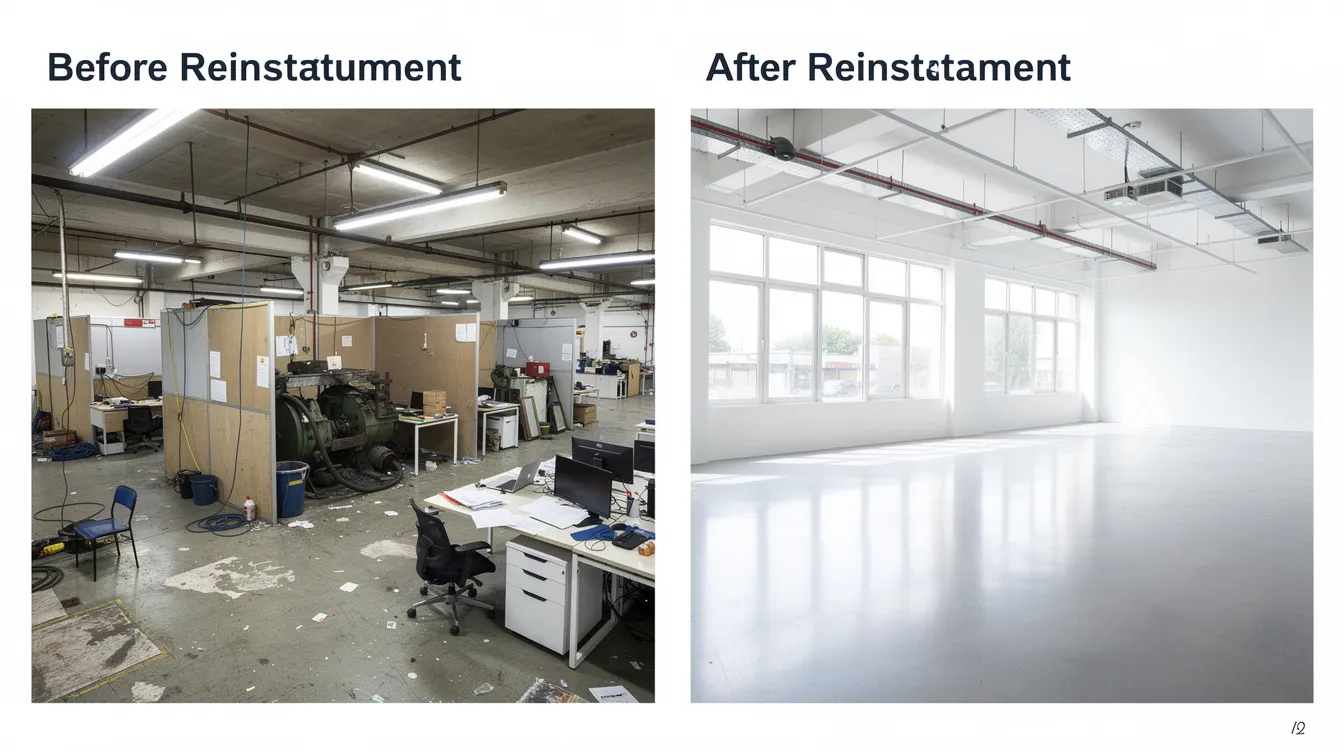
Throughout this article, illustrative photographs and diagrams are suggested to help you visualise what a typical JTC reinstatement project looks like – from the cluttered post-A&A condition to the clean, baseline-ready handover state.
Understanding JTC Reinstatement and A&A Obligations in the Tenancy Agreement
JTC reinstatement obligations at lease end and A&A approvals during the lease operate under different rules, different timelines, and different risk profiles – but they are linked by a single principle: every alteration a tenant makes is a potential reinstatement liability. JTC is stricter than most Singapore landlords because its Standard Terms (e.g. IG/84932T) tie these obligations to commercial leases by explicitly requiring tenants to comply with lease clauses to “remove all buildings, structures, fixtures, fittings, additions and alterations installed by the lessee … repair and make good … unless informed otherwise in writing.” For JTC premises, both the tenancy agreement and the JTC-approved layout plans govern what must be reinstated – not a vague notion of “original condition.”
What Are Reinstatement Works for JTC Premises?
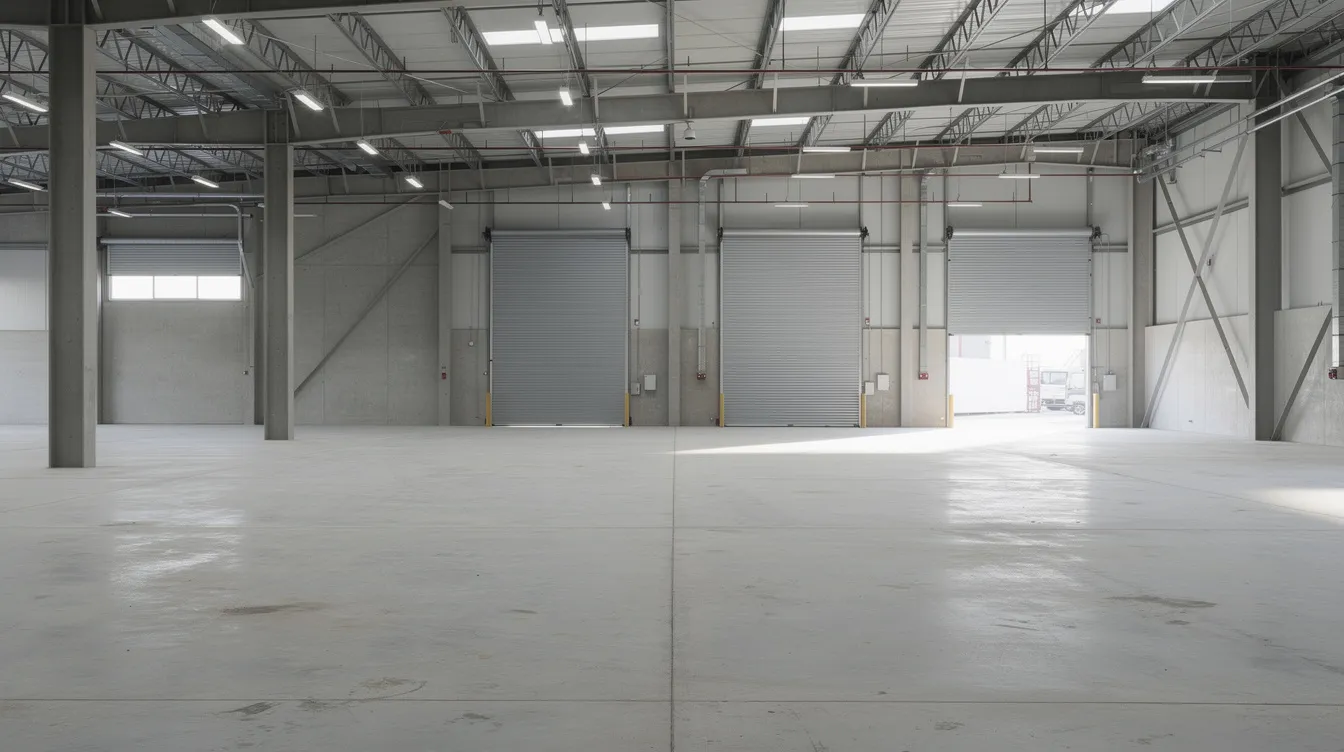
Reinstatement works in the JTC context mean removing every tenant-installed structure, fitting, and modification, then making good the premises to the last JTC-approved base condition or the documented handover condition. Reinstatement must restore properties to original condition per tenancy agreements. The reinstatement scope is usually set out in the JTC lease clauses and further clarified by JTC’s reinstatement inspection list, which is issued approximately 3–6 months before lease expiry. A joint site inspection occurs approximately six months before lease expiry, during which JTC and the tenant walk the premises together and agree on what must be removed.
Typical reinstatement scope for industrial properties includes:
-
Removing partitions and fixtures installed during tenancy, including built in furniture and office fit out works
-
Removing epoxy floor coatings that exceed JTC specifications
-
Infilling slab openings cut for machinery, conveyors, or drainage
-
Reinstating original roller shutter positions and closing up non-approved door openings
-
Restoring ceiling heights, fire-rated walls, and escape routes to their original layout
-
Patching, repainting, and restoring basic services to original conditions
The reinstatement process may include substantial demolition and site clean-up. Photos of the premises before tenancy and the approved JTC layout serve as the key evidence used to define the reinstatement target. It is critical to maintain historical documentation for A&A when preparing for reinstatement – without it, disputes about the exact scope of removal become far more difficult to resolve.
What Are A&A (Addition & Alteration) Works in JTC Units?
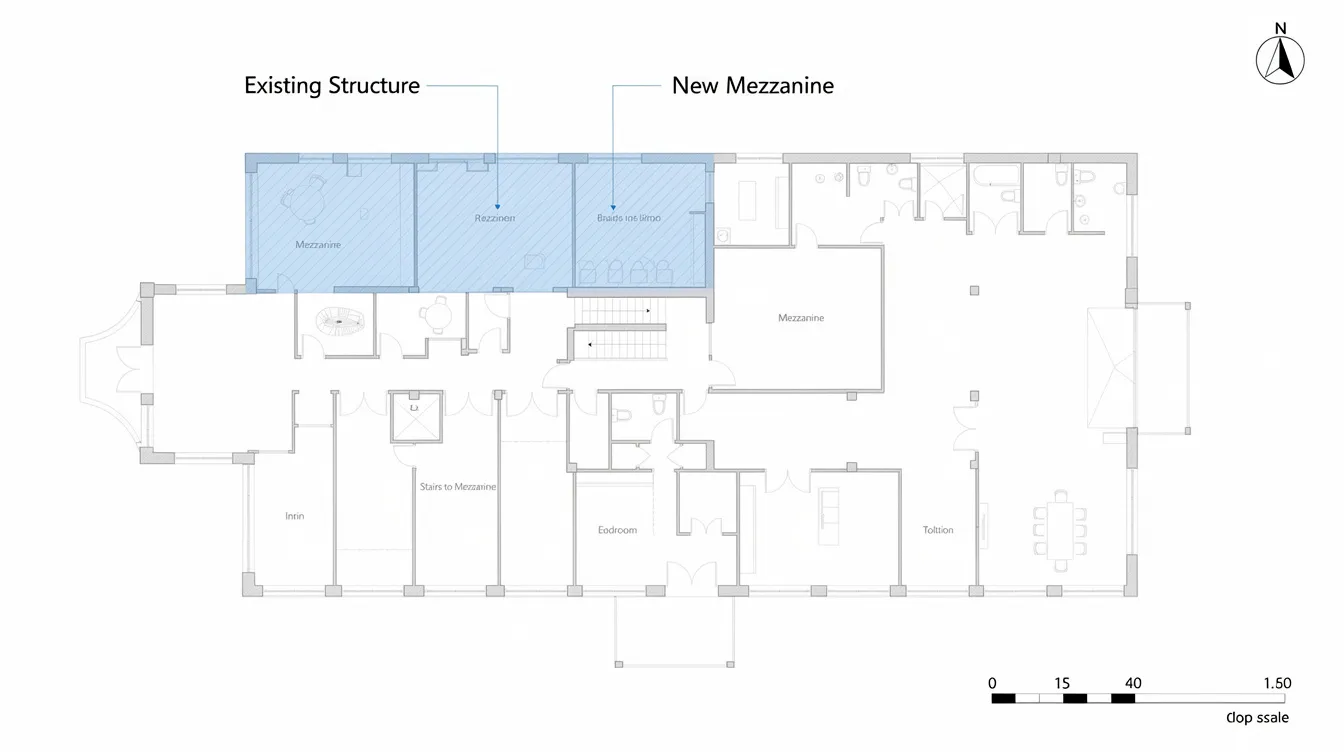
Alteration and Addition (A&A) refers to changes made during the lease – tenant-initiated modifications such as new offices, laboratories, cold rooms, mezzanine platforms, chemical stores, fan rooms, and M&E upgrades. These changes require JTC Plan Consent (Land Owner’s Consent) and, depending on complexity, regulatory approvals from the Building and Construction Authority (BCA), SCDF, PUB, or NEA.
Tenants must submit detailed floor plans for A&A before starting any physical changes. Compliance with building codes and obtaining necessary approvals are crucial for A&A works. Heavy installations require proper documentation and approval processes under JTC guidelines, including PE design reports, structural calculations, and fire safety submissions.
Critically, A&A is carried out during the lease period to support operations – not at the end. JTC distinguishes between approval to carry out A&A and the obligation to reinstate at lease end. Approval from JTC does not guarantee that alterations can remain at lease expiry. The role of a Professional Engineer and architects during A&A includes structural checks, fire safety compliance, and coordination with JTC’s Development & Land division.
How Reinstatement and A&A Interact Under JTC Rules
Every approved A&A becomes a potential reinstatement item when the lease expires, unless JTC confirms in writing that specific works may remain for the next tenant. The lease wording is typically unambiguous: “unless we inform you in writing that such removal is not required.” Without that explicit written waiver, removal is typically required regardless of whether the A&A was properly approved during the tenancy.
JTC’s plan consent drawings are the reference for both mid-lease inspections and end-of-lease reinstatement. All alterations made during the lease must be assessed for reinstatement obligations. Poor documentation – missing approved drawings, undocumented as-built deviations, or lost PE certifications – creates ambiguity and disputes. In UDL Marine v JTC (SGHC 236, 2013), JTC successfully claimed over S$282,000 in reinstatement costs for removal of structures and cladding, underscoring how costly these obligations can become.
Understanding this relationship is crucial for planning the last 12 months of the tenancy and deciding whether any late-stage A&A still makes practical or financial sense.
Key Differences: Reinstatement Works vs A&A When Preparing for Lease End
From the perspective of an outgoing JTC tenant, confusing “improvement works” with “obligatory make-good works” as the lease winds down is an expensive mistake. The sections below provide a practical comparison to help tenants and property managers draw clear boundaries between the two.
Purpose, Timing, and Approval Flow
A&A serves operational needs – for example, installing a new production line in 2022 to meet growing demand. Reinstatement serves legal and contractual needs at lease expiry, returning the premises to the condition JTC requires for handover.
The timing windows differ sharply. A&A is usually carried out early to mid-lease. Reinstatement works begin in the last 3–6 months before the lease end date, following JTC’s notice and joint inspection. JTC sends a reminder approximately one year ahead of lease expiry, and the formal joint site inspection is arranged roughly six months prior.
Approval routes also diverge. A&A requires prior JTC plan consent and possibly BCA, SCDF, or PUB clearances. Reinstatement often proceeds under JTC’s pre-approved scope after the joint inspection, with PE endorsement required only when structural works or fire-safety elements are affected. Electrical works must be done by EMA-licensed electricians in both cases.
Scope of Work and Technical Complexity
Typical A&A items in JTC premises include new mezzanines, heavy equipment foundations, chemical stores, fan rooms, and major M&E upgrades – works that increase structural loading and fire load; by contrast, in office towers, A&A and later reinstatement more often focus on partitions, ceilings, and building services rather than heavy production infrastructure. Reinstatement items are the reverse: demolition, infilling, strip out of tenant installations, reinstating fire ratings, restoring drainage and fall, and applying neutral paint finishes.
A&A may increase a building’s structural demands and fire load, while reinstatement reduces these back to the baseline JTC criteria for that building type (B1 vs B2 vs specialised facility). However, some reinstatement tasks can be as technically complex as the original A&A. Removing a 20-ton machinery foundation, for instance, requires PE design, method statements, temporary propping, and careful sequencing – just as the original installation did.
Removing unauthorized A&A works can increase reinstatement obligations significantly, because the tenant may need to remedy damage caused by works that were never properly engineered or approved.
Risk, Cost, and Proper Documentation
The risk profile differs fundamentally. During the lease, A&A risk is mainly regulatory compliance – failing to obtain necessary approvals or violating building codes. At lease end, reinstatement risk shifts to failed JTC handback inspection, forfeited security deposit, chargeback for JTC-appointed contractors, and potential litigation. Failure to comply with reinstatement standards can incur financial penalties, including double rent under the Civil Law Act Section 28(4) if the tenant remains beyond the lease expiry date.
Reinstatement costs vary significantly by project complexity. A standard office reinstatement cost depends on floor area and the extent of modifications made during the tenancy. A&A costs are usually capex planned years earlier, while reinstatement is often under-budgeted unless tenants start cost estimation 9–12 months pre-expiry. In UDL Marine, reinstatement costs for a large industrial unit exceeded S$282,000 – a figure that caught the tenant off guard.
Proper documentation is the thread connecting both: approved A&A drawings, PE calculations, method statements, and photo logs make reinstatement faster, cheaper, and less contentious.
Key differences at a glance:
-
Purpose: A&A enhances operations; reinstatement fulfils a contractual exit obligation
-
Timing: A&A during occupancy; reinstatement in the final 3–6 months before lease expiry
-
Cost trigger: A&A is planned capex; reinstatement is often an underestimated exit cost
-
Risk: A&A risk is regulatory non-compliance; reinstatement risk is deposit forfeiture, double rent, and litigation
|
Criterion |
A&A Works |
Reinstatement Works |
|---|---|---|
|
Purpose |
Operational enhancement |
Contractual baseline restoration |
|
Timing |
Early to mid-lease |
Last 3–6 months before lease end |
|
Approval path |
JTC Plan Consent + BCA/SCDF/PUB |
JTC reinstatement list; PE only if structural/fire elements involved |
|
Technical direction |
Adds load, services, complexity |
Removes and restores to baseline |
|
Cost planning |
Budgeted as capital expenditure |
Often under-budgeted; requires early estimation |
|
Documentation |
Formal drawings, PE reports, plan consents |
As-built records, photos, inspection logs |
|
Key risk |
Regulatory non-compliance during operations |
Failed handover, deposit deduction, double rent |
Planning Lease-End Strategy for JTC Units: From A&A Inventory to Reinstatement Plan
Once a JTC tenant decides not to renew, managing the transition from a highly customised facility back to JTC’s baseline condition is a structured project – not an ad-hoc demolition job. Reinstatement projects for industrial premises demand the same discipline as the original A&A, but under tight deadlines and with the added pressure of avoiding holdover charges. This section gives a practical, chronological process tailored to JTC premises, aligned with how Stellar Structures typically advises clients.
Step-by-Step Process for Outgoing JTC Tenants
Most tenancy agreements require reinstatement before lease expiry. Most tenants wait too long before engaging a contractor, which compresses schedules and drives up costs. Follow these steps to stay ahead:
-
Confirm the lease expiry date and renewal decision (12+ months ahead). Determine whether renewal or surrender is the path forward; this is especially important when a business is transitioning between two units and needs to avoid overlapping rent and delayed handover. JTC communications often start one year before expiry. If surrendering, begin assembling an inventory of A&A works likely to require reinstatement.
-
Retrieve all JTC-approved plans, A&A submissions, and original handover photos. Collect every plan consent letter, structural drawing, PE certification, and regulatory submission from your tenancy. These documents define both what was approved and what the reinstatement target is.
-
Conduct an internal technical audit with your facilities team or consultant. Walk every zone of the premises. Identify all A&A works – authorised and unauthorised – structural impacts, current condition, and deviations from plan consents. A thorough site assessment at this stage prevents surprises later.
-
Meet JTC for preliminary discussion and clarifications. Arrange correspondence with your JTC Customer Engagement Officer to clarify reinstatement requirements, explore whether any A&A items may remain, and understand Environmental Site Assessment (ESA) obligations. Environmental Site Assessments may be required for pollutive operations before handover.
-
Prepare the reinstatement scope and budget. Develop a detailed breakdown of works, separating removal, disposal, structural infill, M&E reinstatement, finishes, and final cleaning. Request a detailed quotation from prospective contractors. Reinstatement costs vary significantly by project complexity – the cost depends on floor area, the number of A&A modifications, and whether structural or hazardous elements are involved.
-
Engage a qualified PE and consultant where needed. For any structural removal, infilling of floor openings, or alterations to fire-rated elements, PE involvement is mandatory. Engaging a contractor 8–10 weeks before lease end is recommended to allow adequate programme time.
-
Schedule and execute works. Sequence dismantling first, then structural make-good, then M&E and services restoration, then finishes and cleaning. Allow buffer time for curing, inspections, and snagging.
-
Prepare documentation and attend final JTC inspection. Maintain photo logs at every stage: pre-removal, during works, and post-reinstatement. Present annotated drawings showing what was removed and what was restored. Attend JTC’s inspection with all documentation ready.
For complex facilities – food factories, chemical plants, or operations involving pollutive materials – add a decommissioning plan for utilities and process lines that runs in parallel with the reinstatement schedule.
Reading and Interpreting JTC Plan Consent vs Lease Reinstatement Clauses
Critical information sits in several documents: the JTC Letter of Offer, the tenancy agreement (including Standard Terms and appendices), and each plan consent letter issued during the tenancy. Tenants should cross-reference these to identify:
-
Which works were approved and under which reference dates (e.g. consent granted in 2019, variation in 2021)
-
Clauses requiring removal of unauthorised works or restoration of external elevations
-
Obligations relating to shared M&E systems, contaminated soil, or groundwater
-
Whether any prior correspondence from JTC explicitly waives reinstatement for specific items
Example scenario: An outgoing tenant of a B2 unit assumed their approved mezzanine could remain because JTC had granted plan consent in 2020. However, the lease reinstatement clause required removal of “all additions and alterations” unless waived in writing. No waiver existed. JTC insisted on removal, restoration of original headroom, and infilling of the bolt-fixed anchor points – adding approximately four weeks and significant cost to the reinstatement programme. The mezzanine floor approval had been valid for operational purposes, but it did not override the reinstatement covenant.
When You Still Need A&A Close to Lease End
In certain situations, small-scale A&A is still required near lease end. JTC may require a corrective A&A to regularise an older unauthorised opening before it can be safely removed or made good. Sometimes a “reverse A&A” – a formal submission to remove a previously approved structure – is needed for JTC’s records even though it is practically part of the reinstatement process.
Stellar Structures helps tenants assess whether a proposed late modification should be submitted as formal A&A with JTC consent or deferred and bundled into reinstatement works. The decision typically hinges on whether the work involves structural elements, whether it affects fire safety compliance, and whether JTC’s records need to be updated before the physical removal can proceed.
Implementing Reinstatement Works in JTC Premises
A well-managed reinstatement project for JTC B1/B2 units flows from initial survey to handover with a focus on programme certainty and strict compliance – not just demolition speed. The process involves multiple trades working in sequence, each governed by JTC-specific considerations.
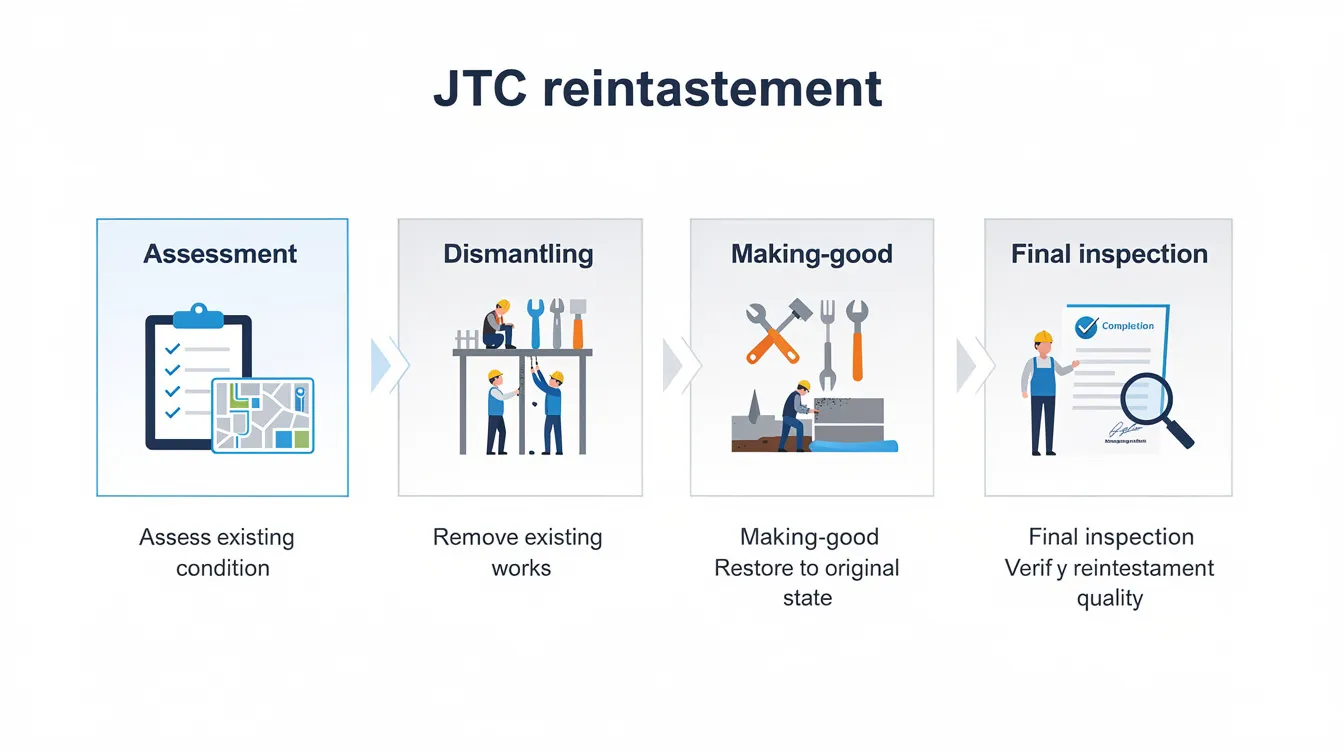
Typical Reinstatement Workflow for JTC B1/B2 Units
The reinstatement process phase follows a logical sequence:
-
Site survey and photographic record (1–3 days). Initial site inspection and quotation last 1 to 3 days. Document current condition in detail: wide-angle shots per zone, close-ups of structural connections, M&E terminations, and any damage.
-
Dismantling and removal of tenant’s installations (3–7 days for standard units). Dismantling and removal works take 3 to 7 days depending on complexity. This includes strip out of partitions, mezzanine structures, exhaust ducts, machine plinths, and floor coatings. Use approved disposal facilities for industrial waste and comply with NEA/HSE requirements for any chemical residues.
-
Civil and structural make-good. Infill slab openings, repair damaged structural elements, restore floor falls and drainage. This stage commonly requires PE oversight if structural modifications were involved. Method statements must be prepared and followed.
-
M&E reinstatement and safety checks. Restore electrical distribution, lighting, and mechanical ventilation to base-building standard. Electrical works must be done by EMA-licensed electricians. Decommission any tenant-installed effluent or drainage lines.
-
Architectural finishes and cleaning. Repainting, floor finishing, and restoration of doors, roller shutters, and windows to their original positions. Final cleaning and quality inspection require 1 to 2 days.
-
Pre-inspection snagging. Walk the premises against JTC’s reinstatement list, rectify any defects, and prepare final documentation packages.
Indicative durations for 5,000–20,000 sq ft units: Typical reinstatement takes 2 to 6 weeks overall. Reinstatement for smaller offices under 500 sq ft takes 1–2 weeks. Larger commercial spaces over 5,000 sq ft can take 6–8 weeks, particularly where heavy structural works or environmental remediation is involved. Programmes also differ by asset type, with retail units in shopping malls often facing tighter handover windows than industrial premises. These figures assume work begins on schedule and that the right reinstatement contractor is engaged early.
Comparison: Keeping vs Removing Tenant’s A&A at Lease End
Not every A&A item necessarily has to go. In some cases, JTC may agree in writing that certain improvements can remain for the next tenant. The table below contrasts the two strategies:
|
Criterion |
Full Removal & Restoration |
Partial Retention with JTC Consent |
|---|---|---|
|
Upfront cost |
Higher – all items removed and surfaces restored |
Lower – only non-retained items removed |
|
Programme risk |
Longer programme, more trades involved |
Shorter programme, but requires early JTC engagement |
|
JTC acceptance likelihood |
High – default expectation under lease |
Variable – depends on JTC’s plans for the premises and the nature of the improvements |
|
Future liability |
None after handover |
Tenant may remain liable for defects in retained works until formal acceptance |
|
Documentation burden |
As-built records and photo logs for all removed items |
Written waiver from JTC plus condition report for retained works |
When full removal makes sense: Standard units where the next tenant is likely to have different requirements, or where the A&A involved specialised installations (chemical stores, heavy machinery foundations) that JTC would not want to inherit.
When partial retention may work: If the improvements are generic (office partitions, standard M&E upgrades), the building management team or incoming tenant has expressed interest, and JTC provides explicit written confirmation. Without that written waiver, assume full removal.
When PE Endorsement or a Reinstatement Contractor Is Needed for Reinstatement
Concrete triggers for PE endorsement during reinstatement include:
-
Removal of structural mezzanines or platforms – particularly where the mezzanine involved structural steel connections to the base building
-
Demolition of reinforced concrete machine plinths or foundations
-
Infilling floor openings cut for conveyors, heavy equipment, or drainage
-
Alterations to fire-rated walls or modifications affecting escape routes (SCDF requirements apply)
-
Temporary propping or support structures needed during dismantling
The process involves condition surveys, design of temporary supports where needed, method statements, submission to the Building and Construction Authority (BCA) or JTC’s appointed consultants where applicable, and final PE certification confirming that the completed work is structurally sound. Stellar Structures, as an engineering and architectural consultancy, typically leads this coordination and can advise early whether PE input is mandatory or simply advisable for risk management.
Common Lease-End Pitfalls with JTC Reinstatement and A&A
Even experienced facility managers get caught out by JTC’s procedural and technical expectations when vacating long-held units. The following problems appear repeatedly across reinstatement projects – along with practical solutions.
Problem 1: Treating Reinstatement as Just “Demolition”
Some tenants approach reinstatement as crude hacking and removal, proceeding without method statements, damaging base building elements, or inadvertently removing items JTC wants to retain (such as original fire-rated partitions or base building M&E).
Solution: Read JTC’s reinstatement list carefully and map every item to plan consent drawings. Engage an experienced contractor and consultant familiar with JTC regulations to supervise the process. Ignoring landlord requirements can result in project delays and rectification costs that exceed the original reinstatement budget.
Problem 2: Missing or Incomplete A&A Records
When approved plans are missing, variation drawings are lost, or as-built data does not exist, JTC may treat unapproved works as unauthorised and require full removal. The tenant’s defence is severely weakened. In [2014] SGHC 50, the court examined whether a tenant’s claim of fair wear and tear was supported by documentation – and lack of evidence was decisive.
Solution: Reconstruct records early via measured surveys. Engage JTC to obtain any archived plans from their system. Create a clear A&A inventory – date, description, plan consent reference, PE endorsement status – before tendering reinstatement works. Not obtaining necessary permits and documentation can lead to compliance issues that delay handover.
Problem 3: Underestimating Time for JTC Inspections and Rectification
JTC may require multiple inspections and can direct additional rectification works. Each round of snagging adds days or weeks. Delaying reinstatement can incur higher holdover rent charges – under the Civil Law Act Section 28(4), the landlord may charge double rent for any period the tenant remains beyond the lease expiry date.
Solution: Lock in a realistic programme with buffer weeks. Engage a contractor 8 to 10 weeks before lease end. Avoid starting major reinstatement in the very last month. Keep photo evidence ready to support any disagreement about scope or condition. Failure to reinstate properly may result in deposit deduction – or worse, a lump sum claim from JTC for appointing their own contractors.
Problem 4: Confusing Corrective A&A with Reinstatement
Tenants sometimes attempt to regularise unauthorised works through a corrective A&A submission just before lease end, only to discover they must still remove the works immediately afterward. This creates duplicated effort and cost – paying for A&A approval requirements and then paying again for demolition.
Solution: Assess whether it is more efficient to remove unauthorised works directly as part of reinstatement rather than regularising them first. In some cases, JTC will insist on a corrective submission before removal can proceed (particularly if the unauthorised work poses a structural or fire safety risk during dismantling). Stellar Structures can advise case-by-case, helping tenants comply with JTC’s procedural expectations without incurring unnecessary double costs.
Conclusion and Next Steps
JTC lease-end compliance hinges on clearly separating A&A (operational modifications made during the tenancy) from reinstatement (the contractual obligation to make good at lease end). Key takeaways:
-
JTC plan consent for A&A does not waive reinstatement – only explicit written confirmation from JTC permits retention of tenant works
-
Documentation is your strongest asset – approved drawings, PE certifications, and photo logs directly reduce reinstatement cost and dispute risk
-
Timing is everything – starting 9–12 months ahead of lease expiry with planning and 3–6 months ahead with physical works prevents double rent exposure and rushed, substandard outcomes
-
PE involvement is not optional for structural elements – mezzanine removal, slab infilling, and fire-rated wall alterations all require engineering oversight
Your next steps this quarter:
-
Pull your latest JTC tenancy agreement and all approved plan consent documents
-
Compile an A&A inventory with dates, reference numbers, and PE endorsement records
-
Book a lease-end readiness review with an engineering consultancy such as Stellar Structures
-
Set an internal cut-off date after which no new major A&A should be proposed if the lease will not be renewed
-
Begin photographing the current condition of every zone in the premises for baseline comparison
Related topics you may explore next include PE endorsement requirements for industrial buildings, JTC environmental and contamination obligations at handover, and how to sequence your move-out from a JTC site while fitting out a new facility.
Additional Resources and Lease-End Checklists for JTC Tenants
JTC Lease-End Preparation Checklist
Use this checklist to track your reinstatement readiness:
-
☐ Confirm lease expiry date and renewal/surrender decision
-
☐ Retrieve all JTC plan consents and A&A approval letters
-
☐ Collect original handover photos and as-built drawings
-
☐ Conduct internal site survey; identify all tenant modifications
-
☐ Flag works likely to require PE endorsement (structural, fire-rated elements)
-
☐ Meet JTC to clarify reinstatement requirements and any ESA obligations
-
☐ Prepare reinstatement scope with detailed breakdown and budget
-
☐ Tender works to experienced contractors; obtain itemised quotations
-
☐ Engage PE/consultant for structural and fire safety elements
-
☐ Schedule reinstatement works with buffer for inspections and snagging
-
☐ Execute works in sequence: dismantling → structural → M&E → finishes → cleaning
-
☐ Attend JTC joint inspection with full documentation
-
☐ Archive “after reinstatement” photos and handover records
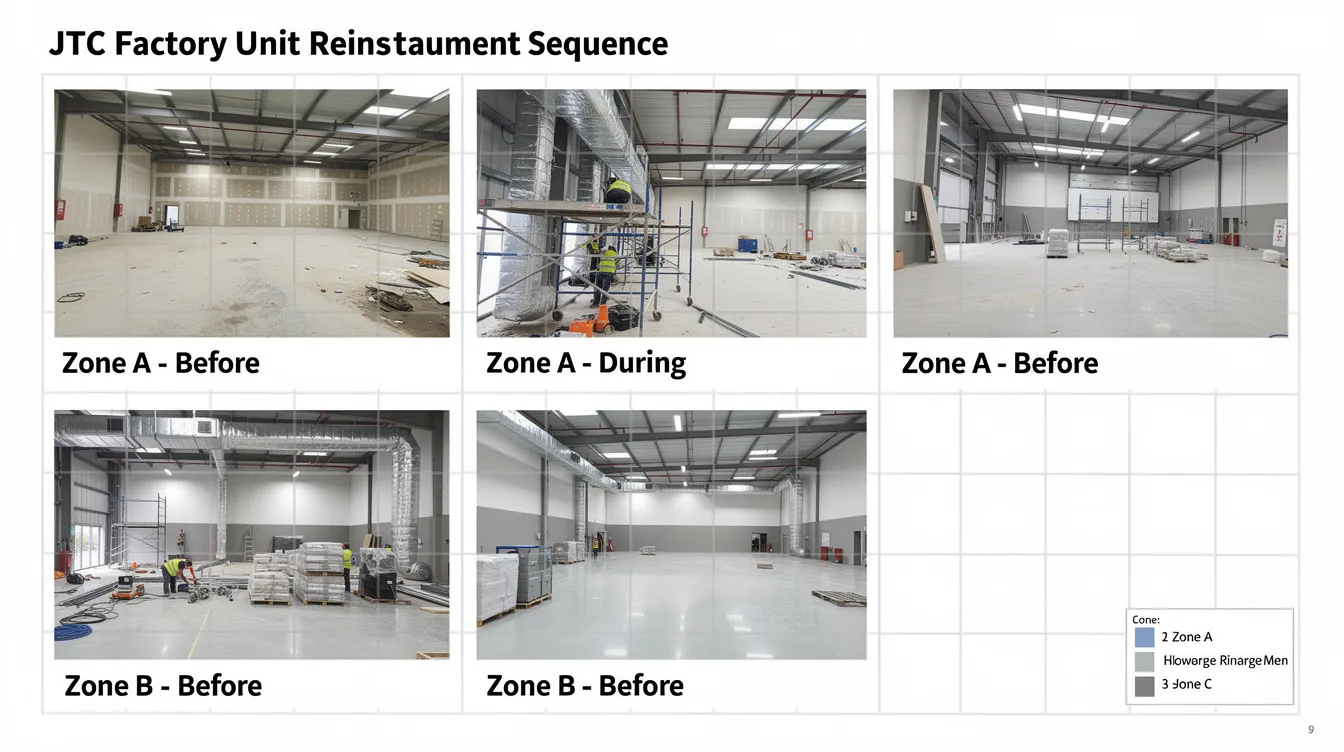
Visual Documentation and “With Pictures” Guidance
Photograph the premises before, during, and after reinstatement using a systematic approach:
-
Wide-angle shots of each zone (one per 500 sq ft minimum) showing overall condition
-
Close-ups of structural details: slab openings, bolt fixings, connections to base building steel or concrete
-
M&E terminations: electrical panels, plumbing connections, exhaust duct penetrations
-
Repaired areas: infilled openings, patched walls, repainted surfaces
Annotate photographs with zone references that match the JTC-approved floor plan. Side-by-side comparison images – the unit before fit out, post-A&A, and post-reinstatement – are powerful evidence during JTC inspections and invaluable in defending against unjustified claims about scope or condition.
How Stellar Structures Can Support Your JTC Lease-End Strategy
Stellar Structures reviews JTC leases and plan consent documents, advises on A&A vs reinstatement strategy, provides PE endorsement for structural removal and infilling, prepares method statements, and coordinates reinstatement contractors across multiple trades. The firm’s experience with JTC submission requirements and building and construction authority processes means outgoing tenants receive technically accurate advice grounded in current regulatory requirements.
Early engagement – ideally 9–12 months before lease expiry – allows time for thorough planning and avoids the compressed timelines that drive up reinstatement costs. To start an informed consultation, tenants should provide: site address, JTC tenancy reference number, total floor area, and a list of past A&A approvals with dates and PE endorsement status.