




Introduction
The SCDF P&FM licence application for utility facilities cost is one of the most frequently underestimated budget items in Singapore infrastructure projects. If your data centre, district cooling plant, hospital, or cogeneration facility stores petroleum and flammable materials beyond statutory exemption quantities, the Singapore Civil Defence Force requires you to hold a valid P FM storage licence before operations can commence. This complete guide breaks down every cost component so facility managers, EPC contractors, and project owners can budget accurately and avoid expensive surprises.
The direct answer: SCDF statutory licence fees are modest-typically a few hundred to a few thousand Singapore dollars per year depending on stored volume. But the total cost of obtaining and maintaining compliance ranges from roughly SGD 30,000–80,000 for a straightforward single-diesel-tank utility room, up to SGD 500,000–2,000,000+ for large, complex multi-fuel infrastructure plants. That total includes Professional Engineer (PE) design and submission fees, physical rectification works (bunds, fire protection, ventilation), testing, documentation, and operational impacts. It does not include land costs, bulk fuel procurement, or unrelated civil works.
This article focuses on storage and usage licensing for infrastructure and utility facilities-diesel generator farms, LPG rooms, fuel oil systems, town gas installations, and scheduled chemicals storage-in Singapore. Retail petrol stations and pure warehouse scenarios fall outside its scope. The target readers are facility managers, building owners, EPC contractors, and project managers who need to plan new plants or regularise existing flammable materials storage, and who want to avoid the pain of unplanned rectification costs and blown project schedules.
Key takeaways you will gain from this guide:
-
A clear breakdown of every cost component in a P&FM licence application for utility facilities
-
The exact SCDF fee levels for liquid, solid, and gaseous flammable materials storage
-
How design decisions, site constraints, and facility type dramatically influence total cost
-
Where hidden costs typically creep in-and how to prevent them
-
How Stellar Structures’ integrated engineering and authority-submission approach helps control both cost and compliance timelines
Understanding SCDF P&FM Licensing Costs for Utility Facilities
Most facility owners initially assume the “cost” of a P&FM licence is just the application fee paid to SCDF. In practice, the total cost of compliance encompasses regulatory fees, professional engineering services, physical construction or rectification works, testing, certification, and often significant operational impacts. Thinking only about the application form fee is like budgeting for a building permit while ignoring construction costs.
The Petroleum and Flammable Materials Storage Licence is issued by the SCDF to any premises storing or using petroleum products, liquefied petroleum gas, or other flammable materials above defined thresholds. For infrastructure-type plants, these thresholds are almost always exceeded-sometimes by orders of magnitude-which triggers the full suite of fire safety requirements, engineering submissions, and physical compliance measures that drive real cost.
Regulatory Framework, Fire Safety Requirements, and Why It Affects Cost
SCDF regulates petroleum storage under the Fire Safety Act, which establishes the legal basis for all P&FM licensing. Compliance with the Fire Safety (Petroleum and Flammable Materials) Regulations is necessary for any facility storing materials above exemption quantities. The SCDF defines specific exemption limits for various classes of petroleum-for example, the Maximum Allowable Quantity for liquids is 40 liters, and scheduled chemicals have no exemption thresholds for licensing at all.
The fire code and FM regulations prescribe separation distances (separation distances for Class I petroleum must be at least 3 meters), containment volumes (typically 110% of tank capacity), fire protection systems, ventilation rates, and structural fire ratings. Each of these prescriptive requirements translates directly into a mandatory project cost item-bund construction, fire-rated walls, sprinkler or foam systems, gas detection, and more. Where prescriptive distances cannot be met in tight urban sites, performance-based fire engineering solutions become necessary, adding further design complexity and cost.
SCDF’s own processing or application fee is modest. The real budget exposure lies in the engineering design and physical rectification required to achieve approval and pass site inspection.
What Counts as a “Utility Facility” from a Cost Perspective
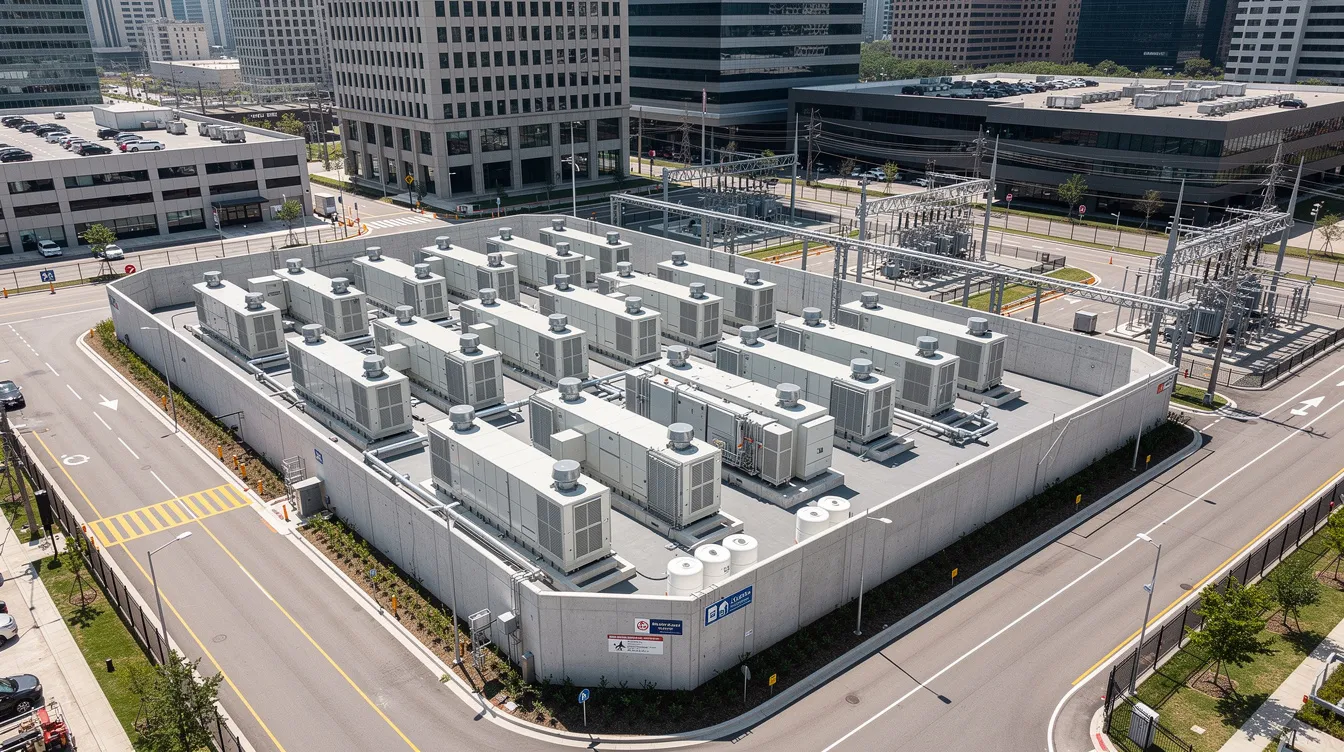
For this guide, utility or infrastructure facilities include data centre generator farms, district cooling and heating plants, central LPG rooms serving malls or hospital complexes, cogeneration plants, and centralised fuel supply systems for campus-type developments. These facilities share common characteristics that make them costlier to license than, say, a single small diesel day tank in a commercial building.
Why the higher cost? Utility facilities typically involve large fuel inventories stored across multiple bulk tanks and day tanks, complex distribution piping, and tight urban sites where achieving adequate separation distances requires creative engineering. They also interface with critical operations-a data centre cannot afford generator downtime, and a hospital’s emergency power must remain uninterrupted during any rectification works.
Co-location with hospitals, transport nodes, residential towers, and other occupied buildings often triggers higher fire-protection safety standards imposed by both SCDF and other agencies. This means more robust containment, higher-specification detection and suppression systems, and thus higher engineering and construction cost. Utility facilities must also ensure no unauthorized access to storage areas, adding security infrastructure to the cost equation.
Key Technical Drivers Behind Petroleum and Flammable Materials (P&FM) Licence Costs
The classification of stored materials-Class 0 through Class III petroleum, liquefied petroleum gas, and scheduled chemicals-directly determines the tier of fire safety features required. Higher-hazard classifications demand larger separation distances, more sophisticated fire protection, and more extensive containment systems.
A critical point many facility managers miss: the Maximum Allowable Quantity is aggregated across all bulk tanks, day tanks, drums, cylinders, and utility rooms within licensed premises. Mixed storage of different fuel types (diesel plus LPG plus town gas, for example) compounds the compliance scope and pushes facilities into more stringent-and more expensive-tiers. Aggregate weight of gaseous or solid flammable materials similarly affects fee bands and safety requirements.
These technical parameters link directly to major cost elements. Larger total volumes mean bigger bunds, higher-capacity fire suppression systems, more complex gas detection networks, structural fire protection works, and more detailed emergency response plans, with safety data sheets kept aligned to the facility’s hazards and accessible to cert members during incidents. Understanding these connections early is essential for accurate budgeting.
The next section breaks these influences down into specific cost components with realistic Singapore-dollar bands.
Cost Components in an SCDF P&FM Licence Application for Utility Facilities
Costs for a P&FM licence application in a utility facility fall into four broad buckets: statutory fees paid to SCDF, professional and consultancy fees, testing and documentation costs, and physical rectification or upgrade works. A fifth, often-forgotten category-internal and operational costs-can be equally significant. The figures below are indicative Singapore-dollar bands that vary with fuel volume, facility complexity, and site conditions, but they provide a realistic foundation for project planning and budgeting.
SCDF Statutory Application and Licence Fees
SCDF fee schedules include both annual licence fees for storage and administrative fees. Fees are structured for liquid, solid, and gaseous materials, and fees for P&FM storage licenses scale with declared quantities. Storage licence fees depend on material type and maximum volume or weight. Fees for storage licences are non-refundable and paid online during application through the GoBusiness portal.
For liquid petroleum and flammable materials, the published fee tiers are:
-
Not exceeding 500 litres: SGD $184/year – a liquid quantity not exceeding 500 liters costs $184
-
500–5,000 litres: SGD $242/year
-
5,000–50,000 litres: SGD $413/year – 5,000–50,000 liters costs $413 for P&FM storage licenses
-
50,000–250,000 litres: SGD $862/year
-
250,000–450,000 litres: SGD $1,320/year
-
Volumes beyond 450,000 litres incur incremental top-up fees per additional quantum
For gaseous flammable materials, fees start at $212 for up to 50 kg. Solid flammable material fees start at $212 for up to 200 kg.
The licence can be valid for a period of up to three years, which spreads these fees over a longer time period and avoids frequent renewal costs. Some owners choose maximum FM storage licence validity to reduce administrative burden and recurrent PE involvement.
Beyond storage, a separate P&FM Pipeline Licence is required for conveying materials through pipelines outside premises boundaries, at $350 per pipeline per year. Pipeline licence requires submitting technical documentation to the SCDF. SCDF charges a licensing fee of S$70 for import licenses, and where imported goods are involved they must be declared using the correct HS and product codes, kept at authorised licensed premises, and transported in licensed vehicles where applicable before the import license is issued. Transport licences for vehicles carrying P&FM run approximately SGD $105 per vehicle.
Compared to the engineering and construction costs that follow, these statutory fees are a small fraction of total compliance spend.
Professional Engineer (PE) and Consultancy Costs
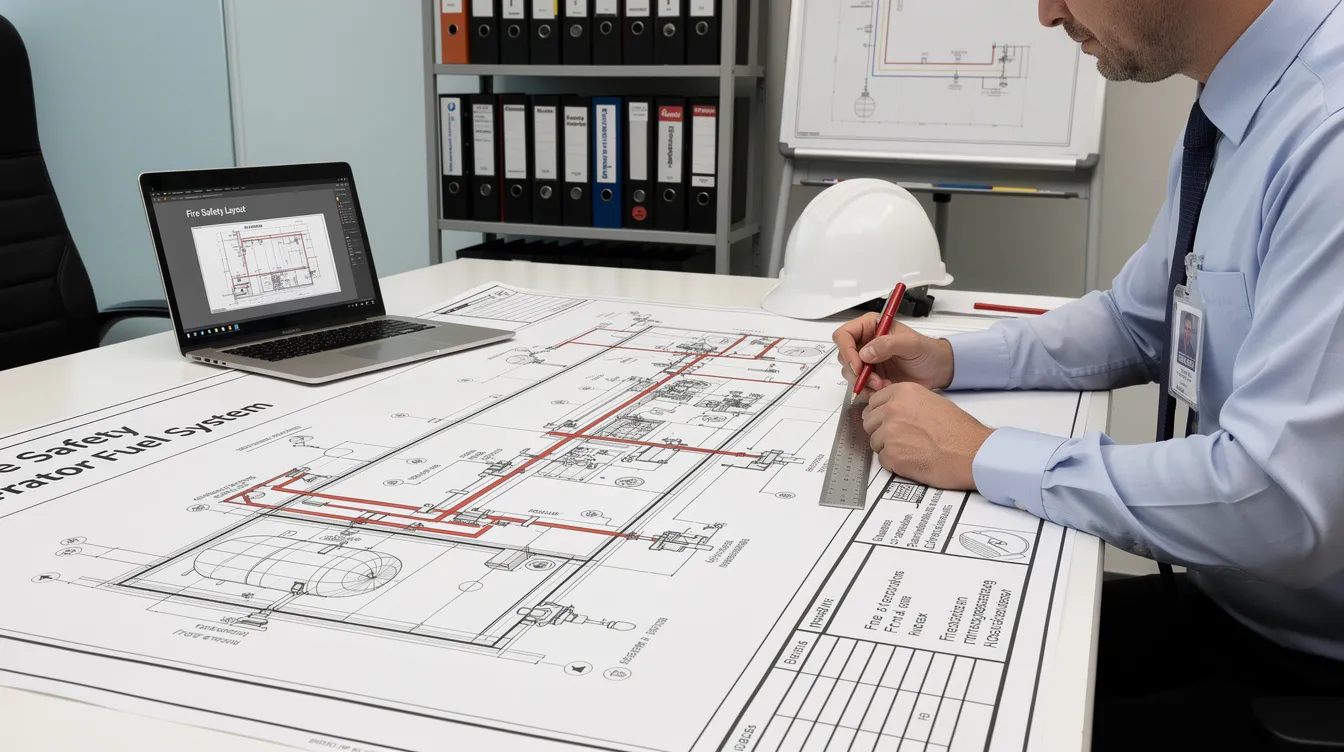
SCDF requires a qualified person to prepare application submissions. A Qualified Person must prepare fire safety plans for submission-typically a Professional Engineer or Registered Architect. This professional engagement represents a major component of soft costs.
The typical scope for an engineering consultancy like Stellar Structures includes: fire safety code compliance review, P&FM layout design, hydraulic and containment calculations, performance-based fire engineering where prescriptive solutions are infeasible, preparation of submission drawings, GoBusiness portal submission, and ongoing liaison with SCDF through clarifications and site inspection stages.
A Professional Engineer diagnoses gaps in P&FM applications, and PEs conduct forensic gap assessments for P&FM compliance. PEs prepare and submit P&FM storage plans to SCDF, ensure compliance with fire safety regulations for P&FM, and take professional liability for submitted P&FM documents. This professional liability is a key reason PE fees are not trivial.
Indicative PE and consultancy fee ranges:
-
Small scope (single diesel tank, straightforward utility room, new build): SGD 5,000–20,000
-
Medium scope (multiple tanks, mixed storage of diesel and LPG, some site constraints): SGD 30,000–100,000+
-
Large scope (multi-generator farm, scheduled chemicals, performance-based fire engineering, Quantitative Risk Assessment): SGD 100,000–300,000+
Fees are pushed higher by site constraints requiring multiple design iterations, several rounds of re-submissions to SCDF, and the need for fire engineering analysis or QRA. Regularisation of older, non-compliant utility plants-where existing documentation may be incomplete or inaccurate-typically costs more than new-build PE support due to the investigation and redesign work involved.
Testing, Certification, and Documentation Costs
The FM regulations require a comprehensive documentation and testing package before licence issuance. Test reports must be prepared and endorsed by a qualified person. A Registered Inspector is required to certify fire safety compliance. The typical tests and documents include:
-
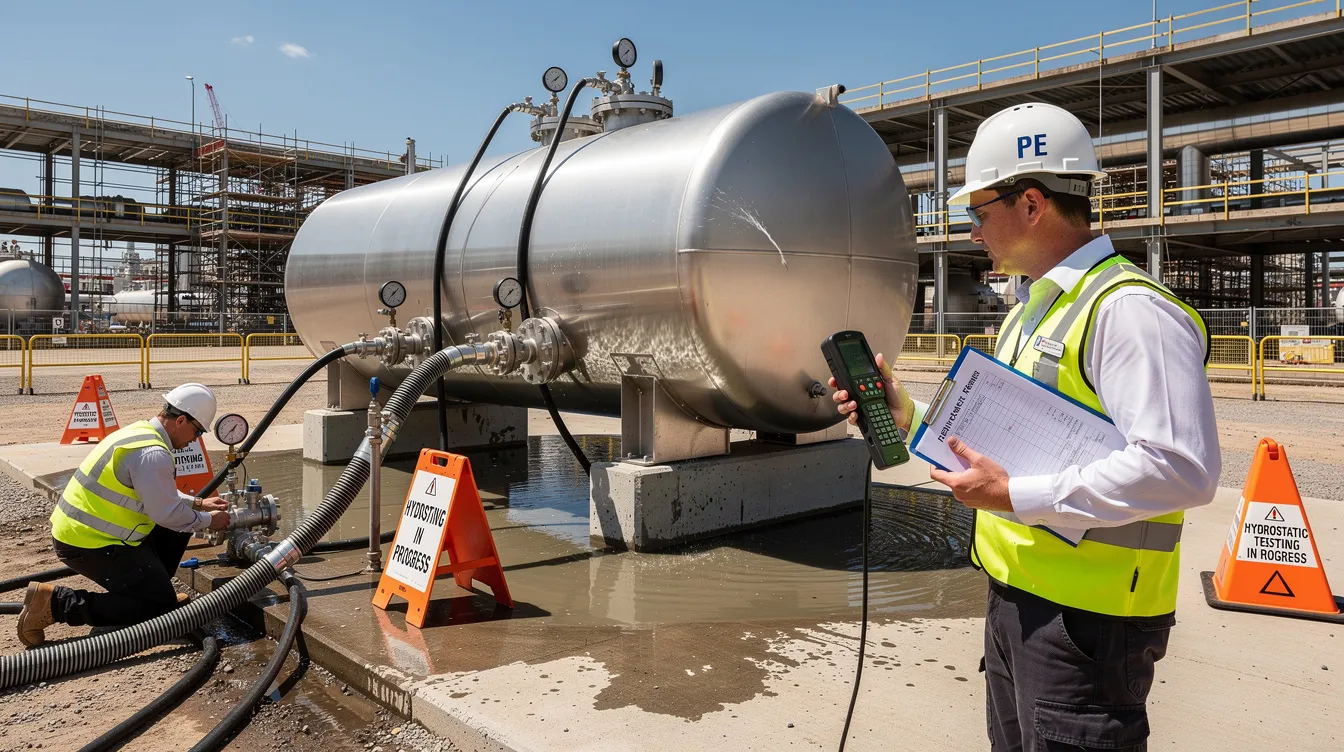
Hydrostatic and leak tests for tanks and piping systems
-
Functional testing of fire protection systems (sprinklers, foam, deluge) and gas detection networks
-
Calibration of combustible gas sensors and flame detectors
-
Structural certification of utility rooms, bund walls, and fire-rated separations
-
Emergency response plans tailored to specific P&FM scenarios-these must be prepared for utility facilities storing flammable materials
-
Safety data sheets for all stored materials, which must accompany the application submission
-
Supporting documents including as-built drawings, approved building plans, and inventory schedules
Each test involves mobilisation of specialist contractors, laboratory analysis, and PE endorsement. Costs scale with the number of tanks, pipe runs, and safety systems. For a single-diesel-tank utility plant, a combined test and certification exercise might cost SGD 2,000–5,000. For a mixed diesel/LPG utility with multiple systems, expect SGD 10,000–50,000.
Where legacy documentation is missing-common in older infrastructure-the cost of producing updated BIM or CAD as-built models and verifying existing installations against approved codes adds a further layer. All documents must comply with local codes and safety standards.
Construction, Rectification, and Upgrade Costs
For many existing utility facilities, the largest cost by far is physical rectification. This is where fire safety works translate into concrete, steel, and mechanical installations. Common work items include:
-
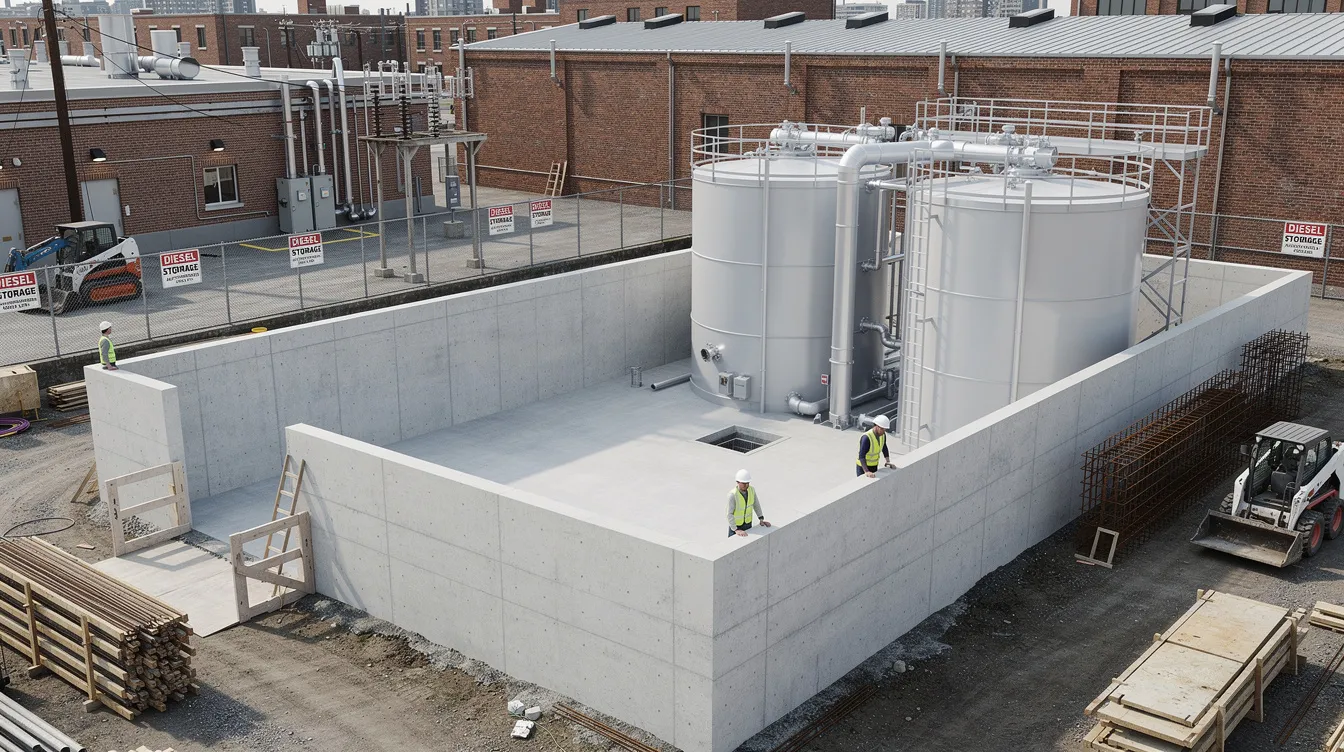
Constructing or resizing bunds to 110% of tank capacity with chemical-resistant coatings and proper drainage
-
Installing foam or sprinkler fire protection systems
-
Upgrading mechanical ventilation to prevent accumulation of flammable vapors
-
Adding fire-rated walls, doors, and shafts to achieve required separation distances
-
Segregating incompatible materials into separate containers or rooms
-
Installing explosion relief or blast panels for LPG rooms
-
Re-routing fuel pipelines to maintain clearances from escape routes and emergency vehicles access paths
Cost variability is extreme. Working in live facilities-where generators cannot be shut down or where operations must continue-means night works, phased shutdowns, and safety management premiums. Access constraints in basements or rooftop locations add crane, scaffold, and logistics costs.
Rough construction cost bands:
-
Small facility (single tank, accessible site): SGD 20,000–50,000
-
Medium facility (multiple tanks, some M&E upgrades): SGD 100,000–300,000+
-
Large, complex utility plant (multi-fuel, structural reinforcement, performance solutions): SGD 500,000–2,000,000+
Facility owners should treat the FM storage licence application as part of a larger capex and opex budget, not a standalone paperwork exercise.
Internal and Operational Costs Often Overlooked
Beyond direct project costs, facilities may incur additional compliance costs that are easy to miss during budgeting. Generator downtime during fuel system works may require temporary rental of mobile generators or LPG skids. Operations staff may need overtime to support testing and regular inspections. Temporary fuel supply arrangements add logistics cost.
Delaying licence approval can impact commissioning milestones for new developments. If a storage licence is not in place, Temporary Occupation Permit (TOP) or Certificate of Statutory Completion (CSC) cannot be issued, potentially triggering liquidated damages in construction contracts-a significant indirect cost that can dwarf the licensing fees themselves.
Facilities storing hazardous substances without valid licences also face insurance implications. Operating without compliance can void or limit coverage, magnifying financial exposure in the event of an incident. These operational impacts belong in every business case for P&FM licensing.
How Facility Characteristics Influence P&FM Licensing Cost
Two seemingly similar utility plants can have vastly different licensing costs. Understanding the key physical and operational differences helps facility owners benchmark their own situation and set realistic budgets. This section explains the variables that matter most.
Scale and Complexity of Fuel and Gas Systems
A small utility room with a single 10,000-litre diesel tank and minimal pipework is a fundamentally different proposition from a multi-level data centre generator farm with several 30,000–60,000-litre bulk tanks, multiple day tanks, extensive pipe routing, and dual-fuel arrangements.
More generators mean more tanks, longer pipe runs, more valves, and more containment requirements. Introducing multiple fuel types-diesel plus liquefied petroleum gas plus town gas-compounds design complexity because each material class has distinct fire code requirements for ventilation, detection, and separation. Complex projects with mixed storage require more drawings, more calculations, and more coordination meetings with SCDF, all of which increase PE and contractor hours.
Site Constraints, Separation Distances, and Structural Conditions
Tight basements, rooftop installations, and boundary-adjacent utility yards often cannot meet prescriptive fire code separation distances. When prescriptive compliance is impossible, performance-based fire engineering solutions become necessary-fire-rated barriers, enhanced suppression systems, or computational fluid dynamics modelling-all of which add cost.
Structural upgrading is another cost driver: enhancing slab fire ratings to support heavy tanks, adding fire-rated shafts for fuel piping penetrations, and reinforcing walls for explosion relief panels. In infrastructure contexts, common examples include generator farms located under podium carparks, LPG rooms adjacent to escape stairs, and utility plants squeezed between property boundaries where appropriate locations for storage simply don’t exist without engineered solutions.
New Build vs Existing or Legacy Utility Facilities
New greenfield infrastructure projects allow fire safety compliance to be built in from the concept stage. Tank locations, bund dimensions, pipe routing, and fire protection can all be optimised in the approved plan before construction begins, minimising rework and cost.
Brownfield regularisation of existing utility plants tells a very different story. Retrofits often require hacking existing structures, relocating equipment, and extensive shutdown planning. Legacy facilities frequently lack proper documentation-no as-built drawings, no original approved building plans, no records of previous modifications. Investigating what exists, designing compliant solutions around immovable constraints, and managing construction in an operating facility all add significant contingency to budgets.
The pattern is consistent: it is cheaper to integrate P&FM licensing requirements at the master-planning stage than to retrofit after an SCDF rejection or enforcement notice.
Operational Criticality and Risk Tolerance
Mission-critical facilities-data centres requiring 99.999% uptime, hospitals with life-safety obligations, transport hubs serving thousands daily-often choose more robust and redundant fire-safety solutions than the regulatory minimum. Double containment, fast-acting automatic shutdown systems, remote monitoring with 24/7 alarm response, and higher-specification gas detection for potential hazards all increase upfront cost but reduce the risk of operational failure.
Insurance requirements and corporate risk standards may mandate exceeding baseline SCDF requirements. These additional measures-while voluntary from a regulatory standpoint-are effectively mandatory from a business perspective and must be budgeted accordingly.
Step-by-Step Costed Process for P&FM Licence Application
Understanding when costs arise in the licensing process helps with cash flow planning and resource allocation. Below is the typical sequence in chronological order, with notes on where major expenditures occur and indicative timelines. Think of this as a horizontal timeline of key milestones and task dependencies that a project manager can map onto gantt charts or similar project management tools.
1. Preliminary Feasibility and Budgeting
The process begins with a desktop review: examining intended storage quantities, layout concepts, and existing drawings to flag major cost drivers early. At Stellar Structures, this typically involves reviewing the facility’s fuel inventory against SCDF exemption thresholds, assessing site constraints from available plans, and identifying whether a Quantitative Risk Assessment may be required for major hazards.
This stage usually involves a modest consultancy fee (often a few thousand SGD) and produces a preliminary cost range and compliance strategy. It is the single most cost-effective step in the entire process-identifying a non-compliant bund design at this point costs a fraction of discovering it during SCDF site inspection.
Typical duration: 1–2 weeks.
2. Detailed Design and Compliance Planning
With feasibility confirmed, the PE team prepares detailed P&FM layouts, containment design, fire protection and ventilation design, all annotated with references to applicable approved codes and standards. Design decisions made here-tank sizes, bund configuration, room separation distances, ventilation rates-lock in major cost items for builders and suppliers.
PE design and coordination fees are mainly incurred at this stage. For complex projects, this phase may also include fire engineering analysis or QRA preparation, adding both time and cost. The application must include an inventory of all stored flammable materials, and applications must include layout drawings and inventory schedules.
Typical duration: 3–6 weeks depending on complexity.
3. Submission to SCDF and Clarification Stage
The submission package is compiled for the GoBusiness portal: drawings, calculations, inventory schedule, safety data sheets, and supporting reports. Applications must be submitted through the GoBusiness portal, and SCDF processing fees are paid at this point-fees are non-refundable.
SCDF processing of storage license applications takes 19 working days. During this period, SCDF reviewers may raise queries requiring PE responses. Additional PE hours for clarifications and potential revisions should be budgeted. Incomplete fire safety documentation is a common rejection reason, as are mismatches between approved plans and actual conditions-both of which trigger re-submission costs.
Typical duration: 4–8 weeks including clarification rounds.
4. Construction, Installation, and Rectification Works
This is where bulk contractor costs are incurred. For new facilities, construction proceeds according to the approved plan. For existing utility plants, rectification works address gaps identified during the compliance review-resizing bunds, adding fire-rated elements, upgrading detection and suppression systems.
Changes requested by SCDF at the clarification stage (e.g. a larger bund, an additional fire-rated door, revised ventilation routing) may trigger variation orders and added capex. Building in a contingency of 10–20% in budgets for such scope adjustments is strongly recommended. Potential delays from material procurement or access scheduling in operational facilities should be factored into project schedules.
Typical duration: 4–16 weeks depending on scope.
5. Testing, Commissioning, and Final Inspection
Required tests-tank integrity, piping leak tests, alarm functionality, ventilation performance-must all be completed and documented. Test reports must be prepared and endorsed by a qualified person. SCDF conducts site inspections to verify compliance with submitted plans. This submission and site inspection stage is where everything must align: physical installation, documentation, and the approved plan.
Failed tests or non-conformances discovered during inspection mean re-mobilisation charges, additional contractor time, and potentially further PE endorsement fees. Re-inspection by SCDF adds weeks to timelines.
Typical duration: 2–4 weeks.
6. Licence Issuance, Renewal, and Ongoing Compliance Costs
Upon successful inspection, the storage licence is issued. The FM storage licence validity can extend up to three years, after which renewal is required. Storage or layout changes within the validity period can trigger additional submissions and costs-any modification to quantities, tank locations, or material types within licensed premises requires updated documentation and potentially a new approval cycle.
Cyclical costs include periodic licence renewals, regular inspections, ongoing maintenance of fire detection and firefighting equipment (proper maintenance of fire detection and firefighting equipment is required post-licensing), and updates to emergency response plans. Maintaining compliance is not a one-time event-establishing a long-term compliance budget line is essential for utility facilities.
Typical duration for licence issuance: 1–2 weeks after successful inspection. Ongoing costs recur throughout the licence period.
Common Cost Pitfalls and How to Avoid Them
Based on Stellar Structures’ experience with infrastructure and utility projects across Singapore, the following pitfalls account for the majority of budget overruns in P&FM licensing. Each is preventable with proper project planning and time management.
Underestimating Rectification Needs in Existing Utility Plants
The most common and costly mistake: an owner assumes the licence is “just paperwork” and budgets only for fees and documents. Then the PE or SCDF reviewer identifies undersized bunds, inadequate ventilation, non-compliant pipe routing, or missing fire-rated separations. Suddenly, unplanned civil, M&E, and architectural works must be executed-often at premium cost due to compressed deadlines.
Solution: Conduct a thorough pre-application audit. Walk the site with a PE, compare existing conditions against current fire code requirements, and budget for physical works from the outset. This upfront investment typically saves multiples of its cost in avoided rework.
Late Involvement of Professional Engineers
Designing utility plants or tendering construction works without early PE input on P&FM requirements leads to re-design, re-tendering, and costly site changes. A common pattern: the architect or M&E engineer places diesel tanks in locations that violate separation distances, and the error is only discovered when the P&FM submission is prepared.
Solution: Engage PEs at concept and schematic design stages. At Stellar Structures, our integrated engineering and authority-submission role means fire safety, structural, and M&E considerations are coordinated from day one, eliminating the disconnect that causes expensive late changes.
Misjudging SCDF Timelines and Their Cost Impact
Project teams frequently assume near-instant licence approval, then face compressed commissioning, overtime charges, or delayed TOP/CSC when reality intervenes. SCDF processing of applications typically takes 19 working days-and that is the nominal processing time before any clarification rounds, which can add weeks or months.
Solution: Build realistic float into master programmes. Map SCDF submission and review periods, clarification rounds, and inspection scheduling against your project’s important dates and deadlines. Track progress against these milestones weekly. For complex projects, assume 3–4 months from submission to licence issuance and plan accordingly to protect against cost escalations linked to schedule slippage.
Ignoring Indirect Costs and Insurance Implications
Operating significant P&FM storage without a valid licence can affect insurance cover, potentially voiding claims entirely in the event of a fire or explosion. Beyond insurance, enforcement action or shut-down orders from SCDF carry reputational and operational costs that far exceed any licensing fee.
Solution: View licensing spend as risk mitigation and business-continuity investment rather than regulatory overhead. Include insurance review as part of the licensing process, and ensure your broker is aware of stored quantities and compliance status. Monitor progress on maintaining compliance as part of ongoing facility management, not just during initial application.
Stellar Structures’ Approach to Optimising P&FM Licensing Costs
Stellar Structures is a Singapore-based engineering and authority-submission consultancy specialising in infrastructure and utility facilities. Our focus is cost-efficient compliance: achieving SCDF approval while controlling unnecessary capex and opex. We work across the full spectrum of utility P&FM projects, from single diesel tank submissions to complex multi-fuel infrastructure plants.
Integrated Engineering, Project Management, and Cost-Planning Methodology
We combine structural, civil, M&E, fire, and architectural input into a single coordinated design process. This integration eliminates the siloed approach where separate consultants produce conflicting designs that require expensive reconciliation on site.
Our use of BIM and clash detection pre-empts costly rework-fuel pipe routes, bund locations, fire-rated shafts, and ventilation ductwork are coordinated digitally before any concrete is poured. We provide early-stage cost estimates for key P&FM-driven items-bund construction, fire protection systems, gas detection-so clients can secure budget approvals and align procurement with realistic cost expectations.
Value Engineering and Performance-Based Fire Solutions
Performance-based fire engineering or Quantitative Risk Assessment can, in specific scenarios, avoid over-conservative construction-excessive wall thickness, overly large separation zones, or redundant suppression systems-and reduce cost while maintaining equivalent safety outcomes.
Practical examples of cost optimisation we have delivered include: re-orienting tanks to improve separation distances without increasing facility footprint, combining containment systems for multiple tanks under properly engineered shared bunds, and integrating fire protection into structural works (e.g. fire-rated structural walls serving dual purpose as bund walls) to avoid duplication. All optimisation remains within SCDF’s acceptance framework and is fully documented for transparent authority dialogue.
End-to-End Authority Management to Avoid Costly Delays
We manage the entire process from preliminary consultation through design, SCDF submission, query responses, to attendance at inspections and final licence issuance. Single-point responsibility reduces the miscommunication between contractors, owners, and agencies that typically generates change orders, time claims, and potential delays.
Our team helps clients create a visual representation of their licensing timeline-mapping key milestones, task dependencies, and specific dates for submissions, inspections, and licence renewal deadlines. This allows facility owners and project managers to monitor progress, anticipate cash outflows, and manage deadlines proactively.
Conclusion and Next Steps
The real cost of an SCDF P&FM licence application for utility facilities lies in the engineering, construction, and operational measures required to meet regulations-not the application form itself. Statutory fees measured in hundreds or low thousands of SGD per year are dwarfed by PE design costs, physical rectification works, testing, and the operational impact of managing compliance in live infrastructure facilities.
Early planning, realistic budgeting, and integrated design minimise total cost and potential risks for infrastructure owners. The many benefits of getting this right include avoiding enforcement action, protecting insurance coverage, meeting project deadlines, and ensuring safe, compliant operations for the full licence period.
Actionable next steps:
-
Conduct a high-level inventory and layout review – document all petroleum products, flammable materials, and scheduled chemicals currently stored or planned, with quantities and locations
-
Engage a PE-led consultancy – involve a qualified person with P&FM expertise at the earliest design stage, not after construction begins
-
Allocate provisional budgets for rectification – based on the cost bands in this guide, set aside appropriate contingencies for physical works
-
Integrate licensing milestones into project timelines – map SCDF submission, review, inspection, and licence issuance dates against your master programme deadlines
-
Establish internal change-control processes – ensure any future modifications to fuel storage or layout trigger a compliance review before implementation
Contact Stellar Structures for a preliminary consultation or cost review of your planned or existing utility P&FM installations. We help you plan a clear path from initial feasibility through to licence issuance-on budget and on schedule.
Additional Resources and Cost Checklists
Quick Budgeting Checklist for Utility P&FM Licence Projects
Use this checklist to create an internal budgeting template. For each line item, assess whether it is “likely,” “possible,” or “unlikely” for your specific facility type:
-
SCDF statutory licence fees (storage, pipeline, import, transport) – Likely for all utility facilities
-
PE/QP design and submission fees – Likely; scope varies with complexity
-
Quantitative Risk Assessment (QRA) – Possible for large inventories or constrained sites; likely for scheduled chemicals
-
Fire protection system design and installation (sprinklers, foam, gas detection) – Likely for medium and large facilities
-
Bund and containment construction (civil/structural works) – Likely wherever tanks exceed exemption quantities
-
Fire-rated walls, doors, and structural fire protection – Likely for enclosed utility rooms; possible for open-air installations
-
Ventilation system upgrades – Likely for LPG rooms, enclosed fuel stores, and gas cylinder manifold systems
-
Testing and certification (hydrostatic, leak, alarm functional) – Likely for all installations
-
As-built documentation and BIM updates – Likely for brownfield; possible for greenfield
-
Temporary services (mobile generators, temporary fuel supply) – Possible for retrofit projects in operating facilities
-
Contingency allowance (10–20% of construction/rectification budget) – Recommended for all projects
-
Ongoing compliance costs (renewals, maintenance, regular inspections) – Likely; recurrent throughout licence period
Photographic and Diagrammatic References
When developing a full visual representation for internal project planning, consider including:
-
Annotated images of compliant bund installations – captioned to show the cost impact of 110% containment requirements and chemical-resistant coatings
-
Typical diesel generator farm layout – showing tank positions, pipe routing, separation distances, and fire protection zones with cost annotations
-
LPG room ventilation example – illustrating mechanical ventilation design, gas detection sensor placement, and explosion relief panel requirements
-
Simplified process flow diagram – mapping the journey from preliminary feasibility through design, submission, construction, testing, to licence issuance, with cost buckets at each stage
Each image should link visual elements directly to cost impact. For example: “Fire-rated wall added to meet separation distance requirements, avoiding the need to relocate the tank-estimated cost saving of SGD 40,000–80,000 compared to tank relocation.”
Frequently Asked Questions on P&FM Licence Costs for Utility Facilities
What is the minimum budget I should set aside for licensing a small diesel utility plant? For a single diesel tank under 5,000 litres in a new build with good site access, budget approximately SGD 30,000–80,000 total including PE fees (~SGD 5,000–20,000), SCDF licence fee (~SGD 242/year), a modest bund and containment works (~SGD 20,000–50,000), and testing (~SGD 2,000–5,000). Licences are required for storing materials exceeding statutory exemption limits-even modest volumes quickly exceed the 40-litre liquid exemption.
How often will I incur costs again after the initial licence is obtained? Storage licence renewals occur every 1–3 years depending on chosen validity. Each renewal may involve PE review, updated documentation, and SCDF inspection fees. Ongoing costs include maintenance of fire protection systems, sensor calibration, and emergency response plan updates. Budget a recurring annual compliance allocation.
Can I phase rectification works to spread out cost while still progressing towards compliance? In some cases, yes-SCDF may accept phased rectification with an agreed timeline and interim risk-mitigation measures. However, the licence will not be issued until full compliance is achieved. Discuss phasing feasibility with your PE early, as some works have task dependencies that dictate a fixed sequence.
Does changing fuel type (e.g. from diesel to gas) later require a full new licence and major new costs? Yes. Changing the type or class of stored flammable materials typically requires a new or amended P&FM licence, updated fire safety design, revised import licensing procedures if applicable, new testing, and potentially significant physical modifications (different ventilation, detection, and suppression systems). The cost of switching fuel types can approach or exceed original licensing costs.
Are there cost differences between different infrastructure segments (data centres vs hospitals vs industrial utilities)? Significant differences exist. Data centres often involve large diesel volumes across many generators in constrained spaces, demanding extensive bunding and complex piping design. Hospitals face additional regulatory scrutiny due to patient safety considerations and may require higher fire safety certificate standards. Industrial utilities may store scheduled products or hazardous substances that trigger QRA requirements. Each segment has distinct cost profiles driven by its regulatory context, operational requirements, and risk tolerance.
What recent regulatory changes affect P&FM licensing costs? As of 2026, SCDF is introducing a class licensing regime for certain lower-risk P&FM activities (e.g. buildings storing diesel solely for emergency generators), which may reduce administrative costs for eligible facilities. Additionally, the maximum validity period for individual licences is being extended from three to five years, potentially reducing renewal frequency and associated costs. These changes are detailed in the Civil Defence Shelter and Fire Safety Miscellaneous Amendments Bill.