




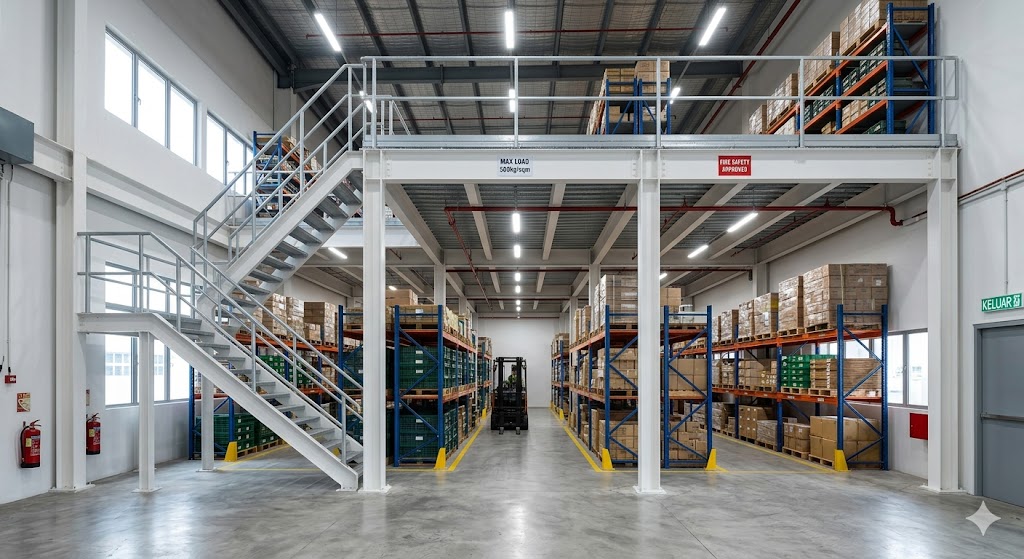
A Successful JTC Submission for a Steel Mezzanine Storage Area
SEO Title: A Successful JTC Submission for a Steel Mezzanine Storage Area
Focus Keyphrase: Successful JTC Submission
Secondary Keywords: Steel Mezzanine Storage Area, JTC Properties, BCA Approval Process, SCDF Fire Safety, Mezzanine Regularisation, CORENET-X.
Meta Description: An exhaustive guide outlining a successful JTC submission for a steel mezzanine storage area. Explore BCA approvals, SCDF fire safety rules, and JTC compliance.
Primary Tags: Structural Engineering, JTC Compliance, Industrial Mezzanines, SCDF Fire Code 2023, Mezzanine Regularisation.
Executive Summary
Singapore faces extreme land scarcity and spatial constraints. Industrial businesses must optimize their existing vertical building space. Consequently, constructing a steel mezzanine storage area is highly popular.
However, these installations operate under strict regulatory frameworks. Navigating these rules dictates a successful JTC submission. Furthermore, property owners must secure multiple government agency approvals. The Jurong Town Corporation (JTC) oversees all property modifications.
The Building and Construction Authority (BCA) ensures structural safety. The Singapore Civil Defence Force (SCDF) mandates strict fire safety. Finally, the Urban Redevelopment Authority (URA) governs land use.
This comprehensive research report details every regulatory parameter. It explains the complex BCA approval process. It outlines the specific SCDF fire safety guidelines. Moreover, it explores the JTC Space Submission Handbook rules. Additionally, it details the transition to the CORENET-X digital platform.
Property owners often construct unauthorised mezzanine floors illegally. Therefore, this report extensively covers the mezzanine regularisation process. Failure to comply brings severe legal and financial penalties. Ultimately, engaging professional structural engineers guarantees regulatory compliance and safety.
The Strategic Demand for Vertical Expansion
Singapore’s industrial landscape demands maximum spatial efficiency.1 Traditional warehouse expansions are frequently cost-prohibitive. Therefore, businesses look internally for spatial optimization solutions.
A steel mezzanine storage area provides an ideal intermediate floor. This platform resides between the main floor and ceiling.1 Structurally, it is not considered a full building storey.1
A well-designed mezzanine floor dramatically increases usable area.1 It allows massive capacity increases without external building expansion.1 Consequently, businesses significantly enhance their overall operational productivity.2
These structures serve incredibly diverse commercial and industrial functions. Heavy-duty mezzanines support complex manufacturing and logistics operations.1
Commercial mezzanines enhance retail customer experiences and rental yields.1 Residential loft-style mezzanines are also increasingly popular space solutions.1
However, adding a mezzanine floor introduces massive structural loads. It permanently alters the host building’s complex fire dynamics. Therefore, the Singapore government heavily regulates these structures.2
They aim to maintain a safe environment for all occupants.2 Achieving a successful JTC submission requires meticulous technical planning.3 Ignoring regulations leads to crippling fines and project delays.2 Unapproved floors can result in severe legal action.2
Jurong Town Corporation (JTC) Compliance Framework
The Jurong Town Corporation serves as the primary industrial landlord.4 JTC manages countless industrial and business park developments.4 A successful JTC submission must respect strict zoning guidelines.4
The authority carefully monitors mezzanine usage and structural layouts.2 They conduct regular property audits and unannounced inspections.2 This proactive oversight helps maintain safe and lawful environments.2
The JTC Space Submission Handbook Version 6
JTC recently updated its regulatory documentation for tenants.5 The JTC Space Submission Handbook Version 6 is now active.5
This handbook guides all fit-out works in JTC-managed properties.5 The updated version completely restructured the submission readability.5 It provides comprehensive technical specifications for various work types.5
The handbook classifies works into distinct statutory lists.6 List A contains specific exemptions from formal JTC submissions.6
List B contains works requiring strict Professional Engineer (PE) endorsements.6 List C applies to works not requiring QP endorsements.6 List D covers buildings with mandatory green building obligations.5 A steel mezzanine storage area construction falls under List B.5 Consequently, it requires strict PE (Civil) endorsed drawings.5
Gross Plot Ratio and Floor Plate Allowances
JTC strictly controls the sheer size of mezzanine additions. JTC typically allows mezzanine floors covering 50% of floor plates.1 Crucially, this 50% allowance often excludes Gross Plot Ratio (GPR) counts.1
However, this allowance varies wildly by specific development types.1 Therefore, consultants must verify parameters for every individual project.1
Furthermore, JTC enforces strict vertical height minimums. Most industrial buildings require a minimum floor-to-floor height.1
This minimum is generally set at 4.5 meters.1 However, engineers typically recommend 5.5 meters of clear height.1 This ensures comfortable 2.5-meter vertical clearances above and below.1
Structural Independence and Building Integrity
JTC mandates absolute structural independence for mezzanine installations.1 The new mezzanine must never affect the primary building structure.1 A successful JTC submission demands rigorous structural integrity checks.5 PEs must evaluate existing structures, calculating precise design loads.5
JTC explicitly prohibits hacking primary reinforced concrete slabs.5 Tenants cannot hack or core structural columns, beams, or slabs.5 Coring the roof floor is strictly banned to protect waterproofing.5
If embedding magnets into slabs is absolutely unavoidable, rules apply.5 The PE must provide plans showing exact gridline references.5 Existing rebars must never be exposed or touched.5
JTC Exemptions and Minor Alterations
JTC recently expanded its List A exemption categories.8 Effective May 8, 2025, many minor works bypass JTC consent.8 This streamlines processes for basic multi-tenanted building upgrades.8
| JTC List A Exemption Category | Specific Requirement or Limitation |
| Ceiling or Wall Fans | Maximum suspended weight must not exceed 35kg.6 |
| Fan Height Clearance | Minimum 2.4m clearance from the finished floor level.6 |
| Anchor Penetration | Bolts and anchors cannot exceed 40mm penetration.6 |
| Shelving Systems | Maximum height is strictly capped at 3 meters.6 |
| Rack Width | Maximum rack width cannot exceed 1.2 meters.6 |
| Machinery Installation | Individual machinery weight must remain below 750kg.8 |
| Internal Passageways | Must maintain unobstructed internal passageways of 1.2m.6 |
Furthermore, the gross weight of fully loaded shelves is controlled. Combined shelf and storage weight cannot exceed 7.5 kN/m².6 Alternatively, it must not exceed the allowable design-imposed load.6 All materials stored on these specific shelves must remain non-combustible.6
BCA Structural Engineering and Regulations
The Building and Construction Authority (BCA) ensures physical building safety.4 The BCA regulates structural integrity across the entire city-state.3
Their efforts continually improve overall building standards and environmental sustainability.3 A successful JTC submission inherently requires a flawless BCA approval process.9
The BCA Approval Process Framework
BCA demands structural plan approval before any construction begins.9 This applies equally to new erections and major renovations.9
Mezzanine additions trigger mandatory Addition & Alteration (A&A) submissions.9 A&A submissions are required whenever structural elements are altered.9 This includes removing load-bearing walls or adding floor platforms.9
The submission package requires extensive architectural and structural cross-referencing.9 It must include detailed site investigation reports and foundation designs.9
A registered Professional Engineer (PE) must formally endorse the design.9 The PE assumes massive personal civil and criminal liability.9 Typical BCA approval timelines take roughly four to eight weeks.9
Applicable Eurocode Design Standards
Singaporean structural engineers must utilize highly specific design codes. Mezzanine designs must comply with recognized international Eurocodes.1 These are legally adapted with specific Singapore National Annexes.1
| Singapore Standard (SS) | Structural Engineering Application Focus |
| SS EN 1993-1-1 | Governs comprehensive steel structure design and connection procedures.1 |
| SS EN 1992 | Dictates requirements for reinforced concrete structures where applicable.1 |
| SS EN 1991-1-1 | Governs all structural loading requirements and load combinations.1 |
| SS 555:2018 | Mandates lightning protection integration for elevated industrial structures.1 |
Imposed Load Limits for Industrial Mezzanines
A steel mezzanine storage area supports massive industrial weights. BCA engineers strictly evaluate minimum imposed load capacities.1 These limits vary drastically based on the specific spatial usage.1
| Mezzanine Usage Type | Minimum Imposed Load (kN/m²) | Engineering Considerations |
| Light Storage Area | 5.0 | Must withstand a 2.7 kN concentrated point load.1 |
| Heavy Storage Area | 7.5 to 15.0 | Must withstand racking loads and forklift impact forces.1 |
| Production Facility | 5.0 to 10.0 | Requires vibration isolation and heavy equipment load management.1 |
| Ancillary Offices | 3.0 to 4.0 | Must support internal partition loads and heavy IT equipment.1 |
Deflection Control and Progressive Collapse
Static loading is only one part of the engineering equation. A successful JTC submission demands complex dynamic structural analysis.1
Deflection control prevents excessive floor bouncing under heavy movement.1 Meeting serviceability limits ensures user comfort and machinery operation safety.1
High-traffic zones require profound vibration analysis by the PE.1 Furthermore, structural engineers must design against progressive collapse scenarios.1
This involves creating alternate load paths and building systemic redundancy.1 Connection designs, particularly base plates, undergo intense BCA technical scrutiny.1
SCDF Fire Safety Engineering and Compliance
Fire safety compliance is exceptionally complex in Singapore. The Singapore Civil Defence Force (SCDF) rigorously enforces the Fire Code.10 A steel mezzanine storage area drastically alters internal fire dynamics. It creates new confined spaces and elongates escape routes.10 Consequently, SCDF involvement centers directly on rapid emergency evacuation.1
The 60 Square Meter AFA Concession
Industrial buildings fall under Purpose Group VI and VIII.10 Chapter 9 of the SCDF Fire Code 2023 details specific rules.10 The Aggregate Floor Area (AFA) is the most critical metric.10
For a single factory unit, the mezzanine AFA has limits. It must not exceed 60 square meters.11 This equals approximately 645 square feet of usable space.10 If the mezzanine remains under 60m², SCDF grants major concessions.10 Specifically, it permits a single open staircase for emergency egress.10
However, this concession carries very strict operational usage limitations. The mezzanine must serve exclusively as stores or ancillary offices.11 A successful JTC submission depends heavily on this exact classification.10
Open Staircase Escape Specifications
If utilizing the single open staircase concession, rules apply.10 The staircase must maintain a minimum width of 1 meter.11 This allows sufficient capacity for commercial emergency evacuation scenarios.10 Furthermore, the entire staircase must utilize strictly non-combustible materials.11 It cannot share an air-well with other occupancy areas.13
Maximum Travel Distances (Table 2.2A)
Evacuation speed is paramount during an industrial fire outbreak. SCDF Fire Code 2023 Table 2.2A dictates maximum travel distances.10 The maximum travel distance starts from the most remote point.11 It measures down the staircase to the nearest main exit.10
A typical sprinkler-protected factory permits a 60-meter two-way travel distance.10 The one-way travel distance is capped at 25 meters.14 The direct one-way distance limit is 16.6 meters.14 Non-sprinklered factories face much harsher one-way limits of 15 meters.14
| Occupancy Category | 1-Way Travel Distance | 2-Way Travel Distance | Persons Per Unit Width |
| Sprinklered Factory | 25 meters 14 | 60 meters 14 | Varies by design |
| Non-Sprinklered Factory | 15 meters 14 | 45 meters 14 | Varies by design |
| Sprinklered Shops | 25 meters 14 | 60 meters 14 | N/A |
| Sprinklered Offices | 30 meters 14 | 75 meters 14 | N/A |
The PE must meticulously calculate this exact evacuation path.10 If distances are exceeded, a second remote exit becomes mandatory.11
Structural Fire Resistance Ratings
Steel loses its critical load-bearing strength rapidly during fires. Therefore, SCDF mandates strict structural fire resistance ratings.10 The elements of structure must possess 1-hour fire resistance ratings.11
Engineers achieve this using various approved fire-protection coating methods.1 Intumescent paint coatings are popular for exposed, visible steel frames.1 Spray-applied cementitious coatings offer budget-friendly protection for hidden members.1 Fire-rated board systems provide exceptional ratings and a clean finish.1
Sprinkler Systems and Active Protection
A new mezzanine visually obstructs existing ceiling sprinkler coverage. Therefore, active fire protection systems require immediate integration and extension.1 Sprinkler systems must extend underneath the new mezzanine floor structure.10
New sprinkler heads are installed directly onto the mezzanine’s underside.10 This guarantees unobstructed water coverage for the newly created spaces.10 For completely non-sprinklered buildings, mezzanines can trigger new sprinkler mandates.10 The added fire load might exceed allowable compartment size limits.10
Urban Redevelopment Authority (URA) Master Plan
The Urban Redevelopment Authority (URA) shapes Singapore’s entire physical landscape.3 URA manages urban density, transportation strategies, and housing parameters.3 A successful JTC submission must strictly align with URA regulations.3
Gross Floor Area (GFA) Parameters
URA dictates property intensity primarily through Gross Floor Area (GFA).15 In commercial Central Business District zones, mezzanines count fully.1 If a commercial mezzanine is accessible, URA includes its GFA.1
However, industrial B1 and B2 zones offer different flexibility.1 JTC’s 50% GPR exemption generally aligns with URA industrial guidelines.1 Yet, URA imposes harsh limits on ancillary office space.1 Industrial zones face a strict 60% ancillary office quantum cap.1 Therefore, mezzanine offices cannot push the building beyond this cap.1
Evolving URA Residential Guidelines
While this report focuses on JTC industrial mezzanine applications, context matters. URA’s strict oversight applies equally to commercial and residential spaces.16
Residential mezzanines in condominiums face specific URA structural limitations.1 URA recently increased the minimum average size of private flats.17
Flats outside central areas must average at least 85 sqm.17 Certain districts, like Marine Parade, require 100 sqm minimums.17
Furthermore, URA revised its GFA apportionment rules for mixed-use developments.18 Common areas in white sites utilize simple average apportionment calculations.18 For example, a commercial, residential, and hotel mix splits common areas equally.18 These complex rules highlight the necessity of professional regulatory consultants.1
Digital Transformation: CORENET and CORENET-X
The administrative process for a successful JTC submission is evolving.9 Historically, consultants submitted flat, 2D PDF documents via CORENET.9 However, BCA is aggressively transitioning the industry to CORENET-X.9
Federated BIM Model Mandates
CORENET-X represents a total paradigm shift in regulatory submissions.9 It requires model-driven, Building Information Modeling (BIM) digital submissions.9 PEs can no longer submit isolated, standalone structural engineering drawings.9
Submissions must utilize highly federated 3D BIM spatial models.9 These models must integrate Architecture, Structural, and MEP engineering disciplines.9
This forces teams to resolve physical clashes before construction begins.9 The platform uses automated code checking to flag spatial deficiencies.9 It identifies missing property data and structural classification errors instantly.9
Implementation Timelines and Industry Costs
This digital transition is legally mandated, not merely optional.9 As of October 2025, large projects faced mandatory CORENET-X adoption.9 By October 1, 2026, CORENET-X becomes universally mandatory.9 This applies to all new building projects regardless of size.9
Consequently, property owners must engage CORENET-X-ready consultants immediately.9 Mid-project conversions from 2D CAD to BIM are financially devastating.9 Conversions add weeks of delay and inflate fees by 30%.9
| CORENET-X Project Size | Estimated Implementation Timeline | Typical Design Fee Range |
| Small (< 10,000 m²) | 4 to 8 weeks | Starts from S$15,000 9 |
| Mid-size (10,000 to 30,000 m²) | 6 to 12 weeks | S70,000 9 |
| Large (30,000 to 100,000 m²) | 12 to 20 weeks | S200,000 9 |
| Mega-projects (> 100,000 m²) | 20+ weeks | Exceeds S$200,000 9 |
Common CORENET-X Rejection Triggers
A successful JTC submission on CORENET-X requires precise digital hygiene. Automated systems routinely reject models for specific digital technical failures.9 Disciplines submitted as completely separate, unfederated models face immediate rejection.9
Failure to classify structural objects correctly guarantees automated submission failure.9 Missing critical property data, like fire ratings, triggers immediate queries.9 Finally, unresolving high-severity clashes causes swift regulatory denial.9
Retroactive Compliance: Mezzanine Regularisation
Despite rigorous legal frameworks, illegal constructions remain a persistent issue.19 Many property owners bypass authority submissions entirely to save money. They build unapproved steel mezzanine storage areas without professional coordination.19 Unauthorised additions bypass essential load checks and fire safety integration.19
The Severe Risks of Unauthorised Construction
The physical dangers of unapproved mezzanine floors are highly severe. In 2024, an unauthorised mezzanine collapsed in a Toa Payoh warehouse.20 Three individuals became trapped under fallen rugs and storage racks.20 Two children required urgent hospitalisation following the structural failure.21
Investigations revealed the tenant engaged a vendor directly.21 They never sought BCA approval or a Fire Safety Certificate.20 SCDF routinely initiates severe legal action against non-compliant parties.20
The Building Maintenance and Strata Management Act (BMSMA) also penalizes violators.22 Ignorance of regulations is never accepted as a legal defense.22 Judges consistently reject “substantial financial hardship” as justification for illegality.22
The Six-Step Regularisation Pathway
When authorities discover illegal structures, owners must pursue regularisation immediately.9 Regularisation is the formal retroactive approval process under the BCA.9 It attempts to bring unauthorised structures into full legal compliance.9 This process is exceptionally complex, highly expensive, and physically demanding.
- Exhaustive Site Survey: A PE must physically inspect the unapproved structure directly.9 They measure dimensions and identify all load-bearing construction materials.9 They evaluate the overall structural adequacy of the existing framework.9
- As-Built Documentation: The PE drafts exact “as-built” structural engineering drawings.9 These drawings reflect the exact, actual constructed condition of the mezzanine.9 They must meet stringent BCA digital submission formatting requirements perfectly.9
- Retroactive Calculations: The engineer performs highly complex retroactive structural calculations.9 They verify if the structure complies with current Singapore design codes.9 They check Eurocode compliance regarding load capacities and joint detailing.9
- Mandatory Remedial Works: Unauthorised structures frequently fail modern BCA safety safety codes.9 Therefore, the PE must specify necessary structural corrective actions.9 This often involves massive steel strengthening or partial demolition works.9 A licensed contractor executes these repairs under strict PE supervision.9
- Formal BCA Submission: The PE compiles an exhaustive, highly detailed regularisation submission package.9 This includes all mathematical calculations, as-built drawings, and site photographs.9 The PE uploads this directly to the BCA via CORENET-X.9 The endorsing PE accepts full legal liability for the structure.9
- Review and Final Approval: BCA engineers rigorously scrutinize the entire retroactive submission package.9 They frequently issue extensive and demanding clarification queries.9 Once thoroughly satisfied with safety, BCA grants formal regularisation approval.9
Timelines and Costs for Retroactive Approval
Regularising a steel mezzanine storage area carries substantial financial penalties. The costs vary immensely based on existing structural compliance levels.9
| Regularisation Project Complexity | Typical Timeline | Estimated PE Consulting Fees |
| Simple (No Remedial Works needed) | 4 to 6 weeks | S5,000 9 |
| Standard (Moderate Rectifications) | 6 to 10 weeks | S12,000 9 |
| Complex (Major Structural Strengthening) | 8 to 12 weeks | S20,000+ 9 |
Why Regularisation Frequently Fails
Regularisation is never a guaranteed regulatory outcome in Singapore.19 Many unauthorised additions face immediate rejection by reviewing authorities.19
Mezzanines are often built with absolutely zero upfront design coordination.19 Original slab loading limits are frequently exceeded without prior checks.19 Improvised staircases fail mandatory SCDF dimensional and safety requirements.19
Furthermore, property owners hold highly unrealistic commercial submission expectations.19 Many demand a low-cost submission while maintaining the flawed structure untouched.19 This approach inevitably leads to immediate regulatory rejection and delays.19
If a mezzanine obstructs critical fire egress, it cannot be retained.19 Sometimes, complete demolition remains the only legally viable path forward.19 Therefore, proactive compliance is drastically cheaper than retroactive regularisation attempts.
Secondary Systemic Insights and SEO Integration
A successful JTC submission demands mastering dense regulatory engineering frameworks. This process reveals deep systemic priorities within Singapore’s governing bodies. Structural integrity and fire safety are completely interdependent engineering concepts.
A structurally perfect mezzanine remains highly illegal if it traps occupants. Conversely, perfect fire exits fail if the steel frame collapses structurally.
The new CORENET-X mandate forces this interdisciplinary harmony digitally.9 By forcing architectural, structural, and MEP models together, conflicts disappear early.9 Furthermore, URA and SCDF parameters artificially limit unconstrained vertical expansion.10
The 60m² Aggregate Floor Area limit prevents massive, undivided fire hazards.10 It ensures single open staircases can mathematically handle occupant evacuation loads.23
From an SEO and digital visibility perspective, professional consultants must adapt.24 Keywords like “BCA Approval Process” and “Mezzanine Regularisation” drive massive traffic.25 High-value clients search for specific solutions regarding SCDF Fire Safety.24
Expertly utilizing keyword planners ensures critical regulatory information reaches property owners.25 Proper metadata tagging guides industrialists toward safe, compliant engineering solutions.26
Conclusion
Constructing a steel mezzanine storage area optimizes vital industrial space. However, achieving a successful JTC submission requires unparalleled regulatory navigation. The Jurong Town Corporation carefully monitors floor plate allowances and structural independence.
The Building and Construction Authority rigorously enforces Eurocode loading capacities and safety. The Singapore Civil Defence Force demands strict adherence to intricate escape distances.
Moreover, the entire industry is pivoting toward complex federated BIM models. The CORENET-X mandate fundamentally changes how structural engineers operate and submit plans. Property owners must abandon dangerous, illegal construction practices immediately. The Toa Payoh collapse vividly highlights the horrific dangers of unauthorised floors. The mezzanine regularisation process remains highly expensive, punitive, and frequently unsuccessful.
Therefore, proactive engagement with licensed Professional Engineers is absolutely paramount. These professionals seamlessly harmonize structural constraints with strict fire safety codes.
They manage the complex digital submissions required by modern authorities. Ultimately, strict adherence to these legal frameworks guarantees a safe facility. It protects massive investments and ensures businesses operate entirely within the law.
Works cited
- Mezzanine Submission and Retention – Aman Engineering Consultancy, accessed May 17, 2026, https://www.amanengineering.com.sg/mezzanine-authority-approval/
- Mezzanine regularization for JTC properties – Stellar Structures, accessed May 17, 2026, https://structures.com.sg/mezzanine-regularization-for-jtc-properties/
- Mezzanine regularisation requirements for JTC property – AEC Technical Advisory Singapore Engineering Consultancy, accessed May 17, 2026, https://www.aectechnicalsg.com/mezzanine-regularisation-requirements-for-jtc-property/
- Mezzanine Authority Submission: Obtaining JTC, URA, BCA, and SCDF Approvals, accessed May 17, 2026, https://structures.com.sg/mezzanine_authority_submission_scdf_bca_ura_jtc/
- Space Submission Handbook PCP-WI-09 Version 6.0, Updated 25.04.2025 – JTC, accessed May 17, 2026, https://www.jtc.gov.sg/-/media/project/jtc-cx/corpweb/space-submission-handbook-v6.pdf
- space-submission-handbook.pdf – JTC, accessed May 17, 2026, https://www.jtc.gov.sg/-/media/project/jtc-cx/corpweb/assets/get-help/space-submission-handbook.pdf
- Space Submission Handbook PCP-WI-09 Version 5.0, Updated 03.01.2022 1 – JTC, accessed May 17, 2026, https://www.jtc.gov.sg/-/media/project/jtc-cx/corpweb/space-submission-handbook.pdf
- Dear Sir/Madam, I hope this email finds you well. 1. I’m reaching out to you from JTC, a government agency under the Ministry, accessed May 17, 2026, http://aces.org.sg/wp-content/pdf/2025/125_2025-JTC%20Plan%20Consent%20Guidelines%20-%20Update%20to%20Space%20Submission%20Handbook%20and%20Expansion%20of%20Exemption%20List.pdf
- BCA Submission Service Singapore: 2026 Complete Guide | CVC, accessed May 17, 2026, https://www.cvcengineers.com/post/bca-submission-service-singapore-complete-guide
- SCDF Mezzanine Requirements: Fire Code 2023 & BCA Guide, accessed May 17, 2026, https://structures.com.sg/scdf-mezzanine-requirements/
- Clause 9.6 Purpose Group VI Occupancy – SCDF, accessed May 17, 2026, https://www.scdf.gov.sg/fire-safety-services-listing/fire-code-2023/table-of-content/chapter-9-additional-requirements-for-each-purpose-group/clause-9.6-purpose-group-vi-occupancy
- Clause 9.8 Purpose Group VIII Occupancy – Singapore – SCDF, accessed May 17, 2026, https://www.scdf.gov.sg/fire-safety-services-listing/fire-code-2023/table-of-content/chapter-9-additional-requirements-for-each-purpose-group/clause-9.8-purpose-group-viii-occupancy
- SCDF Occupancy Load and Exit Requirements | PDF | Stairs | Door – Scribd, accessed May 17, 2026, https://www.scribd.com/document/75197804/SCDF-Chap-2-Means-of-Escape
- Clause 2.2 Determinations of Exit Requirements – Singapore – SCDF, accessed May 17, 2026, https://www.scdf.gov.sg/fire-safety-services-listing/fire-code-2023/table-of-content/chapter-2-means-of-escape/clause-2.2-determinations-of-exit-requirements
- How You Can Install a Mezzanine Floor in Your House Without Getting Into Trouble, accessed May 17, 2026, https://www.propertyguru.com.sg/property-guides/how-you-can-install-a-mezzanine-floor-in-your-house-16550
- URA Guidelines for Residential Development | PDF | Apartment | Condominium – Scribd, accessed May 17, 2026, https://www.scribd.com/document/352057167/Singpore-Resi-Handbook
- New URA rules for bigger unit sizes may reduce affordability for retirees and millennials: Redas – The Business Times, accessed May 17, 2026, https://www.businesstimes.com.sg/property/new-ura-rules-bigger-unit-sizes-may-reduce-affordability-retirees-and-millennials-redas
- URA revises GFA apportionment rules for common areas in mixed-use developments – Singapore Property News – EdgeProp, accessed May 17, 2026, https://www.edgeprop.sg/property-news/ura-revises-gfa-apportionment-rules-common-areas-mixed-use-developments
- How to Regularize Unauthorized Additions – Stellar Structures, accessed May 17, 2026, https://structures.com.sg/how-to-regularize-unauthorized-additions/
- No approval sought to install mezzanine floor in Toa Payoh warehouse that collapsed: Authorities | The Straits Times, accessed May 17, 2026, https://www.straitstimes.com/singapore/no-approval-sought-to-install-mezzanine-floor-in-toa-payoh-warehouse-that-collapsed-authorities
- No approval sought to install mezzanine floor in Toa Payoh warehouse that collapsed: Authorities : r/singapore – Reddit, accessed May 17, 2026, https://www.reddit.com/r/singapore/comments/1iliwe4/no_approval_sought_to_install_mezzanine_floor_in/
- Legal Analysis: Unapproved Mezzanine Floor And It’s Legal Implications, accessed May 17, 2026, https://www.smtplaw.com/legal-analysis-unapproved-mezzanine-floor-and-its-legal-implications/
- CHAPTER 2 MEANS OF ESCAPE – SCDF, accessed May 17, 2026, https://www.scdf.gov.sg/docs/default-source/fire-safety-docs/downloads/fire-code-2002-handbooks/hb_v6_ch2.pdf?sfvrsn=dd152a40_1
- Mezzanine Floor Approval Guide Singapore 2026 – Stellar Structures, accessed May 17, 2026, https://structures.com.sg/mezzanine-floor-approval-guide-singapore-2026/
- LOCUS-T Reviews | View Portfolios – DesignRush, accessed May 17, 2026, https://www.designrush.com/agency/profile/locus-t
PE Endorsements: Calculating Mezzanine Load-Bearing Capacities – Stellar Structures, accessed May 17, 2026, https://structures.com.sg/pe-endorsements-calculating-mezzanine-load-bearing-capacities/