





Cost overruns remain one of the most persistent threats in construction, and design-build delivery is not immune. Value engineering design build projects gives project managers, developers, and property owners a structured method to control lifecycle costs without sacrificing performance or design intent. Unlike reactive budget cuts made during construction, a properly applied value engineering process starts at the earliest design phases, integrates cross-disciplinary expertise, and evaluates every major design decision against both upfront and long-term cost criteria. This guide covers the full process: from understanding the fundamentals to executing and tracking real improvements across a project’s lifecycle.
Table of Contents
- Key Takeaways
- Value engineering in design-build projects: the fundamentals
- Setting up VE for success: early-stage prerequisites
- Executing VE in practice: methodologies and real-world examples
- Monitoring outcomes and continuous improvement
- My perspective on what actually makes VE work
- How Stellar Structures supports your VE program
- FAQ
Key Takeaways
| Point | Details |
|---|---|
| VE is not cost-cutting | Value engineering targets function optimization and lifecycle cost reduction, not just cheaper materials or reduced scope. |
| Early engagement is decisive | Applying VE during schematic design phases delivers the greatest savings with the least disruption to project schedule. |
| Design-build amplifies VE impact | Single-source contracts consolidate responsibility, allowing faster VE decisions without errors-and-omissions conflicts between parties. |
| Phased cost updates are mandatory | Teams must update project costs after each design phase and confirm budget alignment before proceeding to the next stage. |
| Continuous tracking closes the loop | Documenting VE outcomes and comparing projected savings against actual results improves future project performance. |
Value engineering in design-build projects: the fundamentals
Value engineering is a structured team process that analyzes design elements, materials, and construction methods to optimize function and reduce lifecycle costs without degrading performance. This distinction matters. VE is not a license to substitute inferior materials or strip scope. It is a disciplined analytical process that asks a specific question for every building system: does this element perform its required function at the lowest total cost over the project’s useful life?
The lifecycle cost lens is what separates rigorous VE from ordinary budget cutting. A cheaper roofing membrane that requires replacement in 12 years instead of 25 years is not a VE win. Including operations and maintenance costs in every alternative evaluation ensures proposed changes genuinely optimize owner value rather than shifting costs to a later phase.
Design-build contracts provide a structurally advantageous environment for VE implementation. Single prime contracts under design-build reduce errors-and-omissions exposure and allow the integrated team to adopt VE alternatives mid-project without adversarial disputes between separate design and construction parties. When the same entity is responsible for both design quality and construction cost, the incentive to find genuine value improvements is stronger and the friction of implementation is lower. Explore how integrated design and construction changes the project delivery dynamic in practice.
The VE process in a design-build context generally follows these six structured steps:
- Information gathering: Collect project documents, cost estimates, and program requirements to establish baseline performance targets.
- Function analysis: Identify the primary and secondary functions of each building system and assign cost values to each function.
- Creative alternatives: Generate alternatives that achieve the same functions at lower lifecycle cost, without judgment or filtering at this stage.
- Evaluation: Score each alternative against cost, schedule, quality, constructability, and regulatory compliance criteria.
- Development: Prepare detailed proposals for the highest-ranked alternatives, including construction cost deltas and long-term operational impacts.
- Implementation: Integrate approved changes into the design documents and update the project cost plan accordingly.
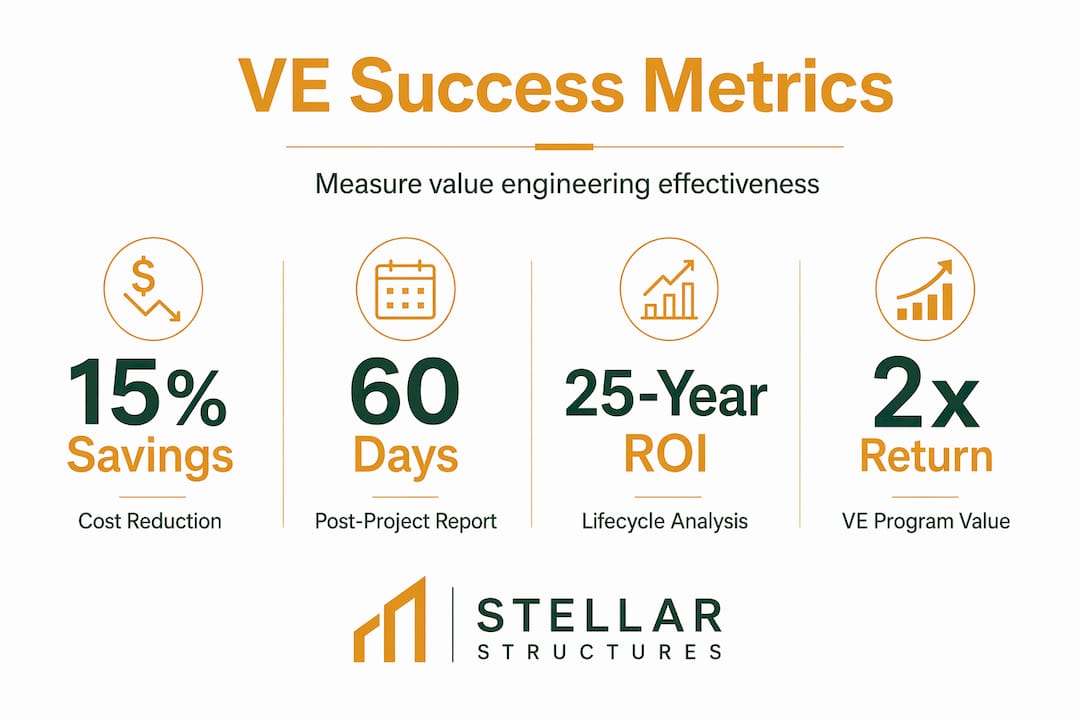
Pro Tip: Request that every VE proposal submitted to the owner include both the construction cost delta and a 25-year net present value comparison. This single requirement eliminates proposals that appear to save money upfront but cost significantly more over the building’s life.
Setting up VE for success: early-stage prerequisites
The timing of VE engagement has an outsized effect on outcomes. Design-phase collaboration and cross-disciplinary reviews consistently deliver greater cost control than late-stage attempts made during construction documents or after procurement. This is not a marginal difference. Changes made during schematic design affect a fraction of the cost and timeline of changes made during construction.
The following prerequisites determine whether a VE program actually delivers results on a design-build project:
- Defined budget alignment milestones: The project budget must be formally reviewed and confirmed at the completion of each design phase: schematic design, design development, and construction documents. No phase should proceed without budget alignment.
- Integrated project team: The owner, architect, structural and civil engineers, M&E consultants, and the construction manager must participate in VE workshops. Siloed reviews miss system-level interactions that generate the largest savings.
- BIM or 3D design models: Digital models allow the team to test material, structural, and spatial alternatives quickly. Testing VE options in a model before detailing them in drawings prevents wasted design effort.
- Baseline cost estimate: A detailed elemental cost plan, updated at each milestone, provides the reference point against which VE alternatives are measured.
- Regulatory compliance reference: All alternatives must be screened against applicable authority requirements before advancing to the development stage.
The table below summarizes the recommended VE activities at each project phase:
| Design phase | Primary VE activity | Key team participants |
|---|---|---|
| Pre-design / programming | Budget feasibility review, scope validation | Owner, project manager, cost consultant |
| Schematic design | System-level alternatives analysis, structural and site options | Architect, structural engineer, civil engineer |
| Design development | Detailed material and method evaluation, M&E system optimization | All disciplines, including M&E and sustainability |
| Construction documents | Constructability review, specification alternatives | Contractor, design team, cost consultant |
Energy assessments integrated with VE provide ROI-driven prioritization of improvements that support lifecycle cost targets while contributing to sustainability objectives. Baseline utility data and benchmarking allow the team to rank mechanical and envelope upgrades by cost-effectiveness before finalizing system selections.
Pro Tip: Assign a dedicated VE coordinator at the start of the project. This person maintains the VE log, tracks the status of each proposal, and confirms that approved changes are reflected in updated cost estimates and design documents.
Executing VE in practice: methodologies and real-world examples
Execution requires moving from analysis to documented decisions with clear cost, schedule, and quality implications for each approved change. The function analysis step is where many teams underperform. Rather than asking “what does this cost?”, the team must ask “what does this do, and what is the lowest-cost way to do it?” That reframing generates alternatives that a purely cost-focused review would never surface.
A structured VE methodology ensures that alternatives are evaluated against function targets before cost. The following process applies to both renovation and new build design-build projects:
- Define the function: State clearly what the system must do. For example: “Transfer floor loads to foundations” or “Manage stormwater runoff from a 10-year storm event.”
- Generate alternatives without filtering: Encourage the team to propose any technically feasible option, including modular construction, material reuse, structural system changes, or modified site layouts.
- Score alternatives on a weighted matrix: Evaluate each option against cost, schedule impact, maintenance requirements, constructability, and compliance. Assign weights based on owner priorities.
- Develop the top-ranked alternatives: Prepare detailed cost estimates, including construction, operational, and replacement cost components. Cross-check against lifecycle cost comparisons rather than only initial savings.
- Submit for owner decision: Present the VE proposal with a recommendation and the data supporting it. The owner approves, rejects, or requests further development.
- Update the design and cost plan: All approved changes must be immediately reflected in design documents, specifications, and the project budget.
Real-world applications demonstrate the range of VE outcomes across project types. For renovation projects, recyclable concrete reuse and distributed stormwater infrastructure have delivered measurable cost and environmental benefits by questioning default assumptions in civil design. Rather than importing fresh aggregate and constructing a single large detention pond, teams have reused crushed existing concrete as fill and distributed smaller bioretention areas across the site. The result was lower material costs, reduced haul requirements, and a smaller infrastructure footprint.
For projects with complex geometries, constructability reviews are a non-negotiable component of VE. Projects with nonstandard façades and floor configurations require custom VE approaches that account for the intersection of budget, schedule, and technical feasibility. The Milwaukee Public Museum project demonstrated that standard construction playbooks fail when applied to unconventional forms, and that VE must be tailored to the specific constraints of each project rather than applied generically. Conducting civil and structural design checks at each VE milestone prevents late-stage rework caused by constructability issues that were not identified during the alternatives evaluation.

Pro Tip: Do not limit VE workshops to architectural and structural systems. Site and civil design regularly account for 15 to 25 percent of total project cost in renovation projects, and the assumptions embedded in early civil designs are rarely questioned. Make civil and geotechnical engineers active participants in every VE workshop.
Monitoring outcomes and continuous improvement
Executing VE decisions is not the end of the process. Continuous cost updating during design iterations prevents budget surprises and enables timely decisions at each design gate. Teams that treat the cost plan as a static document and only update it at major milestones lose the real-time visibility needed to make informed VE choices.
The most common failure modes in VE programs fall into two categories. The first is late engagement. When VE is initiated after design development is substantially complete, the team is constrained by decisions already embedded in detailed drawings, which sharply limits the alternatives available and increases the cost of change. The second is underweighting operational costs. Cost-focused VE without a lifecycle perspective consistently underestimates operational and maintenance expenditure, which erodes the projected savings over the building’s life.
Effective monitoring relies on several practices:
- Maintain a live VE log: Track every proposal by status: proposed, under review, approved, rejected, or implemented. Include the estimated and actual cost impact of each change.
- Reconcile at each design phase gate: Compare the updated cost estimate against the approved budget before authorizing the team to proceed. Phased cost updates at design milestones reduce late budget shocks and support adaptive decision-making.
- Conduct post-project reviews: After project completion, compare the projected lifecycle savings from each approved VE change against actual construction cost and, where data is available, early operational cost data.
- Document lessons learned formally: Record which VE techniques generated the strongest results for specific building types, systems, or site conditions. This institutional knowledge materially improves the performance of future VE programs.
The metrics that matter for VE effectiveness include the ratio of VE savings to the cost of conducting the VE program, the number of alternatives developed versus the number implemented, and the variance between projected and actual lifecycle savings. Teams that track these metrics consistently produce better outcomes on subsequent projects. Reviewing value engineering in civil and structural projects provides additional context on how these metrics apply across different project types.
Pro Tip: Require the design-build team to submit a post-project VE report within 60 days of practical completion. Include projected savings, implemented savings, and any changes that did not perform as expected. This report becomes the foundation for VE calibration on the next project.
My perspective on what actually makes VE work
I’ve worked across enough design-build projects to have a clear view on where VE programs succeed and where they quietly fail. The most important factor is not the methodology. Most teams understand the process well enough. The real differentiator is timing combined with genuine multi-disciplinary engagement.
In my experience, VE that starts as a spreadsheet exercise during construction documents is not value engineering. It’s scope reduction dressed in technical language. The proposals that come out of that process are almost always material substitutions and specification downgrades, not genuine function-based alternatives. The savings are real but shallow, and the lifecycle cost implications are frequently ignored.
What I’ve learned is that the most valuable VE outcomes come from questioning assumptions that were never written down. Site and civil design are the most underexamined areas. Engineers often carry forward preliminary design assumptions from early feasibility studies without revisiting them when better site data becomes available. In renovation projects especially, the assumption that all existing infrastructure must be demolished and replaced is worth challenging directly. Rethinking civil designs for material reuse and decentralized stormwater management has produced meaningful savings on projects where everyone assumed the baseline was fixed.
The other lesson I’d offer is about owner engagement. VE only works when the owner is an active participant, not a passive approver. Owners who understand the lifecycle cost data make better decisions, accept fewer short-term savings that compromise long-term value, and give the team clearer guidance on priorities. That clarity accelerates the VE process and produces better outcomes for every party involved.
— Aman
How Stellar Structures supports your VE program
Stellar Structures brings together architectural design, civil and structural engineering, and M&E expertise under one roof, which positions the firm to support value engineering from the earliest project phases through construction. For developers and project managers working on commercial, industrial, or residential projects in Singapore, this integrated capability reduces the coordination burden and speeds VE decision-making across disciplines.
The firm’s architectural design for commercial buildings service is structured to incorporate VE analysis during schematic and design development phases, where the leverage on lifecycle costs is greatest. Stellar Structures also provides civil and structural design checks that identify constructability risks and verify that VE alternatives comply with applicable regulatory requirements before they are committed to design documents.
Project owners and developers who want a firm capable of managing the technical and regulatory complexity of design-build delivery in Singapore are encouraged to contact Stellar Structures directly for a project consultation.
FAQ
What is value engineering in a design-build project?
Value engineering in a design-build project is a structured process that analyzes building systems, materials, and methods to achieve required functions at the lowest lifecycle cost. It is applied from early design phases through construction document completion.
When should value engineering be applied in design-build delivery?
VE should begin during the schematic design phase, when design decisions are still flexible and changes carry the lowest cost and schedule impact. Early design-phase VE consistently outperforms late-stage cost reduction efforts.
How does design-build improve value engineering outcomes?
Design-build contracts consolidate design and construction responsibility under one party, which reduces disputes over errors and omissions and allows VE alternatives to be adopted faster than in traditional delivery methods.
What are common pitfalls in construction value engineering?
The two most common pitfalls are initiating VE too late in the design process and evaluating alternatives based only on upfront cost rather than total lifecycle cost including operations and maintenance. Both errors reduce the real value delivered to the owner.
How do you measure the success of a VE program?
Success is measured by comparing projected lifecycle savings against actual construction and operational cost data, tracking the implementation rate of approved VE proposals, and assessing the ratio of VE savings to program cost across the project lifecycle.
Recommended
- Value Engineering in Singapore’s Civil & Structural Projects
- The Ultimate Guide to Value Engineering Steel Structures: Design, Cost, & LEED
- From Concept To Prototype: The Engineering Design Process Simplified – Stellar Structures
- Value Engineering Deep Excavations: Smart Steel Strutting Design