





A building information model is defined as a digital representation of a built asset’s physical and functional characteristics, serving as a shared knowledge resource for all project stakeholders throughout the asset’s entire lifecycle. Architects, contractors, property owners, and engineers all work from the same model, which is governed by ISO 19650-1:2018, the international standard defining BIM workflows and information management. Building information modeling (BIM) is not a single software product. It is a process, a data standard, and a collaborative framework that changes how construction projects are planned, built, and maintained.
What is a building information model and what does it contain?
A building information model contains far more than three-dimensional geometry. BIM incorporates multi-dimensional data including spatial relationships, material properties, geospatial information, scheduling data, and cost estimates, all integrated into one intelligent model. Each element in the model carries semantic data: a concrete wall is not just a shape but a record of its mix specification, fire rating, thermal performance, and supplier information.
The dimensions of a BIM model extend well beyond 3D:
- 3D geometry: The spatial foundation. Walls, slabs, columns, mechanical systems, and finishes are modeled as objects with real-world dimensions and positions.
- 4D scheduling: Construction sequences are linked to model elements, allowing project teams to simulate the build process before a single piece of equipment arrives on site.
- 5D cost estimation: Quantities are extracted directly from the model, enabling accurate cost planning and real-time budget tracking as design evolves.
- 6D and beyond: Extended data covers sustainability analysis, energy performance, and lifecycle asset management, supporting decisions that extend decades past project handover.
| BIM Dimension | Data Type | Primary Benefit |
|---|---|---|
| 3D | Geometry and spatial data | Design visualization and clash detection |
| 4D | Construction scheduling | Program planning and sequencing |
| 5D | Cost and quantities | Budget control and procurement |
| 6D+ | Sustainability and asset data | Lifecycle management and compliance |
Pro Tip: Specify which BIM dimensions your project requires in the employer’s information requirements (EIR) before design begins. Teams that define this upfront avoid costly model rework later.

How does the Common Data Environment enable collaboration?
The Common Data Environment (CDE) is the single source of truth for all BIM data on a project. The CDE stores and shares BIM data among all project stakeholders, from architects and structural engineers to contractors and property owners, ensuring every party works from the same current information. Without a CDE, teams revert to email chains and disconnected file versions, which is where coordination errors originate.
Stakeholder roles within a CDE-driven BIM process are clearly defined:
- Architects author the architectural model and coordinate spatial layouts.
- Structural and civil engineers develop discipline-specific models that are federated with the architectural model.
- Mechanical, electrical, and plumbing (MEP) engineers model building services, which are the most frequent source of clashes.
- Contractors use the federated model for construction sequencing, procurement, and site logistics.
- Property owners receive the as-built model at handover for ongoing facilities management.
Early clash detection is one of the most measurable benefits of this workflow. Centralized information management enables early clash detection and reduces costly onsite design conflicts that would otherwise require expensive remediation. A structural beam intersecting an HVAC duct is far cheaper to resolve in the model than on the construction floor.
The shift to BIM represents a cultural change requiring all stakeholders to treat the model as a shared project resource rather than a personal deliverable. This is the part most teams underestimate. Technical adoption is straightforward compared to the organizational discipline required to maintain data integrity across disciplines and project phases.
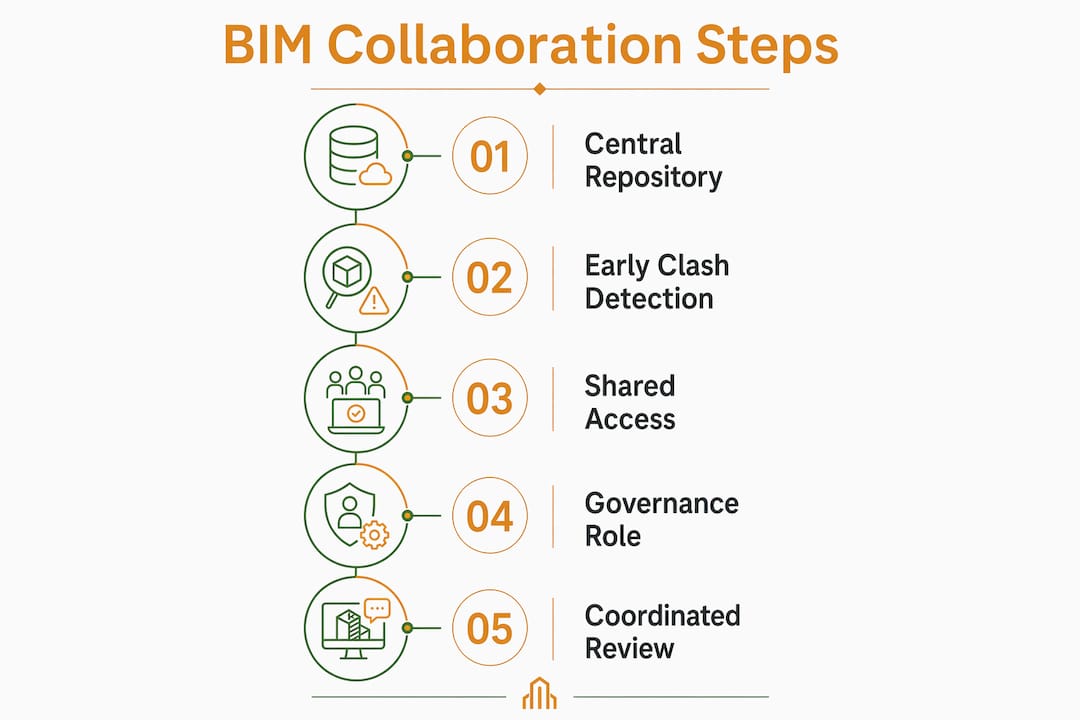
Pro Tip: Assign a BIM Information Manager on every project. This role is responsible for CDE governance, naming conventions, and model audit schedules. Projects without this role consistently produce fragmented data.
For a detailed look at how design coordination in BIM works across disciplines, the process involves structured review cycles that keep all models synchronized.
What are the primary benefits of building information modeling?
BIM delivers measurable benefits across the full project lifecycle, from concept design through to asset decommissioning. BIM delivers design coordination benefits and reduces rework, while also supporting program and cost savings, procurement efficiency, sustainability analysis, safety planning, and lifecycle asset management.
The most immediate benefit for construction professionals is reduced rework. Coordination errors identified in the model before construction cost a fraction of what they cost to fix on site. Quantity surveyors extract accurate material takeoffs directly from the model, reducing the risk of under-ordering or over-procurement.
For property owners and developers, the long-term value is in the as-built model. A well-maintained BIM model at handover becomes the foundation for facilities management: maintenance schedules, equipment replacement cycles, and future renovation works all draw from the same data set. Early specification of BIM requirements by property owners and developers maximizes cost savings and efficiency gains. Owners who define their information requirements at project inception receive a model that is actually useful at handover, rather than a collection of disconnected files.
BIM also supports regulatory compliance and authority submissions. In Singapore, BCA and URA submissions increasingly reference BIM deliverables, and firms that have established BIM workflows are better positioned to meet these requirements efficiently. Understanding BIM adoption trends in Singapore shows how local regulatory expectations are shaping project delivery standards.
What are common misconceptions about BIM implementation?
The most persistent misconception about BIM is that it is primarily a software tool. Successful BIM implementation relies on agreed standards, clear information requirements, and timely adoption, not just software tools. A team using advanced BIM software without defined workflows and information standards will produce a model that is geometrically impressive but informationally unreliable.
Three misconceptions consistently undermine BIM projects:
- BIM software solves coordination automatically. Clash detection is a manual interpretive process. The software generates clash reports, but resolving those clashes requires coordinated team review, negotiation between disciplines, and documented decisions. No software makes that judgment call.
- BIM is only relevant during design. Late adoption during the construction phase diminishes benefits significantly. The highest value decisions, including structural systems, MEP routing, and procurement strategy, are made during early design. Introducing BIM after those decisions are locked in recovers only a fraction of the potential benefit.
- Any level of model detail is acceptable. Defining Level of Development (LOD) and maintaining data accuracy throughout the project prevents rework and delays. LOD standards specify exactly what information each model element must contain at each project stage, from LOD 100 concept through to LOD 500 as-built.
Pro Tip: Include LOD requirements and information delivery milestones in your BIM Execution Plan (BEP) at project start. This document becomes the contractual reference for model quality and prevents disputes at handover.
The collaborative engineering services that architects and engineers provide are most effective when BIM requirements are defined before the first model element is created. Retrofitting information standards onto an existing model is expensive and rarely complete.
Without a strictly managed CDE, BIM models become fragmented, losing synchronization and causing expensive rework during construction. Data governance is not a back-office function. It is a core project management discipline.
Key Takeaways
A building information model delivers its full value only when information requirements, Level of Development standards, and a governed Common Data Environment are established before design begins.
| Point | Details |
|---|---|
| BIM is a process, not software | Successful BIM depends on agreed standards and workflows, not the tools used to author the model. |
| CDE is the coordination backbone | A Common Data Environment prevents fragmented data and enables early clash detection across all disciplines. |
| Define LOD requirements early | Level of Development standards must be set at project inception to ensure model quality and prevent rework. |
| Owners drive lifecycle value | Property owners who specify BIM requirements upfront receive an as-built model that supports long-term asset management. |
| Clash detection requires human judgment | BIM software flags conflicts but resolving them depends on coordinated team review and documented decisions. |
BIM as a culture, not just a workflow
After working across residential, commercial, and infrastructure projects, the pattern I see most often is this: teams adopt BIM tools but not BIM discipline. They produce geometrically detailed models with incomplete or inconsistent data, and then wonder why coordination still breaks down during construction.
The real shift BIM demands is organizational. Every discipline must treat the model as a shared asset, not a personal output. That means consistent naming conventions, regular model audits, and a project culture where flagging a data error is expected, not embarrassing. I have seen projects where the structural model and the architectural model were never properly federated until two weeks before tender. The cost of that delay was absorbed silently in contingency budgets.
The teams that get the most from BIM are not necessarily the ones with the most sophisticated software. They are the ones with a BIM Execution Plan that everyone has actually read, an Information Manager with real authority, and a client who specified their information requirements on day one. Waiting until construction to integrate BIM workflows leaves cost-saving opportunities on the table, and in my experience, those opportunities rarely come back.
— Aman
How Stellar Structures integrates BIM into project delivery
Stellar Structures brings BIM-informed workflows to architectural, civil, and structural engineering services across Singapore. For property owners and developers planning commercial or community projects, defining BIM deliverables early is part of the firm’s standard project approach.

The team at Stellar Structures supports commercial architectural design with BIM deliverables specified to meet BCA and URA requirements, reducing authority submission cycles and coordination delays. For structural and civil engineering scopes, design check stages are aligned with BIM model milestones, ensuring that structural validation and model data remain synchronized throughout the project. Contact Stellar Structures to discuss how BIM requirements can be built into your project from the outset.
FAQ
What is a building information model in simple terms?
A building information model is a digital file that contains the geometry, material data, cost, and scheduling information for a built asset. All project stakeholders use it as a shared reference throughout design, construction, and asset management.
How does BIM differ from traditional CAD drawings?
CAD drawings are two-dimensional representations with no embedded data beyond geometry. A BIM model contains intelligent objects with attached properties such as material specifications, cost, and performance data, enabling simulation and coordination that CAD cannot support.
What is the Common Data Environment in BIM?
The Common Data Environment is a centralized repository where all BIM data is stored and shared across project disciplines. It ensures every stakeholder works from the same current model version, reducing coordination errors and costly rework.
What does Level of Development mean in a BIM model?
Level of Development (LOD) defines how much geometric and non-geometric information each model element must contain at a given project stage. LOD standards range from LOD 100 for concept design through to LOD 500 for the verified as-built condition.
When should BIM requirements be defined on a project?
BIM requirements should be defined by the property owner or developer at project inception, before design begins. Late adoption during construction significantly reduces the cost savings and coordination benefits that BIM delivers.
Recommended
- BIM Adoption in Singapore Construction: Engineering Benefits & Trends – Stellar Structures
- What Is Design Coordination in BIM: A Professional Guide
- What Is a Design Intent Drawing? A Clear Guide
- What Is a Design Build Program: A Developer’s Guide