





Understanding what is a contractor design portion is one of the most consequential gaps in project knowledge for property owners and developers. When design responsibilities are misallocated or poorly defined in a construction contract, the consequences range from compliance failures and construction disputes to cost overruns that nobody budgeted for. This guide explains the contractor design portion (CDP) with precision, covering its contractual basis, how it differs from Design and Build arrangements, and the practical steps you can take to manage it effectively from day one.
Table of Contents
- Key takeaways
- What is a contractor design portion
- CDP trends and industry usage
- CDP vs. Design and Build and other contract types
- Practical guidance for managing contractor design portions
- My perspective on CDP management
- How Stellar Structures supports your CDP compliance
- FAQ
Key takeaways
| Point | Details |
|---|---|
| CDP is a partial design mechanism | The contractor takes design responsibility for a defined scope only, not the full project design. |
| Early application prevents disputes | Assigning CDP responsibilities late in the project timeline fragments accountability and triggers compliance issues. |
| CDP differs from Design and Build | In a Design and Build contract, the contractor owns the full design. CDP assigns only specific elements. |
| Scope definition is non-negotiable | Explicitly listing what is excluded from the contractor’s design scope is the most effective way to prevent scope creep. |
| Compliance standards still apply | Statutory fee limits and regulatory requirements remain in effect regardless of how CDP responsibilities are allocated. |
What is a contractor design portion
The contractor design portion (CDP) is a contractual mechanism in construction where the contractor assumes design responsibility for a clearly defined part of a project, while the client’s professional team retains design authority over all remaining elements. It is not a wholesale transfer of design ownership. The contractor’s design involvement is bounded, targeted, and contractually specified.
In practice, CDP appears most frequently in traditional contract forms such as JCT (Joint Contracts Tribunal) arrangements, where the default assumption is that a separate design team handles project design and the contractor builds to those specifications. CDP creates a defined exception to that default. The contractor takes on design responsibility for elements where specialist knowledge is genuinely required, such as the following:
- Structural glazing systems or curtain wall facades
- Prefabricated mechanical and electrical (M&E) plant rooms
- Specialist foundation solutions requiring geotechnical input
- Proprietary cladding or roofing systems with manufacturer-specific design requirements
- Bespoke structural steelwork designed by the fabricator
The distinction between CDP and a full Design and Build contract matters significantly. In a Design and Build arrangement, the contractor assumes responsibility for the entire design and construction package, giving clients a single point of accountability. CDP, by contrast, leaves most design authority with the client’s team and creates a narrower, more contained design obligation for the contractor.
Pro Tip: When reviewing your contract, look specifically for a “Contractor’s Designed Portion” schedule or appendix. If the document lists which elements fall under CDP and which remain the client’s team responsibility, your risk exposure is far more manageable than if the boundary is left to interpretation.
CDP trends and industry usage
The use of CDP has grown steadily over the last 25 to 30 years, particularly to accommodate specialist subcontractor contributions in sectors such as commercial fit-out and industrial construction. However, an industry survey with over 380 respondents conducted in 2024 found that its effectiveness is frequently undermined by late-stage application, where design responsibilities are transferred to contractors after the main design is already substantially complete.
This timing problem creates serious downstream consequences. When a contractor inherits a CDP obligation mid-project, the interface between the client’s design and the contractor’s design portion is rarely clean. Coordination gaps emerge, and accountability for compliance with building standards becomes contested.
“CDP should be reserved for specialist subcontractor contributions and not used as a broad mechanism to shift all design risk. Applying it too late impairs quality and compliance outcomes.” — CQIC Working Group Recommendations, 2024
The CQIC working group specifically recommends that CDP responsibilities be defined early, ideally before tender, and applied narrowly to elements where specialist contractor knowledge genuinely adds value. Using CDP as a catch-all mechanism to offload design risk onto contractors does not reduce client liability in any meaningful way. It simply creates contested accountability.
Industry professionals also emphasize that late CDP assignment fragments design accountability, complicates compliance with building standards, and often generates construction disputes rooted in unclear interface definitions. For property owners and developers, this is not a theoretical concern. It translates directly into delayed approvals, variation orders, and prolonged dispute resolution processes.
CDP vs. Design and Build and other contract types
Understanding how CDP compares with other procurement structures helps you make better contract decisions before committing to a project delivery method. The differences are not subtle. They carry direct implications for risk allocation, insurance, and your exposure as a client.
| Contract Type | Design Responsibility | Contractor’s Risk Profile | Client’s Risk Profile |
|---|---|---|---|
| Traditional (no CDP) | Entirely client’s design team | Low: contractor builds only | High: client owns all design risk |
| Traditional with CDP | Shared: client team plus contractor for specific elements | Moderate: contractor liable for CDP elements | Moderate: client retains liability for all non-CDP elements |
| Design and Build | Entirely contractor | High: contractor owns full design | Low: single point of accountability |
| Construction Management | Fragmented across trade contractors | Variable by package | High: client coordinates all packages |
The critical insight here is that clients face less risk with fully integrated Design and Build contracts compared to CDP arrangements, where the boundary of the contractor’s design liability is inherently limited and harder to enforce.
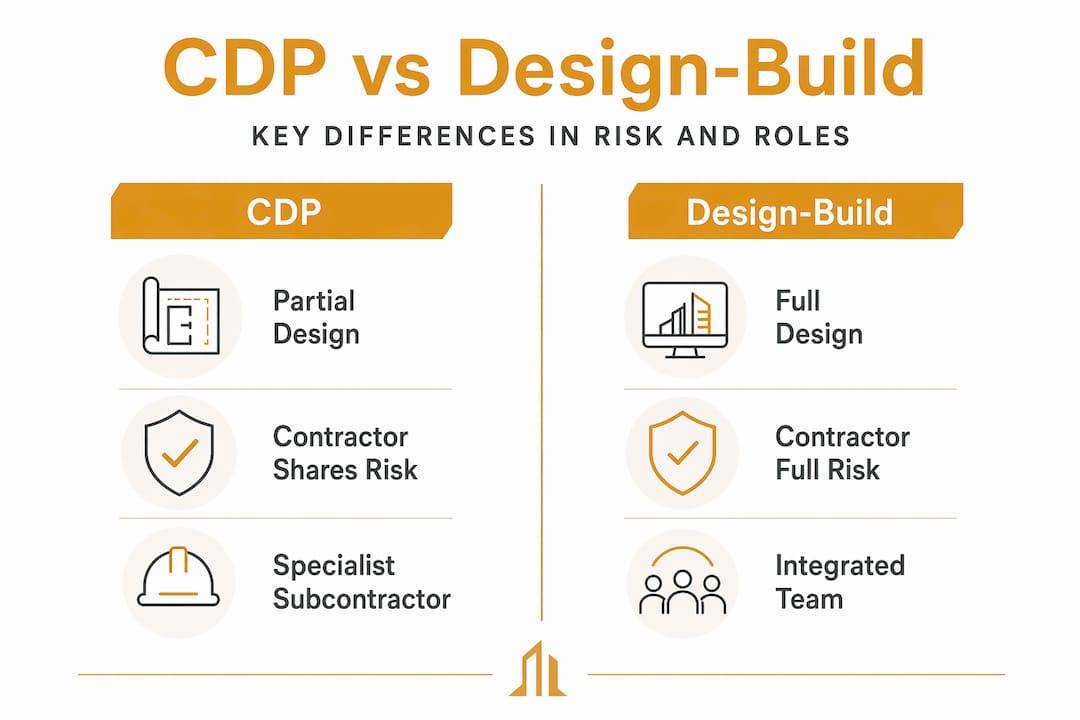
In CDP scenarios, subcontractors frequently carry the actual design work. A specialist facade subcontractor, for example, may prepare full shop drawings and engineering calculations that constitute the CDP output. The main contractor coordinates and takes contractual responsibility for that subcontractor’s design, but the technical expertise originates lower in the supply chain. This layering of design responsibility makes clear operational boundaries in the contract particularly important. Without them, establishing liability for a design defect becomes a protracted legal exercise.
Insurance requirements also shift under CDP. The contractor must carry professional indemnity (PI) insurance covering the designed elements, which adds a procurement consideration that many clients overlook until late in the tendering process.
To understand how CDP relates specifically to the design-build contractor role, the key distinction lies in scope. A design-build contractor owns the full project design. A CDP contractor owns only the portion defined in the contract, and that boundary must be written precisely.
Practical guidance for managing contractor design portions
Property owners and developers who approach CDP without a clear management strategy face predictable problems: scope disputes, compliance delays, and professional liability gaps. The following steps reflect what consistently produces better project outcomes.
-
Define CDP scope at the pre-tender stage. Do not wait until the contract is being signed to determine which elements fall under CDP. The contractor needs to price the design obligation, carry appropriate PI insurance, and allocate resources accordingly. Late definition creates gaps that generate change orders.
-
Include an explicit “Scope Out” section. Clearly scoped contracts that explicitly list what is excluded from the contractor’s design responsibility reduce scope creep and limit liability exposure. If an element is not explicitly included in CDP, it should not be assumed to be the contractor’s design obligation.
-
Establish design interface protocols early. Define where the client’s design ends and the contractor’s design begins. Coordination drawings, interface sheets, and design responsibility matrices should be agreed upon and signed off before construction commences.
-
Monitor subcontractor design submissions systematically. Since CDP design often originates with specialist subcontractors, establish a formal design submission and review schedule. Require the contractor to submit design documents at defined milestones for review by the client’s structural or M&E engineer.
-
Verify compliance with statutory requirements. Under government procurement frameworks, design fees may be capped as a percentage of total construction costs. Confirm that the contractual structure does not inadvertently breach applicable fee regulations or procurement rules.
-
Conduct integrated design reviews. Involve your project team, including civil and structural engineers, in reviewing CDP outputs before construction proceeds. This prevents coordination failures between the client’s design and the contractor’s portion.
Pro Tip: Request a design responsibility matrix (DRM) as a contract document, not just a project management tool. When the DRM is a contractual attachment, disputes about who owns which design element are resolved by reference to the document rather than by negotiation or litigation.
For integrated design and construction projects in Singapore, the regulatory environment adds additional checkpoints. BCA, URA, and other authority requirements must be satisfied regardless of how CDP scope is divided, which means the client’s team retains coordination responsibility for overall regulatory compliance even when specific elements are under CDP.
My perspective on CDP management
I have worked with property owners and developers who treat the contractor design portion as an administrative formality. It rarely ends well. In my experience, the contracts that generate the most disputes are not the ones with aggressive pricing. They are the ones where the CDP boundary was defined vaguely, with phrases like “contractor to design as necessary” appearing in a schedule that nobody reviewed carefully at tender.
What I have observed repeatedly is that clients assume CDP reduces their design exposure. It does, but only proportionally to how precisely the scope is defined. If you transfer a CDP obligation to a contractor without specifying exactly which drawings, calculations, and compliance documents they are responsible for producing, you have not transferred the risk. You have created a contested zone that will surface as a dispute during construction or, worse, during a regulatory inspection.
The other lesson I have learned is about timing. Early contractor involvement in CDP elements, particularly where specialist subcontractors carry the actual design work, produces measurably better coordination outcomes. When the facade contractor joins the project at RIBA Stage 2 rather than Stage 4, their design constraints are absorbed into the base design rather than forcing late-stage revisions.
My recommendation to any developer or property owner entering a contract with CDP provisions is straightforward. Treat the design responsibility matrix as the most important document in your contract package. Review it with your technical advisors before signing. Confirm that every element listed under CDP is one where the contractor has the genuine specialist capability to deliver a compliant design. That discipline, applied at the outset, prevents a significant majority of the coordination failures that define troubled construction projects.
— Aman
How Stellar Structures supports your CDP compliance

Stellar Structures brings the technical depth that CDP management demands. Whether you are a developer structuring a commercial project with specialist contractor design elements or a property owner reviewing contract responsibilities before signing, the team provides architectural design for commercial buildings that integrates seamlessly with contractor-designed portions, preventing the coordination gaps that generate disputes and compliance failures.
The firm’s civil and structural engineers also conduct design checks for building engineering to verify that CDP outputs meet Singapore’s regulatory standards, including BCA and URA requirements. For projects requiring authority submissions, Stellar Structures manages the full authority submission process, reducing the compliance burden on clients throughout the design and construction lifecycle.
FAQ
What is a contractor design portion in a construction contract?
A contractor design portion (CDP) is a contractual provision where the contractor assumes design responsibility for a specified part of the project, while the client’s professional team retains design authority over all remaining elements. It is used primarily in traditional contract forms such as JCT to accommodate specialist contractor design contributions.
How does CDP differ from a Design and Build contract?
In a Design and Build contract, the contractor is responsible for the full project design and construction. Under CDP, the contractor’s design obligation is limited to defined elements only, with the client’s team retaining responsibility for all other design work.
When should CDP responsibilities be assigned?
CDP responsibilities should be defined at the pre-tender stage, before the contract is executed. Late CDP assignment fragments design accountability, complicates compliance with building standards, and increases the likelihood of construction disputes.
What insurance does a contractor need for CDP work?
Contractors undertaking CDP obligations must carry professional indemnity (PI) insurance covering the designed elements. This requirement should be confirmed and documented during the tendering process, not after the contract is signed.
How can property owners prevent scope disputes in CDP arrangements?
Including an explicit “Scope Out” section in the contract, specifying exactly which elements are excluded from the contractor’s design responsibility, is the most effective method. A clearly scoped contract reduces change orders and limits liability exposure for both parties.
Recommended
- What Is a Design Build Contractor Role: A Clear Guide
- Design and build contracts: Singapore developer guide
- Building Authority Submission Consultant Guide – Stellar Structures
- Integrated design and construction for efficient Singapore projects