





A design-build program is defined as a project delivery method that consolidates architectural and engineering design with construction under a single contract, placing full responsibility on one entity accountable to the project owner. This approach, formally recognized through standards set by the Design-Build Institute of America (DBIA) and codified in AIA Contract Documents, eliminates the fragmented contracting structure that characterizes traditional delivery methods. For property owners and developers, the practical result is a single point of contact, unified accountability, and a project team that shares both risk and incentive from the first design sketch through final construction. Understanding how this delivery model works, what contract structures it uses, and how to manage it effectively determines whether a project succeeds or stalls.
What is a design build program and how does it differ from traditional delivery?
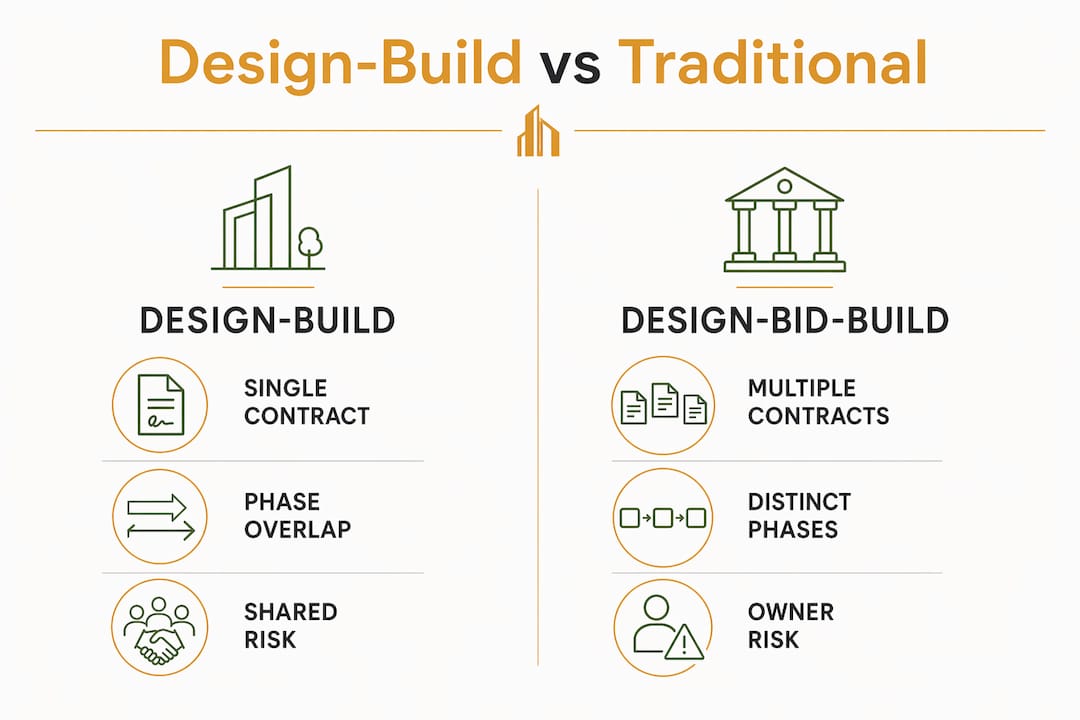
A design-build program differs from design-bid-build primarily in contract structure and phase sequencing. In design-bid-build, the owner contracts separately with an architect to complete design documents, then solicits bids from contractors, creating two distinct contracts and a sequential process. In a design-build program, one entity holds both design and construction responsibility under a single agreement, removing the contractual gap where disputes and delays typically accumulate.
The phase overlap is the most operationally significant distinction. Design-build overlaps design and construction phases, which can reduce total project duration by approximately 10 to 20 percent compared to design-bid-build. This reduction is not incidental. It results from the ability to begin site preparation or foundation work while detailed design of upper floors continues, a practice known as fast-tracking.

Risk allocation also shifts fundamentally. Under design-bid-build, the owner absorbs coordination risk between designer and contractor because they hold separate contracts with each. Under a design-build program, construction-related risks and coordination transfer to the design-build entity, including errors and omissions exposure that would otherwise belong to separate parties. The owner trades some design control for substantially reduced liability exposure.
The table below summarizes the core distinctions between these two delivery methods:
| Factor | Design-Build | Design-Bid-Build |
|---|---|---|
| Number of contracts | Single contract with one entity | Separate contracts with designer and contractor |
| Phase sequencing | Overlapping design and construction | Sequential phases |
| Owner risk exposure | Reduced; transferred to design-build entity | Higher; owner manages coordination between parties |
| Project duration | Typically 10 to 20% shorter | Longer due to sequential phases |
| Communication | Single point of contact | Multiple points of contact |
| Design control | Shared with design-build team | Owner retains greater direct control |
What contract structures and procurement models apply to design-build programs?
The AIA Contract Documents suite includes dedicated design-build forms that address the distinct risk profile of this delivery method. The AIA A141 and A142 contracts separate the owner-design builder relationship from the design builder-architect relationship, clarifying each party’s obligations and limiting architect exposure to risks outside their direct control. This structure matters because architects operating under a design-build entity face different liability conditions than those contracting directly with an owner.
Two procurement models deserve particular attention for owners evaluating how to structure their programs:
- Lump-sum design-build: The owner issues a request for proposals with defined performance criteria. The design-build entity submits a fixed price. This model suits projects with well-defined scope and owners who prioritize cost certainty from the outset.
- Progressive design-build: Parties collaborate on design and budget before final pricing is established. The owner and design-build team work through design phases together, negotiating scope and price iteratively until construction documents are complete. This model suits complex projects where scope cannot be fully defined at procurement.
- Best-value design-build: Selection is based on a combination of technical proposal quality and price, rather than price alone. This model is common in public sector procurement and prioritizes qualifications alongside cost.
Progressive design-build has gained traction on data center, healthcare, and infrastructure projects because it enables transparent pricing and shared risk among stakeholders, including a guaranteed maximum price with adjustments tied to project evolution. This phased budget-setting approach reduces the adversarial dynamic that often emerges when contractors price incomplete documents.
Pro Tip: When selecting between lump-sum and progressive design-build, assess how well-defined your performance criteria are before issuing the request for proposals. Owners who attempt lump-sum pricing on projects with undefined scope consistently encounter costly change orders that erode the cost certainty they sought.
Owners should also review architect and design-build contract responsibilities carefully during negotiation. The AIA Trust notes that updated design-build contract forms reduce architect risk by separating client relationships and contractual obligations, which affects how design professionals price their services within a design-build team.
What are the benefits and challenges of a design build program?
The benefits of a design-build approach are well-documented and directly relevant to owners managing complex projects under time and budget pressure.
Primary benefits include:
- Reduced project duration: The ability to fast-track overlapping phases produces measurable schedule compression, particularly on projects where early occupancy generates revenue or reduces financing costs.
- Single accountability: The design-build delivery method reduces management complexity by combining design and construction under one contract, minimizing delays and improving communication between phases.
- Improved constructability: Early contractor involvement in progressive design-build helps optimize design for constructability and budget accuracy, producing fewer surprises during construction.
- Fewer disputes: With a single contract, the owner is not positioned between a designer and contractor arguing over responsibility for a defect or delay. The design-build entity resolves those issues internally.
DBIA CEO Lisa Washington has noted that design-build’s value lies in early integration and owner involvement aligned with team goals, a point that underscores why owner engagement during design phases is not optional but structural to the method’s success.
Challenges that require active management include:
- Scope evolution: Changes to project requirements after design has progressed generate disproportionate cost impacts. Owners who treat design-build as a set-and-forget contract consistently experience budget overruns.
- Reduced design control: Owners who require granular input on aesthetic or technical decisions may find the design-build structure constraining, particularly under lump-sum models where the team has priced a specific design approach.
- Architect risk exposure: Under some contract structures, architects within a design-build entity carry liability for construction errors that fall outside traditional design professional scope.
Pro Tip: Define performance criteria in writing before the design-build team begins schematic design. Criteria should specify functional requirements, material standards, and regulatory compliance thresholds. Vague criteria at project initiation are the single most common cause of scope disputes in design-build programs.
How should property owners and developers manage design build projects effectively?
Effective design-build project management requires structured owner engagement from procurement through construction completion. The following steps reflect best practice for owners and developers operating within this delivery model.
-
Define decision rights before contract execution. Identify who within the owner’s organization has authority to approve design changes, budget adjustments, and scope modifications. Ambiguous decision rights create delays when the design-build team requires timely responses to proceed.
-
Establish performance criteria, not prescriptive specifications. Owners should specify what the completed facility must achieve, including occupancy capacity, energy performance targets, and regulatory compliance requirements, rather than dictating how the design-build team achieves those outcomes. This preserves the team’s ability to optimize for cost and constructability.
-
Engage actively during schematic and design development phases. Scope evolution leads to increased costs unless expectations and criteria are set upfront. Owner decisions made during early design phases cost a fraction of what equivalent changes cost during construction documents or construction itself.
-
Implement phased approval gates. Structure the contract to require owner sign-off at the end of schematic design, design development, and construction documents. Each gate confirms alignment on scope and budget before the team advances to the next phase.
-
Maintain a single owner representative. Assign one individual with authority and technical competence to serve as the primary interface with the design-build team. Multiple owner contacts with conflicting instructions are a documented source of project delays and cost growth.
-
Use value engineering as a structured process, not a reactive measure. Owners who engage in value engineering practices early in design development, rather than after construction documents are complete, achieve cost savings without compromising project performance.
Understanding the design-build contractor role within the team structure also helps owners set realistic expectations for communication protocols and deliverable timelines throughout the project lifecycle.
Key takeaways
A design-build program consolidates design and construction under one contract, reducing project duration, limiting owner liability, and requiring structured owner engagement to deliver on its core advantages.
| Point | Details |
|---|---|
| Single contract structure | One entity holds responsibility for both design and construction, eliminating coordination gaps between separate parties. |
| Phase overlap reduces duration | Overlapping design and construction phases can shorten total project timelines by 10 to 20 percent versus sequential methods. |
| Progressive design-build suits complex projects | Phased pricing and collaborative scope development reduce disputes and improve budget accuracy on undefined-scope projects. |
| Performance criteria are non-negotiable | Owners must define functional requirements before design begins to prevent costly scope changes during construction. |
| Active owner engagement is structural | Design-build does not reduce the owner’s role. It shifts that role to earlier, higher-impact decisions during design phases. |
Why design-build programs reward owners who engage early
From my experience working across residential, commercial, and infrastructure projects, the most consistent failure pattern in design-build programs is not a contract problem or a contractor problem. It is an owner engagement problem. Owners who treat the single-contract structure as permission to disengage from design decisions routinely arrive at construction documents with a project that does not match their operational requirements, and they pay heavily to correct it.
The growing adoption of progressive design-build in Singapore and across the Asia-Pacific region reflects a broader recognition that integrated delivery works best when owners invest time in the pre-construction phase. The phased budget negotiation model forces productive conversations about scope and cost that lump-sum procurement defers until they become disputes.
I would also caution developers against selecting design-build purely on schedule grounds. The 10 to 20 percent schedule reduction is real, but it is contingent on the owner maintaining decision velocity. A design-build team that waits two weeks for an owner approval on a design question loses the schedule advantage that fast-tracking was meant to create. The method rewards preparation and penalizes indecision.
The contract structure you select, whether AIA A141, progressive design-build, or best-value procurement, should reflect your project’s actual scope certainty and your organization’s capacity for active engagement. Selecting a lump-sum contract on a project with undefined scope is not a cost-saving measure. It is a deferred cost increase.
— Aman
How Stellar Structures supports design-build project delivery
Stellar Structures provides architectural and civil engineering services structured to support integrated design-build programs for property owners, developers, and contractors across Singapore. The firm’s team of engineers and architects delivers coordinated design and engineering solutions under a single engagement, reducing the coordination burden on project owners and aligning design decisions with constructability requirements from the outset. For commercial, residential, and industrial projects requiring authority submissions to BCA, URA, HDB, and JTC, Stellar Structures manages compliance and permitting as part of the project delivery process. Owners seeking civil engineering consultancy support for design-build programs can engage Stellar Structures for end-to-end technical coordination and authority approval management.
FAQ
What is a design build program in construction?
A design-build program is a project delivery method where one entity holds a single contract covering both architectural and engineering design and construction, giving the project owner a single point of accountability from project inception through completion.
How does design-build differ from design-bid-build?
Design-build uses one contract with one entity responsible for design and construction, while design-bid-build uses separate contracts with a designer and a contractor. Design-build also allows design and construction phases to overlap, reducing total project duration by approximately 10 to 20 percent.
What is progressive design-build?
Progressive design-build is a procurement model where the owner and design-build team collaborate through design phases before establishing a final contract price, enabling phased budget negotiation and scope alignment rather than fixed pricing on incomplete documents.
What contract documents govern design-build programs?
The AIA Contract Documents suite includes the A141 and A142 forms specifically structured for design-build delivery, addressing the distinct risk allocation and contractual relationships between owners, design-build entities, and architects operating within those entities.
What are the main risks owners face in a design build program?
The primary risks include scope evolution driving cost increases when performance criteria are not defined upfront, reduced direct design control compared to traditional delivery, and schedule losses when owner decision-making is slow during the design phase.
Recommended
- What Is a Design Build Contractor Role: A Clear Guide
- What Is a Contractor Design Portion? Developer Guide
- Design and build contracts: Singapore developer guide
- The Role of Architect Design Build Contracts Explained