





Temporary works design is the engineering process of designing, calculating, and managing temporary structures and systems that support or protect permanent construction works during building activities. These engineered solutions, which include shoring, propping, falsework, and access platforms, are not incidental site arrangements. They are calculated, checked, and approved structural systems that carry real loads under real site conditions. Without them, the construction of permanent works cannot proceed safely or in compliance with industry standards such as BS 5975. For construction professionals, property developers, and architects, understanding what temporary works design entails is the first step toward managing project risk and regulatory compliance effectively.
What is temporary works design and what does it include?
Temporary works design (TWD) is the engineering activity of designing calculated temporary structures that support or protect permanent works during construction or provide safe access. The scope is broader than many professionals initially assume. A temporary works design is not limited to a simple scaffold or a sheet pile wall. It covers any engineered system that exists to enable construction and is removed once the permanent structure can stand independently.
Common components addressed in temporary works engineering include:
- Shoring and propping: Lateral and vertical support systems for excavations, retained structures, and partially constructed frames
- Falsework: Load-bearing temporary structures that support formwork and wet concrete until the permanent structure gains sufficient strength
- Formwork: Molds that shape concrete elements, designed to resist fluid concrete pressure and construction live loads
- Access platforms and temporary bridges: Engineered working platforms, crane bases, and temporary crossings that carry personnel and equipment loads
- Temporary retaining structures: Sheet pile walls, soldier pile systems, and ground anchors used in excavation support
Each of these systems requires a formal design that accounts for self-weight, imposed construction loads, wind, ground conditions, and the sequence of construction activities. The temporary structures definition under BS 5975 makes clear that these are not ad hoc site measures. They are engineered solutions subject to the same rigor applied to permanent structural design.
Why the design brief is the foundation of every temporary works project
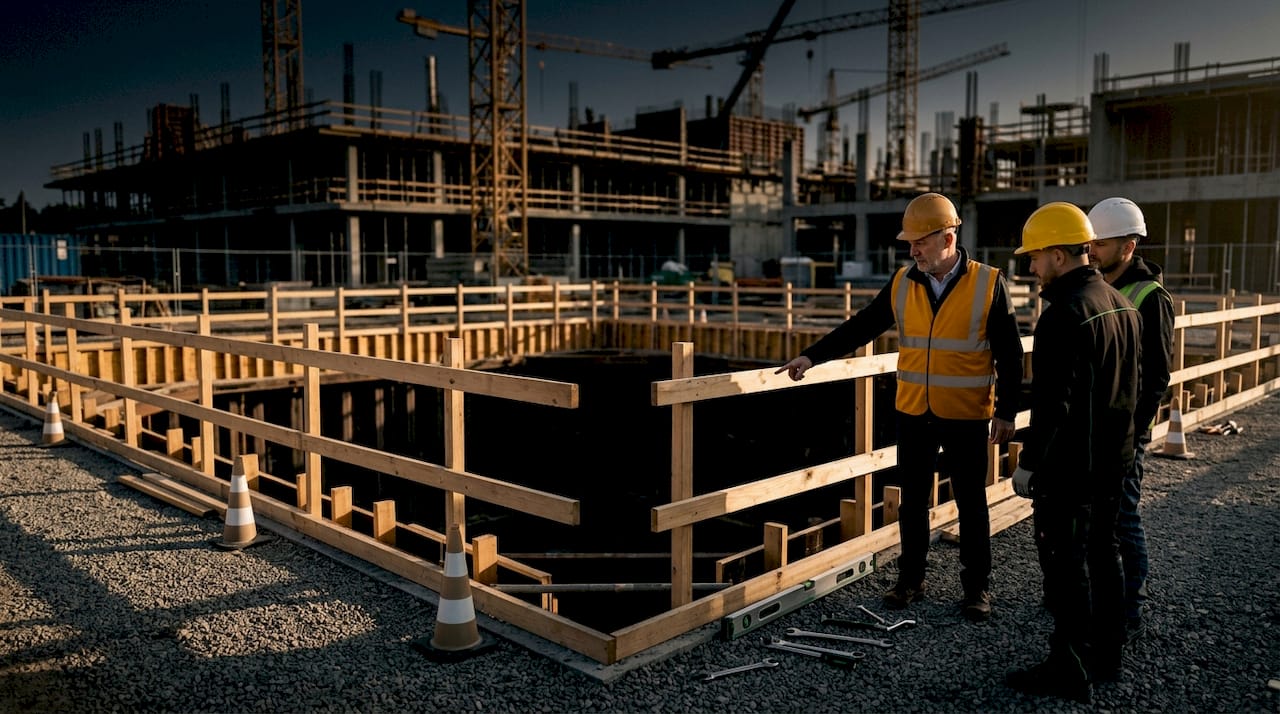
The Temporary Works Design Brief is the primary project document that defines the scope, constraints, and requirements a temporary works design must satisfy. Poor or incomplete briefs are a leading cause of unsafe temporary works, because a designer working from incomplete information cannot produce a safe or suitable design.
A well-prepared brief must contain the following:
- Design loads: Dead loads, live loads, wind loads, and any dynamic or impact loads relevant to the construction activity
- Site constraints: Ground conditions, proximity to existing structures, underground services, and access restrictions
- Construction sequence: The order and timing of construction activities that affect load paths and stability at each stage
- Interface with permanent works: Details of how the temporary works connect to, bear on, or interact with the permanent structure
- Regulatory requirements: Applicable standards, authority approvals, and any project-specific safety requirements
The Temporary Works Coordinator (TWC) holds responsibility for preparing and managing the brief under BS 5975. This role is not administrative. The TWC must understand the engineering implications of every input and identify gaps before a designer begins work. Temporary works are only as safe as the quality and clarity of the design input information, which means an incomplete brief is a direct safety risk, not a documentation shortfall.
Pro Tip: Treat the design brief as a live document. Update it whenever site conditions change, construction sequences are revised, or new information from the permanent works designer becomes available. A brief that reflects the project at tender stage but not at construction stage is functionally useless.
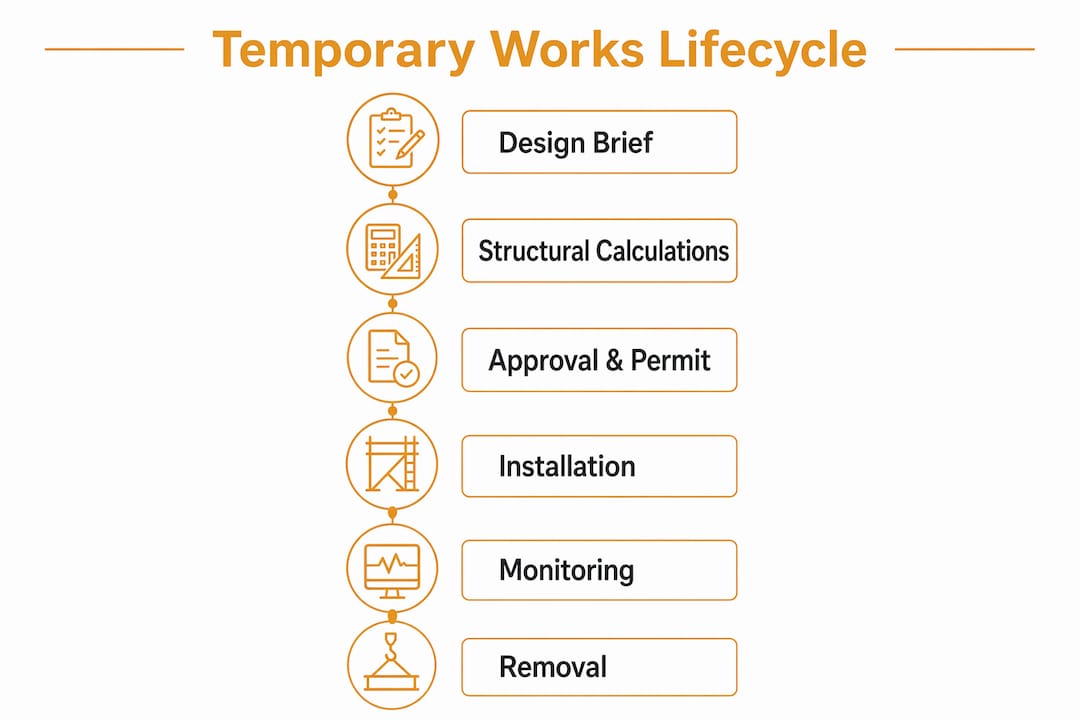
How BS 5975 governs the temporary works lifecycle
BS 5975 establishes the procedural framework for managing temporary works from initial design through to final dismantling. The standard defines roles, checking requirements, approval processes, and permit systems that together form a controlled lifecycle. Understanding this framework is not optional for professionals operating on UK-governed or BS 5975-aligned projects. It is the governance structure that determines whether a temporary works scheme is legally and technically defensible.
The controlled lifecycle under BS 5975 proceeds as follows:
- Appointment of the Temporary Works Coordinator: The TWC is named at project outset, with defined authority and accountability for the temporary works register and all procedural controls.
- Preparation of the design brief: The TWC prepares the brief in collaboration with the principal contractor and permanent works designer.
- Design and independent check: The temporary works designer produces calculations and drawings. An independent checker, whose category of check is proportional to the risk level of the scheme, reviews and approves the design.
- Issue of permit to load: Before any temporary works system is loaded, the TWC issues a formal permit confirming that construction matches the approved design and that conditions are safe.
- Inspection during use: Periodic inspections confirm that the temporary works remain in the condition assumed by the design throughout their service life.
- Permit to dismantle: A separate permit controls the sequence and method of removing temporary works, preventing premature or unsafe dismantling.
The following table compares the two most consequential permit types in the BS 5975 system:
| Permit type | Purpose | Issued by | Triggered when |
|---|---|---|---|
| Permit to load | Confirms temporary works are built as designed and safe to load | Temporary Works Coordinator | Before first loading of the system |
| Permit to dismantle | Controls safe removal sequence and timing | Temporary Works Coordinator | Before dismantling begins |
Failures often arise from management and procedural breakdowns rather than purely technical errors. Unclear responsibilities, bypassed checks, and changed site conditions without reassessment account for a significant proportion of temporary works incidents. This means procedural compliance under BS 5975 is not bureaucratic overhead. It is the primary mechanism for preventing failure.
Pro Tip: Maintain a temporary works register throughout the project. This document records every temporary works scheme, its design reference, check status, permit history, and inspection records. It is the single most important traceability tool available to the TWC.
Coordination challenges between temporary and permanent works design
One of the most underappreciated risks in temporary works engineering is the gap between what permanent works designers know and what temporary works designers are given access to. Permanent works designers should share their calculation assumptions with temporary works designers to reduce the risk of misunderstanding and design errors. Without access to permanent works loading assumptions, stability criteria, and construction sequence intentions, a temporary works designer is forced to make conservative or potentially incorrect assumptions about load paths.
Temporary works designers often depend heavily on permanent works assumptions and must verify load paths under transient construction conditions rather than simply reviewing calculations. The absence of this information is not a minor inconvenience. It is a structural risk.
The specific coordination challenges that arise in practice include:
- Transient stability conditions: During construction, a partially built frame may be unstable in ways that the completed structure is not. Temporary works must address these intermediate states, which are only fully understood when the permanent works sequence is known.
- Load transfer assumptions: If the permanent works designer has assumed that a slab or column will be propped during construction, the temporary works designer must know this to provide the correct propping scheme.
- Ground and foundation conditions: Temporary works bearing on the ground or on the permanent structure require geotechnical and structural data that only the permanent works team holds.
- Changes to permanent works design: Late design changes to the permanent structure can invalidate an approved temporary works design without either team realizing it.
Early and ongoing collaboration between temporary and permanent works teams is the most effective control for these risks. For complex projects such as bridge launches, this means iterative design reviews, coordinated meetings, and clear role definitions from the earliest project stages. The TWC is the professional responsible for bridging these design teams and maintaining information flow throughout the project.
Practical examples of temporary works design in construction
Temporary works design applies across every construction sector and project type. The following table illustrates common temporary works schemes, the loads they must address, and the primary design considerations for each:
| Temporary works type | Typical application | Key design loads | Primary design consideration |
|---|---|---|---|
| Excavation shoring | Basement construction, utility trenches | Lateral earth and water pressure | Stability against overturning and base heave |
| Falsework | Elevated concrete slabs and beams | Wet concrete weight, construction live load | Deflection control and load distribution |
| Formwork | Columns, walls, slabs | Fluid concrete pressure, vibration | Pressure resistance and tie spacing |
| Temporary access bridge | Site crossings over live roads or waterways | Pedestrian and vehicle loads, wind | Dynamic response and bearing capacity |
| Crane base | Tower crane foundation on soft ground | Crane self-weight, overturning moment | Ground bearing pressure and settlement |
Temporary works designs must include appropriate checks and approvals before use, typically via permit to load and permit to dismantle systems. On site, this means the following practices are non-negotiable:
- All temporary works must be constructed in strict accordance with approved drawings and specifications.
- Any deviation from the approved design requires a formal design change and re-approval before work continues.
- Inspections must be conducted at defined intervals and after any event, such as heavy rainfall or impact, that could affect the integrity of the system.
- Documentation of all checks, inspections, and permits must be retained as part of the project record.
For deep excavation projects specifically, smart steel strutting design can deliver significant cost and program benefits while maintaining full compliance with temporary works design requirements. The key is integrating the strutting design with the excavation sequence from the outset rather than treating it as a separate procurement item.
Key takeaways
Temporary works design is a formal engineering discipline governed by BS 5975, requiring calculated designs, independent checks, coordinator-led governance, and permit-controlled execution to prevent procedural and structural failure.
| Point | Details |
|---|---|
| Core definition | Temporary works design covers all engineered systems supporting permanent works during construction, including shoring, falsework, and access platforms. |
| Design brief criticality | An incomplete or outdated design brief is a direct safety risk; the TWC must maintain it as a live document throughout the project. |
| BS 5975 lifecycle | The standard mandates a controlled sequence from design through checking, permitting, inspection, and dismantling, with defined roles at each stage. |
| Coordination with permanent works | Temporary works designers require access to permanent works assumptions to verify load paths under transient construction conditions. |
| Procedural failure risk | Most temporary works incidents result from management and communication breakdowns, not purely technical engineering errors. |
Why governance and communication define temporary works outcomes
From my experience working across residential, commercial, and infrastructure projects, the single most consistent finding is this: temporary works failures are almost never caused by a designer who did not know enough. They are caused by a designer who was not given enough. The design brief arrives late, the permanent works assumptions are withheld, the construction sequence changes on site without notification, and the TWC is not empowered to stop work until the design is updated.
The procedural framework in BS 5975 exists precisely because the engineering community recognized this pattern. The standard does not assume incompetence. It assumes that information gaps and communication failures are inevitable on complex projects, and it builds a governance structure to catch them before they become structural events.
What I find most practitioners underestimate is the role of the design check process as a communication tool, not just a technical review. A well-conducted check surfaces assumptions, identifies interfaces with permanent works, and forces the design team to articulate what they know and what they are assuming. That conversation is often more valuable than the check itself.
The professionals who manage temporary works most effectively treat the design brief as a contract between the site and the design office. They update it when conditions change, they escalate when information is withheld, and they refuse to issue permits to load when the constructed condition does not match the approved design. That discipline, more than any calculation method, is what keeps projects safe.
— Aman
How Stellar Structures supports your temporary works design needs
Stellar Structures provides structural and engineering design services for construction projects across Singapore, including temporary works design, design checks, and authority submissions. The firm’s engineers work directly with contractors, developers, and architects to produce compliant temporary works schemes for excavation support, formwork, falsework, and access structures. Stellar Structures also conducts civil and structural design checks that satisfy BCA and other authority requirements, supporting the full temporary works lifecycle from brief preparation through to permit management. Contact Stellar Structures for a site-specific consultation on your project’s temporary works requirements.
FAQ
What is the definition of temporary works design?
Temporary works design is the engineering process of designing, calculating, and managing temporary structures that support or protect permanent construction works during building. It includes shoring, falsework, formwork, access platforms, and crane bases, all designed to carry real construction loads safely.
What standard governs temporary works design in the UK?
BS 5975 is the primary standard governing temporary works management in the UK. It defines roles including the Temporary Works Coordinator, sets requirements for independent design checks, and mandates permit systems for loading and dismantling.
Why is the temporary works design brief so important?
The design brief defines the scope, loads, constraints, and construction sequence that the temporary works design must satisfy. An incomplete brief is a direct safety risk because a designer working from insufficient information cannot produce a safe or suitable design.
What are common examples of temporary works in construction?
Common examples include excavation shoring systems, falsework for elevated concrete slabs, formwork for walls and columns, temporary access bridges, and crane bases. Each requires a formal engineered design accounting for construction loads and site conditions.
Who is responsible for managing temporary works on a construction project?
The Temporary Works Coordinator holds primary responsibility for managing the temporary works process under BS 5975. This includes preparing the design brief, maintaining the temporary works register, and issuing permits to load and dismantle.
Recommended
- Comprehensive Guide to Temporary Works Design: ERSS, Formwork & Falsework
- Temporary Structure Design Check Explained – Stellar Structures
- Temporary Works Design in Singapore: Mastering Safety
- BCA PTU Submission for temporary works, containers, and signages – Stellar Structures