




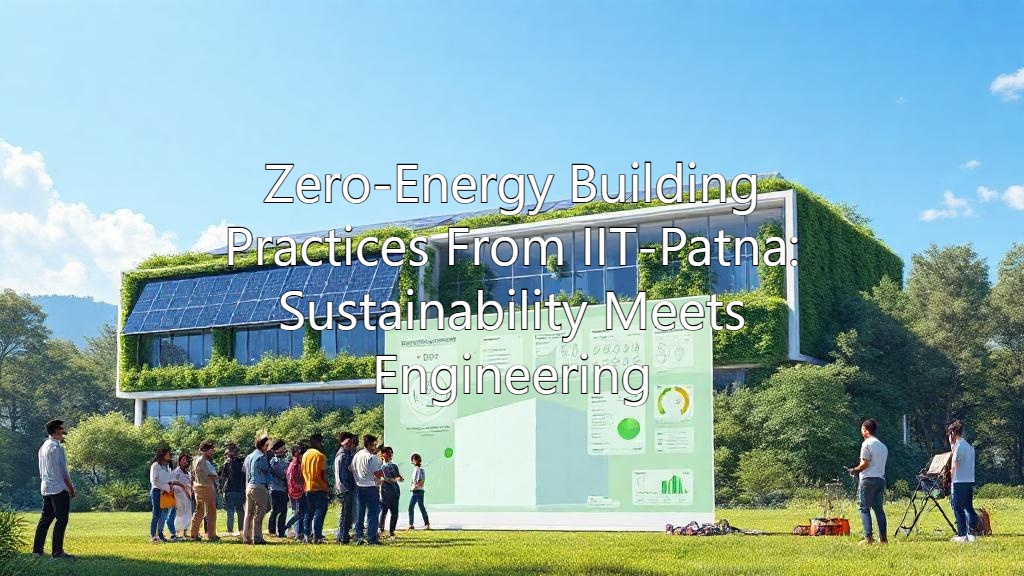
As the world grapples with the complexities of climate change, the concept of zero-energy buildings has emerged as a beacon of hope.
Much like a masterfully crafted puzzle where every piece fits together in perfect harmony to create a sustainable and efficient whole, the Indian Institute of Technology Patna has been at the forefront of this revolution, marrying sustainability with cutting-edge engineering to create zero-energy building practices.
By leveraging innovative materials, optimising energy consumption, and harnessing renewable energy sources, IIT-Patna’s zero-energy building practices are redefining the architectural landscape of India and beyond.
Integrating Sustainability into Engineering Curriculum at IIT-Patna for Zero-Energy Buildings
The Indian Institute of Technology Patna has been at the forefront of incorporating sustainable practices into its engineering curriculum, with a focus on designing zero-energy buildings that minimise environmental impact.
This approach not only reduces the carbon footprint of buildings but also provides students with hands-on experience in developing innovative solutions for a sustainable future.
- Sustainable buildings can reduce energy consumption by up to 50% through clever design and materials selection.
- Green technologies such as solar panels and wind turbines are being increasingly integrated into building designs to minimise reliance on non-renewable energy sources.
- By adopting a circular economy approach, engineers can design buildings that produce zero waste and promote recycling and reuse of materials.
IIT-Patna’s Research-Intensive Approach to Developing Environmentally Friendly Building Practices

The Indian Institute of Technology Patna is at the forefront of this movement, with a strong emphasis on research-intensive approaches to developing environmentally friendly building practices.
By exploring innovative materials, designs, and technologies, IIT-Patna aims to reduce the carbon footprint of buildings and create more sustainable living spaces.
This involves collaboration with various stakeholders, including architects, engineers, and policymakers, to ensure that these practices are adopted widely.
Designing Net-Zero Energy Buildings with Cutting-Edge Technologies and Sustainable Materials
The city of Singapore has made significant strides in reducing its carbon footprint, with the SolarNova program being a prime example, where solar panels are installed on the rooftops of public housing estates to generate clean energy.
The use of sustainable materials, such as recycled concrete and green roofs, has also become increasingly popular in the city’s building designs.
By incorporating these eco-friendly features, Singapore has been able to reduce its greenhouse gas emissions and create a more sustainable environment for its citizens.
Master of High Performance Buildings Program at IIT-Patna with Zero Energy Designation
The Master of High Performance Buildings program at IIT-Patna is a pioneering initiative that equips students with the knowledge and skills to design and develop buildings that are not only aesthetically pleasing but also environmentally sustainable.
This interdisciplinary program combines the principles of architecture, engineering, and construction to create a holistic approach to building design.
With a strong focus on zero energy design, students learn to optimise building performance, minimise energy consumption, and reduce carbon footprint.
Nature-Inspired Technologies for Carbon Sequestration and Ground Engineering Applications

The development of nature-inspired technologies has been gaining traction in recent years, particularly in the fields of carbon sequestration and ground engineering.
These innovative solutions aim to mimic the efficiency and sustainability of natural processes, such as photosynthesis and soil formation, to address pressing environmental challenges.
By leveraging the principles of biomimicry, researchers and engineers can create more effective and eco-friendly systems for capturing and storing carbon dioxide, as well as improving soil stability and fertility.
Implementing Green Technology and Innovative Engineering Solutions for Sustainable Development
Embracing eco-friendly innovations is crucial for a sustainable future.
- Developing renewable energy sources like solar and wind power to reduce carbon emissions
- Implementing sustainable practices in construction and architecture to minimise waste
- Creating green spaces and urban forests to promote biodiversity and air quality
- Designing eco-friendly transportation systems to reduce pollution and congestion
- Investing in research and development to stay ahead of the sustainability curve
IIT-Patna’s College of Architecture Curriculum Focusing on Sustainability and Zero-Energy Design
The Indian Institute of Technology Patna’s College of Architecture is a hub for innovative learning, focusing on sustainability — a crucial aspect of modern architecture.
A new era of architects is being trained to design buildings that not only minimise environmental impact but also produce as much energy as they consume.
The curriculum is designed to equip students with the skills to create zero-energy buildings, which is a significant step towards a sustainable future.
Achieving Net-Zero Emissions through Sustainable Solutions and Reduced Carbon Footprint by 2050
Contrary to popular belief, transitioning to renewable energy sources is not a costly and unrealistic goal, but rather a necessary step towards a sustainable future.
Many argue that the costs of implementing sustainable solutions outweigh the benefits, but this mindset is slowly changing as technology advances.
According to the International Energy Agency, renewable energy sources could power 80% of the world’s electricity by 2050, significantly reducing carbon emissions.
Establishing Earth Science Centres for Research and Development in Zero-Energy Building Practices
The integration of earth science into zero-energy building practices is crucial for sustainable development, as it enables the creation of structures that not only minimise environmental impact but also promote eco-friendly technologies.
These centres can facilitate collaboration between experts from various fields, including architecture, engineering, and environmental science, to design and develop innovative zero-energy buildings that incorporate cutting-edge earth science technologies.
As the sun sets on another day, casting a golden glow over the building’s energy-harvesting facade, we are left with a lasting impression of the profound impact that human ingenuity can have on the planet’s future.
The integration of green technologies, from solar panels to advanced insulation, stands as a testament to what can be achieved when vision and expertise come together.
Looking to the future, it’s intriguing to consider how such pioneering projects might inspire a new generation of engineers and architects to push the boundaries of eco-friendly design, potentially transforming urban landscapes around the world.
With the Zero-Energy Building as a beacon, the possibilities for a more sustainable tomorrow seem limitless, inviting us to imagine a world where functionality and environmental stewardship are not just compatible but inseparable.