




Tender Project Management for GeBIZ Government Tenders: How to Pick the Right Contractor
Introduction
Tender project management for GeBIZ government tenders – how to pick the right contractor – is the discipline that determines whether a Singapore infrastructure project launches with the right partner or stumbles into claims, delays, and cost overruns. For government agencies, statutory boards, and large asset owners procuring roads, bridges, buildings, Alteration & Addition (A&A) works, or structural inspections through GeBIZ, the contractor selection decision is among the most consequential they will make.
This buyer guide focuses on infrastructure and building-related projects where engineering and architectural input is critical – works that demand structural integrity, fire-safety compliance, load-capacity assurance, and long-term durability. The audience is the client side: procurement officers, project owners within a Singapore government agency, state and statutory boards, and private landlords who follow GeBIZ-style procurement processes, and who also need to understand where GeBIZ tenders sit within broader public-sector procurement opportunities. How suppliers bid is outside this article’s scope.
The core process for picking the right contractor can be distilled into one sequence: define precise technical and performance requirements up front, establish transparent evaluation criteria that go beyond lowest price, verify registrations and track record through the Building and Construction Authority’s systems, rigorously assess technical proposals and method statements, and set requirements clearly enough to support compliant bid preparation on the supplier side before enforcing performance through disciplined contract administration after award.
Stellar Structures is a Singapore-based engineering and architectural consultancy that supports buyers at exactly these stages – from structural assessments and preliminary design through tender documentation, technical evaluation, authority submissions, and construction-phase oversight.
Key outcomes you will gain from this guide:
- A clear understanding of how GeBIZ-based government procurement works for infrastructure projects, including current thresholds and rules.
- What to include in tender documents and specifications to attract qualified suppliers.
- A step-by-step framework for shortlisting and evaluating contractors using the Price Quality Method and related models.
- Checklists and practical advice to reduce project risk, delays, and authority-approval problems.
- How Stellar Structures can support technical evaluation, authority submissions, and contract administration for your next tender.

Understanding Tender Project Management in the GeBIZ Context
Tender project management, in the context of Singapore public-sector and quasi-public infrastructure projects, is the structured governance of every phase from identifying a construction need through to contractor handover and defects liability. It encompasses feasibility studies, tender preparation, the bidding process, bid evaluation, award, and post-award supervision – all conducted within the rules set by the Ministry of Finance and administered through GeBIZ, Singapore’s official e-procurement portal, Government Electronic Business, which supports publication, bid submission, and award visibility across procurement opportunities.
This discipline matters for government-funded works because every step must withstand audit scrutiny, ensure open and fair competition, protect public safety, and deliver long-term asset value. When procurement processes are managed loosely, the downstream consequences – scope disputes, variation-order spirals, safety incidents – are both costly and public.
Key Phases in a GeBIZ Tender Lifecycle
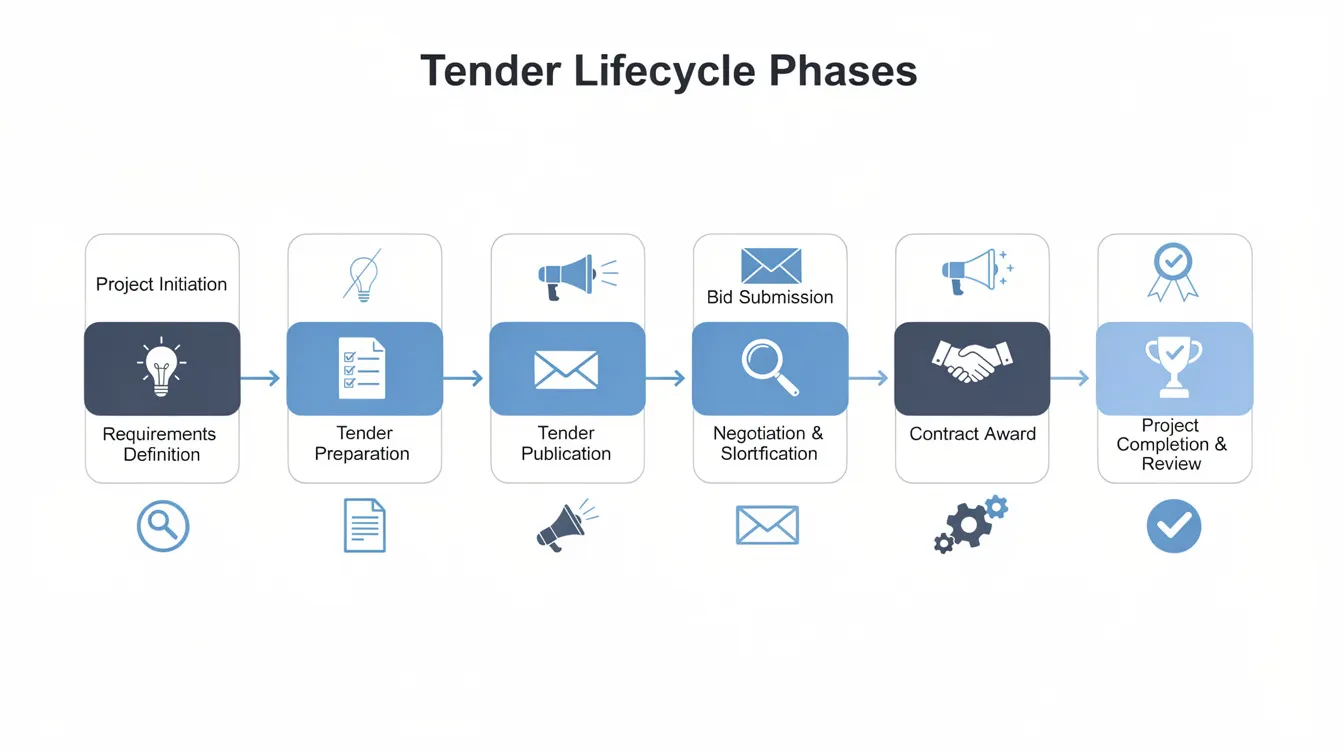
A typical GeBIZ tender for infrastructure works moves through six phases, each of which directly influences how well you can pick the right contractor:
- Project definition and feasibility. Determine what needs to be built or upgraded, perform condition assessments, estimate a budget range, and identify constraints (heritage status, live-facility operations, geotechnical risks).
- Tender preparation. Develop the technical scope (drawings, performance specifications), choose contract form (PSSCOC 8th Edition for construction works, PSSCOC Design & Build 7th Edition, or the newer PSSCOC-Lite released March 2025 for simpler projects), and define the evaluation model. Structure the documents so suppliers can complete compliant bid preparation before the submission deadline.
- Publication on GeBIZ. Based on estimated value and complexity, publish the opportunity as an Invitation to Quote (ITQ), Tender Lite, or full Invitation to Tender (ITT), making these GeBIZ tenders. All government agencies must publish tenders on GeBIZ, and GeBIZ handles over SGD 30 billion in annual procurement.
- Clarifications and addenda management. Answer bidder queries uniformly and issue official addenda in time for suppliers to update their submissions before the closing date and time.
- Bid evaluation and award recommendation. Screen for compliance, score technical and price components against published criteria, and prepare a recommendation for the tender board.
- Contract administration and project monitoring. From Letter of Acceptance through construction, interim payments, variations, defects liability, and final handover.
Strong project management ties these phases together. Weak early-stage scope definition or vague evaluation criteria almost always lead to selecting the wrong firm – and discovering the error only after the contract is signed.
Roles and Responsibilities in Public-Sector Tender Management
On the buyer side, several stakeholders share accountability, with segregation of duties ensuring transparency:
- Project owner (e.g., a government agency division, statutory board, or large private asset owner): sets objectives, budget, and risk appetite.
- Procurement and finance team: ensures compliance with the Government Procurement Act, MOF instructions, and GeBIZ procedures; manages internal approval thresholds.
- Technical consultant team: professional engineer, architects, M&E specialists. This is where Stellar Structures fits – providing structural assessments, preliminary design, and technical evaluation support.
- End-user and operations/maintenance representatives: contribute requirements for accessibility, durability, lifecycle cost, and maintainability.
Specification drafting, evaluation scoring, and final approval are typically performed by different individuals to avoid conflicts of interest. The technical team evaluates capability and methodology, the procurement team checks compliance and financial standing, and a senior approving authority – often a tender board – makes the award decision. This structure directly shapes how contractors are assessed: technical competence is judged by engineers, not administrators.
From Project Need to Tender Requirements
Turning an abstract need – “upgrade a drainage canal by 2028” or “strengthen a pedestrian bridge before the next inspection cycle” – into clear, tender-ready requirements is arguably the most important early activity. A well-defined scope is the first step towards attracting qualified suppliers and enabling meaningful evaluation.
Defining Technical Scope and Performance Outcomes
For infrastructure projects, translating needs into tender specifications involves three layers:
Describe the existing asset condition. Document age, known structural defects, geotechnical data, utility locations, environmental constraints, and site-access limitations. A thorough structural assessment report at this stage prevents expensive surprises later.
Define outcomes, not just methods. Instead of prescribing exact reinforcement details, require measurable performance: “bridge deck to support vehicular Category X loads under SS EN 1991,” or “drainage system sized for a 100-year storm event,” or “façade to achieve specified wind-load resistance and watertightness rating.” Performance-based specifications give contractors room for innovative solutions while maintaining your quality floor.
Identify authority submission requirements up front. State which approvals – BCA structural plan, URA planning permission, SCDF fire-safety certificate, PUB drainage clearance – are needed and whether responsibility sits with the contractor or the procuring agency. Including this in the tender documents eliminates ambiguity later.
Consider three concrete examples:
- Pedestrian bridge strengthening: scope includes detailed structural assessment, performance requirement of 5 kN/m² pedestrian loading, corrosion-protection specification, temporary traffic diversion works, and BCA Qualified Person appointment.
- Industrial facility fire-safety upgrade: scope requires SCDF approval, sprinkler and alarm system installation, fire-rated wall construction, and performance criteria for smoke containment and evacuation time – without mandating specific brands.
- Façade inspection and rectification: scope covers non-destructive testing, condition survey, water-tightness performance spec, wind-load compliance, and repair methodology options.
Stellar Structures can prepare preliminary designs, load assessments, and performance criteria that go directly into the tender – setting a measurable benchmark for evaluation rather than leaving bidders to guess at intent.
Setting Realistic Budgets and Timelines
Unrealistic budgets or schedules are contractor-selection poison. Set the cost envelope too low and capable firms walk away, leaving you with under-resourced bidders. Compress the programme and you invite claims from day one.
Practical guidance:
- Benchmark against recent GeBIZ award data. If similar bridge-strengthening contracts were awarded in the S$4–5 million range last year, that anchors expectations, and the published award results also help suppliers shape future bids by revealing realistic pricing and competition patterns.
- Factor in authority-approval durations. BCA structural-plan approval, URA clearance, and SCDF fire-safety reviews each have processing periods that must sit inside the programme – not be ignored.
- Account for staging in live facilities. Hospitals, schools, depots, and transport infrastructure often require night works, phased access, and operational shutdowns that extend duration and add cost.
- Build milestones: design submission, authority approvals, fabrication/procurement, site works, testing and commissioning, and defects liability.
- Include contingencies: 5–15 % on budget and 10–20 % on time, especially where soil conditions or latent defects carry uncertainty.
Early consultation with a professional engineer or architectural consultant aligns scope, budget, and programme before the tender is published on GeBIZ – not after bids reveal a mismatch.
Choosing the Appropriate Procurement Route on GeBIZ
GeBIZ uses three primary tender types – ITQ, ITT, and RFP – and GeBIZ tenders are one of several sources of procurement opportunities, so the route you select shapes the contractor pool and evaluation effort.
- Small value purchase (SVP): for estimated value up to S$6,000. Direct purchase; no tendering.
- Invitation to Quote (ITQ): ITQs are for contracts valued between SGD 6,000 and SGD 90,000. Suitable for small repair or inspection works.
- Tender Lite opportunities: construction tenders with estimated value not exceeding S$1 million may use Tender Lite, with simplified PSSCOC-Lite contract conditions. As of 30 June 2025, over 1,000 Tender Lite tenders had been published and more than 800 awarded, with approximately 85 % going to SMEs.
- Full Invitation to Tender (ITT): ITTs are used for contracts above SGD 90,000, and are standard for larger or more complex infrastructure projects. Tenders above SGD 90,000 require a formal Invitation to Tender.
- Request for Proposal (RFP): RFPs are for complex projects requiring innovative solutions, where prescriptive specifications cannot capture the full need.
Open tenders allow any qualified supplier to submit bids, while selective tenders are limited to pre-qualified suppliers only. The choice between design-and-build and traditional design–bid–build also matters: design-and-build shifts some design risk to the contractor, but the procuring agency must verify that bidders have genuine design capability, not just construction capacity. Some selective tenders and complex RFPs also use a two stage process, where pre-qualified or shortlisted firms are later invited to submit a full bid.

How to Pick the Right Contractor: Evaluation Framework
With the tender published on GeBIZ and bids arriving, the core question becomes: how do you systematically select the contractor that offers best value and lowest delivery risk? Singapore government procurement contracts are awarded based on best value-for-money rather than the lowest bid alone. Evaluation criteria must be stated in tender documents, and evaluators must adhere to published evaluation criteria without changing them after tender closing.
Establishing Transparent Evaluation Criteria
The evaluation criteria published in your tender documents form the contractual basis for every scoring decision. For infrastructure works, going beyond lowest price is not optional – it is essential for safety, durability, and whole-of-life performance.
Evaluation criteria often include both quality and price. Quality often accounts for 20 % to 70 % of evaluation weight, depending on project complexity. The most economically advantageous tender method evaluates quality and price together, and bids are scored based on published criteria and weightings.
The Price Quality Method framework is mandated for public sector construction tenders above S$3 million in Singapore under CW01 (General Building) and CW02 (Civil Engineering) workheads. Under the PQM, effective since 1 November 2024, price weightage for building tenders typically ranges from 40–60 %, while civil engineering works typically carry 50–70 % price weight, with quality attributes making up the balance. The evaluation of bids under the Price Quality Method considers both price and quality attributes.
Since 1 November 2024, environmental sustainability has become a mandatory quality attribute for construction tenders above S$50 million, reflecting the growing importance of green building certifications and energy efficiency in government contracts.
Quality attributes you can include:
- Safety performance – public sector construction tenders above S$1 million must allocate at least 5 % of the overall score to safety criteria. For PQM tenders, safety must represent at least 15 % of the quality component or 5 % of overall score, whichever is higher. Workplace Safety and Health records are important for evaluating contractor safety performance in Singapore.
- Track record – past performance in similar projects, on-time delivery, claims history.
- Technical proposal and methodology – including temporary works, traffic management, environmental controls.
- Team qualifications – experience and stability of key personnel (PMs, site supervisors, Qualified Persons).
- Programme and risk management – realism of schedule, contingency planning, understanding of site constraints.
An illustrative weighting for a S$5 million bridge-strengthening project under CW02 might be: Price 55 %, Quality 45 %. Within quality: safety 10 %, track record 10 %, methodology and team 10 %, programme and risk management 10 %, environmental sustainability 5 %.
Minimum Eligibility and Registration Checks
Before any scoring begins, screen every tender submission against baseline eligibility. Tender submissions must meet mandatory compliance gates to avoid disqualification. Bids that fall short are non-responsive and must be disqualified at the compliance stage.
Mandatory registrations include BCA Contractors Registration System and Government Supplier Registration in Singapore. Specifically:
- GeBIZ Trading Partner registration. Suppliers must register as GeBIZ Trading Partners to submit bids. Tender headers may be visible publicly, but a relevant notice and full tender documents typically require login to GeBIZ. This is why eligible suppliers must register before they can act on that notice.
- CRS workhead and grade. Contractors must hold the relevant CRS workhead (e.g., CW01, CW02) at a grade sufficient for the estimated contract value. CRS grades range from C3 (entry) through A1, each with increasing tendering limits. For the entry grade (C3, L1, or Single Grade), a contractor must demonstrate at least S$300,000 worth of relevant completed projects in the preceding three years. BCA certification and registration are essential for contractors bidding on construction projects in Singapore.
- Builders Licensing Scheme (BLS). For works requiring Commissioner of Building Control plan approval or specialist activities like piling.
- Professional Engineer certification. Where the tender includes design responsibility, key personnel must hold PEB registration. PE certification requires an approved engineering degree and four years of experience, and Professional Engineers must pass specific examinations for certification. PE qualifications are crucial for civil and structural engineering tenders, and PE-led proposals are favored in tenders requiring regulatory compliance.
- Safety record screens. Consider mandatory thresholds such as “no fatal safety breaches in the past three years” for high-risk infrastructure work.
The financial viability and creditworthiness of contractors are critical capacities required for tender submissions. A contractor’s financial health and operational capacity are a key evaluation focus for government tenders – verify through audited accounts, credit ratings, and bank references.
Assessing Technical Proposals and Method Statements
Technical competency is weighted more than price in many tenders, and reading a technical proposal demands more than scanning marketing language. Compliance with technical specifications is mandatory in Singapore government tenders.
When reviewing submissions:
- Method statements should cover site setup, temporary works design, traffic diversion, safety management, environmental protection, and labour welfare. Generic or templated statements signal weak understanding.
- Constraint awareness is telling. Does the contractor acknowledge live-traffic conditions, limited crane access, underground utilities, heritage restrictions, or night-work requirements? Or does the proposal read as if the site were a greenfield?
- Programme realism must be tested. Check whether the construction sequence allows for authority approvals, fabrication lead times, and third-party dependencies. A compressed programme without contingency is a red flag, not a competitive advantage.
- Design assumptions (for design-and-build tenders) require scrutiny by a qualified professional engineer. Verify proposed codes of practice (SS EN, Eurocodes), structural materials, durability provisions, and maintenance implications. Review against BCA structural design requirements.
- Alternative proposals can deliver value engineering benefits, but only if they demonstrably meet performance criteria. Assess alternatives on technical merit, not just cost savings.
Stellar Structures can act as the buyer’s technical advisor at this stage – reviewing structural approaches, comparing alternative proposals, checking buildability, and preparing clarification queries on method statements.
Comparing Contractor Track Record and Team Capability
Contractors must demonstrate relevant experience with government projects for successful bidding. Past performance in similar projects can influence contractor evaluations during the tender process. Examine the following in detail:
- Project types and scale: relevant works completed in the last 5–10 years – viaduct strengthening, quay-wall rehabilitation, large A&A to existing high-rises, or major civil infrastructure. The evaluation of contractors should not rely solely on the bid price but should assess overall value and delivery risk.
- Performance metrics: on-time and on-budget completion history, variation-order frequency, defects during the defects liability period, and handover quality.
- Safety statistics: lost-time injury frequency, near-miss reporting rates, MOM sanctions, and certifications such as bizSAFE or ISO 45001. In public sector construction, safety performance is a mandatory evaluation component.
- Key personnel continuity: review CVs of proposed Project Managers, Site Supervisors, Qualified Persons, and Accredited Checkers. Tender evaluations should assess team competency and key personnel qualifications. For higher CRS grades, foreign technical personnel must be present in Singapore for at least 183 days per year.
- Reference checks: contact past clients where possible; verify claims through BCA systems or HDB average performance scores.
A technically strong firm with an inexperienced proposed team may warrant a lower ranking for high-risk works. Conversely, a mid-sized contractor with a proven, stable team and strong safety record on similar projects may represent the best value proposition.

Practical Implementation: Step-by-Step Tender Project Management Process
This section provides a procedural guide that a project owner, facilities team, or procurement officer can follow for an upcoming GeBIZ infrastructure tender – whether planned for 2026, 2027, or 2028.
End-to-End Process for Managing an Infrastructure Tender
The following steps assume a construction-type project with an estimated value of S$1–10 million (civil or building upgrade tender). Bids must be submitted electronically before the closing date, and late submissions are typically rejected without review.
- Initiate the project and appoint a technical advisor. Engage a consultancy such as Stellar Structures to perform condition surveys, structural assessments, geotechnical investigations, and preliminary design sketches. Define project objectives, constraints, and a budget envelope.
- Develop tender documents. Prepare technical specifications, drawings, performance criteria, BIM requirements if applicable, PSSCOC contract conditions, the evaluation model (including PQM where mandated), and GeBIZ schedules. Decide between PSSCOC, PSSCOC-Lite, or a Design & Build contract variant.
- Publish the tender on GeBIZ. Upload complete documents with clear timelines, state whether Tender Lite or regular ITT applies, announce any mandatory site visits or briefing sessions, and specify the submission format and closing date and time, so the posting becomes a visible procurement opportunity for registered suppliers.
- Manage clarifications and issue addenda. Provide a defined period for bidder queries. Answer all questions uniformly via official addenda – never through side conversations. Ensure changes are incorporated well before bid closing, noting that some suppliers may first see the notice through tender alerts.
- Open bids and conduct compliance screening. After closing, check each tender submission for eligibility: CRS grade, required licences, certified personnel, mandatory form completeness, supporting documents. Disqualify non-responsive bids at this gate.
- Perform detailed technical and price evaluation. Apply the published model – calculate quality-attribute scores for safety, track record, methodology, and team; compute price scores using the price schedule; derive combined scores. Contractor evaluations should be documented to support award recommendations.
- Conduct clarification interviews or presentations. For complex tenders, invite shortlisted bidders for presentations or site visits to deepen understanding of proposed methodology and team commitment.
- Prepare award recommendation and obtain approvals. Compile evaluation report, score sheets, and justification – especially where the recommended contractor is not the lowest-priced bidder. Seek tender board or management approval.
Published award outcomes can later be reviewed by the market and may influence bidding on similar works.
- Issue Letter of Acceptance and finalize contract. Execute contract documents, collect performance bonds and security deposit, verify insurances, and confirm mobilisation timeline.
- Manage kick-off, construction monitoring, and variations. Conduct a structured kick-off meeting, establish reporting cadences, and implement change-control processes. Monitor progress, safety, quality, and interim payments through to completion and defects liability.
At every step, strong project management reduces risk. Early design inputs prevent scope gaps. Realistic risk allowances reduce variation-order disputes. And disciplined post-award administration ensures the contractor you selected actually delivers the performance their bid promised.
Sample Evaluation Matrix: Quality vs Price
The table below illustrates how two hypothetical contractors might be scored for a S$6 million civil engineering project using a 55 % Price / 45 % Quality split.
| Criterion | Contractor A | Contractor B |
|---|---|---|
| CRS Grade & Relevant Experience | B2 grade; 3 similar projects completed | B1 grade; 7 similar projects completed |
| Methodology & Temporary Works Safety | Generic method statement; limited temporary works detail | Detailed phased methodology; specific temporary works design |
| Programme Realism | 18-month programme; no approval lead times shown | 20-month programme; authority approval milestones included |
| Key Team Strength | PM with 5 years’ experience; no dedicated safety officer named | PM with 12 years’ experience; full-time safety officer and PE on team |
| Tender Price | S$5.6 million | S$5.9 million |
| Quality Score (out of 45) | 27 | 39 |
| Price Score (out of 55) | 55 | 52.2 |
| Combined Score (out of 100) | 82 | 91.2 |
Contractor B’s bid is approximately 5 % higher, yet scores substantially better on quality and risk reduction. The stronger methodology, experienced team, and realistic programme reduce the probability of delays, claims, and safety incidents – costs that would likely exceed the S$300,000 price differential. Total Cost of Ownership considerations are important in Singapore’s contractor price evaluation, and this example demonstrates why the best value approach outperforms a pure lowest price selection.
Using External Technical Advisors Effectively
Engaging independent engineering and architectural consultancies delivers value across the tender lifecycle:
- Scope definition and constructability review before the tender is published – ensuring specifications are clear, complete, and performance-oriented. This includes value engineering to optimise cost without sacrificing performance.
- Technical evaluation of bids – reviewing structural design assumptions, comparing alternative construction approaches, checking safety proposals, and assessing buildability. Professional Engineer certification enhances tender submissions’ credibility, and having a PE-qualified evaluator on the buyer’s side is equally important.
- Authority submissions planning – mapping BCA, URA, SCDF, and PUB requirements, estimating processing times, and advising on regulatory compliance responsibilities.
- Construction-phase oversight – site supervision, design compliance checks, temporary works review, materials inspection, and variation assessment during execution.
Because the advisor is engaged by the owner – not the contractor – this arrangement maintains fairness and avoids conflicts of interest. It also prevents post-award surprises: the same engineers who defined the scope can verify that the contractor’s work matches the intent.
Common Tender Management Challenges and How to Address Them
Even with robust procurement processes, government infrastructure tenders encounter recurring problems that can derail contractor selection or project delivery. Recognising these patterns early is half the solution.
Over-Emphasis on Lowest Price
The risk: the cheapest competitive bid may reflect under-resourcing, inferior materials, or unrealistic assumptions that surface as claims, delays, and quality defects once construction begins.
Solutions:
- Use the Price Quality Method or a similar weighted evaluation model that gives a significant portion of the score to quality, safety, and methodology – not just price.
- Set clear minimum technical scores that bidders must achieve before their price component is considered. For example, require at least 60 % on quality attributes as a threshold.
- Require detailed price breakdowns and question abnormally low bids through formal clarifications. Evaluating contractors for Singapore government construction tenders requires assessing bids against tender-specific evaluation criteria for best overall value.
Vague or Incomplete Technical Specifications
The problem: ambiguous specifications produce inconsistent pricing across bidders and create fertile ground for large variation orders mid-project. Many tenders suffer from this avoidable weakness.
Solutions:
- Invest in proper documentation: condition surveys, structural assessments, and clear drawings before the tender – not during construction.
- Identify and state key assumptions explicitly: soil conditions, existing reinforcement details, load paths, utility locations.
- Use PE-reviewed designs or performance criteria prepared by consultants such as Stellar Structures to remove ambiguity and anchor pricing.
Underestimating Authority Approval and Site Constraints
The problem: ignoring BCA, URA, or SCDF processing times – or failing to investigate underground services and access constraints – can derail the programme by months.
Solutions:
- Require bidders to include a detailed approvals programme and responsibilities matrix showing which party obtains each permit and the expected timeline.
- Engage a consultant early to map out required clearances and typical processing durations.
- Score bidders on how well their method statements address authority approvals and site phasing – this reveals which contractors truly understand the project environment.
Weak Contract Administration Post-Award
The problem: selecting a good contractor does not guarantee good outcomes. Without diligent monitoring, even a capable firm may drift from programme, cut corners, or accumulate undocumented variations.
Solutions:
- Establish clear reporting structures, meeting schedules, and key performance indicators (KPIs) from day one – progress versus programme, safety incident rates, non-conformance counts.
- Track variations and extension-of-time claims against a documented baseline using PSSCOC contract provisions.
- Involve technical consultants to review critical method changes, design alterations, or alternative proposals promptly, before they become entrenched on site.
Conclusion and Next Steps
Good tender project management on GeBIZ is fundamentally about three things: clarity of scope, structured evaluation, and continuous oversight. Each phase builds on the previous one – rushed feasibility leads to vague specifications, vague specifications produce unreliable bids, and unreliable bids lead to problematic contractors.
The “right contractor” is the one that offers best value and the most manageable risk profile across technical capability, safety performance, team strength, and price – not simply the firm with the lowest number on the price schedule. Singapore’s frameworks, including the Price Quality Method, CRS registration requirements, and mandatory safety criteria, exist precisely to support this balanced approach.
Technical advisors and proper documentation are force multipliers, especially for complex infrastructure projects. A well-prepared tender attracts serious bidders, enables defensible evaluation, and reduces the variation orders and claims that erode project budgets.
Immediate next steps:
- Audit an upcoming project to confirm that scope definition and evaluation criteria are sufficiently detailed for meaningful bid comparison.
- Determine whether Tender Lite or a full ITT is more suitable for planned works in 2027–2028, based on estimated value and complexity.
- Develop or refine an internal evaluation-matrix template for infrastructure tenders, incorporating PQM weightings and minimum quality thresholds.
- Consider engaging Stellar Structures early – ideally 3–6 months before planned tender publication – for structural assessments, preliminary design, and tender documentation support.
Adjacent topics worth exploring include detailed guides to BCA submissions and approvals, framework agreements for periodic maintenance, and the differences between design-and-build and traditional contracting models.
Additional Resources and Visual Aids
Suggested further reading and tools for Singapore government tenders:
- GeBIZ portal – the Government Electronic Business portal for tender notices, award histories, registration as a GeBIZ trading partner, and identifying relevant opportunities; suppliers also often review award histories there to refine future bids.
- Tender alerts – optional notifications by email, dashboard, or team channels that help suppliers spot matching opportunities quickly and respond faster.
- BCA Contractors Registration System (CRS) – workhead details, grade requirements, and tendering limits.
- BCA Price Quality Method (PQM) framework – scoring criteria, quality attributes, and weighting guidance effective from 1 November 2024.
- MOF Government Procurement Framework – procurement thresholds, rules for open tender, selective tender, and limited tenders.
- Market access – useful reference material on how procurement rules and trade commitments affect which suppliers can compete for Singapore public contracts.
- Stellar Structures’ resources on structural inspections, authority submissions, and integrated design engineering.
- Private tenders – procurement opportunities outside GeBIZ that can help firms build experience, though submission processes are often less standardised than public-sector tenders.
Recommended visual aids for internal use alongside this guide:
- A tender lifecycle flowchart mapping each phase from need definition through project completion, with decision gates at feasibility, tender preparation, evaluation, and award.
- A radar chart comparing two hypothetical contractors across five dimensions – quality, price, safety, team capability, and programme risk – to visualise trade-offs.
- A stakeholder-roles schematic showing information flows among the procuring agency, procurement team, technical consultant, and contractor during a GeBIZ tender.
Visuals should be clean, professionally formatted, and aligned with an infrastructure and engineering context – using site photographs, structural drawing excerpts (with sensitive data removed), or process diagrams.
Frequently Asked Questions
How early should I involve a technical consultant before a GeBIZ tender goes live? For medium-sized infrastructure projects (S$1–10 million), engage a consultancy like Stellar Structures 3–6 months before planned publication. This allows time for condition surveys, preliminary design, authority-submission mapping, and proper tender document preparation. Rushing this phase is the single most common source of downstream problems.
What documents should I always request from contractors to assess technical capability? At minimum: recent similar project references (last 5 years), detailed method statements for the specific scope, organisation charts showing the proposed team, CVs of the Project Manager, site supervisor, and any appointed professional engineer or Qualified Person, plus safety records including LTI rates and MOM sanctions. Proper documentation of these items enables meaningful scoring rather than guesswork.
How do I justify choosing a contractor that is not the lowest priced on GeBIZ? Document the evaluation scores transparently using the published criteria and weightings. Under the PQM or any weighted model, the combined quality-and-price score determines the best-value bidder. Prepare a clear evaluation report showing how quality, safety, and methodology scores differentiated the recommended contractor. Singapore government procurement explicitly prioritises value for money over lowest price, and your evaluation report is the audit trail that supports that decision before the Government Procurement Adjudication Tribunal if challenged.
Can I change the evaluation criteria after tender publication? In principle, changes to evaluation criteria after publication require official addenda issued through GeBIZ, and they must be distributed to all interested suppliers before the closing date. Substantive changes to weightings or mandatory requirements after bids are received are generally not permitted under public procurement rules and could expose the procuring agency to challenge. Define criteria carefully before publication.
What support can Stellar Structures provide if I already have bids on the table? Even post-publication, Stellar Structures can conduct technical evaluation of received proposals – reviewing structural design assumptions, assessing constructability, comparing alternative methodologies, and identifying risks in proposed programmes. The firm can also perform independent cost-reasonableness checks and prepare technical clarification questions for shortlisted bidders.
How do I handle contractor performance issues after award? Use the contract provisions under PSSCOC: issue formal non-compliance notices, conduct progress meetings with documented minutes, enforce liquidated damages for delays where justified, and require corrective action plans with deadlines. Engage your technical consultant to review critical method changes or design deviations promptly. For persistent issues, escalate through the contractual dispute mechanisms before problems compound. Foreign companies and local contractors alike are held to the same contract standards once the award is made.
Do foreign companies need special registration to bid on GeBIZ construction tenders? Yes. All firms – including foreign companies – must register as GeBIZ Trading Partners to access and download tender documents and submit bids. For construction tenders, BCA CRS registration under the relevant workhead and grade is mandatory. The Corporate Regulatory Authority (ACRA) registration is also required for companies operating in Singapore. Meeting these registration requirements is a prerequisite, not an evaluation criterion.